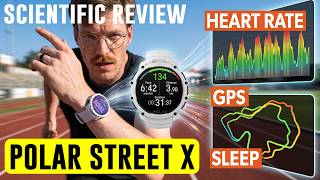

Polar Grit X Heart Rate Accuracy Tested!
51sReveals surprising heart rate accuracy with a 0.98 correlation, sparking curiosity among fitness enthusiasts.
▶ Play Clip"Delivers a thorough, data-driven review, though the title's 'best deal' claim is subjective and the sponsor segment adds some fluff."
This video is a scientific review of the Polar Grit X sports watch, focusing on objective data from heart rate, sleep stage, and GPS tracking tests. The reviewer, a post-doctoral scientist, compares the watch's performance against reference devices and competitors to help viewers decide if it's the right choice.
The video uses objective data from tests on the reviewer to evaluate the Polar Grit X's heart rate, sleep stage, and GPS tracking performance, comparing it to other brands like Garmin, Coros, Suunto, Apple, and Pixel.
During indoor cycling, the Polar Grit X showed a high correlation of 0.98 with a reference ECG chest strap, indicating very good heart rate tracking. Minor deviations occurred at the start of sessions, possibly due to skin warming up.
For running, the correlation dropped to 0.95, still quite good. The watch needed a short warm-up time to lock onto the heart rate accurately. Performance was comparable to the Polar Grit X2 and better than some competitors, though not the absolute best.
Cycling proved more challenging, with a lower correlation of 0.79. The watch sometimes detected heart rate too high or too low, showing a mixed performance. It was not as accurate as some competitors like Apple, Pixel, and Huawei devices.
Weightlifting was the hardest exercise, with a very low correlation. The watch often missed peaks and dips in heart rate, making it unsuitable for this activity. The reviewer recommends an ECG chest strap or Apple Watch for weightlifting.
The final heart rate tracking score, calculated by averaging correlations across cardio exercises and multiplying by 100, was 91, placing it in the 'good' category.
Compared to a Zeemax EEG device, the Polar Grit X showed 64% agreement for deep sleep, 60% for light sleep, and 54% for REM sleep. This is average to slightly above average, with REM sleep being the weakest area.
The Polar Grit X's sleep tracking performance is in the middle of the pack, similar to Garmin devices. It performs better on REM sleep than Garmin but is not among the best devices like Apple, Oura, Whoop, or Eight Sleep.
GPS tracking was tested by running and cycling the same routes multiple times. The watch showed good overlap in signals, with some minor deviations in areas with interference, like near walls or construction. Overall, GPS performance was solid.
The GPS tracking scored 70 out of 100, falling into the 'okay' category. The reviewer concludes that the Polar Grit X is a good value for its price, with good heart rate tracking, okay sleep and GPS tracking, and a nice design with a red light for night use.
The Polar Grit X offers good heart rate tracking, acceptable sleep and GPS tracking, and a solid build, making it a reasonable choice for its price, especially for European users. However, it's not the best in any category, and for weightlifting or top-tier performance, other devices are recommended.
What was the correlation between the Polar Grit X and reference ECG during indoor cycling?
0.98
01:47
What was the correlation during running?
0.95
04:16
What was the correlation during cycling?
0.79
06:29
What was the overall heart rate tracking score for the Polar Grit X?
91
10:22
What was the agreement for deep sleep, light sleep, and REM sleep?
64%, 60%, and 54% respectively
11:26
What was the GPS tracking score?
70 out of 100
18:12
Which exercise was the hardest for the Polar Grit X to track heart rate?
Weightlifting
08:48
What device is recommended for weightlifting heart rate tracking?
An ECG chest strap or Apple Watch
09:29
High Heart Rate Correlation
Shows the watch's strong performance in a controlled setting, a key metric for buyers.
01:47Cycling Accuracy Drop
Highlights a significant weakness in a common activity, important for cyclists.
06:29Weightlifting Recommendation
Provides actionable advice for a specific use case, showing the watch's limitations.
09:29Sleep Stage Agreement
Quantifies sleep tracking accuracy, a key feature for many users.
11:26GPS Score
Gives a clear, numeric assessment of GPS performance, useful for runners and cyclists.
18:12[00:02] compromise for you when it comes to sports and health tracking. And today we're going to use a bunch of data to see if this watch is the watch for you or if you should look at another brand maybe Garmin, Coros, Suunto, or maybe
[00:16] instead of looking at a sports watch brand, you should actually be looking at a smart watch brand like Apple or maybe a Pixel Watch. And we're going to use a bunch of data to figure that out. Now, for those of you who are new to the
[00:29] channel, my name is Rob and I'm a post-doctoral scientist specializing in biological data analysis. Now, as I said, the focus today is going to be on the data. I already did an introductory video on the Polar Street X and all its
[00:41] functionalities. If you want to know more about that, I've linked that below, but today is really going to be about the data and we're going to use that so objective data tested on me to figure out how good this watch actually is. And
[00:54] heart rate tracking performance during a sports watch like this, that's probably going to be important to you. Now, the easiest exercise I test is spinning and not easy for me, but easy
[01:09] for the device to track. And those results are right here with the reference ECG chest strap along the horizontal axis and the values according to the Polar Street X along the vertical axis. And we want them to perfectly
[01:22] agree and if that's the case, all points should be on or close to this blue line and luckily all most points are. actually very good for Polar. Sometimes Polar devices struggle, but maybe because this has a relatively tight fit,
[01:34] isn't too heavy, it's actually not doing that bad. There's a few moments of deviation where it's detecting a too low heart rate. However, overall, this correlation of 0.98 is really good because that correlation cannot be
[01:47] higher than one. So, 0.98 is really close to that and we can actually take a look at the individual sessions that I did with the reference in blue green and the Polar Street X in red. And mostly for most of my intervals, my heart rate
[02:01] beginning was there a tiny bit of struggle right here. Same for this the beginning. So, it seems that potentially my skin was still warming up a bit, and the moment it was properly warm, I didn't have any trouble.
[02:15] However, it did struggle a little bit in the beginning. So, it could be that in the dead of winter, it struggles more. But based on this initial test, it's doing quite okay. And as I said, I want to help you decide for the best device
[02:27] compare this performance to that of the competition. And that is shown in this overview right here. Don't worry, we're going to zoom in in a second. But overall, we want those devices to be as far to the top right as possible because
[02:41] those are the better devices. So, the further to the top right the device is, using that correlation along the horizontal axis, and I just ordered them on the vertical axis. Now, as we just saw, the correlation should be around
[02:55] here, 0.98. I know it's difficult to read, but here we have the Polar Street X. So, it's really among some of the better devices. But let's zoom in a bit. correlation of 0.95 or higher. So, some of the better performing ones.
[03:09] of the better performing ones. And the Polar Street X is right here. It's actually not that far away from some other quite okay performing devices. Like for instance, the Amazfit Helios strap did quite well. It's not
[03:21] quite up there with the actual best performing devices. So, in my testing, performing devices. So, in my testing, those are Apple Watches, but also Huawei devices. So, all of those are doing better. However, I would say that for my
[03:35] purposes, and probably also for your purposes, the Polar Street X is doing a good enough job. Interestingly, it's quite close in performance to the Polar Loop worn on the biceps right here, which should have had an easier job cuz
[03:49] usually the biceps is an easier position to measure your heart rate. But generally, I'm very happy with these results. And again, a slightly more the absolute best devices, I would recommend one of these right here.
[04:03] But okay, let's make things more difficult and let's take a look at the results for running. So, this is a bit more difficult because there's much more outside, which could influence the sensors.
[04:16] dropped a bit now. So, the correlation is now 0.95, which quite okay. But we do see a bit more deviation away from the blue line. Now, nothing terrible, but there is some variation now also right here. So, let's
[04:31] sessions. This [snorts] was actually my marathon distance, and here we can see that I started it too late by accident. But overall, the agreement with the reference is really good, so I'm really
[04:44] For this second run, it needed a little bit of time to warm up. Again, that's my suspicion. So, it needed to warm up. Otherwise, quite good also right here. Generally, quite good agreement with a bit of warming up time.
[04:58] So, not the absolute best, but again, I suspect good enough for most of you out there. And again, we can compare this performance to the competition, and here we have the Polar Grit X. It's quite close to the Polar Grit X2 as well,
[05:13] which does have a different generation sensor. So, I'm quite happy that the older sensor of Polar Grit X is still doing a really good job. Now, we can again also look at some of the best-performing devices out there.
[05:26] And in that case, the Polar Loop worn on the biceps was doing a better job. So, the Polar Loop has the same sensor. However, just measuring heart rate on the biceps appears to be easier. There's also the Apple Watch, which is doing a
[05:38] really good job again, similar to the Pixel Watch and the Huawei devices. So again, absolute best performers out there, Apple Watch, Pixel Watch, and some Huawei devices. However, these first two, so Apple and Pixel, are more
[05:50] smartwatches and those have pretty poor battery life. So, that's also an issue invest in a sports watch even though the performance isn't quite as good, the you're not going to lose out on workouts
[06:03] because you forgot to charge it. Now, to close off, I do want to look at one type of exercise, biking, where the Polar Street X did struggle a lot on me. This tends to be one of the harder exercises for device to track, at least on my
[06:16] body, and we can indeed see that there's now quite a few points below but also above the blue line, indicating it sometimes detected it too high and sometimes too low heart rate. The correlation is also quite a bit lower
[06:29] now at 0.79, so not great, I would say. But here I individual sessions to see how big this problem actually is, or maybe it's actually not as big as it looks. But before doing that, I want to ask for
[06:44] channel, like my full-time job as a scientist, is neither easy or cheap. I have to buy a bunch of cameras, pay my editor Alex, and of course it cost me a lot of time and effort to keep this whole thing running. Now, if you want to
[06:58] that. I'll just quickly list them. Probably the easiest way is by using my general Amazon affiliate link as your default way of going to Amazon. Then if doesn't cost you any extra and you're supporting the channel. You can even
[07:11] bookmark it with command or control D. I also have a set of other affiliate overall health and sports tracking device, the Whoop Strap, my favorite overall health device, the Oura Ring, or my favorite sleep improvement device,
[07:23] the Eight Sleep Pod. All of those give you the best discount possible and also it back if you don't like it. And finally, I also have YouTube access to some of my videos. But let's get back to the biking results for the
[07:36] Polar Street X. Again, the Polar Street X is plotted in red and the reference in blue green. And we can indeed see that it sometimes struggles to pick up on all the peaks and dips in my heart rate. This session was a bit better here. I
[07:48] would be happy enough. But here we can see it struggled a lot, some of the peaks. This one again was quite good. This one right here I'm not too happy with. So a bit of a mixed bag. It's not absolutely
[08:02] terrible, but okay at best for this type of exercise. And if you actually compare it to the competition, we can see it's not doing that well. So it's right here. Again, close to the Polar Loop on the biceps with the same sensor in it. And
[08:16] in this case, it does seem that potentially that newer sensor in the Polar Grit X2 is doing a better job, but it's hard to say with certainty. And better performing devices, Huawei devices, Pixel watches, Apple watches,
[08:33] but also the Amazfit Helios strap worn on the biceps are doing a much better job. And even Garmin devices like the Forerunner 570 or 970 do seem to be doing a better job at tracking my heart rate during cycling outside. Now to
[08:48] section, let's take a look at the results for weightlifting. This is generally one of the hardest exercise to track because there's so much tension on my arm and wrist. And indeed, we can see we have a super low correlation now at
[09:00] And also there's quite a few points above and below the blue line. And if weightlifting sessions, we can indeed see that the red line of the Polar Grit X is all over the place. And for this session right here, most of the peaks
[09:15] >> Similar for this session. It just keeps detecting sort of a baseline heart rate and doesn't detect all the variations that I actually had. So this would not be good enough for me. In general, I don't recommend using a watch without a
[09:29] want the best heart rate tracking during weightlifting, just use yourself an ECG chest strap. If you really insist on using a watch, I can only really recommend Apple watches or potentially in-ear devices. Those also tend to do a
[09:44] decent job at tracking your heart rate during weightlifting. Otherwise, just get yourself an ECG chest strap. So, just for completeness, here's a quick overview of the best performing devices for weightlifting on me at least. Now,
[09:56] for those of you who didn't see in my last video, I actually introduced a new scoring method to give overall scores for heart rate tracking, sleep stage tracking, and also GPS tracking. And this is mostly based on data. Now, the
[10:09] way we're going to calculate the final score for heart rate tracking for the Polar Grit X is by averaging the correlation over the three cardio exercises, so running, cycling, and indoor cycling, and then multiplying
[10:22] indoor cycling, and then multiplying that by 100. So, the final score is 91, good. So, it's not great or perfect, which are the highest two categories, but it's pretty good. Now, I put an asterisk here just because it's not that
[10:37] caveat. But still, if you go by the overall performance over all the exercises, the category is still good. But next, let's take a look at the performance during sleep stage tracking.
[10:49] performance is by comparing it against the Zeemax EEG device, which can actually measure my brainwaves, specifically designed for sleep stage sort of a silver standard, and especially on me has shown to perform
[11:02] those sleep stages as tracked by the Zeemax, which are on top right here, to the sleep stages as tracked by the Polar Grit X here on the vertical axis. And if
[11:14] they would perfectly agree, all values on the diagonal right here should be 100%. And they're not 100%, but they're also not terrible. Deep sleep agreement is the best out of all with a 64%
[11:26] agreement. Light sleep agreement is a little bit lower at a roughly 60% agreement, and REM sleep agreement is the worst at a 54% agreement. Now, this is sort of average to slightly above average. Many devices actually
[11:40] struggle for REM sleep. This appears to be a less of an issue for Polar, but they're just not great at any of the sleep stages in particular. But, we can competition. Uh but, before doing that, let me actually show you one example
[11:54] night. So, for deep sleep, we have reasonable agreement. So, we can see that most of the deep sleep I had for this night was detected, but the Polar Grit X did detect a bunch of extra deep sleep. So, just to be clear, here we
[12:07] have the reference on top and the Grit X on the bottom. This is the exact same night, but now with the REM sleep marked in red, as detected by the reference, of course. And we can see that REM sleep actually looks quite okay. Maybe the
[12:19] exact duration doesn't match, but it detects the same REM sleep segment. So, overall, I'm not that unhappy. Also, the deep sleep positioning matches just a bit too much. So, overall, not the worst, but also not the best out there.
[12:35] performance to the competition out there with the average sensitivity along the horizontal axis and the worst sleep stage along the vertical axis. Now, I because if a smartwatch is really bad at one of the sleep stages in particular,
[12:50] we want to know that. And the Polar Grit X is right here, very close in performance to the Polar Grit X2 and also to the Polar Loop. So, all of these they're sort of in the middle of all devices. Not amongst the best devices
[13:05] and not amongst the worst devices. They're in about the same category as, for instance, Garmin devices. Though, Garmin devices tend to struggle more with REM sleep than Polar does. Also, the old Amazfit algorithm does about the
[13:18] right here. Now, as regular viewers will know, there are five brands that are moment, but also in some scientific testing that we've done. So, those are Google with their Fitbit and Pixel devices, Apple Watches, there's the Oura
[13:33] good job, also the Whoop Strap, my favorite overall health and sports tracker, and the Eight Sleep Pod. So, that's right here on the top. Now, all hard to say if one is doing a lot better than the others. I think they're all
[13:48] what system you're on and how much money you're willing to spend which one you Watch is really good. It just doesn't have a great app to go with it, so you might have to look at a third-party app. The Google Pixel Watch is doing a really
[14:02] at least at the moment. Then the Whoop Strap and Oura Ring are agnostic, so you can use it on both Android and iOS, but they require a monthly subscription. The but this is also a sleep improvement device, which is why I use it every day,
[14:17] and it's the one device I wouldn't want to miss because it can actually cool and heat each side of the bed independently. So, when I have a partner, she can set tend to need much more cooling during the night. Especially in summer, this is
[14:30] the one reason I still get some sleep. With my ex, actually, we would mostly sleep at my place because that cooling down function just allowed us to sleep in summer. Now, the Eight Sleep Pod is quite expensive and also requires a
[14:42] for a couple of weeks, and if you decide possible, use my affiliate link up here or down here to get the best discount Now, these are the best devices out there. I would say the Polar Grit X is
[14:57] okay, but again, we now have an official scoring system, which is the average scoring system, which is the average sensitivity, which is 59 in this case. So, we have a score of 59, which is indeed in the category of okay. So, so
[15:11] far we have good heart rate tracking, and now okay sleep stage tracking. So, the one thing left to look at is the GPS tracking performance of this device, of you out there. If you're into running, you want to know your pace, but
[15:26] into cycling, you want to know your speed and your total distance traveled. So, let's take a look at those results. Now, the way I test the GPS tracking and running the same route multiple times and then checking if the signals
[15:42] overlap. Now, if they overlap, it's more likely that the GPS tracking performance >> [music] >> However, if the signals diverge a lot, it's very likely that the Polar Grit X is not very reliable at tracking your
[15:55] position with the different GPS positioning systems. So, let's have a let's start with looking at the results for cycling outside. Now, for cycling outside, I tested it by cycling to work eight times. So, we're going to see how
[16:09] actually look quite okay. Here in the beginning, there's good overlap. The important, so you don't need to wait a long time. It almost gets the signal with. Here we see a little bit of deviation. Also, [music] right here, it
[16:24] sees me going through the church, which is not actually where I was cycling. But then later, they're a bit closer again. This area looks quite messy. So, here there's actually some construction going on, which means there's sort of an
[16:37] overhead that I'm cycling under and it just really seems to struggle here. So, signals are on track again and here it looks really good. This looks really ways to go because there was the Vienna City Marathon, which meant I couldn't
[16:50] cycle on this side of the road. Here, I actually also took two different routes. So, overall, it looks pretty okay to good even. This is really good. Here I'm happy. However, here I'm a bit sad. At the moment, there's even a bit
[17:03] of interference. It really starts to struggle. But let's also take a look at running, what I actually did is I ran in a circle many, many times. Now, here we have one example run of the Polar Grit X where I ran in this circle many times.
[17:17] Where on the right side there's usually a lot of interference right here. So, this sort of brown tan color right here is a big wall where you usually get a lot of interference. On the left side there's almost no interference, so there
[17:29] should be an easier job for device to track my position. And overall, the 3X is doing quite a good job here. On the right we do see a bit of jittering. It's a little bit better here on the left side. But overall with this, I'm really
[17:45] happy. So, this looks like pretty good GPS tracking performance. Now, the performance for cycling was generally pretty good, but we did see it might be interference, which would mean that I expect it also for big buildings it
[17:58] might suffer a bit more. So, overall pretty solid performance, nothing to write home about in particular, but it's pretty okay, I would say. So, let's actually give a score to this GPS tracking performance. I would give it a
[18:12] score of 70 out of 100, which means that the total score falls in the category of okay GPS tracking. Good enough for most of you, I suspect, but you can get better if you get yourself a Garmin device for instance.
[18:26] Usually, those have really good GPS tracking performance. So, overall, what is my conclusion on the Polar 3X? Well, for the price it actually isn't half bad. I would be happy enough with it. I like the design.
[18:39] It now also has this light, which I find really nice. So, for camping or hiking, because it now has the red light with it, which for night time is also really nice not to lose your night blindness. So, overall for the package, the quality
[18:54] of the screen, the quality of the build, if you're in Europe that you know that your data stays within Europe, I'm actually not unhappy with the Polar 3X. Yes, it's not amazing in any category, as we saw. So, for heart rate tracking,
[19:07] the performance was good. For sleep stage tracking, the performance was okay. And also for GPS tracking the performance was okay. However, for the price, which was originally 250 euros and I think similar in dollars, but I
[19:20] can already find it cheaper now, it's actually not bad. Compared to much of the competition, the features you get and also the quality of the tracking isn't horrible. And I'm actually making a video soon about sort of finding that
[19:32] middle ground of price to performance where we might want the best out there, but good enough is often just good enough. Now, if you do decide to get yourself a Polar Grit X, maybe instead you still
[19:45] want to get a Garmin device, or you want the latest Cheetah 2 Pro from Amazfit, you decide to get yourself my favorite overall health and sports tracker, the Whoop Strap, maybe you want an Oura Ring, my favorite sleep improvement
[19:57] device, the Eight Sleep Pod, you want the best discount possible and support my affiliate links down in the description below. You will be channel at the same time. And even if you get anything at all on Amazon for
[20:10] toilet paper or coffee beans, you can use my affiliate link down below. Now, given that you watched this video on the Polar Grit X, I think you might like this video on the Polar Loop, Polar screenless wearable, or this video right
[20:26] here on the Eight Sleep Pod. >> [music]
⚡ Saved you 0h 20m reading this? Transcribe any YouTube video for free — no signup needed.