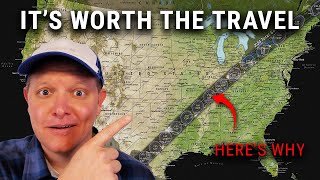

Eclipse Brain Melt: First-Timer Reaction
40sRelatable and humorous description of awe and forgetting everything during the eclipse resonates emotionally.
▶ Play Clip"Title accurately describes the video's content: essential info and science for the 2024 eclipse."
In this episode of Smarter Every Day, Destin Sandlin teams up with eclipse expert Dr. Gordon Telepun to explore the science and wonder of total solar eclipses. They discuss the upcoming April 8, 2024 eclipse, covering everything from the emotional impact of totality to the fascinating partial phase phenomena that occur before and after the main event.
Destin describes his first total solar eclipse in Wyoming in 2017 as a brain-melting experience that made him forget all his planned activities.
Emily notes that during the eclipse, insects changed behavior: cicadas faded out and crickets faded in, then reversed after totality.
Michael describes the eclipse as awesome in the literal sense—aweful, scary, terrifying—due to the immensity of the astronomical bodies involved.
The path of totality is a narrow band across the country; being just 5 miles outside means you won't see the full effect.
Gordon created science stations to teach about the partial phases between first and second contact, which last about an hour and a half.
Gordon developed an app called Solar Eclipse Timer that uses voice announcements to count down contact times for photographers.
Gordon set up a four-station temperature data logging tower to document a mini inversion layer during the partial phases.
Pinhole projection creates crescent shapes during partial phases; a colander or cheese grater can be used to project multiple crescents.
Certified solar eclipse glasses (ISO 12312-2) are necessary for partial phases; welding glasses are not safe. Glasses must be removed during totality.
During the eclipse, shadows become sharp in one direction and fuzzy in the perpendicular direction due to the crescent light source.
An eclipse breeze can occur when cool air from distant hills flows toward the observer as the ground cools during the eclipse.
Convective clouds (fluffy white clouds) can dissipate before totality because the eclipse shuts off the sun's energy that drives their formation.
Animals don't know about the eclipse; they start nighttime behaviors as light dims. Crickets become active, birds head to roosts, and bees return to hives.
As light dims, color sensitivity shifts: bright colors look muddy, making the environment feel weird. Gordon wears a Purkinje effect shirt.
Shadow bands are wavy lines of light and dark that appear on the ground just before and after totality, caused by atmospheric turbulence.
The video is supported by the Independent Media Initiative (IMI), which funds authentic, educational content to counter sensationalism on YouTube.
The April 8, 2024 total solar eclipse is a must-see event for anyone in the path of totality. With proper preparation, including certified glasses and an understanding of partial phase phenomena, viewers can fully appreciate the awe-inspiring science and beauty of the eclipse.
What is the path of totality?
A narrow band of land across the country where the total solar eclipse is visible; being 5 miles outside means you won't see totality.
03:06
What ISO standard must certified solar eclipse glasses meet?
ISO 12312-2.
10:16
What are shadow bands?
Wavy lines of light and dark that appear on the ground just before and after totality, caused by atmospheric turbulence.
17:49
What is the Purkinje effect?
As light dims, color sensitivity shifts, making bright colors look muddy and the environment feel weird.
16:44
What causes an eclipse breeze?
Cool air from distant hills flows toward the observer as the ground cools during the eclipse.
11:43
What happens to convective clouds during an eclipse?
They can dissipate before totality because the eclipse shuts off the sun's energy that drives their formation.
12:41
How do animals typically behave during a total solar eclipse?
They start nighttime behaviors: crickets become active, birds head to roosts, and bees return to hives.
14:08
What is the Solar Eclipse Timer app used for?
It uses voice announcements to count down contact times for photographers and viewers.
06:02
Why should you not use welding glasses to view a solar eclipse?
They do not block the right amount of infrared and ultraviolet light.
10:04
What is the diamond ring effect?
A bright spot of sunlight that appears just before and after totality, caused by the sun's light shining through valleys on the moon's edge.
03:06
Brain-Melting Experience
Destin's vivid description captures the profound emotional impact of seeing a total eclipse for the first time.
00:40Narrow Path of Totality
Emphasizes the critical importance of being in the exact path to experience totality.
03:06Pinhole Projection Technique
A simple, safe method to observe the eclipse's partial phases using everyday objects.
07:58Cloud Dissipation
Explains a lesser-known meteorological effect of the eclipse on convective clouds.
12:41Independent Media Initiative
Highlights a new funding model to support authentic educational content on YouTube.
19:58[00:00] And you're like, yeah, I hear people talking about that. I'm in. I'm all in on this. That's where I'm at with total solar eclipses.
[00:13] Dr. Gordon Telepun. He's a surgeon. you're going to fall in love with eclipses. I've heard cool. And then I just went all in.
[00:27] I look like an idiot on the Internet to millions of people. I went out to Wyoming in 2017. I saw a total solar eclipse for the first time, and it melted my brain.
[00:40] In fact, all the stuff I had prepared to do, I just forgot how to do it. That is.
[00:52] Stars. And I want you to experience that as well. with a bunch of friends, and someone walks up to me and they're
[01:05] Do I really need to do this? And my answer is, yes, you must. [Bobby] One of the most amazing and emotional
[01:17] experiences I've ever had, other than seeing my own children being born. Well, like I am now. It made me really want to see more of things like that.
[01:35] for free and you can just go see it, it's amazing. [Emily] As soon as it started getting darker, you could hear the insects changing.
[01:47] And then as the eclipse started happening, the cicada sound faded out and the cricket sound faded in, and then it went in the reverse, and that blew my mind.
[01:59] [Michael] I've only seen a total solar eclipse once in my life. And it was awesome in the literal meaning of the term awe awful, like scary, like terrifying.
[02:12] Because of the immensities of the astronomical bodies involved. And that morning when I woke up, knowing that it was going to happen in just a matter of hours, I became very scared.
[02:25] with knowing that it was such a big event involving such big things that were so It was inevitable it was going to happen. I could not push a pause button and make it wait for when I was ready.
[02:40] This is your biggest opportunity, if you live in the United States or And I don't want you to miss it because I love you and I want you to love eclipses.
[02:54] That's when the disk of the moon obscures or occludes the disk of the sun. And that's the only time you can see it.
[03:06] of the moon along the perimeter of the sun because you can see the jagged edges. You can see what's called a diamond ring, the ejecta around the sun. And you can only see it if you are right there in the path of totality.
[03:23] of land that goes all the way across the country. If you're 5 miles outside of that land, it doesn't work. [Anne] We were just outside the path of totality, and I set up cameras all over the farm
[03:38] to see how my animals would react to the solar eclipse. It got dark, it got cold, it got light, it got warm again, and they just kept eating.
[03:52] What a letdown. [Destin] So if it's at all possible financially or go to the path of totality and see this total solar eclipse, because it's amazing. So there's articles all over the Internet
[04:08] about, oh, the animals are going to do weird things or the weather might do this. going to slowly walk through and I'm going to ask all the dumb questions of Dr. By the way, he spent his spare time in between the last eclipse and this one
[04:24] So we're going to learn about everything called the partial phase phenomena. eclipse, there's really neat science stuff that happens when you're out there, like,
[04:39] looking at the eclipse and just, like, basking in the glory of the moment. And you're going to have, like, the cheat code. Let's go get Smarter Every Day and check out all these neat phenomena
[04:54] And let's learn about the partial phase phenomena for the total solar eclipse. [G] I do. [Destin Laughs]
[05:06] As long as my wife will tolerate it, I do it. [D] Gordon, you have created a series of, what would you call these stations?
[05:18] teaching the science of the partial phase phenomena. Of course, totality is fascinating. It's beautiful. But there's a lot of stuff you can appreciate and enjoy about the science
[05:33] of what's happening with the moon blocking the sun physically during that hour and a half time between C1 and C2, first contact and second contact. [D] Okay, so to be clear, Gordon loves eclipses so much that you
[05:46] It's an app called solar eclipse timer. My friend Gordon made this and I've used it at every eclipse I've watched. Basically, you go to a location, you pull out your phone,
[06:02] And your voice, it's actually your voice which is endearing. [G] It'll say, it'll count down to the contact times for the photographers.
[06:15] [G] So when the moon first takes that first bite out of the sun, that's first contact. [G] Totality starts when the moon obscures the sun completely. When the moon moves off on the other side
[06:30] And when the moon moves completely off, that's the end of the eclipse. [D] Okay, so to be clear, these science stations that we're talking about, the totality is just between C2 and C3.
[06:45] the partial phase phenomenon between C1 and C2 and between C3 and C4. I've monitored and data logged temperature at all my eclipses but this time,
[07:00] because I can bring a lot of equipment and drive it to Texas, I wanted to do more. So I have a four station temperature data logging tower here. [G] What we're trying to do here is document a mini inversion layer.
[07:14] And you have three on the pole. [D] Okay. And these others have free air circulation around them.
[07:30] So they're monitoring the air temperature. in temperature during the partial phases before the 20 foot sensor decreases.
[07:42] people that are at the event, they'll start feeling the temperature change. [D] All right, let's go to the second station here, Gordon. [G] So the second station is the concept of pinhole projection of the crescents.
[07:58] So when you hold up something and it's a dot that the light from the sun goes through those dots, but it crosses. and it goes to the bottom, and light from the bottom crosses through
[08:14] So right now we're only seeing round circles because the sun. So we're seeing round circles,
[08:28] [D] Now, we're seeing round circles right now [G] Not in the partial phases. So these will turn to crescents during the partial phases.
[08:41] the little banana crescent will be one direction, and after totality, it'll flip. Do your name or do the date, whatever you want to do.
[08:55] [G] Kitchen utensils are great. [G] Well, the more you pull it away, you see it gets out of focus, and a little bit of that has to do with the thickness of what you're using.
[09:09] That's why it's good to use thin paper or, [D] Like a cheese grater [G] Or a cheese grater. [D] So on eclipse day, people should pack the colander. So the other thing for pinhole projection is to make a pinhole projection shoebox.
[09:24] And a little viewing box in the back and a white card on the bottom. the little crescent phase will be projected in the back of the box.
[09:37] And it's a safe way to watch the partial phases because it can't hurt your eyes. [G] So everybody has to go to the eclipse with certified solar eclipse glasses.
[09:49] And, you know, you wear these during all the partial phases and then you take them off during totality. [D] I've heard of people using welding glasses and stuff like that.
[10:04] because they don't block the right amount of infrared and ultraviolet light. So these are certified to block the right amount for viewing.
[10:16] It's got to be ISO 12312-2. You want to be safe. Don't look directly at the partial phase eclipse that could actually injure you.
[10:30] [G] Totality. You have to take them off during totality, yes. [G] So this is sharp and fuzzy shadows. If you take something that's 90 degrees apart like this,
[10:43] when you rotate this during the eclipse, the one that gets sharp is going to be in line with the crescent, the one that is staying perpendicular That's going to be fuzzy.
[10:57] That's going to be the sharp edge. And this will be sharp. All the parallel sides will be sharp, and all the parallel sides will be fuzzy.
[11:11] when people say my shadows look weird, that's what's happening. [G] So we're going to monitor the wind at this eclipse. that says the weather changed during the eclipse.
[11:28] effects during eclipse, but it doesn't really change, change the weather. phenomena to witness, and that's an eclipse breeze. [G] An eclipse breeze. [D] Okay.
[11:43] [G] If you have calm conditions, at your observing site, and there are some mountains or hills in the distance, but relatively close, The ground there will cool before your
[11:59] And that cool air in those valleys will coalesce. as a cool breeze coming from the direction of umbra approach.
[12:13] [D] As the cooler air is more dense, it's going to roll down hills. [G] That's right. So our observing site has a nice flat area, and it also has some hills to the east and the south.
[12:26] We'll have it pointing to those hills, and we'll see if we have calm conditions, if we can pick up a subtle eclipse breeze. [G] So this is a station that talks about
[12:41] the creation and dissipation of convective clouds, and they're created by the ground being warmed by the sun and creating moisture that rises as eddies. And these red arrows represent warm, moist eddies rising.
[12:58] layer, it condenses and it makes those fluffy clouds. But they are reliant on that continued So the eclipse is going to shut off that energy and shut off that moisture.
[13:15] And those little fluffy convective clouds can actually dissipate before totality. there'll be these white, puffy clouds in the sky, and they'll start to go away.
[13:28] But not all clouds will go away to be clear, right? with clouds, like big clouds on a cliff, stay getting your car, go down the path one way or the other to try to get away from the clouds.
[13:41] [G] Big, thick, gray rain clouds are not reliant on this kind of energy. They're more of a weather front type clouds, and they won't have time [D] I don't know what to say about this,
[13:53] other than this is definitely the cutest station here. What is this? Come on over and [G] So this is to teach people about the animal behavior.
[14:08] brains and we know an eclipse is happening and we're watching it. The animals don't know about it. so they think nighttime is coming, so they start their nighttime behaviors.
[14:23] This is a graph of the lux going down. that anything's changing till about within ten minutes or eight minutes of totality.
[14:35] [D] Really? [G] So if you're in any natural environment at all, the first thing you'll hear is crickets. If this was in the path of totality, it would be wild, really wild.
[14:51] The second thing that people are not aware of, and that's why I have the bird here. If you see a group of birds in the 15 minutes before totality flying,
[15:05] like they look like they're going somewhere, that's probably not random. They're going to their nighttime resting spot. That's how they get to their flowers.
[15:19] People put video cameras up at the hives, and before totality, the hives got very active because the bees [G] And they found that bees that couldn't make it back if they were in some field
[15:35] for the sun to come back before they went to the hive or went to their flowers. light changes and they change their behavior. So if you're a beekeeper and you have bees and you're in the path of totality,
[15:51] Or if you're in a place with a flowery bush that the bees, like, love and they're buzzing around it, put a video camera on the flowery bush.
[16:04] phases, and when totality gets closer, the activity will go down. [D] What about this chicken? [G] It's my chicken animal behavior video.
[16:16] I had a farmer in Nashville monitor their chicken coop for me. It's amazing to see what chickens did before and after totality. What else we have here?
[16:32] So I'm going to leave the long description over on the second channel video. Eyes, and the cones are light sensitive.
[16:44] So basically what happens is as the eclipse comes closer, the color sensitivity of your eyes changes and you start to see colors different. The bright colors look muddy, and it just makes it feel really weird.
[16:58] But Gordon did something really funny so. Color shirts and stuff on eclipse day so [G] I need to do something. [D] Okay
[17:10] [D] Okay. [D] Okay. [D] Okay, great. All right.
[17:23] Okay, great. This is my Smarter Every Day Purkinje effect shirt. [D] Okay. Are you going to wear this on eclipse day?
[17:37] This is what I was so excited about in 2017. You don't like that name, do you? [G] I like it.
[17:49] I like it because that's how I described them when I saw them in 2002, because they look like rows of snakes that were wavy but in lines.
[18:01] And what it has to do is that little slit of light is making little rectangles on the ground, but they're in the direction of the slit, so they're always in rows.
[18:13] to perturb them will make what their behavior is going to be. They could look like they're leapfrogging like snakes.
[18:25] They could be very stagnant if the atmosphere where that light is I know this sounds crazy. It's not crazy. If you're watching the eclipse, hopefully they have your solar eclipse app,
[18:42] bands at 90 seconds, 60 seconds, and 30 seconds before C2. in totality coming, and the crowd's going crazy. You have to be forced to look down at the ground.
[18:58] looking here, you look for shadow bands like here. So put a white sheet in front of your group or whiteboards. I don't know the directions, but it looked like low contrast shadows.
[19:12] But it's in rows. It's in rows. because of the dynamic range of the camera sensor, but just look at the ground. [G] Afterwards it's better because before C2, they kind of fade in as the lighting
[19:31] But after C3, you're dark adapted and the sun comes back as a very fine slit instantly. My app will remind you to look for shadow
[19:44] bands again after C3 because they can be more dramatic after C3. This video is supported. to be at the end of the video, they said something very interesting.
[19:58] They said, ask people to be thoughtful about the video they watch after this one That's amazing. Let me tell you about these folks. So this is an organization called the Independent Media initiative.
[20:13] If you're a YouTube creator, you have an incentive to make sensational content. Like, if I can get a bazillion views on a video, then I can get more people
[20:25] That means more money. Therefore, there's market pressure to make sensational content that is not good for society. It's really cool. I came out here because it's quiet.
[20:41] So the independent media initiative is trying something new. They're partnering with foundations to get nonprofit money into the IMI.
[20:54] creators that are authentic, genuine, make it educational, artistic content. And they're going to try to create another second path to promote those creators.
[21:06] there was this program that I used to watch that made me think about feelings. Go on field trip to a manufacturing place, like a factory or something.
[21:19] It was awesome and I loved it. Kind of like Mr. Rogers of stuff, and that's what IMI is going for, the independent media initiative.
[21:32] So again, I asked them, what is the call to action of this video? and they said, simply to remind viewers about the next video you select to watch
[21:44] they've got a selection of creators that's a good place to start. to IMI for the fusion award
[21:58] and I'm grateful for what their trying to do on the internet. Any last minute advice? They have to get into the totality band,
[22:12] and plan to try to drive to a bubble of high pressure. [G] Be mobile it's legitimately good
[22:26] it will get your GPS position, just have them turn their phone on and listen to the announcements [G] Pin hole projection
[22:40] pin hole project your name [Both laughing] [G] Let nature do its work

⚡ Saved you 0h 22m reading this? Transcribe any YouTube video for free — no signup needed.