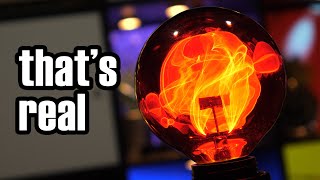

The Wildest Light Bulb Ever Made
45sImmediately grabs attention with a bold claim about a bizarre 1960s novelty light bulb.
▶ Play Clip"Exactly what the title promises: a fascinating deep dive into a wild light bulb."
This video explores the Balafire, a novelty light bulb from the late 1960s that creates a realistic flame effect using a vibrating filament. The host explains the mechanism, compares it to earlier designs like the Gas Glo and SimFlame, and discusses the history of its manufacturer, Kyp-Go Inc.
The Balafire is a novelty light bulb from the late 1960s, produced by Kyp-Go Inc., which creates a flickering flame effect.
The Gas Glo bulb used a similar flame-shaped filament but with a matching glass envelope that restricted filament movement.
SimFlame is a plug-in dimmer switch that randomly changes brightness of an incandescent bulb, creating a flame-like flicker.
The Balafire's subtle flicker closely mimics the light output of a real oil lamp, unlike other imitation products.
A magnet inside the bulb interacts with AC current to vibrate the filament, causing the light source to physically move and create a flicker.
The Balafire replaced the flame-shaped glass with a spherical globe, allowing the filament to move freely without hitting the glass.
The bulb has a rated life of 500 hours; filaments can mechanically fail due to vibration, but gentle driving may extend life.
Kyp-Go produced new runs using A19 bulbs before Bob Kyp's death in 2011. These bulbs are now collectors' items worth ~$100.
The Balafire is a remarkable piece of engineering that uses simple physics to create a convincing flame effect, and it remains a sought-after collectible for vintage technology enthusiasts.
How does the Balafire bulb create a flicker effect?
A magnet inside interacts with AC current to vibrate the filament, causing the light source to move.
03:44
What was the claimed lifespan of the Balafire bulb?
500 hours.
07:12
Which company produced the Balafire bulb?
Kyp-Go Inc.
00:18
What was the Gas Glo bulb?
A predecessor with a flame-shaped filament and corresponding glass envelope that restricted filament movement.
01:04
What is SimFlame?
A plug-in dimmer switch that randomly changes brightness of an incandescent bulb to simulate a flame.
02:12
Magnet-AC Vibration Mechanism
Explains the core physics behind the Balafire's unique flicker effect using simple components.
03:44Design Change from Gas Glo
The spherical globe allowed free movement of the filament, enhancing the flame illusion.
05:33Filament Failure Mode
Unlike standard bulbs, Balafire filaments fail mechanically rather than from tungsten evaporation.
07:12Collector's Value
Original Balafire bulbs now sell for ~$100, highlighting their rarity and appeal.
08:52[00:00] a series [rushed mumbling] Gonna be lots of flickering lights throughout this video, fyi. if not the weirdest light bulb ever made, is certainly the wildest light bulb ever made.
[00:18] It’s called the Balafire and just in case a quick glance at the box isn’t clear enough, it’s a product of the late 1960’s and early seventies. This novelty light bulb was produced by Kyp-Go Incorporated,
[00:31] He was dedicated to the preservation of carbon filament light bulbs and in 1950 founded his company (right here in the Chicago area, as it happens) which manufactured reproductions of various antique light bulb designs.
[00:48] And it wasn’t this. This bulb, called the Gas Glo, was an attempt to produce a realistic flame effect for old-looking but still electric light fixtures.
[01:04] you may recall I covered neon flicker flame lamps in the past. While they’re really not useful for any amount of illumination and the flame effect is...
[01:17] uh, not terribly realistic it’s still a neat idea. These days, since LEDs and microcontrollers are so stinking cheap these new light bulbs are gaining in popularity which are…
[01:31] I don’t love them - these aren’t warm white diodes, they’re amber, so they create terribly unpleasant lighting, plus you can usually notice a pattern in their behavior pretty quickly, so I think there’s lots of room for improvement.
[01:48] I probably have unrealistically high standards, though, since growing up and visiting the Disney parks I was entranced by how they managed to make antique lanterns look like there was actually a flame in there.
[02:00] I even tracked down a product called SimFlame which is a thing - if not the thing - which makes that particular magic happen. This is a plug-in version of the SimFlame
[02:12] and really all it is is a fancy dimmer switch which randomly and subtly changes the brightness of an incandescent light bulb. Incandescent filaments offer a natural shift in color emperature as they dim down
[02:25] so if you simply frost the glass of a light fixture so you can’t see the actual light bulb, it’s a very convincing effect. Jerry’s Electronics is still around and you can still order these if you like,
[02:37] in fact they’ve been updated to support LED light bulbs, and I put a link in the doobly-do. Though, as I later discovered when I started getting into actual hurricane lanterns, this effect isn’t actually representative of the sort of light output a burning oil lamp creates.
[02:54] This, though, it actually is. The flicker of an oil lamp is quite subtle and, well, this light bulb has a very subtle flicker. It also produces about as much light with the same character that a real oil lamp does.
[03:11] Well, through the magic of buying two of them, I have this clear version of the same bulb which lets us look inside. Before I switch it on, and this is going to be very hard to see but hopefully you can,
[03:25] you’ll notice the filament is very long and is sticking up into the point of the vaguely flame-shaped glass bulb. What I’m sure you have noticed is the weird black chunk of something on a stick, positioned right in the middle of the filament.
[03:44] Just a simple magnet. Now, you may know that when current flows through a wire it generates a magnetic field. And the filament in this light bulb is a wire which will have current flowing through it.
[03:59] So once we switch it on, the filament will create a magnetic field which will interact with the magnet and create an attractive or a repulsive force which moves the filament relative to the magnet.
[04:11] But because the electricity that powers stuff in your home is alternating current, where the direction of current flow is constantly reversing 50 or 60 times per second, the direction the filament will move will constantly reverse.
[04:25] The filament is essentially vibrating thanks to the magnet and alternating current. The shape of the bulb restricts the filament’s movement to just a small back and forth motion -
[04:38] you can actually hear the filament hitting the glass if you listen real close. And while the effect is pretty tiny, it’s significant. The source of the light is physically moving and so, even though the filament is not changing in brightness,
[04:53] the amount of light which leaves the bulb in any given direction is always just a little different. Even staring directly at this clear bulb, it does kind of look like there’s an actual flame in there.
[05:06] well I won’t say more convincing but it changes the character of the effect in a useful and pleasing way depending on what sort of light fixture you’re sticking it in.
[05:19] But then, in 1968, Bob decided to let things loosen up a bit. The Balafire bulb is basically the same thing as the Gas Glo bulbs - it even has the same roughly flame-shaped filament.
[05:33] But the matching flame shape of the glass envelope was swapped for a simple spherical globe. While the Gas Glo bulb physically prevents the filament from moving very far, the globe of the Balafire is large enough that the filament can never touch it.
[05:48] An absolutely wild light bulb where the filament is just flying all over the place. It really does look quite a lot like a small fire inside of that light bulb, and they came in several different colors.
[06:04] This really is a mesmerizing effect and you really lose quite a lot of time just staring at one of these, especially if under the influence of the sort of substances that the box design might remind you of. I have this, of course, just in a standard lamp socket but these were often displayed in fixtures specially designed specifically to display them.
[06:25] They might take the form of a mirrored box to let you see the lamp from all sides, and some pretty groovy acrylic cuboids were out there which fit a globe lamp just perfectly and served as a sort of…
[06:38] I dunno, I’m not old enough to have been there. you might have noticed that the glass is somewhat mirrored. While I can’t say for sure, I have a hunch that this was done in part to hide the fact that what’s inside this
[06:53] is literally the same exact thing as the Gas Glo bulb. If you could see clearly into the bulb, it would look identical. Then again, it also just looks pretty cool and a lot more interesting when it’s shut off than a simple red light bulb so maybe I’m just being too cynical there.
[07:12] The box claims these light bulbs had a life of 500 hours which seems quite pessimistic for a lamp which is burning the filament at such a dull brightness until you remember that the tiny, fragile filament is flying around every which way with gusto.
[07:30] This is both really cool to watch and really painful! though for what it’s worth the patent mentions that an aged filament
[07:44] (one which has already been subjected to higher-than-normal voltage and thus had a burn-in period) is preferred. I’m sure that helped keep these things from burning out too early. Then again, I found some forum posts about these where someone claimed they had used theirs for many thousands of hours.
[08:03] Certainly if the filament is being driven as gently as it is in the Gas Glo bulb that’s not outside the realm of possibility - that’s quite dim and evaporation of tungsten is going to be very, very slow.
[08:15] But it relies on getting very lucky as far as how sturdy the filament was in your particular bulb. These don’t “burn out” in the traditional sense where a weak spot forms after hundreds of hours of pushing tungsten almost to its melting point,
[08:31] instead the filament just mechanically fails at some point. Just a couple of weird old light bulbs. Bob Kyp passed away in 2011, but shortly before he died Kyp-Go started up a new run of these using standard A19-shaped light bulbs.
[08:52] the mirrored red sphere looks so much cooler than just a normal light bulb and I would think they would have wanted to do that again if they could have - Now, these are collectors items and are worth around $100 each.
[09:11] I believe Kyp-Go is now defunct, I only found a web presence via the Wayback Machine. But I was genuinely delighted to learn that there actually was a Disney Parks connection this whole time -
[09:23] apparently Kyp-Go was who was making the antique carbon filament bulbs in use in the theme parks and certain attractions. Though I’d be remiss if I didn’t mention my channel icon.
[09:35] That is a photograph of a FerroWatt bulb - one of the newer companies who got into the reproduction “Edison” bulb trend long before it exploded into what it is now. Anyway, it looks like they, too, are defunct.
[09:52] Which is kinda sad, they had some of the best reproductions. For what it’s worth, though, most of those so-called “carbon filament” reproductions were and still are, as far as I know, just tungsten filaments being run very gently.
[10:10] And that means they tend to last a lot longer than they seem like they should - it’s like being permanently on a dimmer set quite low. However, they’re horribly inefficient and produce an extremely warm light and so while they are nice in a few decorative spots,
[10:27] they’re not great at all for general illumination. ♫ wildly smooth jazz ♫ Light fixtures!
[10:42] I don’t love them, these aren’t warm white diodes, they’re amber so they create… terr… …thing if not the thing which makes that par… crap.
[10:55] I have this of course just in a standard lamp socket just inst… ffthwhat? But I was genuinely telighted to lear - ahhhhhh Oh,
[11:10] that reminds me because this one was so short I dunno how many bloopers there are going to be. in case I have to pad it out into the point where I normal cu-
[11:24] that's some movie magic for ya. cutting right when i said cut. i'm so clever makin' funnies like that


⚡ Saved you 0h 11m reading this? Transcribe any YouTube video for free — no signup needed.