
$400 vs $75 Mic: Can You Tell the Difference?
45sBlind audio comparison between a $400 Shure SM7B and a $75 Fifine K688 challenges viewers to spot the difference, sparking curiosity and engagement.
▶ Play Clip"Title is accurate; the video genuinely recommends a budget mic and provides evidence."
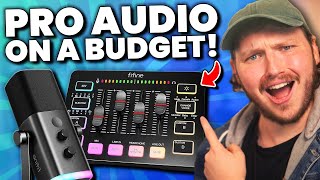
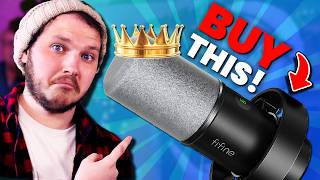
The video compares the budget Fifine K688 microphone (around $75) against the professional Shure SM7B ($400+) and the Samson Q2U, testing whether a cheap mic can sound as good. The creator conducts blind audio samples and evaluates build quality, features, and sound rejection.
Shure SM7B costs ~$400 plus mixer, cables, cloud lifter, totaling over $1,000. Fifine K688 costs ~$75, about 10% of that.
Three audio clips (A, B, C) are played for viewers to guess which mic is which. Clip A is K688 with no filters, B is Samson Q2U, C is K688 with compressor and EQ.
Mic must have USB + XLR (future-proof), be under $100 (budget), and sound great. K688 meets all criteria.
Two knobs for gain and headphone volume, real-time monitoring via headphone jack. Samson Q2U has clicky buttons that pick up in recordings.
K688 has warm, full tone with only a compressor filter. Dynamic mic rejects background noise like AC and daughter playing outside.
Typing close to mic: keyboard noise minimal. With expander filter, chair squeaks audible. Moving mic around: good rejection.
Shocked at build quality and clean sound for $75. Fall-off near instant, background noise rejection excellent.
K688 recommended over Samson Q2U; cheaper and bundle available. Giveaway: comment #fine and Twitter/Discord username.
A: K688 no filters, B: Samson Q2U, C: K688 with compressor and EQ. Shure SM7B with full setup costs $999+ but K688 sounds comparable.
The Fifine K688 offers exceptional value at $75, rivaling the Shure SM7B in sound quality with proper processing, making it a top budget recommendation for streamers and content creators.
What is the price of the Fifine K688 microphone?
Around $75 USD.
3:07
What are the two criteria the creator uses to recommend a microphone?
It must have USB + XLR connectivity and be under $100.
1:48
What type of microphone is the K688 (dynamic or condenser)?
Dynamic.
4:27
What polar pattern does the K688 use?
Cardioid.
4:51
What was the blind sample A?
Fifine K688 with no filters, gain at max, Windows sound at 36%.
7:57
What was the blind sample B?
Samson Q2U.
8:11
What was the blind sample C?
Fifine K688 with a compressor filter and basic three-band EQ.
8:39
What is the advantage of a dynamic microphone over a condenser?
Dynamic mics are less sensitive, reject background noise naturally, and require closer placement.
4:39
What is the giveaway requirement?
Comment #fine and what you'd use the microphone for, plus your Twitter or Discord username.
9:01
K688 sound quality surprise
Demonstrates that a $75 mic can sound warm and full with minimal processing.
3:43Keyboard noise rejection test
Shows excellent off-axis rejection even with close typing.
5:07Blind sample C reveal
Reveals that the K688 with basic EQ can sound comparable to a $999 setup.
8:39[00:00] Picking the right microphone is a big
[00:01] decision, not just for the quality of
[00:02] your content, but also for your wallet.
[00:04] If you've watched any large creator in
[00:06] the last few days, you've probably seen
[00:08] this, the Shure SM7B, a microphone that
[00:11] by itself costs around $400 USD, and
[00:14] then you add a mixer, XLR cables, a
[00:17] cloud lifter, all of which are needed to
[00:19] make it work, and suddenly it's usually
[00:21] over $1,000. So, the question I want to
[00:23] answer today is, can a microphone such
[00:25] as the Fifine K688 that costs just 10%
[00:28] of that price sound just as good? And
[00:30] that's why the very first thing we're
[00:32] doing is, that's right, blind audio
[00:35] samples. The challenge for you, dear
[00:36] viewer, is to pick out which microphone
[00:38] is which. Can you tell which is the Sure
[00:40] SM7B, the K688? And of course, it
[00:43] wouldn't be a Stream Scheme video if I
[00:45] didn't bust out the Samsung QTU, our
[00:47] current challenger. Let's listen to
[00:49] those clips. This is audio clip A. Hey,
[00:51] hey guys. If you want to support the
[00:52] channel, consider becoming a member for
[00:53] just $1 a month. This is audio clip B.
[00:55] Let me know in the comments what you
[00:57] think of this microphone. How does it
[00:58] sound to you? If you want to buy any of
[01:00] the microphones shown in today's video,
[01:01] then you can check them out at my kitco,
[01:03] which is linked in the description. This
[01:05] is audio clip C. How does it sound to
[01:07] you? Does it sound nice? Does it sound
[01:09] clean? Does it sound like it's 75 USD?
[01:11] Or does it sound like it's 999 USD? With
[01:14] that done, I really recommend commenting
[01:16] your guess because we're giving away a
[01:18] Fifine K688 to you guys in the comments.
[01:21] I bought this one back in August 2023.
[01:24] I've been testing and planning this
[01:25] video for a long time. So long, in fact,
[01:28] that Fifine reached out and offered to
[01:29] send me one. So, instead, I told them to
[01:31] send you guys one. Stick around to the
[01:33] end of the video to learn how to win
[01:34] that. Okay, let's talk about why I
[01:36] picked these three microphones. Well, in
[01:38] order for me to recommend a mic to you
[01:39] guys, it has to meet a lot of criteria.
[01:42] I am an incredibly picky person. Let's
[01:45] walk through what I look for and talk a
[01:46] bit more about the K688 while we're at
[01:48] it. First, it has to be USB plus XLR.
[01:51] While you might think I'm being pedantic
[01:53] about this, if I am going to spend money
[01:55] on a microphone or recommend you guys
[01:57] spend money on a microphone, then we
[01:59] should expect to be able to use it for
[02:01] years. When I bought the AT2020 Plus as
[02:03] a new streamer off a certain tech
[02:05] influencers recommendation, I hadn't
[02:07] thought about the fact when I wanted to
[02:09] move to a real mixer like the Roland
[02:11] Bridgecast that I'd not just be spending
[02:13] money on the mixer, but an entire new
[02:15] microphone as well. It really felt like
[02:17] I wasted money buying a microphone that
[02:20] was only USB. On the topic of money, for
[02:22] me to recommend a microphone, the second
[02:24] criteria is it has to be budget. And
[02:27] when I say budget, I am meaning a h
[02:28] 100red bucks or less. I don't care what
[02:30] anyone else says. If it's over $100, it
[02:33] is not a budget microphone. So, do these
[02:35] microphones fit that criteria? Well,
[02:37] obviously the Sure SM7B doesn't meet
[02:39] that criteria, but it is probably the
[02:41] most used microphone in professional
[02:43] content creation. So, I am including
[02:45] that as the topend professional
[02:47] challenger today. Now, if you've watched
[02:49] this channel before, you know the
[02:50] Samsung Q2U does, and it's been over 3
[02:53] years now without me ever recommending
[02:55] another microphone. Well, in until now.
[02:58] The K688 has honestly surprised me. When
[03:01] I first plugged it in, this is what
[03:03] happened. All right. Oh. Oh. Oh. Coming
[03:07] in at around 75 USD, it is absolutely
[03:10] meeting the budget criteria. And that's
[03:12] not including the bundles that I found
[03:14] on Amazon when I was looking to check
[03:16] the price in USD. Talking about bells
[03:18] and whistles, it has two knobs on the
[03:19] bottom. One for quickly controlling
[03:21] microphone gain and the other for
[03:22] headphone volume. If you want to have
[03:24] real-time monitoring for your voice and
[03:26] your PC, you can plug your headphones
[03:27] into the bottom of the microphone, which
[03:29] is something the Samsung Q2U can do as
[03:31] well. But the problem I've had with the
[03:33] Samson is if I want to adjust the
[03:34] headphone volume, I have to click these
[03:36] little buttons. And because they're
[03:38] clicking, it actually comes up and gets
[03:40] picked up in my recording. Of course, it
[03:42] goes without saying, a microphone needs
[03:44] to sound great. And as you likely have
[03:45] heard in this video, because I've used
[03:47] it for almost the entire thing now, the
[03:49] K688 does sound pretty damn good for its
[03:52] price bracket. As someone with quite a
[03:54] nasely or grally voice, I always expect
[03:57] microphones to sound awful when I first
[03:59] plug them in, and I have to do a lot of
[04:01] work to make my voice sound good. But
[04:03] actually, there is a really warm or
[04:05] full, rich tone to this mic that I kind
[04:08] of love. The only filter I have added to
[04:10] this microphone is a compressor filter.
[04:12] Otherwise, there's no effects or EQ at
[04:14] all during this recording, which has
[04:16] surprised me a lot because I have not
[04:18] just my air conditioning blasting in the
[04:19] background, but I can also hear my
[04:21] daughter playing outside my office door.
[04:23] And I'm willing to bet you guys can't
[04:25] hear that. Now, this is because the K688
[04:27] is a dynamic microphone, which
[04:29] thankfully most companies making mics
[04:30] for streamers are moving this direction.
[04:32] But essentially, microphones can either
[04:34] be dynamic or condenser. The difference
[04:36] between these is a bit complicated for
[04:37] this video. So instead, let's simplify
[04:39] it down by saying dynamic is less
[04:41] sensitive, meaning you tend to place it
[04:43] closer to yourself and adjust the gain
[04:44] or levels to match, which helps
[04:47] naturally reject background noise.
[04:49] Naturally, a microphone like this is
[04:51] going to be a cardioid polar pattern,
[04:52] which is fairly common. It means it
[04:54] picks up sound from the front and
[04:55] rejects off-axis noise. As you can see,
[04:58] when I move like this, I suddenly
[05:00] disappear, which is fantastic, cuz it
[05:02] means that everything else that's going
[05:03] on around will also disappear. But I
[05:05] can't just tell you that. Let's actually
[05:07] show it. Let's give it a test. Coming
[05:08] up, we will reveal the blind sample
[05:10] results and how to enter the giveaway,
[05:11] but of course, let's do the test first.
[05:13] As you can see, I've got my mic very
[05:14] close to my keyboard. Normally, I
[05:16] wouldn't have my microphone this close,
[05:17] but I just want to get an
[05:23] example. That's about what I expected
[05:25] without any effects or anything. Now,
[05:26] let's get further away where I would
[05:28] actually sit when I'm playing with my
[05:29] mic. This is me typing away at my
[05:31] keyboard. As you can hear, it is
[05:32] underneath my voice. Yeah, that's very
[05:34] usable. All right, let's put a default
[05:36] expanding filter on. Now I'm going to
[05:38] talk. Now I'm going to talk. Now I'm
[05:39] going to talk. Now I'm going to talk.
[05:41] This is me talking while I have a
[05:42] default expander on. You can probably
[05:44] hear my chair quite a lot. I got my
[05:45] squeaky one out of the garage today for
[05:47] this one. I'm moving around. It's
[05:48] squeaking. Can you hear it in the
[05:50] background at all? A lot of people don't
[05:52] really do this, but I like to move
[05:53] around a lot while I stream. So I kind
[05:55] of am constantly moving my mic and doing
[05:58] things. So I'm curious how this is going
[05:59] to sound. Lift my mic up. Put my mic
[06:02] down.
[06:11] This is me speaking on the mic at about
[06:13] 3 centimeters away. It's about where you
[06:15] would speak into a microphone, uh,
[06:16] especially a dynamic microphone. This is
[06:18] me about an arm's length away from the
[06:20] microphone. I'm not going to adjust the
[06:21] gain at all. I'm still talking as I
[06:23] normally would. And now I'm going to
[06:24] boost the gain to match the level, so
[06:26] you can hear the background noise if
[06:27] you're not on top of the microphone.
[06:28] This is me about two arms lengths away.
[06:30] Again, I'm not going to project further.
[06:32] I'm not going to boost this audio right
[06:33] away. I'm just going to let you hear how
[06:35] it sounds. And now I'm going to boost
[06:36] the audio so you can hear what the
[06:38] background sound sounds like. Breaking
[06:39] it down, I have to say I am kind of
[06:42] shocked. This microphone is 75 USD. For
[06:46] that price, I didn't expect such a solid
[06:48] build quality. I didn't expect such a
[06:50] clean and warm sound straight out of the
[06:52] box. The test showed exactly what I'd
[06:54] expect from any dynamic microphone. The
[06:55] fall-off is near instant the moment you
[06:57] step away from the mic. But is that a
[07:00] bad thing? It just means that all the
[07:01] background sound is also going to fall
[07:03] away. Remember the keyboard test blew me
[07:05] away. While actually doing it and
[07:07] typing, I was watching the levels in OBS
[07:09] and thought, "Ah, damn. It's screwed.
[07:11] It's not going to work." And then
[07:13] listening back, I was so surprised at
[07:16] the rejection. Now, before I tell you
[07:17] whether or not I would recommend this
[07:18] mic, I would love to hear in the
[07:20] comments, what do you think about the
[07:21] results? What do you think about the
[07:23] microphone? Is this something that you
[07:25] would consider getting for yourself
[07:26] based on what you've seen today? And
[07:28] now, as it stands, can I add this
[07:29] microphone to my very short list of one
[07:32] other microphone that I
[07:34] recommend? Yeah. Yeah. In fact, I might
[07:37] start recommending this instead of the
[07:39] Samson QTU. It's about 15 to 20 bucks
[07:42] cheaper, I can see, across the board.
[07:44] And technically, for the same price as
[07:46] the Samson, you could get the K688 in a
[07:48] bundle. I'll tell you how to enter the
[07:50] giveaway in a second, but for those keen
[07:51] to know the results of the blind
[07:53] samples, well, blind sample A was the
[07:57] K688 with absolutely zero filters,
[08:00] effects, the gain knob was at max, and
[08:02] my Windows sound settings at 36%. I
[08:04] literally plugged it in and took an
[08:06] audio sample, which sounds incredibly
[08:08] unfair, but I think it did really well.
[08:10] In fact, I did the same thing with the
[08:11] Samsung QTU as well, which of course
[08:14] still sounds amazing as audio clip B.
[08:17] And of course, to continue being
[08:18] incredibly unfair, audio clip C, the
[08:21] Shore SM7B is not just plugged into my
[08:23] roll in Bridgecast, but it has a Cloud
[08:26] Lifter, a compressor, a low cut DSer,
[08:28] noise suppression, and I've even got
[08:30] custom EQ. Can you hear it? Does C sound
[08:33] that much better? Let me know in the
[08:35] comments because if you said yes, you're
[08:36] a liar. Sample C is just the K688 again,
[08:39] but this time with a compressor filter
[08:40] and a basic barely touched threeband EQ
[08:43] where I slightly dropped the mids and
[08:44] lows and raise the highs. That's it. But
[08:46] if you actually want to hear the clip of
[08:48] the Sure SM7B with all those things,
[08:49] this is that for comparison. And this is
[08:51] the Shure SM7B. I think you can hear a
[08:53] difference. Obviously, you can hear a
[08:55] difference, but this cost me over
[08:57] $999. And the other stuff cost a
[08:59] fraction of that. If you want to go in
[09:01] the draw to win this microphone, all you
[09:03] have to do is comment #fine what you'd
[09:05] use the microphone for. And very
[09:07] important, please comment your Twitter
[09:09] or Discord username so I can contact you
[09:11] if you win. We'll be picking someone at
[09:13] random from the comments and letting
[09:14] them know very soon. If you guys enjoyed
[09:16] this, then I really would appreciate if
[09:17] you consider becoming a member for just
[09:18] $1.
⚡ Saved you 0h 09m reading this? Transcribe any YouTube video for free — no signup needed.