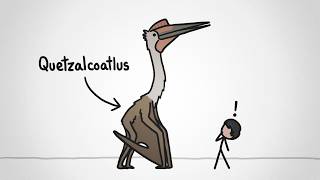

Could a giraffe-sized pterosaur really fly?
45sThe shocking visual of a giraffe-sized flying creature immediately grabs attention and challenges common assumptions.
▶ Play Clip"The title is accurate; the video thoroughly explains the scientific evidence for Quetzalcoatlus's flight capability."
The video explores how the giant pterosaur Quetzalcoatlus, despite being the size of a giraffe, was able to fly. It explains the anatomical adaptations—hollow bones, powerful chest muscles, and a unique quadrupedal launch—that made flight possible. The conclusion emphasizes that the evidence confirms these creatures truly soared.
Quetzalcoatlus was one of the largest pterosaurs, giraffe-sized, but only as heavy as a large pig.
Pterosaurs had elongated hand bones for wings, hollow bones, and large breast bone attachments for strong flight muscles.
Unlike birds, giant pterosaurs used their wings for a quadrupedal launch, pushing off the ground with all four limbs.
Bats independently evolved the same quadrupedal launch strategy.
What is the name of the giant pterosaur discussed in the video?
Quetzalcoatlus
How heavy was Quetzalcoatlus estimated to be?
It was about as heavy as a large pig.
01:06
What adaptation did pterosaurs have that helped them deliver oxygen to flight muscles?
Hollow bones that increased respiratory system volume and delivered oxygen to flight muscles.
01:34
How did giant pterosaurs solve the launching problem without huge legs?
They used their powerful wings for both taking off and flapping, a quadrupedal launch.
02:25
Which other flying animal independently evolved the same launch strategy as giant pterosaurs?
Bats independently evolved the same quadrupedal launch strategy.
02:38
Quetzalcoatlus size and flight
Establishes the central paradox: a giraffe-sized reptile that could fly.
Weight comparison to a pig
Explains how a favorable wing-to-mass ratio made flight possible.
01:06Quadrupedal launch strategy
Reveals the unique evolutionary solution to launching a heavy body into the air.
02:25Convergent evolution with bats
Highlights how natural selection arrived at the same efficient launch method in different lineages.
02:38[00:00] This video is brought to you by FarmKind, more about them at the end of the video. The Ketzel Coatelos, one of the largest terasurs that ever lived, was able to fly.
[00:12] That doesn't sound right. I mean, look at this thing. It's the size of a giraffe. However, giant terasurs able to fly is really well established in the scientific community.
[00:24] So how on earth did this giant manage to fly? Hi, I'm Ever and this is Minot Earth. Thanks to the fossil record, we know that terasurs had wings with elongated hand bones,
[00:38] just like every other flying vertebrate. But simply having wings doesn't mean you can actually fly. If you're too heavy for the size of those wings, or if you can't flap them fast enough, you'll never get anywhere. And compared to the biggest flying creatures alive today,
[00:54] the Koi Bostard, or the Wandering Albatros, or even the Andean Condor, depending on how you measure it, the Ketzel Coatelos was way, way bigger. But despite this giant terasurs wing span,
[01:06] scientists estimate that it was only about as heavy as a large pig. Now, with a wing-to-mass ratio looking more decent, giant terasurs still need to be strong enough to flap them. And while wing muscles themselves are not preserved in the fossil record,
[01:22] we know terasurs had huge bumps in their four limb bones and highly modified breast bones with ample attachment for powerful chest muscles, just like modern flying birds do.
[01:34] So it's reasonable to believe their wing muscles were pretty broad. On top of that, terasurs had mostly hollow bones that increased the volume of their respirator system,
[01:46] again, just like modern flying birds, which allowed them to deliver tons of oxygen to all those flight muscles. All this likely helped the Ketzel Coatelos big body stay aloft once
[01:58] it was in the air. But getting into the air in the first place is the hardest and most energy-intensive part of flight. Flying birds use their strong leg muscles to launch themselves into the air.
[02:10] That's why the bigger a bird is, the larger and more powerful it's legs tend to be. Giant terasurs were so huge that in order to jump into the air like birds, they would have needed truly gigantic legs that would have made them
[02:25] definitely too heavy to fly. So they solved the whole launching problem in a different way. They used their powerful wings for the dual purpose of taking off and flopping.
[02:38] And this strategy is so efficient that bats independently evolved it as well. By the way, I think this is my favorite fact about giant terasurs. And bats, of course. Once you look at all the evidence and the facts,
[02:51] it makes perfect sense that these giant terasurs could truly soar. They might look too big and wonky, but the Ketzel Coatelos was about as close as we've ever come to a flying pig. Pigs these days, of course, rarely fly. And sorry to be a downer,
[03:09] especially after that uplifting video. But in a lot of places, the conditions they're kept in are hard-breaking. As someone who loves animals, I hate to see any animal suffering so much.
[03:21] That's why we want to help make a genuine positive change with today's sponsor, FarmKind. FarmKind helps improve the lives of animals by recommending expert-reviewed top charities whose work really makes a big difference, like Scinerhia Animal, which is helping end the
[03:38] inhuman practice of keeping breathing pigs confined in tiny crates. FarmKind never takes a cut of your donation. It all goes to the charity's helping animals. If you sign up for just 15 bucks a
[03:51] month, that's just 50 cents a day, you'll save 350 animals from unnecessary suffering in your first year. Use the code MinuteUnderScoreEarth for a 50% boost on monthly donations. If even a fraction
[04:05] of this community did that, we'd transform the lives of hundreds of thousands of animals. Check out the description for more info. Thanks, FarmKind.



⚡ Saved you 0h 04m reading this? Transcribe any YouTube video for free — no signup needed.