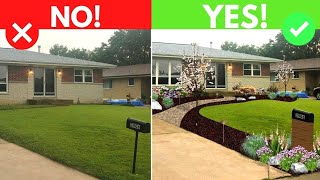
Transform a Boring House on a Budget
46sShows homeowners how to dramatically improve curb appeal with low-cost landscaping, a highly searched topic.
▶ Play Clip Landscaping Made Simple - Bobby K Designs
"The title promises curb appeal on a budget and delivers a full design plan with exact costs—true to the content."
This is a concise tutorial that teaches how to transform a bland house's curb appeal through strategic landscaping. Professional designer Bobby Cam outlines key design principles—curved beds, varied plant heights, upgraded walkways, and a modern mailbox—and provides a full cost breakdown for DIY versus hiring a pro.
Most homes lack architectural character; curb appeal can be created with landscaping.
Bring beds 12 feet away from the house, use sweeping curves to add depth to both beds and lawn.
Plant trees (e.g., cherry trees) to create height; combined with varied textures and colors, this adds visual interest.
Remove old concrete walkway, install a 25 ft×3 ft paver path that follows the curve of the bed.
Replace a dated mailbox with a modern wood-and-stain version for a contemporary touch.
Add path lights and uplighting on trees and mailbox to dramatically enhance nighttime curb appeal.
DIY ≈ $3,500; hiring a professional company ≈ $8,000–$10,000.
A bland house can be transformed into an eye-catching home using four landscaping strategies: curved beds, vertical plantings, paver walkways, and a modern mailbox—all for under $3,500 if you DIY.
What is the ideal distance to extend planting beds from a bland house?
About 12 feet off the corner, using sweeping curves.
1:10
What are four specific elements to add visual interest to a front yard?
Curved beds, varied plant heights (trees), textured/colored plants, and a modern mailbox.
1:10
What is the estimated cost to DIY the full landscape transformation shown?
Approximately $3,500.
4:01
What is the estimated cost to hire a professional company for the same project?
$8,000 to $10,000.
4:23
What type of walkway is recommended to replace an old concrete one?
A paver walkway, approximately 25 feet long by 3 feet wide, following the curve of the bed.
2:29
Why does the designer recommend lighting as the 'X factor'?
Because lighting the mailbox, trees, and walkway dramatically transforms the property's nighttime appearance.
3:44
Depth via curved beds
This principle of bringing beds away from the house is the central design tip for transforming a flat, boring front yard.
1:10Vertical interest from trees
Using trees (rather than only low shrubs) creates height variation that visually elevates a monotone landscape.
1:52Mailbox as design anchor
A small, often-overlooked element (the mailbox) can be upgraded to define the entire style of a front yard.
3:02DIY vs. hiring cost analysis
The explicit cost comparison ($3,500 DIY vs. $8,000–$10,000 pro) provides practical decision-making data for homeowners.
4:01[00:00] Not everybody has an amazing house. Some of us live in a very modest house that's relatively boring. It doesn't have a lot of architectural elements that make it jump off the page. So how do you take a house that is pretty bland and make it amazing?
[00:16] How you do it is with landscaping, curb appeal. I'm going to show you exactly how we're going to take something super boring and make it awesome. If you're new to the channel, my name is Bobby Cam.
[00:31] I'm a professional landscape designer in install and I love to help people, usually very busy people with their landscaping. They don't quite know what a space can look like or how to update something or make it look cool. We're going to jump right into this.
[00:44] We're going to go into the design, we'll have a little time lapse going on. I'm going to fire off a bunch of tips that break down the design and help you and give you out some cost effective things that you can do when it comes to your landscaping. By the end of the video, I'm going to tell you how much it costs if you were to pay someone
[00:59] or if you were to do it yourself, which I think a lot of us are DIYers nowadays and that's pretty important to know. What am I going to be paying if I want to have this look? Let's go. So the first thing when you got a house that's pretty bland, pretty flat.
[01:14] There's not much going on is have fun with the beds. Bring those beds out away from the house create some depth in the design. One thing that I think is super cool that I haven't done on a lot of designing is I really had fun with curves going on here where I brought it away from the house.
[01:29] A good probably 12 feet off that corner brought it around and then connected it and hooked it all the way down to the mailbox. And so it gave this really cool shape not only to the beds but to the lawn.
[01:42] So play with curves, have fun with them and bring those beds off the house and create depth. The second thing to create even a little bit more depth and interest is with these trees. We've got these two cherry trees so instead of everything being bushes and flat and down to the ground,
[01:58] we created some height by putting a tree over in the corner and a tree over by the walkway that we've got going on. So it's almost like as you pull up you kind of go around that first tree opens up to the house and creates a little bit more interest versus everything just being up against
[02:14] the house and flat. So have fun with heights, have funs with textures, have funs with fun, you know, just have fun with different kinds of plans and different kinds of colors and textures and heights
[02:26] and that is going to create interest with something like this. The third thing that I really like is we busted out the old concrete walkway that was just your typical kind of came out hooked over
[02:38] into the day and we created a paper walkway which ups the value. It's a cooler material. A little bit of money is going to go into that but it's only about 25 feet total by three feet wide so it's
[02:51] not a ton of square footage and you take that walkway, you bring it out, you bring it out and away from the house and kind of go along with the curve of the bed. It just really flows, really neat. The last thing that I think is the X factor is something so small and this design is the mailbox.
[03:09] A lot of people don't ever even look at a mailbox or when they do a mailbox it might be brick and mortar or a veneer stone but in this way we did some wood and we would stain it and that gives it
[03:22] this modern contemporary vibe. So we just took this like old nasty sorry it's not old and as he just hadn't been touched since like 1950 house and we gave it a modern vibe by upping the landscaping,
[03:35] working with curves, putting some different colors and textures in, updating the walkway, updating that mailbox and man this thing is a cherry. I think it looks awesome night and day better and then the final thing you do is you light it all up. You put some lighting in there, you light up the mailbox,
[03:51] you light up the trees, you put some intimate path lights along that walkway and this thing screams curb appeal, absolutely screams it. So homelessness is all costs. If you were to do this yourself,
[04:04] all the plants, the wood, trees, a couple of boulders, the lighting, I think you're going to be in for about $3,500. That's what you're going to spend. You might have a little bit of turf repair, you can
[04:16] either do seed and straw on the outskirts or you can do site. If you're going to pay a company like mine to install this, you're going to be closer to the 8 to 10 grand range depending on the quality of
[04:29] the lights, how many lights you put in, just a couple of different factors. So there is a savings obviously with paying a company or doing it yourself versus paying a company but here's what I want you to think about. Are you better off paying a company and doing what you do or going out and
[04:48] thinking you're saving 3 to 4 grand but putting in a ton of sweat equity, going out and getting the plants and just really using your time there versus using your time doing what you do and making money.
[05:01] It's definitely something to think about. If this is something that you want to take some pride in, you want to say I did the front landscape, I'm all for it, I get it. When you get out there and you start digging and you mess with that shovel and it's 100 degrees, you might think otherwise and
[05:14] you might want to hire a company. So if you like this kind of video, go watch this video. I got some other really cool little gems in that one. If you want to define a small space or make something pop
[05:26] up on the page, see you on the video.
⚡ Saved you 0h 05m reading this? Transcribe any YouTube video for free — no signup needed.