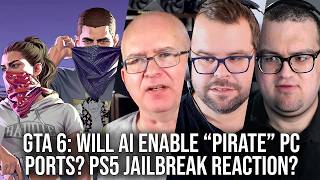

GTA 6 Emulation: The Real Threat?
60sThe discussion of GTA 6 being emulated on PC before launch taps into the hype and curiosity around the game, making it a hot topic for gamers.
▶ Play Clip"The title promises a Q&A show, and that's exactly what it delivers, though the content is dense and may not appeal to casual viewers."
In this episode of DF Direct, the panel discusses the potential for GTA 6 to be played on PC via emulation or translation layers, the implications of the PS5 jailbreak, and the evolution of the PS5 Pro's value proposition. They also explore the future of upscaling technologies like QSSR and the challenges of implementing dynamic resolution scaling on PC.
The show begins with a sponsor segment for Enshrouded 1.0, highlighting its voxel-based world, performance improvements, and PS5 Pro support.
The panel discusses whether PS5 translation layers could expedite a PC port of GTA 6, noting the rapid progress of such tools but also the significant hurdles like encryption and the need for a polished experience.
Rich highlights the PS5 jailbreak limitations, the likelihood of updated encryption for GTA 6, and the challenges of decrypting and reverse-engineering the game, especially without a physical disc.
John provides a historical view, noting that piracy and emulation have existed for decades without significantly impacting sales, using the Switch as a recent example.
The panel speculates on how Sony might handle the jailbreak, suggesting they could improve their own services or target piracy ecosystems, similar to Nintendo's approach.
The panel agrees that the PS5 Pro has improved significantly, especially with PSSR 2, and now offers better image quality and performance, making it comparable or better than the PS4 Pro.
Discussion on whether QSSR will be a PS5-only feature, with the panel leaning towards it being a backport, while PS6 will likely use ML-based upscaling.
The panel discusses why Nintendo doesn't force VRR on Switch 2, noting that it only works with patched games and that forcing it could cause compatibility issues.
The final question addresses why PC upscalers use fixed ratios instead of DRS, with the panel explaining the variability of PC hardware and the potential of dynamic frame generation.
The episode concludes that while emulation and jailbreaks pose challenges, they are unlikely to significantly impact major releases like GTA 6. The PS5 Pro has proven its worth, and the future of upscaling lies in ML-based solutions, with dynamic frame generation emerging as a promising PC feature.
Encryption as a Barrier
Explains why GTA 6 might be difficult to emulate due to updated encryption and lack of physical media.
05:31Historical Resilience of Game Sales
Provides evidence that piracy and emulation haven't historically hurt sales, suggesting GTA 6 will be fine.
09:29PS5 Pro's Redemption
Highlights the significant improvement of PSSR 2, changing the value proposition of the PS5 Pro.
23:21Dynamic Frame Generation Works
John's positive experience with Gears E-Day shows that dynamic frame generation can be effective on PC.
42:05[00:00] Hello there and a warm welcome of course, of course, for this the latest edition of the DF Direct Q&A show. I'm sure the format is self-explanatory by this point. Joining me on the panel first of all, John Miniman, hello.
[00:14] Hey Rich, that was a very warm welcome. I felt it all the way here in Germany. Thank you. And it was sincere as well. Of course, it always is. And of course, hello Oliver McKenzie. Yes, that's right. I hope the format is self-explanatory by this point because we've done quite a few of them.
[00:31] But if you're not familiar, we take your questions and hopefully provide answers, or at least the best we can manage. Hopefully. Absolutely. The questions are sourced from the DS Supporter Program at patreon.com slash digitalfoundry.
[00:45] So if you want to get involved, that's where you go. But with that, let's crack on with our first question. But first, this. This video is sponsored by Inge Shrouded, which is officially leaving early access to deliver the full 1.0 experience.
[01:00] Built on King Games' custom holistic engine, it features a massive, fully voxel-based world where you can build and terraform anywhere. For the 1.0 launch, the engine is considerably faster, featuring a new brick renderer for better distant detail,
[01:14] and up to 8 times faster global illumination in dense scenes. These optimizations perfectly support the game's simultaneous PC and PlayStation 5 launch. On PS5 you get a 60fps performance mode and a 30fps quality mode, plus full DualSense support.
[01:30] Crucially, 1.0 includes PlayStation 5 Pro support at launch, featuring PSSR2 upscaling and a dedicated 60fps mode. On the gameplay front, this update introduces the Sparkworks logic system.
[01:43] You can now wire switches, timers and logic gates to build your own real-time puzzles and dungeons. Combine that with a rebuilt deeper combat system, seamless co-op for up to 16 players and a brand new vertical biome called Cinder's Cradle,
[01:57] and there's a huge amount of new content to explore. Enchanted 1.0 is available right now on PC and PS5. Check out the link to the video description below to find out more. Okay, so we're going to kick off with a question by Hobbit.
[02:14] Greetings and salutations to you, good gentlemen. Given the breakneck speed of PS5 PC translation layers, do you see the PC port of GTA 6 being expedited lest the PlayStation version is ported to PC
[02:28] and given superior features such as 60 frames per second and who knows what else? Okay, so I'm going to go through first on this one, Oliver, because it's fair to say that there is a breakneck pace
[02:40] when it comes to PlayStation 5 emulation and translation layers, where basically instead of actually emulating the whole system, there's kind of like a sort of proton-like translation layer
[02:53] that converts the PlayStation 5's own graphics API into, I assume, Vulkan. So, you know, there have been various videos posted online of games that were running exclusively on PlayStation consoles running on PC.
[03:08] I don't think it's fair to say, however, that there's a couple of potential issues with this, but I'm curious to hear your opinion about this. Yeah, I don't know whether it will be expedited.
[03:23] I'm not sure they're going to move up any particular data as a response to this because ports take time, and presumably they have a certain budget in terms of the time they would expect to actually get this game ported. But I do think that people will attempt to get the game running on PC fairly quickly,
[03:39] whether that's through translation layers or through emulation, I'm not quite sure. Especially when you consider the fact that we have models with increasing capability out there, and there may be new frontier models like Aster 6.1 at that point, that might be able to tackle this problem with much greater efficiency and capability relative to prior models.
[03:58] I don't know exactly how close those tools will be to actually getting a good-looking, playable version of GTA 6 running at 60 FPS, which sounds like a bit of a tall order, but there's been a lot of progress in these tools over the past few weeks,
[04:15] so I would expect that it's not outside the realm of possibility at all that these tools would have a substantially good-looking version of GTA 6 running at that point, especially if new Frontier models continue to be deployed.
[04:27] with a problem like this, like if there was a PC version, people wouldn't be talking about emulation or translation layers except as a curiosity, right? So there might be separate piracy issues
[04:40] with that PC version, but in general, it would be a different kind of problem for them to address the problem that I think companies are pretty used to at this point. They're actually pretty used to tackling as a kind of problem to be dealt with,
[04:53] you know, in large parts redistribution, just having easy access to any one of the variety of platforms we're putting on these these teams. I think it is a concern, but I wouldn't assume that GTA 6 will be playable in polished form at that point.
[05:06] And I do expect that the vast majority of people who do want to play GTA 6 will just buy a console of choice. I think that's inevitably the way this thing kind of will go. And I don't expect Take-Two to move up the release date of GTA 6
[05:18] substantially in response to these concerns. I think they probably have a plan for deploying the game on PC that's pretty fixed at this point. Right, okay. So from my perspective, there's a couple of things to this.
[05:31] First of all, there's the concept of basically being able to gain access to the code. And you might think the game's coming out in November. So, you know, obviously all of the reverse engineering effort
[05:43] is going to happen at that point. I think what we can safely assume is going to happen is that, well, first of all, I believe the jailbreak for PlayStation 5 is limited to firmware 13.6 at the moment, which basically means that it's almost a given
[05:59] that Grand Theft Auto 6 will be running on a much later firmware, or a later firmware rather, and I'm assuming that the encryption keys used for the data will be switched up.
[06:13] I don't think the existing decryption tools will be able to work with it. Now, if there had been a physical version of the game, that would have been pressed months ago. Maybe that would have been a different story, but it's all digital.
[06:26] So I don't see a route forward at the moment for decrypting the game into something that can be reverse engineered. Now maybe I'm... ...mostly misinformed on that, but you can rest assured that certainly from Sony's perspective
[06:40] and from Rockstar's perspective, they're going to be looking to make sure that the game that actually comes out in early November is as cryptographically encrypted as possible in
[06:52] order to stop basically the decryption and then the reverse engineering. So I think that's basically the route forward. And it's an endeavor that won't just be applying to GTA 6, right, because obviously Sony wants to limit the impact of this jailbreak as much as possible.
[07:08] Now, the only thing I think that could possibly change things is if there exists an exploit for a higher firmware that Sony isn't aware of. The way this works is that basically Sony has a bounty system.
[07:21] So when an exploit is discovered, basically hackers disclose it to Sony and they get paid X number of thousand dollars not to share it before Sony has patched it.
[07:36] So I think that's kind of like an issue that Sony has got to make sure is fully covered. by the time the game comes out, because I think that's a way to ensure that the data is uncompromisable, so to speak.
[07:51] The other thing I've really got a question is basically how good FaceForge 5 emulation is at the moment, and these translation layers. I think we've reached the point now where we're starting to see games becoming playable,
[08:04] and we're starting to see 3D games becoming playable. The question is the extent to which the videos you see on Twitter and whatnot are actually poorly picked examples of games running really, really great and better than they are on the
[08:17] PlayStation 5, or whether it is basically, okay, people's got issues, but check out this bit, which looks absolutely fantastic. I haven't actually seen any sort of evidence of people playing through games start to finish.
[08:30] Maybe this is just because I haven't seen it, you know, been exposed to it. So I think there's still quite a long way to go before this is actually something that can fully replace the experience.
[08:45] I guess the other thing, of course, is the question to which it's going to rely on online. Because if there is an online component, even if it is a single-player game, that's going to need to be replicated by whatever is happening with the new compiled versions.
[09:04] So there's a lot of obstacles on the route there. And the question is the extent to which something is released that is actually a commercial challenge to the retail game.
[09:16] I'm wondering how far along everything is in order to facilitate that. And I don't know, to be honest, but it's clear to see that there is breakneck speed, as HobX explains here.
[09:29] Anything to add, John? Sure. I would like to take a more historical viewpoint of this and note that this sort of access to console games running on PC or piracy, for that matter,
[09:41] it's been around for decades upon decades. It's a challenge that companies have had to deal with that entire time. And it's, you know, the different approaches taken by the community,
[09:54] that does change per generation, of course. But, you know, during the PlayStation, PlayStation 2 era, piracy, mod chips, that stuff was running rampant. It was easy to achieve. But then you look more forward at more modern platforms,
[10:08] you look at the Switch. The Switch was emulated very quickly early on, and people were, I mean, they'd been very openly modding stuff like Breath of the Wild for years, making it look and run way better on the PC than it did on the real Switch hardware.
[10:23] When games like Tears of the Kingdom were coming out, I think there was, like, early people playing it early on there. And this type of stuff has just been going on and on and on, and I guess my point there is that it hasn't actually materially impacted the success or reception of these titles,
[10:41] because it does, I still feel, limit it to a specific type of audience that's willing to jump to these hoops and do this sort of stuff. And even then, the chance that the experience
[10:53] will be up to par with what people want is relatively low still. But even if it was better, like in the case of the Switch emulation, it still hasn't decimated sales
[11:05] or caused any major issues, I would say. And on the Switch side, it wasn't even just emulation. and it was also piracy was rampant on the Switch for years. So you can still find success even in the face of these sorts of issues, I think,
[11:20] which is why I don't think that their plans will change in any significant way. There are going to be a subset of people that are trying to play this on a PC via any number of these methods.
[11:33] I predict that it will not be very good early on, but I think that the community demands GTA enough that there's going to be a ton of attention poured into it, and we don't yet know what all challenges they're going to face, but I think they're going to put a lot of effort into actually solving them.
[11:49] So it could happen relatively quickly that we get a pretty decent way to play it but I just don think that registers with the masses And I think when they eventually do get a PC version officially released on Steam I think it will have absolutely
[12:03] zero effect on the sales of that version. Like, in no world would I think anybody say, oh yeah, this emulated version is going to be the superior option to the officially released version, especially given
[12:15] Rockstar's recent track record, where I think their PC version since Red Dead Redemption 2 and the re-release of GTA, I think they're largely regarded as very good and also offer features that you don't really get on the consoles,
[12:28] so they're even better all around. And I do believe GTA 6 will be the same. I think it's going to be very likely a very good PC version that takes all the features they've developed for consoles but allows you to push them much further on the PC side.
[12:43] They're definitely not afraid to do that. I think this doesn't change any plans other than, you know, Sony has to get more defensive again, as they've been many times in the past with this sort of stuff.
[12:56] And there's going to be people taking a crack at it like crazy. And I do think that it's this mix of the AI stuff and the discontinuation of disks that really lit this fire, so to speak.
[13:09] People rightfully were very angry about that situation, and it does seem to have had a direct impact on pushing people to solve this problem faster than they might have otherwise. Yeah. Because fundamentally, aside from like GTA 6 and a few exclusives,
[13:23] I don't think there's that much reason to emulate the PS5 because I feel like most games on PS5 have good PC versions. Wouldn't you guys agree? Like, I mean, why would you want to emulate most of the library?
[13:39] There's just a handful of games where it does decay. Yeah, I agree with you. And obviously, of course, when you make the PC port, you're going to be beholden to all of the issues that blight PC ports,
[13:53] except there won't be any mitigations. Shader compilation stuff is being a key example of that. How are they going to mitigate that? Tricky. Oliver? I do think there's a bit of a question here in terms of, like,
[14:06] obviously you have the jailbreaks and the exploits on the one hand, and then you have Sony on the other hand. And I think both of those parties are using LMs to either harden or weaken the defenses of that console. And where that equilibrium ends up settling in terms of actually getting an exploit early on, like you mentioned, Rich, like you put that forward, on day one to actually get the GTA 6 rip.
[14:31] That's kind of the question to me. On the emulation side, I do think that, and on the translation layer side, I do think these tools are advancing. I mean, maybe they're cherry-picked examples, but I do think they're going to get substantially better over the intervening months,
[14:44] especially because look at the progress over the past week, two weeks, that's been made by those projects. I think they're going to continue to make progress. I guess I don't know if they're going to, you know, achieve a retail console-level experience,
[14:56] but who knows where it will end up. And then there's also another question, which I don't think people will focus much attention on, because it hasn't been relevant up to this point, but what about Xbox? because just give it up.
[15:08] It's an Xbox. People may forget this, and it's one of very few games that actually is probably of meaningful interest to the community of Xbox in terms of emulation or translation because this is a title that's only appearing on consoles, right?
[15:21] Obviously. So I think that's another possibility. I'm just putting that out there because I've seen literally zero emphasis on that and zero focus on it, but perhaps it could be an area of where it could be of interest and focus.
[15:35] That's an interesting point, Oliver. I thought about that too. And I feel like in the case of Xbox, it's actually more doubly true that almost like basically everything Xbox is on PC. Right. There's virtually zero exclusives, possibly zero, that isn't also on PC.
[15:52] So there's basically like zero reason to emulate an Xbox at this point, I would say. Versus PS5, where even though the exclusive library is quite small, there is at least some exclusive
[16:05] where obviously with Xbox over the last decade Microsoft made a very deliberate push to make everything also on PC GTA 6 weirdly is one of the very few games
[16:17] that will also only be on the consoles at launch that's also on Xbox so it is a very rare situation I'll be curious to see if it actually pushes anybody to jump into
[16:30] that and I wonder like I feel like Xbox One and up we haven't really seen much movement at all on in terms of like getting this stuff on PC so I don't know interesting okay let's move on
[16:43] got a question here from AnxiouslyQuantoTicket Hey DF2! How do you think Sony would handle the whole jailbreak situation not only can you play PC games on it now but you can pretty much enjoy most of the
[16:55] PlayStation games ever released sometimes with a nice resolution bump and other quality of life improvements. And you can use disks too! Cheers! I'll guess the question is really the definition
[17:08] of what is meant by handle. I mean, there's two ways to handle it, or probably multitude of ways to handle it, thinking about it, but there's two that sort of strike me in particular. First of all, there's the concept that
[17:20] having a jailbroken console opens the door to basically access prior generation PlayStation games in a way that Sony should have actually sorted out for themselves years ago, right?
[17:33] So the concept that it is essentially piracy is solving a problem that Soli should have solved itself. Hopefully, the positive outcome of that is that Soli would actually up its game
[17:46] in order to produce an equivalent or better experience. That's one way of quote-unquote handling it. The second scenario that springs to mind is basically not the jailbreak as such,
[17:59] but the piracy elements that are streaming up around it. How does that, quote-unquote, get handled? And basically, legally, there's nothing Sony can do about emulation, right, because it's legally protected.
[18:13] But then you look at what Nintendo has done with the Switch emulators, and basically what they've done is to target the kind of piracy-focused, for want of a better word, ecosystems that are surrounding these emulators,
[18:25] targeting them and in turn getting the emulators themselves shut down, which is a pretty grim outcome. John, what do you think are the options that Sony might be considering here?
[18:40] I mean, essentially the modern version of what they've done in the past and in fact perhaps following some of Nintendo's playbooks since this is just a mirror of the situation that Nintendo faced with Switch,
[18:53] as I just mentioned. Like, that system was blown wide open very early, and there was emulation everywhere. Like, this is exactly the same scenario. If anything, Sony should be counting their blessings that it took, like, six years to get to this point.
[19:10] Like, they had a long time with the system on the market before having to tackle this, but it's pretty inevitable for any console that this will happen. so yeah I mean they're just going to have to deploy
[19:23] their usual methods but I think as you noted Oliver they're going to have to start using LLMs to sort of combat the LLMs the war has changed as they say and they are facing that new reality but in terms of the conceptual
[19:39] thing they're facing it's not new for them I would say There's another thing of course Going back to what we were discussing with GTA 6
[19:51] Is that Xbox is out there And Xbox is said to be coming out Or there's been the suggestion That Xbox is coming out with an open console Which basically means that all of the stuff That's happening with PlayStation now
[20:03] Would just happen naturally On Xbox As it has on PC Which is an interesting thought Yeah, I mean ultimately I do think Some of these problems are Just service problems
[20:15] Like, why doesn't Sony have PS3 emulation across a broad range of games? Why don't they have PS3 emulation? I understand there are some issues with PS1 emulation,
[20:27] because, at least for disc-based games, because I don't think PS5 actually has CD support, which is a little off. It does. It does. It does. I'm pretty sure it does. People found out, like, that's just a bunch of nonsense.
[20:40] And I thought that for years, but I think the drive can actually read CDs. Oh, okay. I need to double check that, but I'm pretty sure that's the case. There are really very few reasons why Sony shouldn't be offering some kind of service to any of these titles on PS5,
[20:56] because it's evidently very doable. I don't know if every single PS3 game, if you're like FTU maxing, MLA maxing, crazy, title like Uncharted 2 or 3 or something or Last of Us or whatever would work well,
[21:12] but I think a lot of games would work well. and I think they should offer that kind of service. Just like Microsoft does, you know, I think it should be done. I don't think there's a good reason to pursue that behavior. But otherwise, it's primarily a piracy issue with respect to, you know,
[21:29] getting cracked games on PS5 and whatnot. Ultimately, I do think, like John said, there will be like this epic battle between Sony and the modders. Perhaps Sony will end up getting even better of them, though,
[21:42] because I do suspect they're going to get advanced access to new LLMs, so they're probably going to be part of various driver security programs that enable them to have the best LLMs, the 6-point lens, whatever, whatever,
[21:55] to actually make this less practical. But I do think this is going to be a continuing issue over the near term. By the way, Oliver, I should note that it seems like PS5 currently isn't doing CDs,
[22:09] but I think I've seen where somebody has a homebrew-enabled PS4 where they were able to get either PS1 or music CDs and working on there just fine,
[22:21] and I think that it had the same sort of limitation as the PS5, so I feel like it should be possible. Okay. Right, we've got a question here from Gorguts with a Z.
[22:35] Yes, nice, that's the digital sound. Good day to all you good sirs. We're still on this Elizabethan English sort of situation. Everybody's playing like Thor from Marvel Comics. The question is regarding the PS5 Pro.
[22:49] More specifically, have your opinions about the usefulness of the PS5 Pro changed at all over the last two years? I recall that you believed initially that it made less sense than the PS4 Pro. Has the release of PS4 2 changed any of that?
[23:01] Has perhaps your appraise of the Pro decreased, perhaps owing to the confirmation of your belief that it does not bring meaningful visual updates? John, I think it's fair to say that the Pro has had a redemption story of sorts, and now, you know, pricing apart, we highly recommend it delivering on title after title, right?
[23:21] I would agree, yeah. Like, you're right, the first year of it was disappointing, and it really did come down to the fact that PSSR was not great. And in fact, sometimes produced results arguably worse than the base PS5,
[23:36] which was pretty unacceptable. But now, there's two things. First of all, anything that uses PSSR at all benefits from the upgraded model, and it is significantly better.
[23:48] It genuinely really good and it has changed the game for any titles that use it which is great But in addition we seeing more titles come along that have slightly better performance just better image quality in general, even if they're not using PSSR.
[24:04] And it's just kind of like it's that period, and it's not a great thing, where the base consoles have started to struggle a little bit more with some of the things like image quality especially.
[24:17] We're seeing lower resolutions than we might like. And there's been some of this throughout the generation, but it seems to be happening a little bit more, I feel, based on the games that I've been playing. And I feel like Pro kind of rescues it to some degree.
[24:30] So I would say it is now at the point where it is comparable or better than the PS4 Pro. The PS4 Pro is quite good, but it still struggled a lot with performance.
[24:43] Because that was an era when frame rates being unlocked was pretty common, and sometimes that was viewed as a feature, even though the performance wasn't great. And we're largely past that, I think, which is good.
[24:56] And the Pro does a good job of delivering smooth frame rates that are stable, but with significantly better image quality. Yeah, that's an interesting point. I think from my perspective, there is a defining difference
[25:08] between PS4 Pro and PS5 Pro now. I mean, the great thing about the 4 Pro, of course, 4K TVs were coming along and it addressed the 4K TV unless the developer
[25:20] didn't address the 4K TV and basically what you got was we saw a whole multitude of games where the enhancement was essentially to run a 1080p game at 1440p
[25:32] and that's okay but it's not like a game changing improvement and I think for me personally when I'm looking at the PS5 Pro game now that has been like there's more games that are actually
[25:44] meaningfully addressing that 4k screen and they're doing so with really good image quality i mean the last game i played on the 5 pro star wars galactic racer which as we discussed in the direct last week it's the cleanest unreal engine 5 game you've seen running on the pro which looks awesome so i
[26:01] just think generally maybe it is actually surpassing the um the ps4 pro in that you know you are getting great image quality now you are getting more meaningful pro support on more games and it's actually far less frequent that games are rolling up with no pro support or lackluster
[26:17] pro support. I mean, there is good examples, of course, but, you know, overall, it's looking really, really good. Anything to add, Oliver? Yeah, I do think that PSSR 2 changed the game, and I actually think we have a couple of snapshots
[26:31] in time that you can go back to and try to check our opinions on PSSR at that time and the PSSR Pro at that time and kind of get an idea of where we're at, where we did a one-year PS5 Pro retrospective, where I think we were kind of broadly mixed
[26:44] on the console and its various technologies. But then if you go back to our, like, PSSR2 coverage from March this year, I think we're much more positive, and we have a much better outlook for PS5 Pro. I think PS5 Pro delivers a much better rendition
[26:57] of PS5 games, especially across the board that comes out into visual features, resolution in many cases, PSSR2, obviously, ray tracing, like, it's a really impressive increase in a wide range of titles.
[27:10] But I think in many cases that was just a typical PS4 to PS4 Pro, 1080p to 1440p classic that we saw in so many games, like you guys mentioned. That was really common. The one wrinkle now is QSSR, where maybe PS5 possibly, depending on the implementation of the gaming game, might be able to get a little bit closer to PS5 Pro in terms of the result image quality.
[27:31] But PS5 Pro is still going to have an advantage in the sense that it's going to deliver a very pristine 4K, good-looking image. that QSFR is probably not capable of delivering just because the millisecond cost would be prohibitive
[27:45] for that level upscale. So I still think that Pro has earned its seat here. I think it's the right to talk for. Okay, fair enough. Let's move on.
[27:57] A question here from Jagster. Hello, fine analytical gentlemen. While I do think the development of QSFR is definitely handy and could be of great benefit both to the current console generation as well as the next generation,
[28:10] is there any fear or concern it will perhaps not see the same level of dedication and attention and development as PSFR, perhaps as a means to still steer consumers towards a more expensive platform that uses PSFR,
[28:23] or do we think that the PS6 will only use PSFR and QSSR is strictly a PS5-related feature? I'm personally inclined to go with the latter argument.
[28:35] It is basically what you might call a backport of sorts, of an ML model to non-ML hardware. And as far as we understand the next generation Sony products,
[28:47] which consist of a handheld and a full console, both of them have machine learning acceleration. So QSSR becomes more of a platform-specific PlayStation 5 solution
[28:59] as opposed to anything meaningful. I would imagine though that if the handheld isn't supremely powerful there will be a lighter weight ML version
[29:11] of PSFR. If needed it may well be the case that the lower resolution does the job of making up for the frame time cost there. John, thoughts? I mean if they're introducing a feature I feel like they have no
[29:26] reason to just stop putting resources into it to hold back. And I think even as we've seen it now, it doesn't necessarily match the higher-end
[29:38] PSSR solution, right? So if they were worried about this specifically, I feel like they would not have introduced it at all. You know what I mean? Why would you introduce this at all? Nobody expected it.
[29:55] But they went ahead and did it, which suggests to me that they saw value in creating something like this. And not to say that they haven't released things and then failed to support it,
[30:07] but I don't really see any reason why they would do this optional thing and then just completely abandon it out of fear that it will perhaps turn players away from the more powerful hardware. I think maybe it's born out of this concern over the cost of hardware at this point,
[30:23] and they feel like they want to try to serve their base CS5 customers as best as they can because they have a gigantic audience out there, as it is. And I'm sure they're aware that any sort of transition to a next generation
[30:38] is going to be very challenging this time. So it makes sense to continue to support those owners on their original PlayStation 5s as best as they can. And I think they're going to continue to do it,
[30:50] but I don't think there's any fear of it necessarily outperforming the superior machine-learned options that we've seen already, such as the current PSSR or whatever else they have in line for PS6,
[31:02] but it is demonstrably better than what they had before, so, yeah. Yeah, yeah. I mean, there is the chance, of course, that QSSR, as it is today, won't be iterated and improved upon. Sure. Good enough.
[31:14] Whereas there's probably more legs to do more with PlayStation 5 Pro, and obviously things will change once again, you'd imagine, once we move on to PlayStation 6 and the muted handheld.
[31:26] I guess I'm still waiting to see more implementations of titles. I think there's a difference here compared to PSSR. First of all, you can't do the system level replacement. It requires developers to go back and add the support.
[31:41] So it's not quite as impactful as it was on PS5 Pro where PSSR 2 came along and suddenly, the majority of your existing library looks better just by flipping a switch. That's not going to happen.
[31:54] But it is going to require developers to actually implement this. And as I understand it, it is fairly easy to implement. So I think it will make a difference, maybe not quite as much as it did on PS5 Pro,
[32:06] but I don't see any reason why it would be developed and then basically thrown into the weeds, so to speak. Oliver? Yeah, I would expect there to be continuing emphasis, at least, on QSSR on PS5 consoles.
[32:22] But I think there's an open question as to how much optimization space, how much room for improvement there is in this kind of technique that we're seeing with temporal upscalers,
[32:35] machine learning temporal upscalers. Because I think when you look at the PC progression of the technology, like the OSS 2 to 3, 3 to 4, then now 4.5, we're seeing there is a bit of a diminishing return there.
[32:49] So exactly how much space is there to actually improve one of these upscalers in a broad way, that remains to be seen. Now, there are specific issues with PSSR that we highlighted,
[33:01] and presumably they would apply to QSSR to some degree as well, that we highlighted with a couple of the regressions that we noted and a couple of the remaining problems that we noted back in our March coverage. So maybe they could sort out those specific issues, but in terms of a broad improvement for the upscaler.
[33:15] I'm not really seeing a strong imperative to do so, or that would necessarily be worth a lot of engineering effort, but we'll have to see on that. When it comes to PS6, I'm not sure PS6 will use PSSR, actually, for PS6 titles,
[33:30] because presumably PS6 will just support FSR5 or whatever it is, a target. But I'm not sure, you know, maybe Sony will rebrand it, but at least the technical foundation for supporting the contemporary AMD upscaler
[33:45] in a more substantially unmodified form would be there if Sony wanted to use it. And if Sony felt like the upscaling challenges that are presented by a console title
[33:57] are similar enough to upscaling challenges that are presented on PC, perhaps that's where they could go down. But I expect that Sony probably wouldn't launch this feature, like you suggested, probably wouldn't launch this feature.
[34:09] if they weren't intent on many games having it and to support it in the future as we did. Okay, fair enough. Let's move on. A question from Snorlax Cat.
[34:21] Can Nintendo force VRR on Switch 2 by forcing it? Interesting question. I think fundamentally talking about a system level feature that enforces it on games. PlayStation 5 can force, and it works mostly in my experience, VRR and old titles and it works. Why Nintendo did not
[34:37] not go the extra mile and added that with a new feature. I'm not complaining, to be honest. I'm surprised they managed to do VRR via USB-C in the first place. We were talking about this question earlier, weren't we, John?
[34:49] In the case that Nintendo does force VRR on, but the software doesn't support it. Yeah, that's kind of the interesting thing. It's because, yeah, they do force it on when you enable it.
[35:01] Your display will always show VRR, but the software doesn't allow it. And that's what's curious. And unusual for VRR because usually when it is enabled, it just kind of works.
[35:14] So there must be something with the software layer that's preventing this from working correctly, which has required this to need patches for each game. So I guess the piece of information we don't know is even though they are forcing on the display side,
[35:29] is there a way for them to force it on the software side? Maybe there is, maybe there isn't. for whatever reason though they've chosen not to do that. And that makes me think it might be more difficult
[35:41] than we believe, especially when considering that they do allow you to force the handheld boost mode across the board knowing that it could also potentially cause compatibility issues So that says to me they not afraid to offer this sort of feature to the players
[35:56] So there must be a good reason for this, presumably. And that's, I guess, the disappointing thing is, like, we basically just don't know at this point why it is the way it is.
[36:08] But yeah, the way it is is not good, I would say. because, I mean, for me, like, having it on all the time is useless because it disables key features that I like to use in the TV for no benefit.
[36:21] So I would only really use it on titles that support it explicitly, and they have frame rate issues. So not going to be that useful in the end, I would say.
[36:33] We'll see. We'll see. Hopefully it starts to become part of the games, but I would say even on the handheld side where VR is supported, developers haven't done a great job at actually supporting it. So which leads back to the hope I raised the other week,
[36:47] where if both modes now support it, maybe developers will take it more seriously. That's what I would hope. But then the bigger problem is the whole low frame rate compensation thing,
[36:59] which obviously on PlayStation 5, it needs to be handled by the game itself. On Xbox, it's automatic. But in both cases, the system can still output 4K at 120 frames per second, and it works.
[37:11] Switch can't do that. It's limited to working 40 max and a lot of TVs, including my own setup, like it only does 1080p 120. So that instantly creates some other issues there,
[37:24] which makes low frame rate composition kind of a difficult prospect because you essentially have to give up resolution, presuming it is above 1080p anyway, to use it.
[37:36] Interesting. I wonder if there's some sort of system level implementation of vSync that they've got there that causes problems with VRR. If that is the case, there could well be in the future some
[37:48] sort of system level tweak that could be introduced. Oliver, thoughts? Yeah, I agree. I think support here is likely necessary for reasons that
[38:00] John enumerated and it is a little bit odd that technically VRR doesn't work for games but it's not working correctly because every time it was for us to use it when it's on, which is a little bit odd.
[38:12] But I think that Nintendo missed the step here in general by not making it an option that only turned on with supported software because, like John mentioned, there are issues that come up,
[38:24] features that get removed on televisions when you do have VRR turned on, black frame insertion, things like that. I know that a lot of televisions have reduced quality local during behavior or no local during behavior when you have VRR on.
[38:37] So the benefits of a fixed refresh for a television that may have a lot of processing features to improve the image that only might work, especially in older televisions with VR turned off, that is not ideal.
[38:51] That is not ideal. And also it sends a mixed message to the consumer where we're having a lot of people, at least I've had a number of people come up online and say, like, you guys say VR isn't working, but I actually turned it on and it's working with everything. It's like, no, not really.
[39:05] I mean, there's just a communication problem there. And maybe people actually get a negative impression of VR because they're like, hey, VR isn't improving my, like, Resident Evil game or something. That's really annoying. It's like, yeah, maybe it's not working on your copy of, like,
[39:19] Resident Evil Requiem because it actually isn't working at all. You know? So, you know, that's my concern. Okay. Let's move on to the final question now, kind of some succulent Chinese meal. Good day, Jets.
[39:31] Why did AMD, Intel, and Nvidia decide to implement upscaling at fixed ratios instead of a DRS system, such as what consoles use. Being able to set an FPS target and let the upscale adjust resolution seems like you have the best of both worlds,
[39:44] since it retains the highest image quality. I hope you are all doing well, with a special shout-out to Alex in missing your content, mate! Exclamation point, haven't we all? Man, this last quarter's been punishing, but not having Alex about to contribute
[39:59] and to provide his unique perspective, it's certainly we're seeing as well. I think you know just what my sort of viewpoint on this is that it seems to be the case that you know with a console
[40:11] you do target specific frame rates right and it could be 60 frames per second it could be 120 frames per second it can be 30 frames per second so DRS kind of works for that because you know you set the developer sets the target frame rate
[40:25] typically a multiple of the refresh rate of the display and then you sort of vie for GPU resources by increasing pixel counts when the GPU is got less work and decreasing them when it's heavier. That kind of makes sense. In the PC space, I don't think anybody
[40:42] these days is particularly wedded to a frame rate target other than the limit of their panel, right? So in that case, you know, nobody's saying, right, okay, I want to have dynamic resolution
[40:55] scaling up to 165 Hz for example or 240 and in many cases it's not going to be viable anyway. I was playing galactic race on a 240 Hz screen but I was using the mainstream PC,
[41:12] it's not going much above 60, 60 to 80 generally. But I do think the point is that in the monitor space VRR is now prevalent, I think it's the basic choice and it is an arbitrary frame rate.
[41:25] it can change at any point I think there's a good reason to fix frame rates but you know you've got to basically tweak it for every single game according to the capabilities of your hardware
[41:38] and that's tricky John I mean I guess there is a sort of an alternative of sorts it's not quite the solution as such but dynamic multi-frame
[41:52] generation is sort of aiming to target the refresh rate of your display. Yeah, and it actually can work, which I was skeptical of until very recently when I mentioned
[42:05] Gears E-Day actually does this exact thing, and it does it very, very well. In fact, that's probably the best example I've seen of a dynamic system in a PC game actually working, and you can use it with DLSS, dynamic DLSS as well.
[42:22] like I've been very skeptical of this and on the PC there's a lot there's there's more potential bottlenecks and like weird hiccups and also people have different targets and on a console you just
[42:35] have better visibility I think on like exact frame times and you can sort of dial that in pretty well whereas on the PC there's just a lot more going on so I think it does become slightly harder to do it like we've seen games with proper DRS but it does tend to be slightly more challenging on the
[42:51] PC side, but this actually works. Like I said in my impressions on eBay, I just set the I just want to hit my monitor's refresh rate. I had to force
[43:03] V-Sync, to be fair, which I know, again, they really don't like when I say that, but that's what I do, and I think it feels fine. But it's just running the game at 160-ish frames
[43:16] per second, like all the time. With FrameGen, of course, with Dynamic frame gen, and I think it feels, looks great in motion. So I would like to, this is the type of thing I want for PC games, because you're right,
[43:31] Rich, everybody has a different usage scenario, but there's far more variations in terms of resolutions and refresh rates. And I think most PC gamers at least would rather just have their games run as high as
[43:44] they can within the refresh rate container, using VRR to smooth it out, and I think that's is where you get the best experience. But if it can dynamically add frames like this and you're okay with frame gen,
[43:56] I think that's where we're looking at the best possible solution right now. So, yeah. Okay. Oliver? Yeah, these solutions do support upscaling with varying input ratios,
[44:09] or at least you can do that. And there are lots of PC titles, like John Merch has mentioned. E-Day will be one, which I mentioned. Galactic Racer as well, I think offers an original PC.
[44:22] But it's not a PC convention. Maybe it should be. I don't know. But I think one challenge here is that with consoles, we have a very predictable idea of what correct frame rate behavior should be just because of the proliferation of so many, like, 60 hertz,
[44:37] 60 refresh functions out there. Everyone is basically trying with their primary modes to target the same targets, which is, like, 60 hertz or, you know, 30 FPS or whatever. fixed, v-sync, yada yada yada
[44:50] it's very predictable. Whereas on PC you have so much proliferation of like crazy display tech that I think people have different ideas about how they want to configure their games and so DRS in that
[45:02] environment needs some tuning. What's your frame rate target? What do you want to do? Do you want to fix to a frame rate? Do you want 120 FPS? Do you want 180 FPS? Do you want 60 FPS? What do you want to do with that?
[45:14] Probably it needs more configuration in the back end and that adds complications for developers that maybe ultimately just presents more confusion to the end user if you did want to actually provide that level of DRS configurability and behavior
[45:27] and minimum, maximum, whatever, resolution scale, frame of target, et cetera, et cetera. I also think that the benefits of DRS these days are less than it used to be because of the fixed costs of certain upscalers and neural networks that are being present in some titles.
[45:45] So when we look at it like PSSR or DLSS, these have fixed upscaling costs, so 2 milliseconds, 3 milliseconds, whatever. And that kind of mutes the impact of DRS behavior.
[45:57] And indeed, as we move into the future with resolution-agnostic neural networks that are operating over game graphics, or at least neural networks that are operating at the output resolution of the game as opposed to the input resolution of the game,
[46:10] I think we're going to see less and less benefit to modulating internal resolution as a means to control the output frame rate and output frame time of the game.
[46:22] I think that's going to be less of a concern. But, you know, I think developers should do it, but among all the priorities I have for PC titles, it is not too high of a list,
[46:35] and I get why people don't support it. And like John said, there are a lot of complications technically as well. Yeah, I think that sounds about enough. Basically, you know, six refresh rates to address on a console with, you know, finite but known GPU and CPU resources.
[46:52] It's a target, right? PC, it's impossible to set a target because everybody's PC is different. That said, you know, there have been cases where DRS has been implemented on PC. You know, it's another tool in the toolbox.
[47:04] And I think it's well worth pursuing from that respect. I think ultimately, though, you know, we probably will end up with a dynamic phone generation system. that, you know, as John pointed out, it needs a work for him and hopefully will work for more games and more people.
[47:18] Anyway, that was the final question. We're off to the end of the show, so I'd like to just go and share all of that stuff. Patreon.com slash Digital Sound is a chance to help shape this show and, of course, the After Effects, high-quality video downloads of everything we do,
[47:31] ad-free, ad-free websites, reports from the team, lots of great stuff going on there, but that's all for now. Thanks for watching and supporting Digital Soundry and I guess we'll see you in the next direct popper.
⚡ Saved you 0h 47m reading this? Transcribe any YouTube video for free — no signup needed.