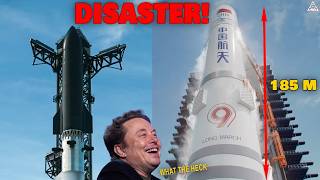

China's Starship Copycat?
45sThe opening claim about China copying Starship with a cargo hold three times larger sparks immediate curiosity and debate.
▶ Play Clip"Delivers a detailed comparison and analysis, but the title's 'Disaster' and 'Musk Laughs' are exaggerated; the content is more balanced."
The video examines China's Long March 9 rocket program, which has evolved to resemble SpaceX's Starship, with recent plans for an even larger version. It compares the two rockets, discusses the physics of rocket fuel, and argues that SpaceX's lead in flight experience and orbital refueling gives it a decisive advantage.
China's Long March 9 cargo bay is three times the size of Starship's, as big as every pressurized module of the ISS combined.
Originally designed in 2011 as a Saturn V-like rocket, China redesigned it multiple times after Starship's debut, each version looking more like Starship.
At the 2024 Zhuhai Air Show, the latest Long March 9 design was called a 'clone' by Western journalists, featuring two stages, full reusability, and 30 methane engines.
Starship stands about 124 meters tall and weighs over 5,000 tons on the launch pad, making it the largest flying machine ever built.
Construction documents for the Long March 9 factory in Hainan revealed plans for a rocket between 165 and 185 meters tall, taller than Starship.
The Long March 9's fairing could be 15 meters wide and 40 meters long, with almost 3,000 cubic meters of space, enough to swallow a subway car.
The factory costs over $400 million with assembly bays reaching 120 meters high, and includes an enclosed viewing gallery for visitors.
The rocket's own fuel is its worst enemy; over 90% of Starship's weight is fuel, and only 2-3% of the total weight is actual cargo to orbit.
The Long March 9 uses the YF-215, a full-flow staged combustion methane engine, similar to SpaceX's Raptor, but has only about 1,000 seconds of test firing.
The Soviet N1 rocket, with 30 engines, flew four times and exploded all four times, highlighting the difficulty of managing many engines.
SpaceX's key advantage is orbital refueling, which allows Starship to be topped up in orbit, enabling full payload to the moon or Mars.
Long March 9's first flight is planned for 2032-2033, by which time Starship will be generations ahead with hundreds of flights.
The video concludes that while China's Long March 9 is an ambitious and serious project, SpaceX's lead in flight experience and orbital refueling technology makes it unlikely that China can catch up in the near term. The real race is not about building the biggest rocket, but about building one that can fly again and again.
What is the height of Starship?
About 124 meters tall.
01:56
What is the estimated height of the future Long March 9?
Between 165 and 185 meters tall.
02:51
What is the volume of the Long March 9's fairing?
Almost 3,000 cubic meters.
03:34
What percentage of a rocket's weight is fuel?
Over 90% for Starship.
06:01
What is the name of the Long March 9's engine?
YF-215.
06:43
How many test firings has the YF-215 engine had?
About 1,000 seconds of test firing.
07:11
What happened to the Soviet N1 rocket?
It flew four times and exploded all four times.
08:05
What is SpaceX's 'deepest moat' according to the video?
Orbital refueling.
08:33
When is the Long March 9's first flight planned?
Around 2032 or 2033.
10:23
Clone Accusation
Highlights the perception that China is copying SpaceX's design, which is a significant admission of SpaceX's technological leadership.
01:13Fuel as Enemy
Explains a fundamental physics constraint that limits rocket size, crucial for understanding the trade-offs in rocket design.
05:32Orbital Refueling
Identifies the key strategic advantage that could make SpaceX's approach superior despite China's larger rocket.
08:33Time Gap
Emphasizes that the real competition is against time, as SpaceX will continue to advance, making China's target a moving one.
10:23[00:02] inside it for cargo is as big as every pressurized module of the ISS combined. But, what if I told you China is building a copy of Starship with a cargo hold three times that size? Three times. To engineers, even ones at NASA, that
[00:17] put the numbers out there like a challenge thrown right at SpaceX. We'll copy you and we'll do it better. So, can China really build a rocket larger than Starship? And can something that big even survive the laws of physics? Let's
[00:32] even survive the laws of physics? Let's find out. The story starts in 2011 when China first drew up the Long March 9. And that first version, honestly, it looked like a Saturn V with a Chinese flag on it. Huge, three stages, fly
[00:45] once, and dump it in the ocean. A machine straight out of the 1960s. Then Starship showed up and it turned the entire space world upside down. And attention. So, they quietly tore up their blueprint and started over. A few
[01:00] years later, they tore it up again. And here's the strange part. Every single time they redrew it, the Long March 9 looked a little more like Starship. By late 2024, when the newest version was rolled out at the Zhuhai Air Show,
[01:13] Western journalists took one look and had a single word for it: clone. Two stages, fully reusable, 30 methane engines, basically a Starship with a Chinese flag on it. Now, they say imitation is the sincerest form of
[01:27] flattery. But in the rocket business, it's more than flattery. When your engineering to walk down your path instead, that's not admiration. That's an admission. An admission that SpaceX was right. But, hold on. If this were
[01:41] just a copycat story, this video wouldn't exist. Because the newest June, shows China doesn't just want to copy Starship anymore. They want to build something bigger, a lot bigger. But bigger, how much bigger exactly? To
[01:56] answer that, let's put these two giants side by side. Starship today stands side by side. Starship today stands about 124 m tall and weighs over 5,000 tons on the launch pad. Those numbers alone make it the largest, most powerful
[02:08] flying machine humans have ever built. Taller than Big Ben. In all of history, nothing that flies has ever beaten it, not once. Until that June paperwork showed up. Early in June, the government of Hainan province quietly posted a
[02:23] batch of construction documents online. Boring, right? Building permits. But the space community dug through every line and struck gold. Because it was the paperwork for the Long March 9 factory. And the size of a factory tells you the
[02:38] size of whatever's getting built inside it. You haven't seen the monster yet, building and figure out how big it's going to be. And what those documents hinted at made people rub their eyes. The future Long March 9 could be a
[02:51] The future Long March 9 could be a three-stage rocket standing between 165 and 185 m tall. Sit with that number for a second. 185 m. Starship at 121 is already a world record, and this thing blows right past it. The Statue of
[03:06] Liberty, pedestal included, is about 93 m, which means this version of the Long March 9 is nearly as tall as two statues of Liberty stacked on top of each other. It's not really a rocket anymore. It's a Manhattan skyscraper that decided to rip
[03:21] itself out of the ground and fly. But the height isn't even the craziest part. The craziest part looks is the cargo bay up top. On any rocket, the nose cone that wraps around the payload is called the fairing. Basically, a disposable
[03:34] shell that wraps around the payload and gets thrown away once the rocket reaches space. The Long March 9's fairing could be 15 m wide and 40 m long with almost 3,000 cubic meters of space inside. Starship's payload bay, around 100 and
[03:50] 100 cubic meters. Except Starship's isn't a throwaway shell at all. It's built into the ship itself, and it flies home to be used again. How much is 3,000 cubic meters? Enough to swallow an entire New York City subway car whole
[04:04] with room to spare. If Starship is a big cargo truck, what China is drawing up is cargo truck, what China is drawing up is a full C5 military transport plane. Two completely different leagues. And how serious are they? That factory runs over
[04:18] $400 million with assembly bays reaching almost 120 meters high. But my favorite detail is one tiny line most people skipped right they designed an enclosed viewing gallery. For what? To walk visitors up
[04:33] even built the thing yet, and they've already put in a balcony for the whole world to come admire it. Say what you want, that's a very specific kind of confidence. They built a balcony to show off a rocket that doesn't even exist
[04:47] yet. Me, I'm just going to ask you to hit subscribe. Costs you 5 seconds. Way cheaper than a balcony. Now, the scoreboard looks clear. Taller than Starship, heavier, the cargo bay is three times the size. On paper, this
[05:02] should be the runaway winner. So, why does China keep chasing bigger and bigger? Are they crazy? Or do they see something we don't? Here's where it gets business, there's a brutal truth that outsiders almost never expect. Bigger
[05:17] doesn't mean more powerful. Sometimes it's the opposite. And to understand how a machine this enormous could still lose to a smaller rival, we have to talk about the silent enemy that's haunted every rocket engineer for 100 years.
[05:32] It's not gravity. It's not heat. It's the rocket's own fuel. Sounds backwards, doesn't it? The fuel that lifts the rocket is also its worst enemy. But picture driving from LA to New York with one rule. Not a single gas station the
[05:46] entire way. So, you have to carry all your fuel with you. And fuel is heavy. So, you need a bigger vehicle. A bigger vehicle burns more fuel. So, you need more fuel just to carry the fuel. Round and round until the thing you're driving
[06:01] across America is a giant tanker truck hauling one tiny package to the other side. That's every rocket ever built. Remember that 5,000-ton Starship weighs on the pad? Over 90% of it is just fuel.
[06:14] The actual cargo that reaches orbit is maybe 2 to 3%. 2 or 3%. A machine taller than a 35-story building shaking the ground as it lifts off. And it's basically a flying gas tank. And here's the one thing to remember from this
[06:29] section. Making a rocket bigger doesn't break that cycle. It just makes the whole cycle bigger, too. Double the size doesn't mean double the cargo. Physics never gives you a discount, which is exactly why a fairing three times the
[06:43] size of Starship sounds amazing, but might not deliver any more to the final destination. Now, the heart of the Long March 9 is the YF-215 engine. On paper, it's a marvel. A full-flow stage combustion methane engine, the same tier
[06:58] of tech as SpaceX's Raptor. Only a tiny handful of engines in all of history have ever cracked that cycle. That China pulled it off, even just on a test stand, is genuinely impressive. According to the program's chief
[07:11] engineer, the YF-215 has racked up around 1,000 seconds of test firing. 1,000 seconds. That's under 17 minutes. Raptor? Raptor has burned through dozens
[07:23] of real flights, hundreds of firings under real brutal conditions. It's blown up for real, failed for real, been ripped apart and redesigned across three generations. SpaceX now cranks out Raptors like Ford builds truck engines.
[07:38] The gap between these two isn't in the blueprint. It's in the number of times they've collided with reality. And in this business, there's no shortcut around failure. You can only start failing sooner. History already taught
[07:50] this lesson the hard way. The Long March 9's first stage is set to use 30 engines. 30. If that number rings a bell, here's why. Over 50 years ago, the Soviets built a giant moon rocket with 30 engines on its first stage, too. It
[08:05] 30 engines on its first stage, too. It was called the N1. It flew four times, and it blew up all four. 30 engines firing at once is an orchestra from hell. One musician hits one wrong note, and the whole thing comes apart. SpaceX
[08:18] has tamed 33 engines on Super Heavy, but only after all those fireballs over Texas we've watched again and again. China hasn't paid that tuition yet. But let's say they get past all of it. Say the YF-215 is flawless, 30 engines
[08:33] humming like a choir. There's still one more thing, and this to me is SpaceX's deepest moat. The funny part, it has nothing to do with size. Remember that tanker truck from LA to New York? China's answer is to build a bigger
[08:46] tanker truck. SpaceX's answer, don't build a bigger truck, build a gas station in the middle of the sky. That's orbital refueling. The idea sounds like science fiction. A Starship reaches orbit nearly empty, then tanker ships
[09:00] fly up after it, dock, and pump the fuel across. It's exactly like aerial refueling for Air Force jets. Except both vehicles are screaming along at 17,500 miles an hour. And the liquid moving
[09:13] between them sits at 300° below zero. One gas bubble, one pressure spike, and the whole thing aborts. Insanely hard. Nobody's ever done it at this scale. But if SpaceX pulls it off, and they're closing in on the test flights this
[09:28] year, the rules change completely. Because a Starship topped off in orbit can carry its full 100 tons all the way to the moon, or to Mars. A giant rocket with no gas station, no matter how strong, burns most of itself just
[09:43] clawing off Earth and delivers only a fraction to the final stop. So, here's what I want you to walk away with. The moment that first gas station opens up in orbit, the race to build the biggest tanker truck on the planet stops
[09:56] mattering, which makes me wonder where you're at right now. Team bigger or team faster? If China's giant still has you sold, comment bigger. If you're with the gas station in the sky, comment faster. I'm genuinely curious which way this
[10:10] channel leans, which brings us to the last truth. Which brings us to the last truth, one I think China understands better than anyone, even if they'll never say it out loud. The real rival of the Long March 9 isn't Starship, it's
[10:23] time. The Long March 9 is aiming for its first flight around 2032 or 2033. Sounds close, right? But, do the math. That's 6-7 years out. Six years ago,
[10:36] Starship was a steel water tower that hopped a few hundred meters and blew up to a cheering Texas crowd. Today, it's being caught out of the sky by giant metal chopsticks over and over. So, six years from now, when the Long March 9
[10:50] finally lifts off, it won't be fighting today's Starship. It'll be fighting the Starship of 2033, maybe a fourth or fifth generation, hundreds of flights deep with a working gas station in orbit. China is aiming at a target that
[11:03] orbit. China is aiming at a target that never stops moving. So, let's add it all up. We've got a superpower that tore up its blueprint three times to admit SpaceX had it right. A machine, on paper, nearly twice the height of the
[11:15] Statue of Liberty with a cargo bay that swallows Starships three times over. A swallows Starships three times over. A $400 factory rising on Hainan Island. Those are real ambitions, real money, real steel, and it would be a mistake
[11:28] for America to wave them off. But, there's also a gap you can't measure in meters. A gap made of hundreds of flights, thousands of engine burns, and dozens of fireballs over Boca Chica. The price of lessons no textbook can teach.
[11:42] People keep asking whether China can catch SpaceX, but I think that's the wrong question. The real one is whether they can catch SpaceX's shadow, because the biggest machine doesn't win the race. The machine that can fly again
[11:56] race. The machine that can fly again tomorrow does.

⚡ Saved you 0h 12m reading this? Transcribe any YouTube video for free — no signup needed.