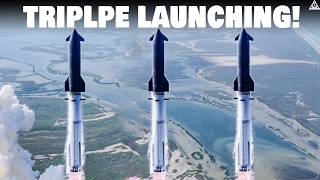

3 Flights That Could Make or Break SpaceX
44sHigh-stakes countdown hook that frames the entire future of SpaceX around three critical flights, creating immediate intrigue.
▶ Play Clip"Title promises a shocking reveal, but the content is a solid, factual breakdown of SpaceX's roadmap—delivers substance but oversells the 'shock' factor."
The video analyzes SpaceX's roadmap for Starship, focusing on the next three critical flights (13, 14, and 15) that are pivotal for the program's progress. It explains the technical and operational milestones each flight represents, from proving the new Block 3 configuration's reliability to achieving orbital flight and establishing a commercial launch site in Florida. The video also contextualizes these flights within a three-phase development plan, emphasizing that despite the hype, Starship is still in its foundational phase.
The next three Starship flights (13, 14, 15) are make-or-break for Elon Musk's lunar and Mars ambitions. If any fails, the timeline could slip by years.
Falcon 9 took 8 years to evolve from Falcon 1 to reliable operations, and even now 200 launches a year is a stretch. Starship doing thousands of flights a year is not realistic yet.
SpaceX's president outlined that the next three flights are the immediate focus, each with a specific job, and they are just the beginning of Phase 1.
Flight 12 (May 22) was the first Block 3 flight. The ship survived re-entry and splashdown, but the Super Heavy booster failed during boost-back due to engine relight issues, causing an uncontrolled fall. FAA grounded Starship.
The booster failure was due to an engine relight command sequence issue, not a fundamental hardware flaw. This is fixable in weeks, which is why SpaceX remains confident.
Flight 13 will use new vehicles (Booster 20, Ship 40) and will be a near-repeat of the suborbital trajectory, focusing on fixing the relight issue and proving Block 3 reliability.
Flight 14 will be the first serious attempt at full orbital flight, requiring ~28,000 km/h and multiple in-space relights. It will also demonstrate commercial value: deploying larger Starlink satellites and in-orbit propellant transfer.
Flight 15 will launch from Florida (LC-39A or SLC-37), marking a shift from experimental testing to routine commercial operations. This provides redundancy with multiple pads.
Flights 13-15 are still Phase 1: prove Block 3 works, repeat reliably, ramp production, and achieve orbital capability. The dream of high-frequency flights is far off.
Phase 2 requires catching both Super Heavy and Ship with Mechazilla arms in the same mission. This is non-negotiable for revenue generation and is a costly, high-risk bridge.
Phase 3 shrinks time between flights to weeks, making thousands of flights per year conceivable. Earliest realistic start is late 2026, more likely early 2027.
SpaceX is still in Phase 1 of Starship development. Flights 13, 14, and 15 are critical but just the beginning. Patience and steady progress are key to achieving the ultimate goal of high-frequency flights.
What are the next three critical Starship flights?
Flights 13, 14, and 15.
01:56
What caused the Super Heavy booster failure on Flight 12?
Several engines failed to relight during the boost-back burn, causing an uncontrolled fall into the Gulf of Mexico.
02:50
What is the primary goal of Flight 13?
To prove the reliability of the new Block 3 configuration by repeating a suborbital trajectory with the engine relight issue fixed.
04:14
What speed is required for Starship to reach stable orbit?
Approximately 28,000 kilometers per hour.
04:55
What is the significance of Flight 15?
It will be the first Starship launch from Florida, marking a shift to routine commercial operations and providing launch redundancy.
06:32
What is the non-negotiable requirement for Phase 2?
Mastering the catching of both the Super Heavy booster and the ship with the Mechazilla tower arms in the same mission.
09:08
Gwyn Shotwell's Roadmap
Provides authoritative insight into SpaceX's immediate plans, directly from the company's president.
01:43Setback is Operational, Not Structural
Clarifies that the Flight 12 failure is fixable, indicating SpaceX's confidence and the nature of the problem.
03:05First Orbital Attempt
Highlights the significant technical leap from suborbital to orbital flight, including the need for multiple in-space relights.
04:55Florida Launch
Marks a strategic shift from experimental testing to commercial operations, a key step for Starship's viability.
06:32Phase 2: Dual Catches
Identifies the critical engineering challenge that must be overcome for Starship to generate revenue.
09:08[00:02] happens if they pull off three absolutely critical flights. Just three. And if even one of them fails, Elon Musk's entire dream of the moon, of Mars, could get pushed back years. What are these three flights? Why do they
[00:17] matter this much to the point of being make or break? Let's find out. >> And we expect this we expect Starship to be flying more than once per hour. Maybe we've all gotten a little too used to Elon Musk's big vision for Starship. The
[00:31] idea of flying people from one side of the planet to the other in under an hour or pulling off thousands of flights a year like it's no big deal. But let's be real for a second. Is this actually pie in the sky stuff? Look at Falcon 9, the
[00:46] workhorse that's been paying the bills for SpaceX. It took them roughly 8 years to evolve from the tiny Falcon 1 all the way up to a reliable Falcon 9. They didn't nail consistent drone ship landings until 2015. And here we are in
[01:00] 2026. Even with the ability to launch from both the east and west coasts, hitting 200 launches in a single year still feels like a serious stretch. So when people talk about Starship doing thousands of flights a year, come on,
[01:15] the honest answer, not yet. But before they can even think about that kind of crazy cadence, they first need to reliably hit monthly flights. And the truth is that milestone is actually coming sooner than most people think.
[01:29] SpaceX has laid out a very clear, very specific road map to get there. And that road map breaks down into three distinct phases. The most important thing you need to understand right now is exactly where they stand on that road. Gwyn
[01:43] Shotwell, the person actually running SP X daytoday, spelled it out pretty clearly in her recent comments. And it all comes down to the next three all comes down to the next three flights. Flight 13, flight 14, and
[01:56] flights. Flight 13, flight 14, and flight 15. At first glance, these are just the next three numbers in the test flight sequence, but each one has a very specific important job. And even all three combined are still just the
[02:08] beginning of the first major phase in Starship's long development road map. The story picks up from the most recent flight, flight 12, which launched on May 22nd. The first flight with the allnew block 3 configuration. Super heavy was
[02:22] significant down from four grid fins to three, a much simpler tail section, and most importantly, powered by the new, more powerful, and lighter Raptor 3 engines. Most of the flight went very well. Clean
[02:36] stage separation, the ship successfully survived the intense re-entry, made a controlled splashdown in the Indian Ocean, and even deployed over 20 simulated next generation Starlink satellites. But the Superheavy booster
[02:50] wasn't so lucky. During the boost back burn, several engines failed to relight, causing it to fall uncontrolled into the Gulf of Mexico. The FAA immediately grounded Starship pending investigation. It sounds like a big setback, and it is.
[03:05] It sounds like a big setback, and it is. But SP X is surprisingly confident. Why? Because this wasn't a structural failure or a heat shield problem. The kind of This was a problem with the engine
[03:18] relight command sequence. More of an operational and software issue than a fundamental hardware flaw. That kind of problem can often be solved in a matter of weeks. That's why when asked about the next flight, Gwyn Shotwell was quite
[03:31] straightforward. The ship has already successfully relid its engines in space before and the team feels confident about it. However, they still want one more suborbital flight before attempting a full orbital test. That flight is
[03:45] flight 13. So what exactly does flight 13 look like? It will be the first mission using an entirely new pair of vehicles. Booster 20 and ship 40. Both have already completed deep cryogenic proof testing and are now moving into
[03:59] static fire testing in the coming days, most likely by the end of June. Early FCC filings suggested SpaceX might try pushing ship 40 all the way into a real orbit. But after the issues on flight 12, the latest signals point to a much
[04:14] more conservative plan. A near repeat of the previous suborbital trajectory. This time with the engine relight problems fixed. It might sound overly cautious, but right now that's exactly what they need. After rolling out a whole new
[04:28] Block 3 configuration, the priority isn't breaking records. It's proving they can repeat the same process reliably flight after flight without surprises. That's the entire focus of phase 1. make Block 3 truly dependable
[04:42] before moving on to anything more ambitious. If flight 13 is about proving stability, then flight 14 is where they start pushing the limits while still staying inside phase 1. This will be Starship's first serious attempt at a
[04:55] full orbital flight instead of just kissing the edge of space and coming back down. The difference is bigger than it sounds. To reach stable orbit, the vehicle needs to hit roughly 28,000 kilometers per hour, nearly five times
[05:09] faster than a typical suborbital hop. At those speeds, re-entry is far more brutal. Heat loads skyrocket, structural stresses increase dramatically, and every system has to work perfectly. Engine reliability becomes critical
[05:23] because a real orbital mission requires multiple inspace relights for orbit adjustment, de-orbit burns, and eventually for orbital refueling. That's why they want to nail the Raptor relight on flight 13 first before flight 14
[05:38] raises the stakes. And here's the exciting part. The first time Starship reaches orbit will also be its first real chance to show genuine commercial value. Something that until now has mostly lived in PowerPoint slides. We're
[05:51] talking about deploying much larger next generation Starlink satellites, laying groundwork for AI powered spacecraft that SpaceX has started talking about openly and most importantly the first demonstration of inorbit propellant
[06:04] transfer. That last one is a gamecher. It's essential for NASA's Artemis program and absolutely non-negotiable for any serious Mars ambitions. If they can maintain a cadence of roughly one
[06:16] flight, flight 14 could come as early as August. But even if it succeeds, it's still just a major technical milestone within phase 1. Not yet the jump to the next stage. So what about flight 15? This might actually be the most
[06:32] because of the technical challenges in the air, but because of where it lifts off, Florida. For years, Starbase in Texas has served as a massive laboratory. A place where engineers could build, break, fix, and fly again
[06:47] in an almost non-stop cycle. Florida represents a completely different mission. It's the home of real routine commercial operations, right alongside the ecosystem that already handles hundreds of Falcon 9 launches every
[07:00] year. Bringing Starship to Florida means shifting from pure experimental testing to treating it as a regular part of the business. To make that happen, SpaceX is pouring serious money into infrastructure along the space coast.
[07:13] infrastructure along the space coast. Historic launch complex 39A, the same pad that once sent Apollo astronauts to the moon, is being upgraded specifically for Starship. The propellant loading arm is already installed, and the tank farms
[07:26] are steadily coming together. Not far away, they're building an entirely new facility at SLC 37 with plans for multiple parallel pads. Once both sites are complete, SpaceX could have up to three dedicated Starship launch
[07:41] complexes, giving them something they've never truly had before, real redundancy. One pad goes down, the others keep flying. A successful launch from Florida would be a powerful signal. Starship is no longer just a flashy demonstration
[07:56] vehicle out in the Texas desert. It's becoming genuine operational infrastructure. But even then, keep this in mind. Flight 15 is still very much a phase one milestone, the foundation building phase. Florida proves that
[08:10] Starship can operate in a commercial environment. It doesn't yet prove it can fly fast and frequently like a true production machine. Now, let's step back and look at the big picture because this is where context really matters. These
[08:24] three flights 13, 14, and 15 are important, but they're still firmly inside phase one. This is the patient foundational phase. Prove the new block 3 design actually works as intended. Repeat it reliably, ramp up production,
[08:40] and achieve solid orbital capability. That's why no matter how exciting the headlines sound, SpaceX is still quite far from the dream of flying Starship dozens or hundreds of times a year, let alone the thousands of flights per year
[08:53] that Elon Musk has talked about for true point-to-point Earth transport and serious Mars ambitions. Right now, they're only completing the very first step of a three-step journey. Phase 2 is where things get seriously difficult. It
[09:08] comes after flight 15. This is the phase where they need to master catching both the super heavy booster and the ship with the Mechazilla tower arms in the same mission. We've seen successful booster catches since flight 5 almost 2
[09:21] years ago. But catching both vehicles together, especially in the new block 3 configuration, is a much bigger engineering challenge. It's also the non-negotiable requirement before moving to the next level. The payoff, once they
[09:36] nail reliable dual catches, Starship can finally start generating real revenue, deploying much larger next generation Starlink satellites at scale, supporting AI spacecraft, and demonstrating in orbit refueling. But here's something
[09:51] many people overlook. Phase 2 is as much about money as it is about technology. Speeding up production drives costs higher immediately, more workers, more materials. While the big cost savings per flight only arrive once you reach
[10:06] real volume, it's an expensive high-risk bridge to cross. Phase 3 is when the pace really starts to matter. This is where they shrink the time between flights from months down to weeks and eventually toward the kind of cadence
[10:19] that makes thousands of flights per year even conceivable. They don't need Falcon 9 level daily launches because a single Starship carries many times the payload. Falcon 9 will continue handling other missions during the transition. Based on
[10:33] current progress and Gwyn Shotwell's recent comments, the earliest realistic phase 16, more likely landing in early 2027. So where does that leave SpaceX today? They're still solidly in phase 1, still
[10:49] waiting for a clean, stable flight, still waiting for orbit, still waiting for Florida, and still facing a risky dual catch phase after that. The next time you hear someone say Starship is about to fly every week, remember
[11:01] exactly where they are on the map. Flights 13, 14, and 15 are just the opening chapter of the opening act. The real story, the one that could eventually deliver thousands of flights a year, is still being written. And as
[11:15] SpaceX has shown us time and again, patience and steady progress have always been their strongest weapons. T - 10 9 8 7 6 5 4 3 2 1
[11:48] >> How wind do you chamber pressures? Stage one landing leg deploy.




⚡ Saved you 0h 12m reading this? Transcribe any YouTube video for free — no signup needed.