
You Won't Believe This Stew Uses Canned Tuna!
45sThe surprising premise of making a gourmet stew from canned tuna hooks viewers immediately.
▶ Play Clip"The title accurately describes the recipe; the video delivers exactly what it promises without fluff."
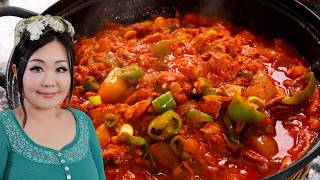
This video presents a straightforward recipe for chamchi-jjigae, a Korean spicy tuna stew made with canned tuna. The host demonstrates the step-by-step cooking process, including the ingredients, timing, and a complementary apple ssamjang (dipping sauce) recipe. The tutorial concludes with a serving suggestion and a taste test.
The video begins with the host introducing the recipe for tuna stew, using canned tuna. She starts by dicing the tuna and preparing an onion, lining the pot with it.
The host adds the core seasonings: 2 tablespoons of gochujang (Korean chili paste), 2 tablespoons of gochugaru (hot pepper flakes), and 1 tablespoon of soy sauce. She then adds 1.5 cups of water to submerge all ingredients.
The pot is covered and cooked over medium-high heat for 10 minutes. During this time, the host prepares additional ingredients: 4 minced garlic cloves, 2 chopped green onions, and a green chili pepper.
The host introduces a complementary sauce, apple ssamjang, which she invented while writing her first cookbook. Ssamjang is typically a mix of fermented soybean paste, hot pepper paste, garlic, onion, and sesame oil, but she uses apple instead of sugar for sweetness.
After 10 minutes, the host adds the prepared garlic, green onion, and green chili pepper to the stew. She cooks it for an additional 3-5 minutes to thicken it.
The apple ssamjang is completed with one small Gala apple, 1 tablespoon of sesame oil, and sesame seeds. The host notes the exact ratio is available on her website.
The stew is turned off and served with side dishes, lettuce, rice, and fresh kimchi. The host demonstrates wrapping the stew and ssamjang in a lettuce leaf with rice, and tastes it, declaring it delicious.
The video provides a simple, step-by-step guide to making a flavorful Korean tuna stew from pantry staples. It also offers a unique twist with the apple ssamjang, making it a complete and satisfying meal.
What are the three main seasonings added to the tuna stew?
Gochujang (Korean chili paste), gochugaru (hot pepper flakes), and soy sauce.
00:45
How much water is added to the stew?
1.5 cups of water.
00:59
How long is the stew cooked before adding the garlic and green onions?
10 minutes.
01:19
What is the key ingredient used in the ssamjang to replace sugar?
A small Gala apple.
02:04
What is the base of a traditional ssamjang sauce?
A mixture of fermented soybean paste, hot pepper paste, garlic, onion, and sesame oil.
02:33
How long is the stew cooked after adding the garlic and green onions?
An additional 3 to 5 minutes to thicken it.
03:47
What is the Korean name for this spicy tuna stew?
Chamchi-jjigae.
05:55
Invented Apple Ssamjang
The host shares a personal story about inventing this recipe while writing her first cookbook, adding a unique twist to a traditional sauce.
02:04Ssamjang Base Ingredients
Provides a clear definition of the traditional ssamjang sauce, making the recipe accessible to those unfamiliar with Korean cooking.
02:33Stew Consistency
The host explains the choice to cook the stew longer for a thicker consistency, offering a tip for customizing the final texture.
04:44[00:00] Today's recipe is tuna stew. Here you go. It's canned tuna. Let's dice it this way.
[00:13] Put it here. I lined this with my onion. Also slice this.
[00:27] Mmm, smells very refreshing. Here.
[00:45] Add gochujang, 2 tablespoons. And gochugaru, hot pepper flakes, 2 tablespoons.
[00:59] And soy sauce, 1 tablespoon. And then add water. Let's add 1 cup. Half a cup more. All these ingredients are submerged.
[01:19] Close the lid and cook over medium-high heat. Now, cook for 10 minutes. After 10 minutes, I'm going to add more green onion, garlic, and green chili pepper. Four large garlic cloves.
[01:36] I minced the four garlic cloves. And green onions, chop two green onions.
[01:49] Green chili pepper. Just mix together.
[02:04] I'll make apple ssamjang here. You guys made my apple ssamjang? It's so delicious! I'm going to use apple because this is apple ssamjang. Actually, I invented this recipe.
[02:20] When I invented this recipe, that year, I was working on my first cookbook. I was so happy all summer until fall. I always made this ssamjang, apple ssamjang.
[02:33] Ssamjang is a mixture of fermented soybean paste, hot pepper paste, garlic, onion, and sesame oil, all mixed together. Usually, we add sugar here to make it a little sweet, but I used apple.
[03:00] This one I like to cut into tiny pieces. Like this.
[03:23] Already 10 minutes have passed. I'm going to add all this stuff. Garlic, green onion, and more green chili pepper.
[03:47] I like to thicken this stew, so I'm going to cook it a little longer, 3 to 5 minutes. Here, I added Korean soybean paste, hot pepper paste, green onion, garlic, and then apple,
[04:03] one small Gala apple. And then sesame oil, around 1 tablespoon, and sesame seeds.
[04:25] I already posted this recipe, apple ssamjang. Check out the exact ratio on my website. Wow, nice. Such a delicious smell from this. I can't believe this is from canned tuna. I just cooked
[04:44] this for three more minutes. I think that's enough because sometimes we need to eat this like a stew.
[04:58] Turn it off. These are my side dishes for this. And this is lettuce. So I made a kind of vegetable basket. Exciting! Rice.
[05:25] My rice. Very freshly made kimchi. And I will show you how to eat it. Open sesame. Lettuce? I have two. And rice. Just a little rice. This is tuna stew. And this is apple ssamjang. And then, wrap.
[05:55] Mmm. Very, very delicious. Today, we made spicy tuna stew, chamchi-jjigae. Enjoy my recipe! See you next time. Bye~
⚡ Saved you 0h 06m reading this? Transcribe any YouTube video for free — no signup needed.