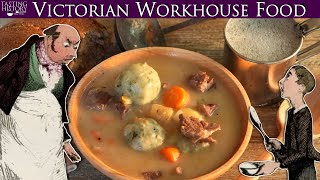

The Disgusting Reality of Workhouse Gruel
54sFirsthand vivid description of revolting gruel evokes strong emotional reaction and curiosity.
▶ Play Clip"Accurate title; the video delivers both a historical cooking demonstration and contextual background, with minimal filler."
This video explores the reality of food in Victorian workhouses, contrasting popular depictions with actual recipes. The host recreates a typical meal of scouse (meat stew) and suet dumplings from period cookbooks, while discussing the historical context of the New Poor Law and the often poor quality of ingredients.
Contrary to the watery gruel in 'Oliver Twist', workhouse dinners could include more substantial dishes like scouse (meat stew) and suet dumplings.
The New Poor Law (1834) transformed workhouses from charity to a deterrent, based on the principle of less eligibility.
Typical meals included gruel and bread for breakfast, bread and cheese for supper, and meat with potatoes for dinner.
The scouse recipe comes from the 'Manual for Workhouse Cookery' (1901), providing exact ingredients for a single serving.
Chop unpeeled vegetables and meat, make a roux with flour and fat, add water and seasonings, then simmer for two hours.
From a Scottish poorhouse management book, ingredients include flour, suet, baking powder, salt, pepper, and parsley.
In 1536, Henry VIII dissolved monasteries, eliminating a key safety net for the poor and leading to increased homelessness.
Matthew Marryott's workhouses became infamous for torture and starvation, leading to the ballad 'The Workhouse Cruelty' about Mary Whistle.
By the 18th century, the poor were seen as responsible for their own poverty, leading to harsher workhouse conditions.
Dictated that workhouse conditions, including food, must not exceed the standard of living of the poorest independent laborer.
Poor Law commissioner Charles Mott laid out daily diets in 1835: bread, gruel, meat, potatoes, and cheese with gender and age variations.
Despite sufficient quantity, the quality was often abysmal – bug-infested flour, rotten vegetables, and even rat droppings.
In 1897, Mr. John Lobb protested the lavish dinners enjoyed by guardians while inmates ate poorly, but his proposal was defeated.
The host tastes the scouse and dumplings, finding them surprisingly good, but notes that quality depended on ingredients.
The food in Victorian workhouses varied greatly, from adequate meals to revolting slop, largely due to the quality of ingredients and the attitude of those in charge. The principle of less eligibility ensured that workhouse life was never too comfortable, but the reality often fell far short of even minimal standards.
What was the principle of less eligibility in the context of Victorian workhouses?
It dictated that no aspect of workhouse life, including food, should be superior or equal to the ordinary mode of subsistence of the laboring classes outside.
15:46
Which 1834 law transformed workhouses from charity to a deterrent?
The New Poor Law.
14:44
What event in 1536 contributed to the rise of homelessness in Britain?
The dissolution of the monasteries by Henry VIII.
07:42
What was the name of the ballad about workhouse cruelty from 1731?
The Workhouse Cruelty.
11:04
How much beer did washer women receive per day at one workhouse in Suffolk?
Eight pints.
12:42
What did Charles Mott's standardized daily diet for able-bodied men include for breakfast?
6 ounces of bread and 1.5 pints of gruel.
16:29
What scandal involved guardians dining lavishly while inmates ate poorly?
The guardian dinners scandal of 1897, where Mr. John Lobb protested the excessive meals.
22:23
What was the name of the woman who died in Matthew Marryott's workhouse and inspired a ballad?
Mary Whistle.
11:20
What two drinks were used in Hogarth's prints to symbolize societal perception of the poor?
Beer (wholesome) and gin (associated with poverty and squalor).
12:58
What was the 'New Poor Law' also known as?
The Poor Law Amendment Act of 1834.
14:44
Dissolution of monasteries and poverty
Links a key historical event to the rise of workhouses, showing how the loss of monastic charity created a need for state intervention.
07:42Beer vs. gin in Hogarth's prints
Illustrates the societal double standard where beer was seen as wholesome while gin was blamed for poverty, reflecting class bias.
12:58Principle of less eligibility
A core concept that intentionally made workhouses unattractive to deter the poor, influencing policy for decades.
15:46Poor quality of workhouse food
First-hand accounts reveal that despite adequate quantity, the food was often contaminated and revolting, exposing the gap between policy and reality.
17:13Guardian dinners scandal
Highlights the hypocrisy of workhouse administrators who feasted while inmates starved, leading to public outrage.
22:23[00:00] and while novels like 'Oliver Twist' might have you think that all they ever ate was watery gruel, and they did eat gruel mostly for breakfast, for dinner you might get something a little bit more interesting
[00:12] like this dish of scouse and suet dumplings. as we examine just exactly how terrible the food in a Victorian workhouse really was this time on Tasting History.
[00:31] During the Victorian era, workhouses in Britain were nothing new, they had been around for a couple centuries. Something called the new poor law as opposed to the old poor law transitioned these institutions
[00:45] from a place of charity to a place of, if not exactly punishment, to a place of last resort for relief. It was believed that if the workhouse was too comfortable, it would actually entice people to
[00:58] become poor or stay poor just for the free handout. Not that it was exactly free, seeing as you were doing backbreaking work for 10 to 12 hours a day, But even in the Victorian era, there were still guidelines of what kind of food to feed the inmates,
[01:16] It was often gruel and a bit of bread and beer for breakfast. Then bread and cheese for supper. And in the middle of the day for dinner, a person could expect a little meat and potato
[01:28] So I found two recipes meant to be made at workhouses of the Victorian era. One is for a stew, a meat stew called scouse, and the other is for suet dumplings.
[01:43] So, the first for the scouse, it comes from the 'Manual for Workhouse Cookery' from 1901. And it provides a detailed list of the exact ingredients and quantities to make it, so I'm going to use those, but it only makes one serving, so I'm going to triple it, but the ratios will all be the same.
[02:00] So for the scouse what you'll need is 1 pounds or 450 grams of beef, 3/4 of a cup or 90 grams of flour, 3 tablespoons or 42 grams of butter or other fat, 340 grams or about four small potatoes, 255 grams or two large carrots,
[02:15] 85 grams or about a half of a small turnip and 45 grams or a 1/2 cup of diced onion. Then the recipe says to "Cut up the meat and vegetables.
[02:27] Fry the flour in the fat till brown, stir in the water. Add pepper and salt; then put in the meat and vegetables. Simmer gently for two hours. To make 1 pint of stew." Simple and very easy to follow, just like the recipes from today's sponsor, Hungryroot.
[02:43] Hungryroot is a great way to make sure you stick to your New Year's nutrition goals this year, namely because they do all of the weekly meal planning and the grocery shopping, and they screen out a lot of different preservatives and additives like corn syrup and artificial sweeteners.
[03:00] And with over 50,000 chef crafted recipes to choose from, there is really something for everyone, whether you're watching your calories, trying to get more protein into your diet, or if you're dairy free or gluten-free or vegetarian.
[03:13] And what I really love is that many of them are designed to be made ready in just 15 minutes or less. So if you want to see why I love Hungryroot, then give them a try. And for a limited time,
[03:25] you'll get 40% off of your first box, plus a free item in every box for life. Just use my link in the description, hungry.com, and use my code TASTINGHISTORY for 40% off of your first box, plus a free item of your choice in every box for life.
[03:42] Now let's make some workhouse scouse. So start by chopping up the meat and vegetables. Also, as the workhouse was all about economy, you don't want to peel the potatoes, carrots, and turnips. You just want them to be washed and chopped up.
[03:58] Then we move on to making the soup's thickener by melting the butter in a large pot, then adding in the flour and mixing it together. 1:1 ratio of flour to fat, this one has more of a 2:1 ratio,
[04:15] twice as much flour than fat, and that means it can be rather dry. And so really, you need to keep stirring it around so it doesn't burn. So keep it moving over a medium heat for about 5 minutes And then you can pour in a little more than seven cups of water.
[04:32] The exact recipe would call for three imperial pints or 1,700 ml. Then give it a good stir and let that come to a simmer at which point the thickener should dissolve fairly well. Then add in the pepper and the salt, followed by the meat and the vegetables.
[04:47] And give it another good stir and let it return to a simmer and then place the lid on the pot and let it cook for 2 hours. And every once in a while, give it a good stir and kind of scrape the bottom to make sure nothing is burning to the bottom of the pot.
[05:00] And then really it's actually ready to eat as is, but if you want some extra energy, you know if you're breaking up stones into gravel to pave the roads of Britain in a workhouse then I suggest making some suet dumplings. And so for that
[05:15] we look to a Scottish book on the management of poor houses of all sorts "6 ounces of flour, 2 ounces chopped suet, 1/16th ounce baking powder,
[05:29] Mix all the dry things, rubbing the sew it through the flour; make into a firm paste with the cold water; divide into ten or twelve small pieces, which roll up into balls having the outsides well floured.
[05:43] Drop the balls into the stew and cook for half an hour longer; then serve." And to make these, what you'll need is just under 1 and 1/2 cups or 170 grams of flour. And then a heaping 1/3 cup or 55 grams of beef suet. And if you can't find beef suet that you can get it online,
[06:00] you can use really cold butter. Then a 1/2 teaspoon baking powder, 1 teaspoon of salt, a 1/2 teaspoon of pepper, and 21 grams of chopped parsley. That is a lot of parsley. It's actually like an entire bunch of parsley if you're just using the leaves.
[06:15] And then when they're chopped really really fine, it's about a cup of parsley. So mix the salt, pepper, and baking powder into the flour. And then add the parsley and mix. Once well distributed, you can add the suet. And you want to work that in by rubbing it into the flour with your fingers.
[06:31] And once it is well incorporated, you can add some cold water. I would start with about a 1/4 cup of water and only add more if you need it. You want it to be just enough that the dough comes together and can be formed into balls.
[06:44] You're going to make about 10 to 12 dumplings. Once you've rolled your dumplings, you can coat them in a layer of flour. And then 30 minutes before your scouse is done, or about an hour and a half into the cooking, you can add your dumplings into the stew. Gently stir them in so you don't break them up,
[06:59] but you get them nice and coated with the liquid. And then return the lid to the pot and cook for another 30 minutes. Hit the LIKE button, it really does help out the channel. And we can take a closer look at the food of a Victorian workhouse,
[07:14] and decide if it really was as bad as 'Oliver Twist' would have us believe. It is called The Workhouse Cookbook by Peter Higginbotham.
[07:29] It is a super deep dive into into this topic and it is absolutely worth a read. Now to discuss Victorian workhouses, we really need to go back and see why workhouses existed in the first place.
[07:42] And to answer that, we have to go back to one of the most important years in all of British history, 1536. This was the beginning of what was known as the dissolution of the monasteries by Henry VIII.
[07:55] Now poverty had of course always existed in Britain, but for centuries, the degree of homelessness was actually kept at bay because there was a system of charity set up
[08:07] through the monasteries. People could go for alms or sometimes even a bed. But when in just a few years those monasteries disappeared, that safety net went with them. Over the next few decades, the amount of beggars on the streets of Britain skyrocketed. And to combat that,
[08:23] the government did things like ban giving alms directly to them. And instead, all alms or help for the poor had to go through the church common box. And as it happened, a lot of that money never actually made it to the people that it was supposed to be helping.
[08:37] So there was a new system, at least in some cities like Colchester, York, and London, that was set up that was essentially a tax And again, it wasn't meant to go directly to people, but rather to prop up institutions that would help people.
[08:56] See, new vagrancy laws like the Vagabonds Act of 1572 and later the Poor Relief Act of 1601 effectively made it illegal to be homeless. And so, you would be taken in by one of a series of new establishments.
[09:10] If you were mentally ill, this meant you would go to a hospital or asylum. The most famous being the Bethlehem or Bethlehem hospital, also known as Bedlam. Then there were poor houses for those who were too old to work or jail or prison for those who refused to work,
[09:26] And for those who could and were willing to work, the able-bodied poor, there was the workhouse. Now the workhouse was not meant to be a punishment, but rather an act of charity
[09:40] that would help lift you out of poverty until you can move along your way. It wasn't exactly anyone's first choice, but it wasn't the worst option out there. In 1732, it was written, "It is remarkable, that all the parishes in Southwark, except St. Thomas's,
[09:55] have set up large workhouses, for the reception of their numerous poor, which are so well regulated, that as fast as there is any vacancy, interest is made by the poor themselves to be admitted."
[10:07] In those years, the work tended to be that of spinning flax, hemp, and wool, and the food was simple, but not far off from what the majority of the population was eating with plenty of porridge, bread, cheese, and beer along with some roast or boiled meat,
[10:21] And if you should fall sick while in the house, you'd actually be given claret or wine, fish, oysters, Of course, just like with any institution, the quality varied depending on where you were and who was running it.
[10:38] In the early 1700s, there was a man named Matthew Marryott who ran a few of these workhouses, and he kept gathering more and more and eventually had basically a monopoly on an entire area of the country
[10:51] quality went down as is often the case, and a lot of issues ended up happening. There were incidents of torture and starvation and all of those kinds of things.
[11:04] And it culminated in a famous ballad, a song written about a woman who actually died in one of the workhouses. The song which came out in 1731, was called 'The Workhouse Cruelty'. And it was about a woman named Mary Whistle
[11:20] who was a housekeeper who lost her position and eventually found herself having to enter the workhouse. And there she did something to offend the governor who was in charge of the workhouse, it's not specific what she did or what he did but they threw her down into the basement.
[11:37] "There for eleven weeks poor soul she lay, half starved, ate up, with vermin (as they say) holes in her legs, her arms, her hips, and thighs the vermin eat and in her head likewise."
[11:49] So essentially she died and was eaten by rats. It's really quite sad and it became an incredible hit throughout Britain and it actually had consequences for Matthew Marryott
[12:02] who was stripped of his power over all these workhouses and ended up dying the next year. Now it is during this period the 18th century that many people's perception of the poor
[12:15] starts to change and it is best exemplified by the perception of two drinks of the period. Beer, typically low alcoholic small beer, was the drink of choice for most of society.
[12:29] And in workhouses, men got two pints a day and women and children got one. Though if you were engaged in hard labor, you would actually receive more. At one workhouse in Suffolk, the washer women received eight pints a day.
[12:42] Beer was a wholesome drink and is depicted in William Hogarth's 1751 print 'Beer Street', which shows prosperous and productive members of society all drinking beer. But gin a new and obviously much stronger drink, had recently come on the scene.
[12:58] And I actually did an entire video all about the London gin craze. So I'll put a link to that in the description, but essentially, it was very quickly seen as a drink for the poor And it is shown in Hogarth's other print, 'Gin Lane', where London's poor live in squalor.
[13:18] They're fighting dogs for bones, neglecting their children, and then just dying in poverty. And one account from 1725 says that many of the poor "chose to struggle with their necessities, and to continue in a starving condition,
[13:34] with the liberty of haunting the brandy shops and such-like houses, rather than submit to live regularly in plenty." In that quote it was brandy, but very soon it would be gin that would become the leading culprit.
[13:47] They chose to drink gin. They chose to live like this. They chose to be poor, that became the thought. Before this very often the poor were called unfortunates meaning that they were poor yes
[14:02] but it wasn't anything that they did. It was fortune literally just circumstance that made them poor but as the 18th century came to a close it began to be seen that it was not fortune that did this
[14:17] but rather their own iniquity that made them poor. This led to a change in how the poor were treated, especially in these institutions. It went from being charity to being more of a punishment,
[14:31] to trying to change their behavior by making things so uncomfortable in the workhouses that they would simply choose not to be in them, choose not to be poor anymore.
[14:44] It was very much the mindset of Ebenezer Scrooge in 'A Christmas Carol', but that comes because that was very much the mindset of much of Victorian society. And this view was essentially written into law in 1834 with what was known as the 'New Poor Law'.
[15:02] Here the work in the workhouses really changed. While some people still did laundry and tailoring, shoe making, basket weaving, there were a lot more harsher forms of work like brick laying, chopping wood, or even stone breaking became common.
[15:16] There was even the literal bone crushing work of crushing bones to be made into fertilizer. This period also saw a standardization in the served to the inmates in poor houses
[15:32] because at some of the poor houses, namely rural locations, it was seen that they were eating too well. These new laws enshrined something called the principle of less eligibility,
[15:46] which basically dictated that no aspect of life in the workhouse, including the food should be "superior or equal to the ordinary mode of subsistence of the laboring classes of the neighborhood."
[15:58] it will entice people to want to become poor or stay poor and live in these workhouses. And so in 1835, the Poor Law commissioner Charles Mott
[16:13] laid out daily diets for men, women, children under 9, and those people over 60. He just wanted it to be standardized and to make sure that people had just enough calories
[16:29] that would allow them to do the work that they were supposed to do in the workhouse. The new system gave able-bodied men 6 ounces of bread and 1 and a 1/2 pints of gruel for breakfast, 5 ounces of meat and a half pound of potatoes or one and a half pints of soup for dinner,
[16:45] Then for supper, it was 6 ounces of bread and either some broth or 2 ounces of cheese. Then women received roughly the same thing, though only 5 ounces of bread instead of six.
[16:58] Now in the face of it, this lineup of meals really seems quite nutritious and more or as much as most people in Britain were getting. But while the quantity might have been there, the quality, it turns out, was absolutely not.
[17:13] When Charles Shaw wrote about his childhood in a workhouse in Staffordshire in the 1840s, he described his first encounter with workhouse skill, the local term for gruel. "I had heard of workhouse skill, but had never before seen it. I had had poor food before this,
[17:29] but never any so offensively poor as this. By what rare culinary making nausea and bottomless fatuitousness, it could be made so sickening I never could make out.
[17:41] Simple meal and water, however small the amount of meal, honestly boiled, would be palatable. But this decoction of meal and water and mustiness and fustiness, was most revolting to any healthy state.
[17:54] It might have been boiled in old clothes which had been worn upon sweating bodies for three score years and ten." That workhouse skilly was the vilest compound I ever tasted, unutterably insipid,
[18:07] and it might never have been made in a country where either sugar or salt was known." "I was invited to taste the dinner of the day, which happened to be soup. I was rash enough to take a breakfast cupful,
[18:23] with a piece of their excellent bread, and I paid the penalty of a severe attack of indigestion... Black beetles... are a great nuisance, and occasionally get into the food, but vigorous steps are being taken to decimate them."
[18:38] Now workhouse officials, called guardians, tried to make it so that the public didn't really know about how horrible the conditions could be. They would do things like invite newspaper men in to view the workhouse
[18:51] and give them food, but they would do so only in the best fashion and they would clean everything just like I do when I have company over so nobody can see how I actually live. This of course would lead to writeups in newspapers like in 1841 that said,
[19:05] "The inmates have recently dined. We taste the food which has constituted their meal; and we acknowledge that the suet pudding, the bread, and the cheese are, in quality, equal to what may be found in the larders of the wealthiest."
[19:19] But the public was of course not fooled because too many real people were going in and out of the workhouses to keep that kind of thing under wraps, and so you get novels like 'Oliver Twist'.
[19:31] Though one of my favorite chastisements of the food in the workhouse was actually printed in 1838 in newspapers across the country and it is absolutely brilliant. It is a rewarding of act four, scene one of the play Macbeth, one of my favorite plays.
[19:48] It's the scene where the three witches are over the cauldron brewing something Instead of three witches though, it's three guardians of the workhouse making food for the inmates.
[20:02] "Thrice hath the dying popper groaned, and once his starving child hath moaned, rot gut cries, his time, "Tis time, tis time." Double, double, toil and trouble, fire burn and cauldron bubble.
[20:15] Shell of oyster, chickens claw, ducklings and trails, turkeys maw, measled pork and moldy meal, claws and stickings, greasy heel. Here I have a strangled mole lately taken from his hole;
[20:29] add thereto the back of ferret; round about the cauldron stir it. Black gruel and white, green gruel and gray, mingle, mingle, mingle. They that eat it may. Now for water; make it thin. Put of that a plenty in. That will make the paupers grin."
[20:47] I obviously didn't read the whole thing. It's really quite long, but all quite brilliant so I'll actually include that in the next Tasting History newsletter, which you can sign up for at tastinghistory.com. Now this and other public works like 'Oliver Twist' actually did lead to public outcries,
[21:03] and there were occasional attempts at reforming the workhouses, but they never really stuck because even as late as the 1890s, when a British politician named George Lansbury visited a workhouse in an official capacity,
[21:20] sort of an inspector, a post known as a guardian of the poor, he wrote that the "Food was mainly skilly, bread, margarine, cheese, and hard, tough meat and vegetables, and occasionally doses of salted, dried fish... On one visit, I inspected the supper of oatmeal porridge.
[21:37] On this occasion, the food was served up with pieces of black stuff floating around. On examination, we discovered it to be rat and mice manure. I called for the chief officer, who immediately argued against me, saying the porridge was good and wholesome.
[21:51] 'here you are, eat one mouthful and I will acknowledge I am wrong.' 'Oh dear, no," said the fine lady. "The food is not for me, and is good and wholesome enough for those who want it.'
[22:05] I stamped and shouted around till both doctor and master arrived, both of whom pleaded it was all a mistake, and promptly served cocoa and bread and margarine." There was one scandal which really raised a collective eyebrow that took place in March of 1897
[22:23] when a Mr. John Lobb or Lobe, I'm not sure how he pronounced it, who was a- on the board of governors for one of the workhouses, decided that they should not probably after every single weekly meeting have an entire dinner
[22:39] within feet of the very poorly fed paupers who were living in the workhouse. He felt that the "business occupying an hour and a half does not justify a dinner consisting of
[22:54] fish of three kinds, joints of mutton or beef, poultry, a variety of puddings and sweets, cheese, butter, biscuits and celery, with a selection of hawk, claret, champagne and whiskey. Neither does he think that a dessert of pineapples, almonds, and raisins is warranted by the proceedings.
[23:10] The knowledge that the guardian's table groans under plenty, whilst the inmates have to content themselves with the fair of the workhouse, he says, accentuates discontent, envy, and hatred, and is subversive of the discipline of the institution.
[23:25] Mr. Lobb has no objection to the light lunchon, but he thinks that the dinners at the house should be stopped." A vote was taken, and of course, Mr. Lobb's proposal was very soundly defeated, and the grand dinners continued.
[23:39] It wasn't until 1929 that the workhouses began to close and new forms of public assistance began to replace them in British society. But before we hurrah the closure of the workhouse, let us try to eat one of the meals that those inside would have eaten
[23:55] So after that half hour of cooking, the dumplings should have puffed up nicely and the stew is ready to serve. And here we are. Scouse and sew it dumplings from a Victorian workhouse.
[24:07] So is it the prettiest dish you ever done seen? Absolutely not. It really doesn't look super appetizing. But it doesn't smell bad. In fact, it smells quite good. I mean, it's just meat and vegetables, right? This a lot thicker than I thought it would be.
[24:23] [chomp] Hm! It's actually quite good. I mean it's really thick stew with vegetables
[24:36] meat stew. I don't know what I was expecting, but uh it's very good. Let me try one of the dumplings here. A little fluffy, but also kind of dense. Here we go.
[24:53] [chomp] Delicious. Doesn't taste of parsley at all, which is surprising, so much parsley.
[25:06] Not going to lie, this is actually really good. Now, this experiment does not mean to say that the food at the workhouse was good because
[25:22] or rather the dish itself is good, it really depends on the quality of the ingredients. And there are records of pieces of meat being so tough that they were inedible and instead that they would use them
[25:38] outside basically like you would a tennis ball kind of throwing it around. Often the flour had bugs and weevils in it or rat droppings. It could
[25:50] be you know semi-rotten vegetables. A lot of times they would have a lot more water in it. So it wouldn't be really thick, it would just be watery and and you're barely getting anything. So, depends on where you are, when you are, who's in charge. And yeah,
[26:07] it's a nice thing that the workhouses don't exist anymore. So, as I mentioned, I did do a video on gin a while back and is actually one of my favorite videos. I also did a wonderful video on gruel,
[26:19] So I'll put links to both gruel and gin videos down in the description, and I will see you next time on Tasting History.



⚡ Saved you 0h 26m reading this? Transcribe any YouTube video for free — no signup needed.