
AI Summary
The speaker shares his personal journey from being a stutterer with severe anxiety, trauma, and depression to becoming a hypnotherapist and eventually finding relief through TRG. He explains the principles of Ericksonian hypnosis and conversational trance, emphasizing that hypnosis is a natural state of hyper-focus and relaxation.
Chapters
The speaker describes having many problems: insecurity, traumas, fears, anxieties, nightmares, insomnia, and a terrible situation overall.
He worked as a hypnotherapist for about a year using Ericksonian hypnosis, which is authorized by the Federal Council of Psychology.
Ericksonian hypnosis is a gentle, delicate approach that helps a person enter deep relaxation through conversation, as opposed to authoritarian hypnosis.
Trance (transpotic) is a relaxed and hyper-focused state of consciousness.
The speaker gives an example of a soap opera that put viewers in a trance, showing that hypnosis is natural and not the work of the devil.
Out of 100 people, 30-35% would enter a trance state within minutes using his techniques.
He learned to alter speed, tone, rhythm, emphasis, and nasality to facilitate conversational hypnosis.
Key technique: speak calmly, say less, and emphasize key points to capture the person's attention.
The speaker used to stutter and was extremely anxious, but through TRG, he resolved his emotional problems and no longer stutters or has anxiety.
At age 15, he bought 'Introduction to Psychology' with a month's salary, hoping it would solve his problems, but was disillusioned by its focus on experiments.
During a second depression, he started studying neurolinguistic programming (NLP) and specialized in various techniques, maintaining a critical eye on what works.
The speaker's journey shows that overcoming deep-seated emotional issues is possible through methods like Ericksonian hypnosis and TRG, and that understanding the mind is a lifelong pursuit that can lead to personal transformation.
Mentioned in this Video
Study Flashcards (6)
What is Ericksonian hypnosis?
easy
Click to reveal answer
What is Ericksonian hypnosis?
A gentle, delicate form of hypnosis that helps a person enter deep relaxation through conversation.
00:44
What is the definition of trance (transpotic)?
easy
Click to reveal answer
What is the definition of trance (transpotic)?
A relaxed and hyper-focused state of consciousness.
01:12
What percentage of people enter a trance state within minutes using the speaker's techniques?
medium
Click to reveal answer
What percentage of people enter a trance state within minutes using the speaker's techniques?
30-35%.
02:45
What voice modulation techniques did the speaker learn for hypnosis?
medium
Click to reveal answer
What voice modulation techniques did the speaker learn for hypnosis?
He altered speed, tone, rhythm, emphasis, and nasality.
03:41
What is the key technique to capture someone's attention for hypnosis?
hard
Click to reveal answer
What is the key technique to capture someone's attention for hypnosis?
Speak calmly, say less, and emphasize key points.
04:20
What book did the speaker buy at age 15 and why was he disillusioned?
hard
Click to reveal answer
What book did the speaker buy at age 15 and why was he disillusioned?
He bought 'Introduction to Psychology'; he was disillusioned because it focused on experiments with rats and architecture, not on how the psyche works.
07:04
💡 Key Takeaways
Attention Capture Technique
Provides a concrete, actionable technique for conversational hypnosis that is simple to apply.
04:20Overcoming Stuttering Through TRG
Demonstrates that severe speech and anxiety issues can be resolved through TRG, offering hope.
04:48Trance Induction Statistics
Gives a specific statistic that adds credibility to the effectiveness of the method.
02:45Disillusionment with Academic Psychology
Highlights a common frustration with traditional psychology's lack of practical application to personal problems.
06:11Full Transcript
[00:02] had a lot of problems. I was insecure, I had traumas, fears, anxieties, I had nightmares, I had insomnia, anxiety, in short, it was a terrible situation. And I thought worked with hypnosis, I was a hypnotherapist for a year, a year and a
[00:18] hypnotherapist for a year, a year and a bit, years. Well, I had one. This is a methodology that is endorsed and authorized by the Federal Council of Psychology; it's Erxonian hypnosis,
[00:32] because there are several types of hypnosis. One is authoritarian, right? The one Freud used, and then he said he abandoned it, but that's a lie, he didn't abandon it, he
[00:44] continued. He has accounts of himself talking about this, right, but your story... Well, there's gentle hypnosis, delicate, which is Eric Sonana. That's the one
[00:59] you used to do. That's the one I used to do . In the sense that you help the person enter a state of deep relaxation by talking to them, you understand? So, what is transpotic?
[01:12] what is transpotic? It is a relaxed and hyper-focused state of consciousness. Well, back in the time of a soap opera, uh, that Well, back in the time of a soap opera, uh, that had Audet Hitman, uh, anything goes
[01:26] 's the time of the first version that was Odet Hotman. Aet R. But there was an actress whose name I don't remember. No, I think it was Aldet. Oh, yeah, it's not.
[01:39] Yes, it's a different actress. So, what happens then? There was the night of the murder and all that. That caused quite a stir in Brazil, the 8 o'clock soap opera, if I'm not mistaken, right? And everything stopped.
[01:53] The curious thing is that there has been a significant increase Ah, you say: "But what does the logic have
[02:06] everyone would be standing inside their houses watching? Yes, obviously. So, see what happens. The person is focused, entertainment TV program, and they're extremely focused. She was in a
[02:19] trance. This is a transpotic. There are some people who, oh my god, are the work of the devil, of the demon. Wow, that's nonsense. in love, it would have been the work of the devil. And truth.
[02:33] And we only think about that person, you visualize them, you're hyper-focused and relaxed. This is a trance, that's all hypnosis is. So, we help the person
[02:45] enter that trans state. And that's when I used transhypnosis or worked with it, I knew from simple statistics that out of every 100 people who came into my office, 30-35%
[03:01] would enter a transhypnotic state within minutes. Do you have the technique for that? It's clear, voice really is, it's calming, is
[03:16] n't that right? AND. Do you use this? I use it. Well, even my students embarrassing, because they would say
[03:29] , jokingly, "Oh, wow, when I'm sleepy, I love guys? But it was clear, it's all part of the joke.
[03:41] My voice is calm. AND . Yeah, and there's something else about my voice. Yeah, and there's something else about my voice. I learned to alter speed,
[03:54] tone, rhythm, emphasis, and nasality. Because I wanted to learn how to hypnotize, and since my hypnosis was conversational hypnosis.
[04:06] I had to learn the main techniques. And the main technique is to get the person to focus their attention on you. How do you capture someone's attention ?
[04:20] ? You capture someone's attention by speaking calmly, saying less, and emphasizing what you're saying.
[04:33] "Yeah, I loved that, Jair, that's really good." Speaking calmly, speaking less, and emphasizing. Look, wonderful. Wonderful. Now imagine, I didn't say who I was. I used to stutter.
[04:48] who I was. I used to stutter. Ouch! I was extremely anxious. I would talk, I'd start one thing, then immediately move on to the middle of another story, finish with a third, and already have a fourth in my head. My mouth couldn't
[05:02] thoughts. It was very difficult to live with me. Now, in addition to depression, in addition to fears and anxieties, I used to say that I
[05:14] was a coward, that I was weak. Why? Because I was afraid of everything. Because anxious people are always afraid of what will happen, because they only think about the worst. Now imagine that person learning to speak
[05:30] learning to speak calmly. with TRG have my problems
[05:43] truly been solved. And today, for example, I don't stutter. I don't have anxiety. I don't have anxiety in my voice because I do n't have anxiety inside me. So, I needed to resolve my
[05:55] emotional problems. And it was up to RG that I managed to do that. And it was up to RG that I managed to do that. But I wanted to know where your interest in psychology comes in, at what point it begins, that leads to TRG. That's what
[06:11] that statement that depression is incurable. when do I become interested in psychology? There were two
[06:25] psychology? There were two important moments. First, well, important moments. First, well, , I used to read a lot, and that's what saved me from the environment I lived in. At 15 years
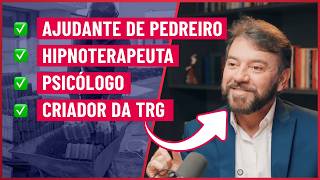
[06:38] old, I worked as a construction laborer, a bricklayer's assistant. But I was 1.77 m tall, like I am today, and I weighed 55 kg. A bag of cement
[06:51] used to weigh, and still weighs, 50. Thank God, in recent years, they've created the 25 kg bag of cement recent years, they've created the 25 kg bag of cement . Wow, that was my dream. . Wow, that was my dream. And then I remember taking a month
[07:04] 's salary and buying a book, Introduction to Psychology. He's right over there. Introduction to Psychology. He's right over there. It's a very thick book. At the time, it was almost my entire salary, practically my whole salary.
[07:17] That book was very expensive. So, why? Because I translate psychology, I wanted to be a psychologist. I always wanted to. I had a lot of problems. I was insecure, I had traumas, fears, anxieties, I had nightmares, I had insomnia, anxiety,
[07:31] in short, it was a terrible case. Yeah, and I thought psychology was going to save me. And when I started reading that book, Introduction to Psychology, I remember to buy it and saying, "Son, the money is yours, but I have a
[07:47] very high degree of responsibility and so on." Then they gave the authorization, and I went there to buy the heavy book and all that. When I started reading, there were experiments with rats, experiments on architecture, and so on,
[08:03] history, but nothing about what the psyche is, how it works. I the psyche is, how it works. I understood, I hated that. I closed the book and became disillusioned with psychology. Now look, I lived in an
[08:19] extremely poor environment. I had never met any psychologists; they didn't exist where I lived. That was an alien. Well, actually, I don't remember knowing anyone with a college degree in our neighborhood either.
[08:33] . So, I had no access, there was no internet, I had no access to anything. So, for me, that was psychology. And then I let it go. Then we return to the period of depression, the second depression. Uh-huh
[08:46] . Well, I started to get desperate because I needed to get out of that situation, so I started reading, reading, reading. I started studying neurolinguistic programming. I specialized in everything I could.
[08:59] Naturally, what I saw—and I'm very critical of what works and what doesn't—was what I saw. critical of what works and what doesn't—was what I saw.