
Retire in 3 Years? Insane Strategy!
45sThe promise of retiring in 3 years through entrepreneurship is a high-engagement hook that sparks curiosity and debate.
▶ Play Clip"Delivers a thorough breakdown of 15 strategies as promised, though the timeline visualization is only described, not shown."
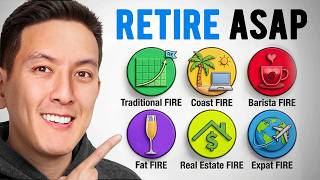
This video provides a comprehensive breakdown of 15 different strategies for achieving financial independence and retiring early (FIRE), placing each on a timeline from year zero to year 30 based on how quickly they can lead to early retirement. Using a hypothetical person earning $100,000 per year, the presenter explains the mechanics, pros, and cons of each approach, from traditional FIRE to more niche strategies like Coast FIRE, Barista FIRE, and Fat FIRE.
The video introduces the concept of financial independence retire early (FIRE) and promises to break down every strategy on a timeline, using a hypothetical person earning $100,000 per year for simplicity.
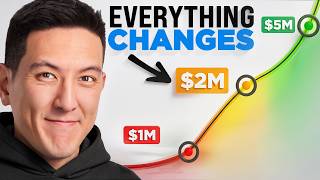
The OG strategy: save 30-50% of income, invest in low-cost index funds, and follow the 4% rule. Target portfolio is 25 times annual expenses. For a $40,000 annual withdrawal, that's $1 million. Timeline: ~15-18 years.
Build a business (e-commerce, SaaS, content) and sell it for a lump sum or generate cash flow. Fastest but most volatile. Use solo 401k or SEP IRA for tax advantages. Timeline: ~3 years if successful, but uncertain.
Save aggressively early, then stop contributing and let compounding work. Example: saving $40k/year for 5 years from age 23 yields $253k, which grows to $5M by 67. Timeline: ~7 years to reach the coast point.
Build remote income and combine with investments while living in lower-cost areas. Not fully retired but work on your own terms. Use solo 401k and taxable brokerage for flexibility. Timeline: ~7 years.
Live on 25-30% of income, reduce expenses to minimum. Example: $30k annual spend requires $750k nest egg. Saving $50k/year with 8% returns achieves FIRE in 9-10 years. Timeline: ~9 years.
Semi-retirement: leave high-stress job, take part-time job (e.g., barista) for income and health insurance. Calculate gap between expenses and part-time income; nest egg = 25x gap. Timeline: ~10-11 years.
Blend investment income with earned income from consulting, freelancing, or side business. Less consistent than barista fire. Timeline: ~12-14 years.
Earn high income from a high-cost area but live in a lower-cost area. Geoarbitrage is medium-term; expat is permanent. Example: $60k expenses drop to $35k, reducing target portfolio from $1.5M to $875k. Timeline: ~11-13 years.
More sustainable than extreme frugality: spend $35-40k/year. Example: $40k spend requires $1M portfolio. Saving $35k/year with average returns hits in 13-15 years. Timeline: ~13-15 years.
Build cash flow from rental properties. House hacking with FHA loan (3.5% down) is a common entry. By year 12-16, generate $48-72k/year rental income. Cons: landlord duties, vacancies. Timeline: ~15 years.
Live off dividend income without selling stocks. Example: $50k/year at 4% yield requires $1.25M in dividend stocks. Slower than traditional FIRE. Timeline: ~22 years.
Pension FIRE: work for government/military/union for a guaranteed pension. Slow FIRE: save 15-20% and enjoy life, retire at 57-59. Timeline: pension ~25 years, slow ~27 years.
Financial independence on steroids: spend $100k-500k/year. Requires $5-10M portfolio, usually from high income or business sale. Unlikely at $100k income. Timeline: ~28-35 years.
The video presents a comprehensive overview of 15 FIRE strategies, each with different timelines and trade-offs. The presenter suggests that most people should aim for Slow FIRE as a sustainable and realistic approach, while acknowledging that the best strategy depends on individual circumstances and risk tolerance.
What is the 4% rule?
A rule based on William Bengen's study that retirees can withdraw 4% of their portfolio annually without running out of money, even in worst-case market scenarios.
01:04
What portfolio size is needed for traditional FIRE if annual expenses are $40,000?
25 times annual expenses, which is $1,000,000.
01:18
What is the key difference between Coast FIRE and Digital Nomad FIRE?
Coast FIRE prioritizes saving a lot early and then taking a chill job, while Digital Nomad FIRE involves saving moderately and working remotely from lower-cost areas.
07:06
What is the target portfolio for Barista FIRE if annual expenses are $50,000 and part-time income is $20,000?
The gap is $30,000, so the nest egg needs to be 25 times that, which is $750,000.
09:30
What is house hacking?
Buying a duplex or small multi-family property, living in one unit, and renting out the other, often using an FHA loan with as little as 3.5% down.
14:13
What is the main advantage of Pension FIRE?
It provides a guaranteed monthly income for life, similar to a paycheck that never ends, without relying on market performance.
16:44
What is the approximate timeline for Fat FIRE?
28 to 35 years, often requiring a very high income or a business sale to accumulate $5-10 million.
19:06
The 4% Rule
This is the foundational principle behind most FIRE strategies, providing a clear withdrawal rate for sustainable retirement.
01:04Coast FIRE Example
Illustrates the power of compounding: saving $40k/year for 5 years grows to $5M by age 67 without further contributions.
04:31Geoarbitrage Portfolio Reduction
Shows how relocating to a lower-cost area can significantly reduce the required nest egg, from $1.5M to $875k.
12:14Slow FIRE Recommendation
The presenter suggests most people should aim for Slow FIRE as a sustainable and realistic approach, balancing saving and enjoying life.
17:36[00:02] early and hit financial independence. Some of them can take you under 5 to 10 years, but some will take 30. Now, most people have only heard of one or two of them. Today, we're going to break down every single strategy, and instead of
[00:14] something a little bit different. I'm going to lay all the strategies on a timeline. Ricky, bring up the timeline. On the left, year zero. On the right, you'll have year 30, and every strategy in today's video lands somewhere on this
[00:26] timeline based on how quickly it can get you to retire early. We're going to be using a person hypothetically earning $100,000 per year just to keep the numbers simple and easy to follow, but as you're watching, you can plug in your
[00:38] you would land. Now, let's get into strategy number one today, and that is traditional FIRE, or financial independence retire early. This is the OG recipe to retire early. It stems from the fact that you want to save as much
[00:51] of your income as you can, typically between 30 to 50% of your income, and you'll want to invest in low-cost index funds and follow what's called the 4% rule. About 30 years ago, a financial advisor named William Bengen studied
[01:04] retirees could withdraw 4% of their portfolio every single year without running out of money even through some of the worst stretches the market has means that you want to get your portfolio to a size of 25 times what
[01:18] your desired yearly withdrawal number is. So, if you wanted to withdraw $40,000 per year, you would aim for a portfolio size of 40,000 * 25, which is $1 million, and that way you could withdraw 4% per year. The idea here is
[01:31] that your portfolio gains will make up for your withdrawal and then some so the worst performing stretches of the market. On our timeline today, that hypothetical person earning about $100,000 per year, they'll probably get
[01:45] there in about 15 to 18 years depending on their savings rate and market returns. So, for that reason, let's place it around year 16, and this will be our baseline for retiring early. Now, let's see which strategies beat it and
[01:57] which ones take longer. Strategy number two today is known as entrepreneur fire saving your way to financial independence, you build a business that grows. You will then either sell it for a lump sum or you get it to a point
[02:10] where it's generating you some cash flow to cover your expenses permanently. So, for someone who is making about $100,000 per year at their job, you would have to building some sort of e-commerce brand, a SaaS product or perhaps a content
[02:23] business or agency. If you're able to sell it within, let's say, 3 to 5 years and you make 1.5 or 2 million dollars, then technically, you're done using the 4% rule. Now, this is a huge wild card, right? Like, some people are going to
[02:36] their business and they're going to be able to sell it within 3 years, but their business off the ground and it might not even be successful and they might even lose money doing it. So, while entrepreneur fire is the fastest
[02:49] possible path to early retirement, it's also the most volatile. If you are going to try entrepreneur fire, you definitely at least want to set up at least a solo 401k or a SEP IRA if you want something simpler. So, in both cases, these are
[03:01] retirement accounts designed for self-employed people. The solo 401k lets you contribute as both the employee and the employer, so you can contribute up to $72,000 a year if the business is doing well. I believe the SEP IRA has
[03:13] so, the point is pretty much the same here, which is that if you are building want to be sheltering as much of that income from taxes as possible while it grows. So, we won't know if entrepreneur fire will work out in 3 years or 10
[03:27] years or perhaps never, but still on our timeline today, I think entrepreneur fire is still the fastest way to retire early provided you do very well. So, we'll put it at year three on the timeline with a big asterisk by it
[03:39] because you just never know if it'll work out. This next method though, still come with some sacrifices and that strategy is called coast fire. Now, this is one of the strategies that's It's of a checkpoint rather than achieving the
[03:52] end goal. In Coast FIRE, the strategy is to save aggressively until you get to contributing entirely to your retirement account. It's at that point where you've portfolio is compounding in the background and you can retire at a
[04:06] traditional retirement age as long as you can cover your expenses day-to-day. that still sounds like you're working." And well, you would be correct because it's called Coast FIRE. The idea is that you are coasting at your job or you're
[04:18] taking a lower-paying job that you love instead. With that job, the only goal of it is to earn enough money to cover your living expenses, but you're not saving the amount that you've already aggressively saved is going to compound
[04:31] let's say our 100k earner saved aggressively for the first 5 years and they saved $40,000 a year into index funds. That means if they started at the age of 23, by the time they're 28, they would have $253,000
[04:45] in their nest egg. They then stop contributing altogether and after 39 years of compounding to the retirement age of 67, they have over $5 million. Of course, the key thing to note here is that this person started very early and
[04:57] had 39 years of compounding. So, depending on how old you are and what be very different for you based on Coast FIRE. Ideally, your funds are held you to have tax-free compounding, which
[05:10] Another account that you could use with the Coast FIRE strategy is the traditional 401k because the tax break on early contributions is going to be pretty massive in helping you compound to that amount. Still, I'm a pretty firm
[05:22] Coast FIRE within 10 years as long as they're being reasonable with their expenses and they are saving aggressively. Sure, it might suck for 10 FIRE, then you could actually do that. For our timeline today, I'm going to
[05:35] place it on year seven, but this is just to get to the Coast point only. This next strategy to retire also takes some creativity because it involves you moving and working on the go and that is called digital nomad FIRE. This is a
[05:47] strategy that didn't really exist about 15 years ago, but it's the idea that you portfolio as long as you never fully stop earning money perhaps remotely. So, instead of grinding 9-5 for 20 years at a corporate company, what you're going
[06:00] to do instead is build up a remote income either you're freelancing or online business and then you are combining that with a smaller investment expenses. The idea here is that you're usually working in a lower cost of
[06:14] you're experiencing life, but you're still earning some money working the 40-hour work week. You're not completely retired in the traditional independent in the sense that you are working on your own terms and you're
[06:28] probably saving a lot of money because of the cost of living difference. In something that you really enjoy from wherever you want and with time zone changes that means you could work hours that could still give you a lot of free
[06:40] like you work very early in the morning Most digital nomads can probably benefit from a solo 401k because a lot of them are self-employed and a taxable brokerage account is also helpful
[06:53] because you need flexibility and global access to your funds. So, I would always prioritize those two accounts. On our timeline today, digital nomad fire lands interesting is that coast fire and digital nomad fire sound very similar,
[07:06] Coast fire is the strategy where you prioritize saving a lot early on. You're you hit that number and then you just take a chill job at home and you let compounding do the rest. Digital nomad fire lets you save moderately and you're
[07:21] flexibility as of right now and what going to be as hard as the person working on coast fire because you're freedom as you pursue this strategy. Both of these strategies are really
[07:33] great to get you out of the traditional 9-5 type of job, but they just do it in actually fully retired. This next strategy though requires a lot of sacrifice it's not a strategy where you need to still continue working but it is
[07:46] going to be very hard because it's called extreme frugality fire. As its name suggests, it means that you are literally going to be the most frugal early. This relies on you reducing your living expenses to the lowest
[07:59] sustainable level. I'm talking about you possibly living with many roommates or shoebox. In addition, you are reducing your consumption considerably so you're don't have a car payment and you definitely don't subscribe to any apps
[08:13] or streaming services. On the r/frugal subreddit, you're probably the one that you found that really work or maybe you're the co-worker that this poster is referring to who gets the exact same dollar and $0.25 meal every day. For our
[08:27] year, that means you are living off of 25 to 30% of your income and you are math here on financial independence, if someone is spending $30,000 per year in
[08:39] annual spending, they would technically need a nest egg of $750,000 in order to achieve financial independence retire early. That means in about 9 to 10 years of saving $50,000 per year after tax and getting an 8%
[08:52] return in the market, you can actually fire based off of extreme frugality. The keep up this lifestyle indefinitely if you wanted to retire right then and there. So on the timeline today, extreme frugality fire is placed right at year
[09:05] not without some sacrifices. Next up on our list is barista fire. This one will land you around year 10 or year 11 on semi-retirement strategy where you basically want to leave any high-stress
[09:17] career job. You want to leave that early and instead you just take on a flexible part-time job like being a barista. To calculate barista fire, you would take your total annual living expenses and subtract your expected part-time income.
[09:30] off of $50,000 per year and you expect barista to be about 20k per year, your gap is $30,000. That means your nest egg needs to be 25 times that or 750K in order to barista fire with the part-time
[09:45] income job of 20K per year. The main benefit is that many of these part-time they provide you some sort of employer subsidized health insurance and this years go by. Now, this strategy isn't just limited to baristas. You could be
[09:59] local golf course or you could do some seasonal work like you work at a summer were to do the strategy, I'm definitely working at the golf course so that I can think for me that would be a win-win and I would save a lot of money doing that.
[10:14] strategy called hybrid fire and I'm covering it here because it's essentially the expanded version of barista fire. Instead of a simple fire means that you're blending your investment income with any kind of
[10:28] earned income. This usually refers to having some sort of knowledge-based job consult for a few months of the year and then you take the rest of the year or you're a freelancer or maybe you run a small side business that brings you 25K
[10:41] a year while your portfolio covers the gap. The income source of hybrid fire is a little bit less consistent than say a customer-facing job of barista fire. So, for hybrid fire, I'm probably landing that around years 12 to 14. It's just a
[10:53] because the earned income is a little bit less consistent. The next two closely related so I'm just going to cover them together and they are called geoarbitrage fire and XPAT fire. Geoarbitrage fire is the broader concept
[11:08] of the two. You're essentially getting a high-income job from a place based in something like that and then you're going to relocate yourself to a place further. Some companies are going to recognize this and they will give you a
[11:22] way when they find out that you're moving, which makes this a little bit find a company that doesn't do that, then this is where this strategy really shines. So, imagine you're getting paid an SF tech salary of a $180,000 per
[11:37] year, but then you're able to relocate to Bozeman, Montana or Boise, Idaho. That would count as geo arbitrage. Or you can even do something international like you go to Portugal, Mexico, Thailand, or Costa Rica. The expat fire
[11:49] So, instead of being strategic about moving abroad long-term. The first one was more perhaps about the medium-term, but the expat fire is more a long-term permanent move. With expat fire, that
[12:02] you're setting up a bank account there, you're probably navigating their healthcare system as well. For our hypothetical 100k earner, let's say you were spending 60k year in a high-cost city. Well, if you're able to relocate
[12:14] somewhere where your lifestyle costs $35,000 a year instead, then your target portfolio is going to drop. Instead of needing $1.5 million to fire, you only need $875,000, and that means you can retire a lot
[12:26] earlier without having to save more money. Both geo arbitrage fire and expat hybrid fire. So, I'd put this around years 11 to 13 on our timeline. All right, if extreme frugality fire earlier in this video sounded too intense for
[12:39] called lean fire, is the more sustainable version. In our hypothetical example, lean fire means that you're spending more money than the extreme frugal fire person. You're probably spending between 35 to $40,000 a year
[12:52] instead of 25 to 30,000. So, yes, your target portfolio has to be bigger than someone that's doing extreme frugality fire, but with lean fire, you're going ahead of traditional fire. In this strategy, you're probably still cooking
[13:04] being intentional about where your money goes. That means you can probably still take a budget trip here and there, and you might have a gym membership. You're not living extremely frugally, but you are living quite simply. For our 100k
[13:18] earner, that means you're spending about $40,000 a year in annual spend. So, your million dollars. At a savings rate of around 35k year after taxes with average market returns, you're hitting that around years 13 to 15. So, you are
[13:32] than extreme frugality, but the quality of life difference between spending 25K year versus 40K year is really different. That 10 to 15,000 dollars a year difference in spend means
[13:45] life a little bit better on your way to financial independence. We are getting into the final stretches and this next strategy uses a completely different Every strategy up until this point has used some version of save money, invest
[14:00] it, and use the 4% rule, but real estate fire has you building cash flow from this is probably my least favorite strategy on the list and I'll tell you path that many people have used successfully, so let's break it down.
[14:13] fire is called house hacking, so that's where you buy a duplex or a small multi-family property. You live in one unit and you rent out the other. Because you are living in it, you can use an FHA loan with as little as 3.5% down instead
[14:27] properties usually require. The rent from the other unit will cover most or chunk of your income so that you can save it for the next property. You strategy and maybe each property adds up to 500 or 1,000 dollars a month in cash
[14:43] expenses like mortgage, maintenance, and insurance. By year 12 to 16, if you've you're generating four to six thousand dollars a month in rental income, and that becomes 48,000 to 72,000 dollars per year. Now, here's why I'm not a fan
[14:57] landlord. You're dealing with tenant repairs for washing machines at say 2:00 a.m. and any vacancy that you might have is going to eat into your cash flow and in my opinion, you're not really retiring early, you're just simply
[15:11] landlord, and that's why I personally don't like it. It's also not that interest rates are, but the people that love this strategy really seem to enjoy it. A huge pro is that you get to use a mortgage, so that means you have
[15:24] money to acquire assets and then your tenants are paying the mortgage for you. right at years 12 to 16, but let's put it at year 15. Next up is one I really this is where you build up a portfolio of dividend paying stocks and you live
[15:40] entirely off of the passive income without ever having to sell a single generate $50,000 a year in dividend income at 4% yield, for example, you would need $1.25 million in dividend paying stocks. So, the math becomes
[15:54] portfolio size that big, our hypothetical 100k earner probably needs to save between 20 to 25 years and invest enough in order to get that portfolio big enough. So, this is actually slower than traditional FIRE,
[16:07] people are going to love the psychological aspect, which means that amount. The fact that your portfolio is just spitting out dividends every single year is really nice and the underlying dividend stocks are generally less
[16:20] going to sleep better at night knowing that your future cash flow is safe, but still on the timeline, this will go somewhere between the years 20 and 25, so let's put it at year 22. Now, these two strategies before our final strategy
[16:32] of the day is what I like to call long game strategies and they are called pension FIRE and slow FIRE. Both are going to land in the 20 to 30-year range on our timeline and both are completely fine with that. Pension FIRE is unique
[16:44] investing, it's about working for a government, military, or union job long benefit pension, which means that you get that guaranteed check every month for the rest of your life. After many years of service, our $100,000 earner
[16:58] year, but that's really nice because it's kind of like guaranteed income, market, they just get a paycheck that never ends. The trade-off here is that you're committing to a specific career for two, three, or even four decades.
[17:12] So, for our purposes of the timeline today, we're I'm to put pension FIRE at year 25, but you can make an argument that it could be year 30 or even later. And then there's slow fire, which is basically the opposite philosophy of
[17:24] everything and speed running your way to financial independence, you are trying to save about 15 to 20% of your income and you're trying to enjoy your life while you're on the way to slow fire. At a $100,000 income per year, you're
[17:36] and the nice part of this is that you're not really sacrificing any years when actually think that most people should aim for slow fire. It's very sustainable and honestly, it's very realistic for you to retire at say the age of 57, 58,
[17:51] or 59. It's not going to be super early, but at least you're not finishing at say the age of 67. With that being said, slow fire will sit at around years 25 to 30 on our timeline today, so I will put it at year 27. The last strategy I want
[18:03] to cover today is probably the most fascinating subreddit to read and probably the one that takes the longest time, and that's called fat fire. Fat fire is financial independence on steroids. What that basically means is
[18:15] that you're so wealthy at this point that you can spend 100k, 200k, or even 500k per year in retirement. A fat fire person probably has really nice travel. houses. They're dining out whenever they want. They have full discretionary
[18:28] budgets to buy Rolexes, Pokémon cards, or whatever. It's kind of the version of fantasizes about. But the reality here is that most people are not getting to fat fire because in order to fat fire, you generally need a very high income.
[18:41] So you have to be someone like a doctor that owns their own practice, a VP of you're a business owner that sold it and just made multi-millions of dollars. have between 5 to 10 million dollars in
[18:54] a portfolio, if not more. So at our hypothetical income level of $100,000 per year, it's unlikely that this person even hits fat fire. It's definitely going to be the slowest path unless you're able to strike it big by selling
[19:06] an IPO. With that being said, where should fat fire be on our timeline? I think it's anywhere from the years 28 to 35, which literally doesn't appear on it, all 15 strategies placed on the timeline from year zero to year 30. My
[19:22] dividend fire. That's for some reason you enjoyed this video, you'll probably enjoy my video on every financial trap will leave it linked up right here. Also, let me know which one of these
[19:35] strategies you're closest to and if I missed anything, please let me know in that video or a future one on the channel. All right, thanks for being channel. All right, thanks for being here. Peace.


⚡ Saved you 0h 19m reading this? Transcribe any YouTube video for free — no signup needed.