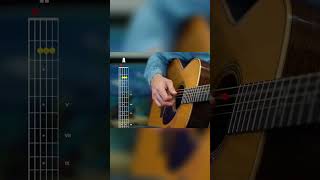

Move Your Thumb for Easy Chord Switches
30sGuitar beginners love visual chord-switching thumb hacks that simplify fingerpicking.
▶ Play Clip"Delivers a focused lesson on the forward roll, but 'Master' oversells a short technique demo."
This video teaches the forward roll fingerpicking technique on guitar, covering how thumb positioning changes for different chords and how rolling across string groups creates varied tones.
When adding chords, the thumb must move to match the chord root: for an E chord it plays the 6th string, for an A chord the 5th string, and for a D chord the 4th string.
The sound produced by the forward roll can be beautiful and very appropriate for certain songs, adding expressive quality.
The forward roll involves moving three fingers across different string groups, creating rolling arpeggiated textures.
Rolling on the inside string group produces a warmer, more mellow sound compared to the outside group.
Applying the forward roll even on a static chord is a great way to add movement and musical interest.
The forward roll is a foundational fingerpicking pattern that, with proper thumb anchoring and string-group awareness, transforms simple chords into dynamic, expressive music.
On which string does the thumb play for an E chord?
The 6th string (low E).
00:19
On which string does the thumb play for an A chord?
The 5th string.
00:31
On which string does the thumb play for a D chord?
The 4th string.
00:31
What is the forward roll technique?
Moving three fingers across different string groups.
00:56
What type of sound does the inside string group produce?
A warmer, more mellow sound.
01:11
Thumb Anchoring by Chord
Provides a clear, actionable rule for thumb placement across three common chords, forming the foundation of the technique.
00:19Core Definition of Forward Roll
Defines the technique succinctly, distinguishing it from other fingerpicking patterns.
00:56Tonal Contrast Between String Groups
Highlights how string choice affects tone, giving players creative control over mood.
01:11Movement on Static Chords
Shows that even without chord changes, the roll adds rhythmic and textural interest.
01:23[00:06] 3. And we're going to change which strings we put these fingers on. But to strings we put these fingers on. But to begin with, if we just start by doing
[00:19] we add chords to the equation, we want to move our thumb to accommodate each of those chords. So, playing an E chord, for example, we would have our thumb on the sixth string. Moving to an A chord, we're
[00:31] going to move our thumb to the fifth string. For a D chord, we'd move our string. For a D chord, we'd move our thumb to the fourth
[00:43] a beautiful and very appropriate sound for certain songs. for certain songs. [Music]
[00:56] the forward roll is moving these three fingers across different string fingers across different string [Music] groups. So, we get really two different sounds as we're doing a forward roll on
[01:11] the inside group, which is a warmer, more mellow sound. And then we get a three. And even that on a static chord is a
[01:23] really great way to add movement. [Music]




⚡ Saved you 0h 01m reading this? Transcribe any YouTube video for free — no signup needed.