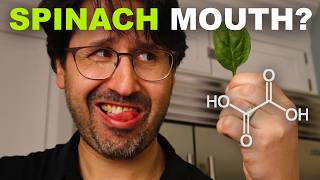

Why spinach makes your teeth fuzzy
45sThis clip explains a common, relatable experience that many people have but don't understand, making it highly shareable.
▶ Play Clip"The title accurately describes the content: a scientific explanation of the 'fuzzy teeth' feeling from spinach."
This video explains why spinach and other dark leafy greens cause a gritty, chalky, or 'fuzzy teeth' sensation in the mouth. The culprit is calcium oxalate crystals formed when oxalic acid in the plants binds with calcium in saliva. The video also discusses the health implications of oxalates, including kidney stone risk, and defends spinach as a nutrient-dense food despite its 'anti-nutrient' content.
Spinach and dark leafy greens cause a gritty, chalky, or pasty mouthfeel due to oxalates.
Oxalates are organic compounds (like oxalic acid) found in plants, named after the genus Oxalis. They protect plants against fungi and pathogens and help detoxify heavy metals.
Oxalates bind with calcium to form tiny, hard, sharp crystals that act as armor against herbivores. When you chew spinach, oxalic acid binds with calcium in saliva and enamel, precipitating as crystals on teeth, causing the fuzzy feeling.
Sorrel, Swiss chard, cassava, and dark chocolate are also high in oxalates. Cooking breaks down oxalates, but spinach is often eaten raw or lightly cooked, so the effect is more noticeable.
Oxalates can combine with calcium in kidneys to form stones. Healthy gut bacteria (oxalate-degrading) help prevent absorption. The video promotes Ritual's Symbiotic Plus for gut health.
Oxalic acid is an 'anti-nutrient' that inhibits mineral absorption, but this is not a reason to avoid spinach. Spinach is rich in vitamins A, C, K, folic acid, and iron.
In the early 20th century, weakness was often due to micronutrient deficiencies, not lack of calories. Spinach was promoted as a strength food because of its high micronutrient content.
Up to 95% of spinach's calcium is bound to oxalates and not absorbed, but this is beneficial as it prevents oxalate absorption and kidney stone formation. Modern advice: eat high-oxalate foods with calcium-rich foods.
The fuzzy teeth sensation is a chemical process, not a physical texture. It is an example of 'mouthfeel', which includes chemical sensations like astringency.
The fuzzy teeth feeling from spinach is caused by calcium oxalate crystals forming on teeth. While oxalates can contribute to kidney stones, a healthy gut microbiome and pairing with calcium-rich foods mitigate the risk. Spinach remains a nutrient-dense food worth eating.
What compound in spinach causes the 'fuzzy teeth' sensation?
Oxalic acid (oxalates) that bind with calcium in saliva to form calcium oxalate crystals.
01:15
What is the biological function of oxalate crystals in plants?
They act as armor to protect against herbivores.
01:15
Name two other foods high in oxalates besides spinach.
Swiss chard and dark chocolate (or sorrel, cassava).
01:46
Why does cooking reduce the mouthfeel effect of oxalates?
Cooking breaks down oxalates chemically.
02:03
How do gut bacteria help prevent oxalate absorption?
They degrade oxalates before they can be absorbed through the intestinal lining.
02:59
What is the current medical advice for preventing kidney stones from oxalates?
Eat high-oxalate foods with calcium-rich foods to form indigestible crystals that are excreted.
06:38
What percentage of spinach's calcium is typically not absorbed due to oxalates?
Up to 95%.
06:08
Why was spinach promoted as a strength food in the early 20th century?
Because weakness was often due to micronutrient deficiencies, and spinach is rich in iron and B vitamins.
05:07
Calcium oxalate crystals cause fuzzy teeth
Directly explains the central phenomenon with clear chemistry.
01:15Oxalates and kidney stones
Connects the mouthfeel to a serious health risk and explains prevention.
02:46Anti-nutrient debate
Addresses common concerns about oxalates as anti-nutrients and reframes them.
04:27Historical context of spinach's reputation
Provides historical perspective on why spinach was valued as a strength food.
05:07Mouthfeel vs. texture
Distinguishes chemical sensations from physical texture, defining 'mouthfeel'.
07:54[00:00] No, you're not making it up. Spinach and other dark leafy greens can make your mouth feel kind of weird, kind of gritty or chalky or pasty. Indeed, this is one reason why I think mouthfeel is a real
[00:18] thing and not some made-up foodie nonsense, as many have accused. But we'll get back to that. Spinach is unusually high in a class of organic compounds known as oxalates, like oxalic acid,
[00:30] which is named after the plant genus oxalis, or in the U.S. it might be pronounced oxalis. Wood sorrel, which is a thing that people eat sometimes, and it was the first kind of plant from which scientists isolated oxalates, which are toxic in large quantities, but perform a number of
[00:47] biological functions inside plants. They can protect against fungi and other pathogens. Oxalates will bond with heavy metals, thus helping the plant to detoxify itself. This is also why oxalic acid is good at dissolving rust, which is why they put it in lots of cleaning products like
[01:03] Bar Keepers Friend. Oxalates will also bond with calcium, giving you a calcium salt of oxalic acid, which forms tiny little crystals as salts tend to do. Plants integrate these hard,
[01:15] sharp little crystals into their tissues as a kind of armor to protect against the mouths of tiny herbivores. It is these same calcium oxalate crystals that make your mouth feel weird when you eat spinach. You chew, you release oxalic acid in your mouth where it binds with
[01:32] calcium in your saliva and your enamel and it precipitates in little crystals on your teeth, and that is what you are feeling. Some people describe it as fuzzy teeth, teeth that are just covered in teeny tiny little crystals that do not dissolve in water,
[01:46] which is why this feeling persists until those crystals just wear off physically or are dissolved by other acids like maybe citric acid in your salad dressing. And it's not just spinach. Here's an analysis of the oxalate content of various foods. Sorrel, obviously, and then there's the
[02:03] spinach. There's just as much in Swiss chard and other dark greens. Cassava is high in oxalates, but nobody notices because they're broken down by the cooking process. Nobody eats raw cassava, and even if you did, you probably wouldn't be able to break it down very much in your mouth
[02:18] where this chemical process has to happen if you're going to feel those little crystals. Spinach, on the other hand, is delicate and easy to physically break down in your mouth, thus releasing all of those chemicals. And it's the rare example of a dark green that we tend to
[02:34] cook very lightly or often not at all. So the oxalates are not chemically broken down in the cooking. They end up in our mouths and in our guts. Oxalates can combine with calcium in your
[02:46] kidneys to create stones. And kidney stones are bad news bears. A healthy person's body has a number of ways of preventing this phenomenon. One is to host oxalate-degrading bacteria in our guts,
[02:59] which we do. We have gut bacteria that literally eat the oxalates before we can absorb them through our intestinal lining. Just one of many examples of how gut health is important, which is why I take Symbiotic Plus from Ritual, sponsor of this video.
[03:15] As I have gotten older, I have needed to take my digestion a little more seriously and I will not get any more specific than that in the context of a food video. I eat lots of plants, I take a fiber supplement with my protein shakes, and I take Symbiotic Plus, Ritual's
[03:31] three-in-one prebiotic, probiotic, and post-biotic to support a healthy gut microbiome. Prebiotics support the growth of beneficial bacteria and post-biotics support gut barrier function.
[03:43] The probiotic itself is the bacteria, and this contains two of the world's most clinically studied probiotic strains, all inside a shelf-stable minty capsule that you can take any time with or without food. And it's delayed release to deliver live bacteria to your colon
[03:59] where they can actually do their thing, helping to break down your food to make it pass through your system without incident, let's just say. Well, I'll be specific about gas. I do notice less gas when taking my Symbiotic Plus, even with the vegetable and legume-heavy diet that I
[04:14] eat. Get 25% off your first Ritual order with my link and code in the description, adamragusea25, for 25% off. Thank you, Ritual. Anyway, oxalic acid, the stuff in spinach and other plants that
[04:27] binds with calcium in your mouth to make your mouth feel kind of weird. People who like to advance meat-based diets for various cultural and ideological reasons that we've discussed, people like that try to scare the rest of us about eating vegetables because oxalic acid is
[04:42] an example of an "anti-nutrient," something that inhibits the absorption of vitamins and minerals in the gut. This is true. This is real. It's just a terrible reason to avoid eating spinach.
[04:54] Popeye was right. Spinach is exploding with micronutrients. It's historically notable that cartoonists in the 1930s hyped up spinach as a strength-enhancing food rather than, say,
[05:07] beef or some other protein source. Why? Well, the specific historical reasons vis-a-vis Popeye are complicated and somewhat disputed, but I can speak to the broader state of health in the early 20th century. When otherwise healthy people were weak 100 years ago,
[05:23] it generally wasn't for lack of muscle tone per se, or even for lack of calories. It was for lack of iron and B vitamins and other micronutrients that are necessary for metabolism. If you don't have enough of those micronutrients, you are unable to extract energy from your macronutrients
[05:40] and you get weak and tired even if you're eating enough calories from bread and stuff. This is a phenomenon that's well-documented in centuries of history and literature, especially stories about soldiers on campaign or sailors at sea. It's why they used to say
[05:55] that vitamins promote vitality, which is part of why they're called vitamins. Anyway, spinach is a great source of vitamins A, C, and K, folic acid, iron, and spinach has a lot of calcium,
[06:08] but it is not a great source of calcium. Because as much as 95% of that calcium is going to be bound up with the oxalic acid in tiny little crystals that cannot pass through your gut lining. You just eliminate them. But that's okay because you can eat other foods
[06:25] to get more calcium. Spinach doesn't have to have everything, and it's good that calcium binds with oxalic acid because, otherwise, that oxalic acid ends up in your kidneys where it makes stones.
[06:38] A long time ago, they used to tell people with these kinds of kidney stones to minimize calcium, but now the mainstream medical advice is to do the exact opposite. If you're going to eat high
[06:50] oxalate foods, eat them with a lot of calcium so as to form indigestible crystals that you safely dispose of in your bathroom. Now, there is one other high oxalate food that I notice will sometimes make my mouth feel a little weird, and that's chocolate, particularly very, very dark,
[07:08] minimally processed chocolate. Coco solids contain a whole lot of oxalates, and depending on how the beans were processed, you can end up with a decent concentration of oxalic acid in your mouth that forms those tiny calcium crystals on your teeth. It's not as dramatic as spinach,
[07:23] but it happens. Is that part of the texture of dark chocolate or spinach? No, I don't think so. I think that texture is a physical property of food. It's how the food structure feels as you
[07:37] bite into it and you mash it around in your mouth. In contrast, this fuzzy teeth feeling is the result of a chemical process that happens in your mouth when you eat certain foods. It is not the feeling of the food structure itself. Therefore, I think that we can aptly describe this and
[07:54] other sensations as "mouthfeel", a category that includes texture but is not limited to texture. There's other chemical things that affect how your mouth feels when you eat, like the astringency
[08:06] that you get from acidic foods like dark chocolate or the lemon, that puckering feeling. It's a similar sensation with a different chemical cause that we will discuss on a different day.




⚡ Saved you 0h 08m reading this? Transcribe any YouTube video for free — no signup needed.