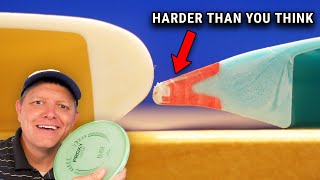

How Disc Golf Discs Are Made
45sThe opening of the video teases a unique manufacturing process and the combination of outdoor activity with engineering, appealing to both disc golf fans and manufacturing enthusiasts.
▶ Play Clip"Title accurately describes the video content: a detailed tour of MVP's disc manufacturing process."
This video from Smarter Every Day takes viewers inside MVP Disc Sports' manufacturing facility in Michigan to explore how disc golf discs are made. Host Destin Sandlin walks through the entire process, from raw plastic materials to injection molding, robotic automation, and final quality control, while also sharing the story of how a single championship shot skyrocketed the company's demand.
Chad and Brad Richardson, brothers and founders of MVP Disc Sports, invited Destin to tour their factory in Marlette, Michigan, to learn about their unique overmold manufacturing process.
MVP started as a hobby, with the brothers packing orders and stamping discs themselves. It took five years before they hired their first employee. The company now employs people from the Detroit area, creating new manufacturing jobs in rural America.
The overmold concept originated from a summer game where Chad stretched a rubber band around a disc for grip. This led to the idea of rubberizing the outer rim to improve catching and stability, eventually evolving into the overmold design.
A disc golf disc is essentially a gyroscopic aerofoil. Increasing angular momentum (moment of inertia) increases stability, which is a key goal in MVP's disc design.
MVP uses American-made plastics, including TPU (thermoplastic polyurethane) which is hygroscopic and must be dried before processing. The material is stored in gaylords, then dried in hoppers using hot air to remove moisture.
The plastic pellets are fed into a reciprocating screw that melts them through friction and barrel heat. The screw then injects the molten plastic into a mold cavity. Fill time is about 5 seconds, followed by 30 seconds of cooling.
Water flows through the mold to cool it, with turbulent flow used for efficient heat transfer. After cooling, ejector pins push the disc out. The mold includes vents for air escape.
Chad designed robot cells with light curtains for safety. A collaborative robot (cobot) picks up discs, transfers them to a trimmer, and then to a laser for marking. The cobot uses force sensing to avoid harming humans.
A groove cutter trims the sprue, runner, and gate from the disc. The disc is then weighed on a scale under a laser, which burns the weight onto the disc. The laser also marks the disc with other information.
A color feeder mixes different colored pellets to create swirly patterns. The system uses a Plinko-style merge and magnets to capture ferrous material. Recipes are built on a controller.
A hot stamp machine applies foil graphics to discs. The operator uses two hands for safety. The foil stamping process can produce multi-colored designs with multiple foils.
In 2021, James Conrad won the World Championship with a 250-foot putt using an MVP Envy putter. This moment caused a massive surge in demand, leading MVP to purchase seven new injection molding machines to keep up.
MVP Disc Sports combines innovative overmold technology with advanced manufacturing automation to produce high-quality disc golf discs. The company's success was dramatically accelerated by a single championship-winning shot, highlighting the intersection of sports, engineering, and business.
What is the name of the company featured in the video?
MVP Disc Sports
00:43
What is the overmold?
A rubberized outer rim on a disc golf disc, originally inspired by a rubber band stretched around a disc for grip.
03:09
Why is plastic dried before injection molding?
Because TPU is hygroscopic and absorbs moisture from the air; drying removes moisture to prevent defects.
05:58
How long does it take for plastic to fill the mold cavity?
Just over five seconds.
12:06
What is the purpose of the check ring on the reciprocating screw?
It moves back to close off the path when the screw moves forward, allowing high pressure to build for injection.
14:15
How does the collaborative robot ensure safety?
It has force sensing on every axis, so it stops if it bumps into a person and won't cause bodily harm.
20:42
What event caused a massive surge in demand for MVP discs?
James Conrad's 250-foot putt to win the 2021 World Championship using an MVP Envy putter.
29:07
What is the term for a disc golf disc's aerodynamic property?
Gyroscopic aerofoil.
04:03
Origin of the Overmold
A simple rubber band experiment led to a patented manufacturing process that defines MVP's product line.
03:09Disc as Gyroscopic Aerofoil
Explains the physics behind disc stability and why increasing moment of inertia is a design goal.
04:03Injection Molding Cycle Time
Provides concrete numbers (5 seconds fill, 30 seconds cool) that illustrate the efficiency of the process.
12:06Collaborative Robot Safety
Highlights the engineering trade-off between speed and safety in industrial automation.
20:42James Conrad's Impact on Business
Demonstrates how a single sports moment can dramatically affect a manufacturing company's capacity planning.
28:55[00:00] A lot of people have been reaching out for a long time asking me So today we're doing a video about disc golf. of a lot of things I love.
[00:14] You've also got just spending time outdoors with your And then today, the special thing we're going to talk about is manufacturing, how So obviously the aerodynamics of the disc are important because when you drive
[00:31] to the basket as you can. that's important, too, because you want the putter to fall down in the basket.
[00:43] Chad and Brad Richardson from MVP Disc Sports up in Michigan, and we want to sponsor a video or a series of videos on disc golf
[00:55] So today I'm extremely excited because MVP Disc Sports does this And a lot of people in the disc golf community think that's really cool for But that is an interesting process, and we're going to learn about it as
[01:10] We've learned about metal stamping, roboforming, some really cool processes used to create films, and this video is going to roll into that. We're going to learn a ton of stuff about injection molding, about robotics, about
[01:25] So let's go get Smarter Every Day in Marlette, Michigan, and let's learn how MVP Disc Sports manufactures disc golf discs. [Intro guitar music riffs]
[01:40] It's SO good. Summers in Michigan are absolutely beautiful. This is the headquarters and factory for MVP disc Sports.
[01:56] I was led in by Shelly, and then we passed a putting green and met Brad and Chad, the two brothers I told you about
[02:08] These are people that had a vision. and they're using the talent pool from all over the Detroit area that traditionally They're all pulling together, and it's been a huge thing for the local community.
[02:25] New manufacturing jobs in rural America using new technologies. I would love to see this model replicated across all of America. It was just more of like a hobby.
[02:40] Then we would go home and pack orders, stamp this. Five years before we got our first employee, four or five? [D] Slinging disc.
[02:54] of is the phrase we use. It's out there. There's 12,000 courses worldwide, and we sell a lot of disc. And your thought was, if I could rubberize the outside
[03:09] [C] We were playing one summer, and it had a traditional disc I stretched that rubber band around the perimeter just for that grippy
[03:22] The idea would be, oh, maybe that could help catch We We figured, well, we can try making that. [D] The intention wasn't to have a gyroscopic effect.
[03:38] That's where the idea started. [C] Just because those were too light and we said, Hey, we need to make it heavier,
[03:50] put it in the center on the overmold, and that's when it clicked. [B] Year number 2 was we made a mid-range disc, which was more focused [C] If you throw a disc with no rotation, it just flips end over end.
[04:03] Ultimately, it's a gyroscopic aerofoil. That's really what it is. If you increase that angular momentum, you're increasing the stability. [D] If I had to guess, I would say you've done a lot of research into how dense
[04:17] [C] That's our job, pushing those limits to increase that. That is our entire goal, increase that MOI. other things players look for, of course [D] Okay, there's two main ways that they
[04:31] So we'll put that right here so we can see the difference. Okay, so this is a heavier plastic, this red stuff here. [D] And this is a solid mold, a solo mold, you call it?
[04:46] [D] So whether it's a solo mold or an overmold, the manufacturing So what we're going to do is we have this roadmap here, and we're going to go And we need to give ourselves permission to jump around along the way because
[05:02] But let's dive in and start at looking at the materials that go into the process. [B] This is the manufacturing warehouse. Okay. Most of our plastics are made in America, which is great.
[05:18] is American-made plastics. [D] Got it. [B] Clear plastic granules here. When I When I squeeze it, I can feel that it's giving away, like it's pliable.
[05:33] [B] Yeah, vacuum line here. [D] Where's it going? [D] You have all this built. [C] You want to automate your material handling.
[05:46] and you've got all the material here, and it feeds up, goes to your dryer, and That's a very crucial step prior to the next building.
[05:58] At least for this particular polyurethane it's very hygroscopic. Hygroscopic, meaning it absorbed moisture from the air. You want to remove the moisture.
[06:12] [D] Step one, we get it from the shipper or from the supplier. [D] Step two, we have to dry it. [B] Yes. [C] Those lines coming from the gaylord, those have plastic in them.
[06:28] [D] What? [C] And they go here. [C] We work with a company that helps us fit it to our specs. [C] Aluminum, but the elbows are stainless steel.
[06:44] [C] The elbows have to be a tougher material because as that material makes that turn, [B] Well, you could see all the different grades of plastic granules [C] The temperature and time at which you dry is important.
[06:59] [C] This is our resin selection station. We can change these hoses, which changes which machine, which plastic goes to. Basically, this is a central system.
[07:13] [D] It looks like you're taking Cat 5. [B] Yeah. Which one is it? [B] That's probably going to the drying hopper. Okay.
[07:27] So for For example, we have a soft version or a firm version, we can switch it Much easier than trying to redo a bunch of lines.
[07:39] That's a manifold. [C] It comes over and into these first, and then it goes out the bottom here
[07:55] [C] This is right before it goes to the machine. [C] Based on how much we're consuming at any given time, how much of that material is being used, if we raise this, it will increase its dry time because it
[08:09] gives you how much time it's exposed to the dryer. [D] It's almost like a grain bin. [B] Exactly. So on the grain bin video, we talked about you put the beans
[08:24] Are you blowing air? [D] Yeah. That's air? Exactly like it. [B] Starts right over here.
[08:36] [B] It's blowing the hot air through each system. [C] Yes. [D] Got it. That level sensor is our demand.
[08:51] So as a machine consumes plastic, if it gets below that level sensor, [D] So where's the master controller for this whole I love how they both know the whole system.
[09:04] Press one, loader one, press one, loader two. Dominic is MVP's process expert on injection molding. He's going to show us where that material first starts to be melted.
[09:19] When you put the TPU beads in here, are you heating it up or is this [DOM] This is a reciprocating screw. [D] Friction. Now, we have barrel heat on this, but most of the heat that
[09:40] into the barrel itself. These heaters on there are just to maintain that minimum level of heat. how fast you're filling, those are all going to affect your sheer
[09:55] [D] Chad took me over to another machine to show me the screw outside of the machine. [C] Yes. Yeah. [D] So plastic pellets go here.
[10:10] [DOM] It turns this way and it feeds the plastic forward. And as it moves forward up the screw, the diameter between the flights increases. and that's where that friction kicks in and melts our pellets.
[10:29] [C] This right here is a smaller diameter compared to out here. [D] But is the outside of the helix the same diameter? [C] Outside of the outer is the same, and that fits in this diameter here.
[10:43] [C] Yeah. [D] All right, so plastic goes in there, which feeds into about right here. As it's turning, it's pushing the plastic forward.
[10:59] Is this heated as well? So the process is called injection molding. That implies that this auger is injecting the plastic into a mold.
[11:13] And the cool thing about the product today, you remember we were talking about the core mold that they make, and then they put the overmold on the outside. Well, the product they're running today is glow in the dark, which is awesome.
[11:27] You see which one has the overmold on which means the raw materials Let's go make some discs. We'll get to one that's running.
[11:40] [D] So this is the injection mold, right? [B] Yep. You have two faces, and we have this picker here
[11:54] So we have a cavity in there, and we're injecting plastic, right? And how long does it take for the plastic to flow in?
[12:06] [DOM] On this process, just over five seconds for the plastic to fill the cavity. After that, there's about 30 seconds worth of cooling in the mold. That will set the plastic up enough for it to be able to demold
[12:22] [D] Are you flowing water through the metal part of the mold to cool it down? Is it chilled water or just room temperature water? If you look on the bottom, we have two water circuits on each half.
[12:41] We regulate the flow on that, so we have a turbulent flow. This is the rare case where laminar flow is not as awesome as turbulent flow.
[12:56] Sean's got a mold, and he's to break it apart and show us the inside. [D] So this is an insert mold. [S] And the plastic would inject throughout here.
[13:12] Whatever profile we put in, it fills in from the side here, get our perimeter. Then when it's done, it opens up, and these pins push the disc out.
[13:25] These are the actual inserts that go into that larger mold assembly. [S] These are all of our overmold inserts. So some halves match up with other numbers, but most of the time,
[13:43] So you'll get the top flight plate. And then you'll have a bottom flight plate, which where your
[13:58] [S] And like I was saying, this profile is usually out here a little [D] Chad gave me access to his 3D CAD files for the overmold so I could animate what's The plastic pellets are fed from the hopper down into the screw,
[14:15] Now, remember, this is a reciprocating screw, which means it has the ability Notice this yellow check ring is moving. so so to speak, by pushing plastic through the holes that are under the check ring.
[14:33] When the screw moves forward, however, the checkering moves back and it closes extremely high pressure. a pipe that branches into other pipes.
[14:47] The plastic in this manifold stays liquid because it's electrically heated. Let's remove that liquid so we can see how the plastic is flowing into the mold. When the screw pushes forward, it pushes the plastic into the manifold,
[14:59] and then it splits and flows to both sides of the mold cavity as it fills it. The air in that cavity escapes through specially-cut vents that are in the mold. Water is flowing through the mold body on the backside of the plates, drawing
[15:12] The amount of time it takes the part to cool down and solidify The mold opens and the ejector pins then kick out the disc. We're going to take the cores and we're going to go all the way through
[15:27] and it's amazing because Chad designed these robot cells that just move There's lasers, you're going to love this part.
[15:39] [C] This is protected with light curtains, floor as well as the walls. You can see different ones. It runs through one, two, three, four, then rotates.
[15:53] In this case, they're all uniform, but a lot of times, if it's not glow in the dark Before this cell, someone's job was to shuffle all the colors.
[16:07] This is so we can go one, two, three, four. And you just keep it shuffling the whole time. That's a pretty wild end effector there. Oh, yeah.
[16:23] I partnered with- [D] Did it spray something on there? There was a small pneumatic cylinder that is knocking the disc below [D] That looks like something you added on afterwards because you had a problem.
[16:40] All right. It goes through that jig. [D] It looks like you're setting it in there and you're indexing for a position.
[16:55] [D] It indexes in such a way where it always And with our different diameters, we have offsets on our control panel
[17:07] [D] So it's waiting on the last one to shoot. It's going to go take out the shot, and it's going to put another one in.
[17:19] So it's unloading and loading at the same time. [C] Yes. It wants to be a catch. [D] After we come out of the protected area here, so we're going to...
[17:35] [C] This is your... [C] Where it's coming from your sprue to a runner to your gate where it's And then also our added trim groove feature, which is not traditional.
[17:52] So this makes a cutting condition. Oh, this is our transfer jig for the collaborative robot to pick up from. It trim that outer perimeter, trimming the gates as well as
[18:08] I call it flash trimmer, but it's more of a groove cutter. We move the blade up and down to extend the life. You actually move it vertically. [C] Yeah.
[18:22] [D] Oh, and you have just a little micrometer adjustment here. [C] You can see we have a vacuum cup that lifts that part up. The robot can go in, drop, lift up, and grab it all in one entry.
[18:37] It's all one entry. [D] This is a... Proximity sensor is everywhere. Robots are blind, so you got to tell it where the parts are at any given time.
[18:52] [C] In this case, this transfer stand, so it's going to wait at the end of a cycle. That cobot's waiting, and it's going to meet it.
[19:07] Get things to settle, because every once in a while... Well, the problem is when it locates on those two pegs,
[19:19] our two runners sometimes can be index a little funny, where it can So we do a little bit of that wiggle motion to make sure it settles in between those grippers.
[19:34] [C] And that lines it up here for the trimmer as well. [D] This is probably the most pleasing part of the process.
[19:46] All the hard work feels good when you see it move. [C] Yeah, you could pull it up. [D] This is going to go to regrind. [C] Recycled. Our recycled line is called R2.
[20:02] Any waste material that comes out of here, we felt it was better to make a product It's part of our mission of sustainability of being able to use everything.
[20:15] These have opened up a lot of doors. Now, I say any guarding.
[20:27] Everyone thinks you can buy them just zip them around everywhere. You can't go above shoulder. [C] Yes, this is an OSHA thing.
[20:42] But in general, what this is, every axis on this has a force sensing. and won't cause bodily harm. [D] The yellow one will just eat you up. [C] This will be bad.
[20:57] [C] You could see our sign on the window to give you an idea. If I were to bump that, it would stop. [C] After trimming, it's going to swing over to that laser.
[21:11] [C] That laser, underneath the laser, is a scale. That scale is communicating with our controller, and that controller is in grams on the disc.
[21:24] [D] Oh, it's burning. It's burning it on So it actually uses a laser to burn that on. So are you feeding colors into?
[21:39] Here's our color master. [D] You do the colors? We're using this color feeder right now to try to make a nice swirly These you feed in.
[21:54] The program all gets run in right here. We could do it on a PC well and then transfer it onto here. But this, most of the time, we'll just build the recipes in here.
[22:07] to just follow the rainbow. All the colors next to each other in the rainbow, they all get along very well. [D] That makes me want to see the Wall of Shame where you made
[22:21] The colors that don't get along when they mix together look awesome So like a red and green, you don't want to mix. it looks phenomenal. [D] So they're complementary colors.
[22:35] [C] There's two different feeders. This is actually a full cylinder rotating. [D] So it goes into this Plinko style merge machine.
[22:51] [C] There's some magnets there to capture any metal, ferrous material. [D] Goes in there. [C] And then a vacuum. It's a Venturi vacuum that goes through.
[23:03] [D] And that goes all the way up here and feeds into the funnel. So now that we have the disc made, it's time to put the art on the disc. connects with the disc.
[23:16] I knew the gyropalooza was going to do what I wanted to do, Anyway, the art is a thing, and people love the art on their disc golf discs.
[23:31] a single color graphic on a disc. [M] This is your foil. So that's going to put the LabSecond print on there.
[23:46] So it varies in colors that you can do foils. And the safety here, so you can't just do it one-handed, So you just do two here.
[24:00] Comes down, take it out, make sure it's good and looks really good. Temp right here, just on the side here. [D] Yeah?
[24:14] You're talking probably two or three degree burns if you're touching that bare-handed. So now that you know how a single image is put on a disc, you can imagine in your
[24:31] on it at the same time. They don't want me to show it to you because they want to keep But they can put all kinds of images on discs, and they can vary all
[24:46] So one of the things that Brad and Chad kept talking about is they really like the idea of having multi-colored discs with multiple colors of foil on it. So you can almost infinitely vary the possibilities of what
[24:58] And that's through all the different color combinations. any number of colors, and it's got a really cool design on it So they put them in boxes, they wrap them up with this really cool
[25:13] plastic wrap palette machine, and then it goes to the warehouse And oh my goodness, do they have a huge warehouse. They have all different kinds of things here.
[25:26] them store 20% more inventory. Regardless, they ship this stuff out to retailers all over the world. But right now, I want to tell you about the second channel video because there are
[25:40] parts of the process I didn't show you in this video, and I think you'd For example, how they recycle the pieces of plastic they don't use. I find it to be hilarious.
[25:53] They regrind this stuff. That video also goes into the quality control of the plastic and how they the correct leading edge. It's fascinating.
[26:08] But for now, I interacted with Brian, who's the guy that programs the robots, and I asked Brad and Chad, Hey, can I just have some of Brian's time? Because I want to put a camera on the robots so I can see this process
[26:23] from the robot perspective, and the results are fascinating. [Plucky guitar music begins] (Song is "Empousai" by Gordon McGladdery) [Valve clicks and hisses turning vacuum grippers on and off]
[26:40] [Metallic sound from knockout pins] [End effector knocking as it inserts other disc into mold] [𝅘𝅥𝅮𝅘𝅥𝅮 Music sounds like a video game 𝅘𝅥𝅮𝅘𝅥𝅮]
[26:55] <Faster servo sounds 🦾⚙️⚙️⚙️> [(Just enjoy this next part visually)
[28:40] about to show you might be even awesomer. They're awesomer? There's a thing that happened in the disc golf world that was a MOMENT. This thing happened, and it changed MVP Disc Sports' business forever.
[28:55] And I really think it's fun to watch Brad and Chad tell the story because you [B] We like to have that extra capacity, the ability to ramp up quickly
[29:07] where you got to ramp up really quickly. An example that we went through in 2021, James Conrad shout out, It was the final hole of the World Championship.
[29:23] [D] Okay, tell me about it. What happened? Paul McBeth and James Conrad were neck and neck on day five of the World Championship's five-day event, and he was behind by one stroke.
[29:37] On this particular hole, he was in a situation where he had to make a shot 250 feet out to tie. Everybody knew, based on the circumstances, he had to make it.
[29:50] He ran it, and he just absolutely nailed it from 250 feet away. [B] He tied the round, and then he went on to the playoff hole, and then he won that particular hole, won the World Championships.
[30:05] We'll see how aggressive of an angle he puts on this, or if he keeps it more He's using that Envy again so..., it's a putter [Crowd is silent.. nervous murmuring]
[30:24] [Screaming now... Building...] [Announcer in disbelief] OOOOooohhhhhh...NO WAY. NO WAY [YOUR SPEAKERS ARE RAILED, IT'S JUST NOISE]
[30:39] [It's not stopping....] [They're probably still screaming in that field] quickly to meet that demand.
[30:51] That's actually why we bought these seven machines in this section here, [C] That one shot in his world championship was this of machines right there. Like.. why?...People just started loving disc golf because of that?
[31:05] the demand for that particular product in that particular era. [C] He just recently switched to our brand, and it was his first year playing with us,
[31:17] [Announcer] You're a world champion, James Conrad... [Crowd Cheering] [D] That footage is from the Professional Disc Golf Association.
[31:32] this sweet logo that I love. It's a fun watch. You might want to check it out. A 250-foot putt, and just the energy of the moment,
[31:47] I want to say thank you to MVP disc Sports for inviting me up to check I thought it was amazing, and I hope you enjoyed this video.
[32:00] So thank you to MVP, Brad and Chad, for sponsoring this episode They didn't say, Hey, go to this website, buy these discs.
[32:13] And I hope you go check it out. It doesn't matter if you buy it, borrow it, whatever, and go out and do a walk with your friends out in nature and do
[32:27] You're on these screens enough, right? Just go to the park. Go find it. I think it's great, and you should do that.
[32:40] Thank you, MVP Disc Sports, for sponsoring this. And If you have ideas for what the next videos that we do with MVP Because, yeah, write a comment. We'll check it out.
[32:52] The physics of disc golf flight, that's a gimme. Leave a comment down below. Please subscribe if you're into that sort of thing.
[33:07] I'm Destin. You're getting Smarter Every Day. Bye.

⚡ Saved you 0h 33m reading this? Transcribe any YouTube video for free — no signup needed.