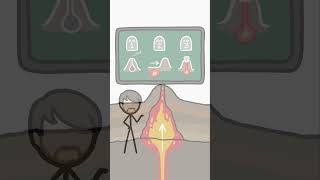

3 Ways a Volcano Can Die
45sThe topic is inherently curiosity-driven and the concise list format is perfect for short-form video, promising quick, satisfying knowledge.
▶ Play Clip"Title promises an explanation of volcano death and delivers exactly that, though it's brief and lacks depth."
This video explains the three primary ways a volcano can become extinct: loss of magma supply due to tectonic plate fusion, being carried away from a stationary hotspot, and internal clogging of vents. It also highlights the difficulty in determining whether a volcano is truly dead or merely dormant.
When tectonic plates fuse together, the magma-forming activity stops, cutting off the volcano's supply and causing it to die.
Hotspots are stationary mantle plumes that create volcanoes, but as the Earth's crust moves, the volcano can be carried away from its magma source and become extinct.
Changes in mantle conditions can slow magma flow, causing it to cool and harden into a plug, or damaged vents can prevent magma from escaping, effectively killing the volcano.
It is hard to know what is happening beneath a volcano, so it is often unclear whether it is truly dead or just dormant, taking a long nap.
Volcanoes can die through three main mechanisms, but determining whether a volcano is truly extinct is challenging, as it may simply be dormant.
What is the first way a volcano can die?
Its supply of magma fizzles out when tectonic plates fuse together, stopping magma-forming activity.
What is a hotspot?
A plume of melting mantle rock that pools beneath the crust and can birth a volcano.
00:15
Why does a volcano die when it is dragged away from a hotspot?
The hotspot stays stationary, but the Earth's crust moves, so the volcano eventually leaves its magma supply behind.
00:15
What is the third way a volcano can die?
It gets clogged when magma cools and hardens into a plug, or vents get damaged preventing magma escape.
00:31
Why is it hard to tell if a volcano is dead?
It is difficult to know what is happening underneath, so it could be dormant instead of extinct.
00:58
Tectonic Plate Fusion Kills Volcanoes
Explains a fundamental geological process linking plate tectonics to volcanic extinction.
Hotspots Are Stationary
Clarifies a common misconception about hotspots and explains how crust movement affects volcanoes.
00:15Clogging as a Death Mechanism
Highlights an often-overlooked cause of volcanic extinction beyond magma supply issues.
00:31Dormant vs. Extinct
Emphasizes the practical challenge in volcanology of distinguishing between dormant and extinct volcanoes.
00:58[00:00] There are three main ways a volcano can die. The first is if its supply of magma fizzles out. The pushing together or pulling apart of tectonic plates can cause magma to form. But when those plates fuse together, the magma-forming activity stops, snuffing out the
[00:15] volcano. The second way a volcano can die is if it gets dragged away from its magma supply. Sometimes, weird conditions in specific places can melt the mantle, sending up a plume of melting mantle rock, known as a hotspot, that pools beneath the crust and can birth a volcano.
[00:31] The hotspot itself doesn't ever move, but the Earth's crust above it does, so the volcano will eventually leave its magma supply behind. The third way a volcano can die is if it gets clogged. Like if conditions in the mantle change and the magma flow slows down, the magma that's
[00:45] already in the volcano's vents can cool, hardening into a giant plug. Or if the volcano's vents somehow get damaged, the magma might not be able to escape. Of course, it's really really hard to tell exactly what's going on underneath a volcano,
[00:58] so we're not always sure what has happened to a volcano. In fact, sometimes it's hard to tell whether a volcano is actually dead. Instead, they could be taking magmanificently long naps.


⚡ Saved you 0h 01m reading this? Transcribe any YouTube video for free — no signup needed.