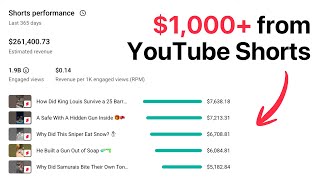

How I Make $7K Per YouTube Short
45sShocking earnings per short grabs attention and promises a lucrative method.
▶ Play Clip"The title accurately promises a method for finding viral ideas, and the video delivers a detailed, actionable three-step process."
The video outlines a three-step process for finding viral YouTube Shorts ideas that generate over $1,000 per video. The creator shares his experience building a content agency and a successful YouTube channel, emphasizing a business-oriented approach to content creation.
The creator will show how to ideate, script, and make faceless YouTube Shorts that earn over $1,000 per video, with over 70 such successes on his flagship channel.
The creator spent five years building a content agency to $98k/month, managed a team of 13, sold part of the agency, and then launched a YouTube Shorts channel doing 40-50k/month with 3.7 billion views.
Use VidIQ to track competitors, filter by outlier score, views per hour, and weekly views to identify trending videos. Create a list of competitors in various formats and languages.
Use ChatGPT and Claude to generate multiple variations of a viral video by identifying viral triggers and creating new ideas with the same structure. Use prompts like 'create 10 ideas using the same viral triggers and structure'.
Keep a spreadsheet with formats, idea summaries, and references. Approve no more than 30% of ideas; kill most to maintain quality.
Pitch ideas to friends, family, or target audience for feedback. The creator's girlfriend recommended a video that hit 20 million views.
On a new channel, the first six videos got 50k views, but the seventh blew up to 16 million views in four days, leading to monetization and $1,000 earnings.
By following the three steps—finding viral ideas via competitors, scaling with AI, and validating in the real world—you can consistently create YouTube Shorts that achieve millions of views and generate significant revenue.
What is the first step in the creator's process for finding viral YouTube Shorts ideas?
Create a list of competitors in different content categories and use VidIQ to track their trending videos.
2:34
What tool does the creator recommend for tracking competitor performance?
VidIQ
2:36
How does the creator use AI to scale viral ideas?
He uses ChatGPT and Claude to generate multiple variations of a viral video by identifying viral triggers and creating new ideas with the same structure.
5:06
What percentage of ideas should be approved according to the creator?
No more than 30%.
8:18
What is the third step in the process?
Real-world validation: pitch ideas to friends, family, or target audience for feedback.
8:45
How many views did the seventh video on the new channel get in four days?
16 million views.
11:34
Creator's Credibility
Establishes authority by detailing a five-year journey building a content agency to $98k/month and a YouTube channel with billions of views.
1:04Competitor Analysis Strategy
Provides a systematic method for finding viral ideas by tracking competitors using VidIQ's outlier score and views per hour.
2:34AI-Powered Idea Scaling
Demonstrates how to use AI to generate multiple variations of a viral video, ensuring the same viral triggers are reused.
5:06Real-World Validation
Emphasizes the importance of getting feedback from real people before producing content, a step often overlooked.
8:45Case Study: From Zero to Viral
Shows a practical example where the process led to a video getting 16 million views and $1,000 in earnings.
10:48[00:00] In this video, I'm going to show you the
[00:01] entire process of how I ideulate,
[00:03] script, and then make faceless YouTube
[00:05] shirts that make more than a thousand
[00:07] bucks per every video we post. This is
[00:10] something that I was able to achieve
[00:11] with my flagship channel more than 70
[00:14] times. 7. If you look at this colum, you
[00:17] will see that this YouTube short made me
[00:19] $7,000. Uh this one as well, 6.7 6K. And
[00:23] if I scroll all the way down, all of
[00:25] those shorts make me more than four
[00:27] figures each one of those. And keep in
[00:30] mind these are just 20 90 secondond
[00:32] videos uh that are made by my team. So I
[00:36] literally don't spend any time uh
[00:38] actually making those videos. Um so this
[00:41] is something that we achieved once on
[00:43] this channel more than 70 times on this
[00:44] channel and then on other channels as
[00:46] well as you can see here here and here.
[00:49] Uh all of those videos are making me
[00:51] more than four figures and all of them
[00:53] are simple YouTube shirts. So, in this
[00:56] video, I'm going to break down the
[00:57] single most important strategy to
[00:59] understand while searching for ideas for
[01:02] your YouTube charts. But first, why
[01:04] should you even listen to me and this
[01:06] video? Because the reason is actually
[01:09] very simple. Because unlike everyone
[01:11] else, I didn't just start YouTube
[01:12] channel at 15 and then got rich at 16.
[01:16] My journey was uh way harder than uh
[01:19] most of those people uh that you see on
[01:21] YouTube. Uh, I spent five years, five
[01:24] actual years building my content agency
[01:26] and scaling it to $98,000 a month. And
[01:29] we did short form content for brands
[01:31] like Sephora. I managed a team of 13
[01:34] people since I was 20 years old. And I
[01:36] even successfully sold a part of my
[01:38] agency to an investor. And that's when I
[01:41] decided to buy my uh first ever dream
[01:43] car around 2 years ago. So my journey
[01:45] was not simple. And with all of that
[01:47] background, I decided to start uh
[01:49] YouTube. So YouTube is not my first
[01:51] business and uh this is actually
[01:53] something that I approach from the
[01:55] business perspective just because I have
[01:57] years of experience like that running my
[02:00] own agency and that's when I launched
[02:01] the art of war channel the YouTube
[02:03] shorts brand that is now doing 40 to 50k
[02:06] a month 3.7 billion views uh 260k made
[02:10] only from AdSense we also had uh an
[02:12] extra 20k from Tik Tok uh money from
[02:15] Facebook and brand deal uh and recently
[02:17] I invested in three more branded
[02:19] channels, adding them to the portfolio
[02:21] that is now doing over 5 billion views
[02:23] per year. But today's video is not about
[02:26] me. It's actually about you and how you
[02:28] find fresh viral ideas for your
[02:30] channels. So, let's start at the very
[02:33] beginning. How do you find those ideas?
[02:34] To consistently find those ideas, you
[02:36] need Vid IQ. So, number one thing I
[02:38] actually recommend you do is to create a
[02:40] list of competitors in different content
[02:43] categories and uh uh even formats. So
[02:45] for example, this is a list of
[02:47] competitors for one of my channel as you
[02:49] can see which uh this list has direct
[02:52] competitors. It has long form
[02:54] competitors that we can then adapt for
[02:56] short form. It has other languages
[02:58] competitors uh 2D competitors and etc.
[03:01] So you want to have a variety of
[03:03] different accounts that you take
[03:04] inspiration from. Long form, short form,
[03:06] uh 2D, 3D, talking hat creators, uh
[03:09] influencers, anyone you can take ideas
[03:12] from, add them to the spreadsheet
[03:14] because then we will need them. Then one
[03:16] thing you do after that is you go to Vid
[03:18] IQ. I have Vid IQ right here. Uh so you
[03:20] go to VidIQ, you go to competitors, and
[03:22] then here you just keep adding those uh
[03:25] competitors here until you have a like a
[03:28] full list of accounts that you will pay
[03:30] attention to. And then uh what you do is
[03:33] uh you can filter them out by let's say
[03:35] the amount of video uh views they have
[03:37] or uh the amount of views they generated
[03:40] this week or last week and etc. And uh
[03:42] you will be able to see their most
[03:45] popular videos by the outlier score.
[03:47] This is very important. And what I often
[03:49] do here is I go to my competitors, the
[03:52] ones that interest me the most right
[03:54] now. I rank the videos by the outlier
[03:57] score just to find uh the ones with uh
[03:59] the biggest one. And what I would do is
[04:02] I would just simply look into those
[04:04] ideas and some of them I would use
[04:06] directly and some of them I would adapt
[04:09] using the uh framework that I'm going to
[04:11] show you uh in a second. So the two key
[04:14] strategies here is you can use views per
[04:17] hour. So here you can simply rank the
[04:20] videos by the amount of views they're
[04:21] getting at this exact moment. So you can
[04:24] predict how many more views it can
[04:26] potentially get. This way you can copy
[04:28] the videos early on without them getting
[04:30] crazy views just yet. Uh and number one,
[04:32] you can use the the weekly views tracker
[04:34] to see what channel are currently
[04:36] outperforming the rest. So for example,
[04:38] I would go down here and I would see
[04:40] that this this week was quite good week
[04:42] on YouTube. As you can see, every single
[04:44] channel kind of outperform its results
[04:47] last week besides just uh Richi who's
[04:50] drastically underperforming. or for
[04:52] example like doggyizuko performed like
[04:55] 400% more than usual, I would probably
[04:57] just go to this page and see what
[04:59] happened and the why their videos are
[05:02] performing that well. So this is one of
[05:04] those strategies. And then once you have
[05:06] the original ideas, once you have all of
[05:08] those videos collected from your
[05:10] competitors and you know exactly what
[05:12] you want to copy, you don't want to copy
[05:14] them directly. You don't want to just
[05:16] steal those ideas. You want to scale
[05:18] them. Meaning you want to turn every
[05:20] idea into a list of multiple ideas. So
[05:24] every viral video has at least five
[05:27] variations or maybe even 10 variations
[05:29] of ideas and uh uh that will also work
[05:32] based on the same exact viral triggers.
[05:34] So what you do next is you go to charge
[05:37] or cla but I recommend you actually go
[05:40] on both and uh put the same prompts into
[05:43] both because for ideiation I've realized
[05:46] that some days for some reason charg
[05:48] performs better than clot and some days
[05:51] cloth performs better than chgpt. I
[05:53] don't know why it happens but uh I just
[05:56] ended up using both because sometimes I
[05:58] like the ideas from chat and sometimes I
[06:01] I really love the ideas from clot. So I
[06:03] would recommend you still do both of
[06:05] them. Let's say I want to check the
[06:06] videos from Zak day films today, right?
[06:09] Uh this I'll go this week. So this video
[06:12] has the most views. I'll copy the link
[06:14] to this video. I'll go to no GPT. I
[06:17] would paste the link there. And again
[06:19] once you sign up, it's free. It's very
[06:21] easy to do. You'll get the transcript of
[06:23] this video. And then using that
[06:25] transcript, I will then ask Claudi and
[06:28] not and charge to create me multiple
[06:31] ideas just like this one. uh using this
[06:33] prompt. So you're a viral uh viral
[06:35] content strategist uh using this script
[06:38] and here you paste the transcript of the
[06:40] video that you just copied. Uh your task
[06:42] is to identify the exact viral triggers
[06:45] and then create X meaning 10 ideas, 15
[06:48] ideas, you can put whatever number you
[06:50] want here. Uh they use the same viral
[06:51] triggers and structure. This will give
[06:54] you a list of viral ideas with the same
[06:56] exact viral triggers and viral hooks
[06:59] that AI will come up for you. So, for
[07:01] example, if the original video is what
[07:04] happens if you shoot a bullet at a
[07:06] crocodile, then a bunch of different
[07:08] ideas are going to be what happens if
[07:09] you shoot at an elephant at at a
[07:11] gorilla, at a at a beer, etc. So, AI
[07:14] will basically replace one or two things
[07:16] in the original video and make it
[07:18] completely new video, but the video that
[07:21] will follow the viral format. So, this
[07:24] is probably the most important part of
[07:25] coming up with viral content. And what I
[07:28] also recommend you do is besides just
[07:30] using this uh prompt, split test it with
[07:33] uh a simpler version of it because again
[07:35] AI sometimes more professional prompts
[07:38] like this one work. But sometimes I
[07:40] actually see quite good success with a
[07:41] very simple prompt. Here's the video
[07:43] from my competitor. Please find me 15
[07:45] ideas about what happens if you shoot at
[07:47] someone that has the same viral
[07:49] potential but a different animal, for
[07:52] example. And you just split test this
[07:54] two and you see which one works best.
[07:55] And after that what you need to do is to
[07:57] create a list uh ideas that you chose
[08:00] and uh uh basically just uh put them in
[08:02] a spreadsheet. Keep everything
[08:04] organized. The spreadsheet for ideas
[08:06] should look something like this one. Uh
[08:08] something where you put the formats and
[08:10] the idea summary and references as well.
[08:13] Every single idea of yours should have a
[08:15] reference. Uh and then also you can rank
[08:18] them yourself. Approved, not approved. U
[08:20] again don't uh don't be gentle with
[08:23] ideas. Your approval score should be not
[08:26] more than 30%. So only one out of three
[08:29] ideas should actually be executed.
[08:31] That's the nature of coming up with
[08:33] content. Uh and yeah, as I said, don't
[08:36] be generous. Kill your ideas. Um you
[08:38] know, kill most of your ideas most of
[08:41] the time because that's the only way you
[08:43] can get higher quality of videos. Uh and
[08:45] then use the third step, the real world
[08:48] validation, which many people ignore,
[08:50] but it actually is one of the keys to
[08:53] success on YouTube. Because before you
[08:56] have data from YouTube, before you have
[08:58] analytics and comments and uh feedback
[09:00] from the real audience, you still need
[09:03] feedback on your ideas, you still don't
[09:05] understand what is good and what is bad
[09:07] just yet. You need a little bit of
[09:09] guidance, a little bit of direction
[09:11] there. So, uh how do you get the real
[09:13] world feedback? go out there and you
[09:15] pitch your idea or script to someone. It
[09:19] can be your friend. It can be your
[09:21] business partner. It can be your
[09:23] girlfriend or your parents. Listen to
[09:25] what they say and improve your content.
[09:28] Improve your idea. Improve your script
[09:30] based on their feedback, especially if
[09:32] they are your target audience. Because
[09:34] remember that behind every view that you
[09:37] see on your YouTube studio is a real
[09:39] person who just watched this piece of
[09:41] content. meaning they are probably
[09:43] having the same traits, the same
[09:45] characteristics like many people in your
[09:47] life. And if you're creating very
[09:49] entertaining, generic content, then
[09:51] maybe your parents are going to watch
[09:53] it, maybe your friends are going to
[09:54] watch it, maybe they are your target
[09:56] audience. So ask them for their
[09:58] feedback. And uh again, many of you
[10:01] might say that it is stupid, but I took
[10:04] my own channel from zero to the first
[10:06] 100 million views doing exactly that. I
[10:09] had a girlfriend, my girlfriend who
[10:11] actually recommended me some of the
[10:13] ideas and I pitched her other ideas and
[10:16] some of them she called stupid and I
[10:17] decided not to go forward with them and
[10:20] some of them were actually very smart
[10:21] and they made her laugh and that's the
[10:24] ideas we ended up executing. I remember
[10:27] uh one of my first ever videos to hit 20
[10:29] million views was the video that she
[10:31] actually recommended me. So again, uh
[10:34] remember to pitch your ideas in the real
[10:36] life. And if everyone you tell your
[10:38] ideas to tells you that they absolutely
[10:40] love it, the the idea is validated and
[10:43] uh ready to be executed. So you can go
[10:45] ahead and create a video about it. And a
[10:48] story about my channel uh related to
[10:50] this exact process is that I did the
[10:53] exact same thing, the exact three steps
[10:55] that I just showed you, and I posted
[10:57] seven videos on a on a brand new uh
[11:00] channel. It wasn't brand new. It was
[11:01] aged, but still like it was no videos.
[11:04] So, seven videos posted from scratch. My
[11:06] first six got stuck at 50,000 views, but
[11:09] then the seventh one blew up, got
[11:11] monetized, and made us $1.1,000.
[11:14] I can show you how it looked like from
[11:16] uh the inside of the YouTube studio. If
[11:18] I go to shorts, if I go to the first
[11:21] ones, you will see that the first ever
[11:23] video I posted on January 27th. This is
[11:26] the seventh video that I posted that
[11:28] blew up from zero to 80k views in a
[11:31] single day. Then 2 million views on that
[11:34] on day two. And then by day four, it was
[11:36] 16 million. We got monetized there. And
[11:38] then slowly kind of stopped, but then it
[11:41] still made us our first $1,000, which
[11:44] proves the point that you can simply
[11:45] follow this three steps. Find viral
[11:47] ideas through competitors in Vid IQ.
[11:49] Then uh scale those ideas using simple
[11:52] prompts with AI and then validate those
[11:54] ideas in the real world by talking to
[11:56] your friends, girlfriends, parents or
[11:59] someone. And if you do that enough
[12:00] times, it will essentially blow up and
[12:03] get to uh some crazy views.
⚡ Saved you 0h 12m reading this? Transcribe any YouTube video for free — no signup needed.