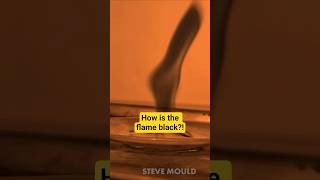

How to Make BLACK Fire
44sThe visual of black flame is highly intriguing and counterintuitive, making viewers want to see and understand it.
▶ Play Clip"Title is intriguing and the video delivers a clear, concise scientific explanation — a solid, educational piece."
This video explains the science behind creating black flames. The creator demonstrates how a methanol flame, combined with salt water, can absorb specific wavelengths of light from a sodium street lamp, resulting in a visually dark flame.
The creator starts with a methanol flame and adds salt water to it, then illuminates the scene with a sodium street lamp.
When an atom is excited, an electron jumps to a higher orbital; when it falls back, it emits a photon of a specific color. Sodium atoms emit photons of a very specific wavelength during this process.
The reverse process also occurs: if a photon of the right energy hits a sodium atom, the electron absorbs it and jumps to a higher orbital. This gives sodium an absorption spectrum in addition to its emission spectrum.
The flame contains a mixture of excited and ground-state sodium, which strongly absorbs photons at 590 nm — the exact wavelength produced by the sodium street lamp. If the flame absorbs these photons, it appears dark.
The black flame effect is a direct demonstration of atomic absorption spectroscopy, where sodium atoms in the flame absorb the specific yellow light from the sodium lamp, leaving a dark region in the flame's silhouette.
What is the specific wavelength of light that sodium atoms absorb and emit?
590 nm
00:40
What happens to an electron when an atom is excited?
The electron jumps to a higher orbital.
00:14
What is the reverse process of emission called?
Absorption
00:27
Why does the flame appear black in this experiment?
The flame contains sodium atoms that absorb the 590 nm photons from the street lamp, so it looks dark.
00:40
Absorption Explains Black Flame
This is the core scientific principle that directly answers the video's title question.
00:40Emission vs. Absorption
Clearly contrasts two fundamental atomic processes, making the science accessible.
00:14[00:01] создать чёрное пламя. Итак, я начинаю с пламени метанола. Затем я добавляю немного соленой воды. Я освещаю сцену одним из этих старомодных уличных фонарей, которые называются натриевыми уличными фонарями. Если правильно возбудить атом,
[00:14] электрон перескочит на более высокую орбиталь. А когда он снова опускается , он испускает фотон света. Атом натрия испускает фотон очень специфического цвета, когда электрон переходит на другую орбиталь. Но
[00:27] бывает и обратное. Если на атом натрия попадёт фотон с нужной энергией, электрон перейдёт на более высокую орбиталь, поглотив этот фотон. Таким образом, помимо спектра излучения, натрий также обладает
[00:40] спектром поглощения. И, исходя из этого простого факта, мы можем объяснить происхождение чёрного пламени. В этом пламени постоянно находится смесь возбужденного натрия и натрия в основном состоянии, которые очень хорошо поглощают фотоны с длиной волны 590 нм, а именно те
[00:53] фотоны, которые производятся натриевым уличным фонарем. И, конечно же, if the flame is absorbing photons, it's going to look dark.




⚡ Saved you 0h 01m reading this? Transcribe any YouTube video for free — no signup needed.