
I Made $178 from 2.5M Views?!
55sShocking reveal of low Shorts earnings sparks curiosity and debate about YouTube monetization.
▶ Play Clip"The title accurately reflects the content, which reveals actual earnings and RPM data for YouTube Shorts in 2025-2026."
The video reveals the actual earnings from YouTube Shorts, debunking the myth that more views automatically mean more money. It explains the critical role of RPM (Revenue Per Mille) and engaged views in determining revenue. The creator shares data from their own channel and other creators to illustrate the wide variation in earnings.
A short with 2.5 million views earned only $178, with an RPM of 16 cents per 1,000 engaged views.
A short with 40,000 engaged views earned $23, with an RPM of 59 cents—four times higher than the previous example.
The average RPM across the channel was 13 cents per 1,000 views, but individual shorts varied from 9 cents to 76 cents.
RPM includes not just ad revenue but also memberships, Super Chats, and Super Thanks, which can significantly boost earnings.
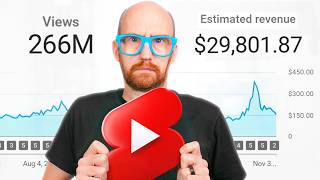
A creator with 266 million views earned less than $30,000, with an RPM of 11 cents, showing the need for diversified income.
What does RPM stand for in the context of YouTube Shorts?
Revenue per mille, or earnings per 1,000 engaged views.
2:51
What is the difference between 'views' and 'engaged views' for YouTube Shorts?
Engaged views are views where the viewer watches a short for a certain length of time, not just swiping away.
1:34
What was the RPM for the short with 2.5 million views?
16 cents per 1,000 engaged views.
2:00
What was the RPM for the short with 40,000 engaged views?
59 cents per 1,000 engaged views.
2:20
What was the average RPM across all shorts on the analyzed channel in 2025-2026?
13 cents per 1,000 views.
3:40
What was the RPM for the short about YouTube demonetization?
75 cents per 1,000 views.
4:08
What was the RPM for the short about the best time to post on YouTube?
9 cents per 1,000 views.
4:29
Besides ad revenue, what other income streams are included in RPM?
Memberships, Super Chats, and Super Thanks.
8:38
What was the highest RPM mentioned in the video, and what contributed to it?
76 cents per 1,000 views.
9:02
What was the RPM for the creator with 266 million views?
11 cents per 1,000 views.
11:06
2.5M views earned only $178
Shows that high view counts don't guarantee high revenue.
1:2540K views earned $23 with higher RPM
Demonstrates that engagement quality matters more than raw views.
2:20RPM includes memberships and super thanks
Highlights the importance of community support for boosting earnings.
8:38Shorts are the top of the funnel
Emphasizes that ad revenue is just the beginning; creators should build engaged audiences.
11:50[00:00] So, inside this makeshift piggybank is
[00:02] exactly how much we made from our
[00:04] highest earning YouTube short over the
[00:06] last year.
[00:10] But, before I show you what's inside
[00:12] here, I need you to do me a little
[00:13] favor.
[00:14] Go down to the comments and put in your
[00:17] own guess.
[00:18] How much do you think 2.5 million
[00:21] YouTube shorts views pays in this day
[00:24] and age?
[00:27] Written it down? Good. Because I
[00:29] guarantee half of you are going to feel
[00:31] really good about your guess.
[00:33] And the other half are going to be
[00:35] really confused about how YouTube works.
[00:38] Either way, I spent the last few weeks
[00:40] going through every single YouTube short
[00:42] we've posted on this channel in 2025 and
[00:45] into 2026. The views, the revenue, the
[00:47] RPM, all of it. And I'm about to expose
[00:50] what I found across our channel. And not
[00:52] only that, we're going to back this up
[00:53] with data from other channels from
[00:55] different niches to see what they've
[00:57] been making as well.
[01:01] Now, here's the thing that most people
[01:03] get wrong about YouTube shorts. They
[01:05] assume that with more views comes more
[01:08] revenue. Yeah, it's not as simple as
[01:10] that. The numbers tell a really
[01:12] interesting, contrasting story. So, as I
[01:15] mentioned earlier, this YouTube short
[01:16] got us 2.5 million views, which is not
[01:19] too shabby. And it made us
[01:25] $178.
[01:32] Thank you, but YouTube calculates the
[01:34] revenue of a short based on engaged
[01:37] views. That's how many people actually
[01:39] watch a short for a certain length of
[01:41] time as opposed to swiping immediately
[01:43] to the next short. Why YouTube has two
[01:46] different metrics for views?
[01:49] I don't know, you'll have to ask them
[01:50] yourself. So, when we factor that in,
[01:52] the number of engaged views plummets to
[01:55] just over a million. And those are the
[01:57] views that earn the YouTube short money.
[02:00] And for every 1,000 engaged views on
[02:02] this particular YouTube short, it pays
[02:05] 16 cents
[02:07] or around about 10 English pennies.
[02:11] However, although this short got a lot
[02:14] less engaged views, just 40,000 of them,
[02:18] it made $23.
[02:20] And that's an RPM of almost 60 cents,
[02:23] which is basically four times as much.
[02:30] So, one short is earning four times more
[02:33] revenue per view than another. But, the
[02:36] one earning more revenue has 40 times
[02:40] fewer views. So, why such the big
[02:42] difference? Well, let's dig into those
[02:43] three letters I've already casually
[02:46] tossed into this conversation.
[02:48] RPM.
[02:51] Now, the technical term RPM stands for
[02:53] revenue per mille, but you don't really
[02:55] need to understand that, to be honest.
[02:57] What you need to know is that RPM
[02:58] calculates the money you earn per 1,000
[03:01] YouTube shorts views. Those are engaged
[03:04] views remember.
[03:06] As we've already shown you in the two
[03:07] examples so far, one short earned 16
[03:10] cents per 1,000 views, while another one
[03:13] earned 59 cents per 1,000 views. Now,
[03:16] that in itself is pretty simple, right?
[03:19] But, here's where things get really
[03:20] interesting. RPM, as we've already shown
[03:24] you, is not a fixed number. YouTube
[03:26] doesn't assign you a RPM for your
[03:29] channel. On the contrary, RPMs vary
[03:32] wildly from one YouTube short to the
[03:34] next. Across all of our shorts in 2025
[03:37] and leading into 2026, the average RPM
[03:40] on our channel sits at around about 13
[03:43] cents per 1,000 views. And the good news
[03:45] is, for shorts creators in general, is
[03:49] that RPMs over time continue to be
[03:53] yeah, trending upwards. So, in summary,
[03:55] with admittedly a lot of fluctuations,
[03:58] that means more revenue for all. But,
[04:00] watch what happens when you look at
[04:02] individual shorts.
[04:05] There are huge variations. This short
[04:08] about YouTube demonetization, around 75
[04:11] cents per 1,000 views. Again, that's
[04:13] another one with four times our average
[04:16] RPM. And this one about a YouTube
[04:18] update, 53 cents per 1,000 views, more
[04:20] than three times our average. But,
[04:22] obviously, if some shorts have a much
[04:24] higher RPM than others have to
[04:27] underperform. This short about the best
[04:29] time to post your videos on YouTube got
[04:31] 150,000 views, but made only 9 cents per
[04:35] 1,000 views, below our own average
[04:37] despite the higher view count. So, it's
[04:39] the same channel, and it should be the
[04:40] same audience and the same team making
[04:42] the content, but completely different
[04:45] RPMs for every single video. And it's
[04:47] not just us who are seeing those
[04:49] patterns.
[04:49] >> And how much did this 4.5 million view
[04:52] short pay me? It gave me 9,600
[04:55] subscribers. That is crazy. And it paid
[04:57] me $158.
[04:59] You know what I mean? Like, oh, what is
[05:00] this? 5 cents per 1,000 views. 99.7%
[05:05] stayed to watch. 99.7,
[05:08] what is that? I've never seen such stats
[05:09] before. How is that even possible?
[05:12] So, the views were massive, and the
[05:14] retention was nigh on perfect. But, the
[05:17] RPM, quite frankly, was shambolic. Now,
[05:20] compare that to his main channel.
[05:22] >> 10 million views, guys. 10 million
[05:24] views. How much does 10 million views of
[05:27] YouTube shorts pay? $1,105
[05:30] from a 56-second video that took half an
[05:34] hour to make. That's kind of bonkers,
[05:35] isn't it? And if we look at the revenue,
[05:37] it pays pretty much the average 20 cents
[05:39] per 1,000 views. Wow. So, double the
[05:42] views, but more than six times the
[05:44] revenue at over $1,000. It's the same
[05:47] creator, but the RPM made all of the
[05:49] difference. So, now that you understand
[05:51] that RPMs can be pretty agile, let's get
[05:54] into our full numbers. Every major short
[05:57] we posted in 2025, what it made, and
[06:01] what
[06:03] we can learn from it. We've posted over
[06:06] 160 shorts in 2025 and into 2026. And
[06:10] here are the five biggest by engaged
[06:12] views. The first one you already know
[06:14] about, 1.1 million engaged views and
[06:17] $178 revenue earned. And this is what
[06:20] these 1 million people were engaging
[06:22] with. Yes. Yes. Yes. Yes. Yes. Yes. How?
[06:30] And why? Here's another one with 1.1
[06:33] million engaged views, but only $145
[06:36] earned this time because of a slightly
[06:38] lower RPM. But, this next one has just
[06:40] over 800,000 views, so that's 300,000
[06:43] less views than the previous short, but
[06:46] it's earned three more dollars at 148
[06:49] thanks to its higher CPM. And this one
[06:52] is just about to crack 800,000 engaged
[06:55] views, but now we're earning less than
[06:57] $100 because the RPM just isn't high
[06:59] enough this time. And finally, this
[07:01] short, ironically about how much YouTube
[07:03] pays me for YouTube shorts, got a little
[07:06] over half a million engaged views and
[07:09] $80 in revenue. All right, then. So, as
[07:11] a quick calculation,
[07:15] that's 4.3 million views in total, which
[07:18] has brought us in
[07:22] carry over one.
[07:23] $652.
[07:26] That's an RPM on our biggest YouTube
[07:28] shorts on the channel of
[07:34] 15 cents, which is slightly higher than
[07:37] the channel's average. And just in case
[07:38] you enjoyed that, here's a little bit
[07:40] more touchscreen tapping ASMR.
[07:46] Like and subscribe.
[07:47] >> It's clear then that making money from
[07:48] YouTube shorts still continues to be
[07:50] what you might call a quantity game. To
[07:52] live sustainably from that type of
[07:54] content, you will need tens of millions,
[07:57] if not hundreds of millions of shorts
[07:59] views per month. That's if we're just
[08:01] talking about ad revenue from YouTube
[08:03] shorts. Because there's something really
[08:05] interesting to look at that most
[08:07] creators probably miss. This short,
[08:09] relatively speaking, has an astronomical
[08:12] RPM. And that's because the majority of
[08:14] its revenue comes from
[08:16] YouTube memberships.
[08:18] Yeah, someone has signed up to the VidIQ
[08:20] membership that gives you custom emojis
[08:23] from this short and has been a member
[08:25] ever since. So, cheers, whoever that is.
[08:28] You see, the monthly recurring revenue
[08:31] from that membership is attributed to
[08:33] this short and its RPM. And that's the
[08:35] subtle difference between CPMs and RPMs.
[08:38] CPMs only concern themselves with ad
[08:41] revenue. RPM includes everything from
[08:43] memberships to super chats to super
[08:45] thanks. In other words, the community
[08:47] directly supporting the channel. So,
[08:48] once again, I say cheers to all of you
[08:51] who've been doing that over the years.
[08:52] Because now I've dug into the data, it
[08:54] happens a lot more than I thought. The
[08:56] highlight of which is this short that
[08:58] not only has membership purchases, but
[09:00] also some super thanks as well that
[09:02] pulled the RPM up to an insane 76 cents.
[09:06] So, maybe instead of wasting time in
[09:08] your YouTube short asking people to
[09:10] press this,
[09:13] instead, you should encourage them to do
[09:15] this.
[09:16] So, that is our channel, but how does
[09:18] this look across the entire YouTube
[09:21] landscape? Different creators, different
[09:23] content, different sizes, different
[09:25] niches. Because this is where things get
[09:27] really intriguing.
[09:31] Let's start off with a big creator,
[09:33] Nathan. After 10.8 million views, we
[09:37] ended up receiving $1,502
[09:41] dollars.
[09:41] >> Nathan has multiple YouTube channels, by
[09:43] the way. The biggest of which has 20
[09:45] million subscribers. So, let's check out
[09:47] a smaller creator, a consistent poster,
[09:50] no viral moments, they're just showing
[09:52] up every single day.
[09:53] >> This is my performance. This, $18.80.
[09:59] My shorts gave me $400
[10:02] and 67 cents. And then my live stream
[10:06] gave me $6. That is lifestyle content
[10:08] and they are making 94% of their total
[10:12] YouTube revenue from shorts and feeling
[10:14] pretty good about it.
[10:15] >> So those of you who are saying "Shorts
[10:18] don't pay. I'm not doing shorts. Shorts
[10:21] don't pay."
[10:23] Like what are you waiting for?
[10:25] >> And then there is this.
[10:26] >> And my audience watched 266 million
[10:30] views, which was mainly YouTube shorts.
[10:32] That sounds like a lot of views, which
[10:34] it is. In 2024, YouTube paid me
[10:37] $29,824.08,
[10:41] which I'm thankful for, but honestly,
[10:43] it's not that much money when you're
[10:45] considering how many videos I had to
[10:47] post.
[10:47] >> Let me try and put that into some sort
[10:48] of context. A quarter of a billion views
[10:52] for less than $30,000 in revenue.
[10:55] Average salary in the US
[10:58] is around about $60,000. And if we put
[11:01] all of these engaged views through the
[11:03] RPM meat grinder, that is a return of 11
[11:06] cents per 1,000 views. Admittedly, a
[11:09] couple of years ago, so it might be a
[11:11] little higher these days. But even so,
[11:13] the creator themselves admits that they
[11:15] can't make enough money from their
[11:17] content by just ad revenue alone.
[11:19] >> Luckily, I have awesome brands that have
[11:21] supported me through the years, which
[11:23] makes it possible to do this full-time
[11:25] because I think I spend a little bit
[11:27] more than that every single year just on
[11:29] travel alone.
[11:30] >> So yeah, the creators making real money
[11:32] from YouTube shorts aren't just looking
[11:34] at the ad revenue numbers. Instead, they
[11:37] are building
[11:38] highly engaged audiences who support
[11:41] them through memberships and super
[11:43] thanks and brand deals, shopping for
[11:46] products, and a whole host of other
[11:48] income revenue streams. Shorts are just
[11:50] the top of the funnel.
[11:54] The ad revenue is just the beginning. So
[11:56] the question for you in the future might
[11:58] not be how much does YouTube pay me for
[12:01] my YouTube shorts? It should be more
[12:03] along the lines of how much does my
[12:05] audience pay me for the value I offer.
[12:08] And if you want to understand exactly
[12:11] what keeps your top of monetization
[12:13] funnel healthy
[12:15] and what helps you get your shorts
[12:16] monetized, but also what might get them
[12:19] flagged, we sat down with a YouTube
[12:21] employee recently who revealed pretty
[12:23] much everything and you can watch it
[12:25] over here.



⚡ Saved you 0h 12m reading this? Transcribe any YouTube video for free — no signup needed.