
The #1 Mistake Traders Make
45sHigh emotional hook about a common trading loss, promising a solution.
▶ Play Clip"Delivers on the promise of avoiding false breakouts with a clear strategy, though some repetition and a promotional plug pad the runtime."
This video explains how traders can avoid false breakouts by distinguishing between a breakout and a fakeout, and combining them with Fibonacci retracement levels for better entries. The presenter emphasizes waiting for price to retrace to a 'golden zone' before entering a trade to improve risk-to-reward ratios.
Traders often lose money by entering trades when price breaks a high, expecting it to continue up, but price reverses instead.
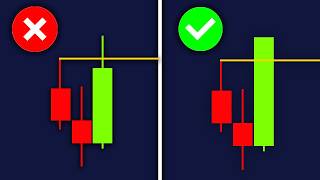
Scenario 1: Price closes above the high (breakout). Scenario 2: Price wicks above but closes beneath (fakeout).
A large upper wick shows buyers tried to push higher but sellers overwhelmed them, increasing probability of a downside move.
Entering a long trade immediately after a close above the high leads to poor risk-to-reward because stop loss placement is problematic.
If you want price to go higher, it should go lower first; if you want it to go lower, it should go higher first. This improves entries.
In an uptrend, a fakeout below a low followed by a breakout above a high provides two confluences for a long trade.
A fakeout above a high followed by a breakout below a low signals a high-probability downside move.
Use TradingView's Fibonacci retracement tool with custom levels (0, 0.706, 0.618, 1, 0.79) to define the 'golden zone' for entries.
After a fakeout and breakout, draw Fibonacci from fakeout low to breakout high, wait for price to retrace into the golden zone, then enter with a tighter stop loss.
To avoid false breakouts, traders should wait for a fakeout to confirm rejection, then a breakout in the opposite direction, and finally use Fibonacci retracement to enter at a better price. This approach improves risk-to-reward and increases win probability.
What are the two scenarios when price breaks a high?
Scenario 1: Price closes above the high (breakout). Scenario 2: Price wicks above but closes beneath (fakeout).
00:48
What does a large upper wick after breaking a high indicate?
Buyers attempted to push higher but sellers overwhelmed them, increasing probability of a downside move.
01:20
Why is entering a long trade immediately after a breakout a mistake?
Risk-to-reward is poor because stop loss placement is either too wide (below the low) or too tight, leading to significant losses.
02:06
What is the key principle for better entries?
If you want price to go higher, it should go lower first; if you want it to go lower, it should go higher first.
02:41
What are the custom Fibonacci levels for the golden zone?
0, 0.706, 0.618, 1, 0.79
06:26
How do you draw the Fibonacci retracement in this strategy?
From the fakeout extreme to the breakout extreme.
07:11
Retracement Principle
This counterintuitive insight is the core of the strategy, emphasizing patience for better entries.
02:41Combining Fakeout and Breakout
Shows how two confluences (fakeout and breakout) increase trade probability.
03:23Golden Zone Fibonacci Levels
Provides a concrete, actionable setting for Fibonacci tools to identify high-probability reversal zones.
06:26[00:00] of the most common ways trader s lose money. They see price break a high, enter the trade expecting it to go up, and unfortunately price does exactly the opposite. If only there was a way to avoid these false breakouts completely. To make sure this never
[00:16] Know when they were about to happen. Well actually, there is. There is a way. these false breakouts are ABOUT to happen. But you will ALSO be able to take advantage
[00:31] of them, for high probability moves. A very common setup you will see is this.
[00:48] Where price moves, and creates a high. The specific point we are going to be focusing on is the break of this high. Now there are two scenarios that can happen. Scenario one, price breaks the high and closes ABOVE the high.
[01:02] Scenario two, price breaks the high and just wicks above the high but ends up closing beneath it. If scenario two happens. Where the candle breaks the high, but closes beneath it. is because price rose above the high, and left behind a large upper wick.
[01:20] What this is showing us is that buyers attempted to go higher, but then an influx of sellers than buyers at this level. Which if this happens, especially at a high, there is a high probability chance that we could get more confluences for a trade to the downside.
[01:36] But what happens if price closes above the high? If price closes above the high, this is now considered a breakout. Now you may be thinking to yourself, well if the other scenario was the quote on quote bad scenario this scenario must mean price will move higher?
[01:52] Which what I see a lot people do is enter a long trade as soon as they see this candle close above the recent high. Expecting it to keep heading upwards. Which if you are doing this, its one of the worst mistakes you can possibly make.
[02:06] You see if you are entering right here, your risk to reward is going to be absolutely terrible. Because where are going to place your stop loss? You could place it below this low, but then your stop loss is going to be massive and if you do get a losing trade, you are going to take a big hit.
[02:23] Yeah, you could make your stop loss smaller. But just because price breaks this high, doesn t exactly mean its going to keep shooting up directly up from here. high does give bullish tendencies it doesn t exactly mean you should enter right away.
[02:41] Which brings me to one of the best words of advice I can possibly give you. If you want price to go higher, you actually want price to go lower first. If you want price to go lower, you want price to go higher first.
[02:54] Once you understand this concept, your trading will change forever. So going back to our scenarios, if price breaks the high but just wicks above it and closes beneath it. This is indeed a fakeout. But we don t want to just enter
[03:07] a short trade immediately. We first want price to come up first, get a better entry then enter. Same thing with the opposite scenario. If price breaks the previous high but closes above it. This is indeed a breakout but we don t want to enter a long trade immediately. We want price to come back
[03:23] down first. Get a better entry, then enter. So now you know the difference between a breakout and a fakeout we can start reading the market a lot better. But not only that, we can combine the So here we have an uptrend. We have are low right here. We have our high right here.
[03:40] Now price can do anything right here. We are trying to predict price we are trying to read it. Price ends up going lower. While going lower, it does end up breaking this low. Now this is the point we need to start paying close attention. If we look closely, while doing this,
[03:55] it didn t close below it. It just wicked beneath it. Which shows us that sellers tried to push price beneath this low, but buyers stepped in, and fought them off at this level. But this in itself is not enough reasoning for us to enter just quite yet. So lets keep watching.
[04:15] After doing this price starts heading upwards. Backing up the idea the fakeout heading towards this recent high. As price crosses this high, it does
[04:27] something that backs our thesis even more. While doing this break. The candle closes above this high. Which, would be considered a breakout. So now we have two confluences. We have our fakeout to the downside. Then we have a breakout to the upside. Both showing signs
[04:42] Price made both a high and a low. This time price moves upwards first. Will moving upwards it breaks this recent high. While doing so, it crossed the high, but it just
[04:56] wicked above it and ended up closing beneath it. Showing buyers tried going up, but sellers took control and brought the price back down. After doing this, price starts heading lower. Backing up the idea the fakout is taking effect. While moving lower, its breaks the recent low. Not
[05:12] only did it break it, it closed beneath it. Giving us a breakout to the downside. We have our fakeout to the upside. Our breakout to the downside. Which can give us the idea there is a great chance for a downwards move. Which is exactly what happens.
[05:26] So now you understand the difference between a breakout and fakeout and understand how to use them together. But there s still a problem. Say if you get a fakeout, the directly after, get a breakout. If you entered as soon as the
[05:40] breakout happens, we still have the same problem that I mentioned before. Where will you put your stop loss. Sure you could put it here, but then your risk to reward is not the best. Because if you do get a losing trade. Your loss will still be pretty significant.
[05:55] So we need to a way to not only make our stop loss smaller, so our losses are smaller. But we also need a way to make our wins bigger. And in order to do that, we need to get a better entry. To do this, go to tradingview. If you don t
[06:10] yet have it, ill leave a link in the description. Go to your chart, grab the fibonnaci retracement tool on the left. Place it on your chart. Next, go to the settings of the fibonnaci. Make the values. 0, 0.706, 0.618, 1, 0.79
[06:26] This will leave us with 3 main levels that look like this. These levels are whats called The golden zoneeee Or where price has the highest probability of pulling back to and reversing.
[06:41] Which if you re thinking like im thinking, we can use this to our advantage. Here prices moves and creates a high and a low. It ends up breaking our low. We look closely, and just wicks beneath it. Showing buyers are stepping in at this level.
[06:56] Leaving behind a fakeout to the downside. After doing so it starts rising backing up the idea the fakeout is taking effect. While doing so, it breaks the previous high. Not only that it closed above it. Once this happens, grab your fibonnaci tool.
[07:11] Mark from the fakeout, to the breakout. This will leave behind our golden zone. Now you aren t entering at the breakout, you let price come down first into our
[07:24] golden zone so you get a way better entry. Now you can place your stop loss below the low, which is smaller than before. Set your take profits at the highs. And then finally just watch price play out. Boom easy winning trade.
[07:38] Hopefully I got the idea in your head, that you no only need a breakout, but you need a fakeout alongside with it. On top of that, let price retace back down your trading will change forever. Thanks for watching. I will be posting
[07:54] some trade ideas inside my telegram. See you in there.
⚡ Saved you 0h 08m reading this? Transcribe any YouTube video for free — no signup needed.


![BEST MACD Trading Strategy [86% Win Rate]](https://img.youtube.com/vi/rf_EQvubKlk/mqdefault.jpg)