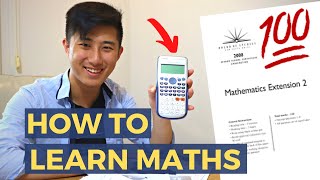

Why Asians Are Good at Math (The Real Reason)
44sThe humorous stereotype hook immediately grabs attention and the speaker's credible background adds intrigue.
▶ Play Clip"The title promises an Asian perspective on learning maths, and the video delivers that, but it's padded with personal anecdotes and stereotypes, making it average."
Shane, a high-achieving mathematics graduate, shares his personal strategies for mastering mathematics, drawing on his Asian upbringing and rigorous study habits. He emphasizes the importance of continuous learning, deep understanding over memorization, and consistent practice to excel in the subject.
Shane graduated with a 99.90 ATAR, achieved 99 in Extension 2 and Extension 1 mathematics, and was one of 100 students invited to the Australian Mathematics Olympiad.
Mathematics is cumulative; primary school concepts lead to high school topics, and junior years lead to senior years. For example, algebra requires understanding order of operations, and calculus requires algebra. Falling behind makes it harder to catch up.
Many Asian students start tutoring early, ensuring they stay on top of content. Shane's parents provided tutoring and homework help, filling any learning gaps from a young age.
Shane memorized squares up to 20 and all multiplication tables, building a solid foundation that made advanced concepts easier to grasp.
Memorization alone is insufficient for harder questions. Understanding concepts allows you to figure out how to solve problems and choose the right formula, rather than relying on rote recall.
Practice questions until confident, then revisit them using spaced repetition (weekly, bi-weekly, monthly) to retain concepts. A teacher used weekly quizzes to reinforce this.
Avoid repetitive practice that wastes time. If you master a concept in 10 questions, skip the remaining 90. If struggling, continue until you understand, or seek help.
Videos like Eddie Woo's YouTube channel or Virtual B15 (Shane's teacher's channel) explain concepts well for Year 11 and 12 topics.
Analyze and revisit mistakes from tests and homework. Mark wrong questions and redo them before exams to avoid repeating errors.
For hard problems, practice multiple approaches. This builds problem-solving skills and helps you find alternative solutions when stuck in exams.
If you struggle with formulas, you'll waste brain power on recall instead of problem-solving. Extensive practice makes formulas automatic, freeing mental energy for complex problems.
Mastering mathematics requires a combination of early preparation, deep understanding, consistent practice, and strategic review of mistakes. By adopting these habits, you can build a strong foundation and tackle even the hardest problems with confidence.
What ATAR did Shane achieve?
99.90
00:13
Why is mathematics a cumulative subject?
Because concepts build on previous content; e.g., algebra requires order of operations, and calculus requires algebra.
00:27
What basic facts did Shane memorize?
Squares up to 20 and all multiplication tables.
01:42
What is the key to solving harder math questions?
Understanding concepts deeply, not just memorizing formulas.
02:09
What is spaced repetition?
Reviewing concepts at intervals (weekly, bi-weekly, monthly) to retain them.
03:02
When should you stop practicing a concept?
When you've mastered it and can solve questions without thinking.
04:07
What should you do with mistakes?
Revisit and analyze them, mark them, and redo them before exams.
05:12
What is the benefit of trying multiple methods?
It sharpens problem-solving skills and gives you alternative approaches when stuck.
06:17
Why do extensive practice make formulas automatic?
It frees brain power to focus on problem-solving rather than recalling formulas.
07:58
Mathematics is Cumulative
Emphasizes the importance of not falling behind, as each concept builds on the last.
00:27Understanding Over Memorization
Challenges the common misconception that memorizing formulas is enough for success.
02:09Spaced Repetition Technique
Introduces a scientifically-backed study method to retain concepts long-term.
03:02Multiple Problem-Solving Approaches
Encourages creative thinking and flexibility, crucial for tackling difficult exam questions.
06:17[00:01] mathematics is probably a subject you're struggling with a little lucky for you there's one type of people who are good at maths which many people in the that is asians
[00:13] hey everyone my name is shane and i graduated with a 99.908 and achieved 99 in extension 2 and extension 1 mathematics i was also one of 100 students in australia invited to participate in the australian
[00:27] mathematics olympiad the first thing you need to understand about mathematics is it's a subject that continuously builds on previous content what i mean by this is a lot of what you learn in primary school leads to what you learn in high
[00:39] school in the junior years and what you learn in the junior years goes on to what you learn in the senior years for example you can't learn algebra without knowing and understanding the order of operations and you can't do
[00:51] much calculus and trigonometry without a strong understanding of algebra this means it's essential that you don't fall behind in terms of content of what you should have learned by which year this means you really got to be continuously
[01:03] on top of your no lazing around and definitely no saying i'll learn it later or learn it next year you have to learn now and if you're behind you've got to catch up quick otherwise it'll just get harder and harder this is something
[01:16] asians have an advantage with because a lot of the asian kids start tutoring from an early age many kids like myself even did tutoring in primary school and so it makes sure we're on top of everything as we spend a lot of time
[01:30] learning maths in the classroom at school as well as in tutoring centers as an asian kid back in the day my parents made sure there were no holes with my learning for me back in the day i did a lot of practice practice practice and i
[01:42] also did a lot of memorization i memorized the squares up to 20 and also all of the multiplication tables and made sure that was very very solid from my mom and dad i also got a lot of tutoring and homework help to make sure
[01:55] that any concepts i was struggling with they would explain it to me especially concepts weren't too difficult made sure i fully understand it which means i them as i went to high school and also in my senior years the second thing
[02:09] about maths that many people get wrong is they think they can get by with just memorization but it's 100 per focus on a pure understanding of the concepts this is especially true for the harder questions where it's not as simple as
[02:23] just knowing which formula to use and plugging numbers into the formula you have to figure out how to solve the question first and then get to the stage where you will need the formula and also which formula do you actually use if you
[02:36] are just memorizing formulas or worse cheating in the tests by writing down the formula that is not going to help you at all you might have the formulas written down on your hand but an asian will know the formula like they know it
[02:49] like the back of their hand this means when we get to harder straightforward we can focus all our effort into thinking how to solve the problem rather than memorizing exactly what was that formula was it negative b
[03:02] or positive b here the third thing about maths is practice makes perfect you should be practicing questions around a concept until you're fully confident about it then even after that you should still practice that concept every one
[03:15] week every two weeks and every four weeks using something called space repetition to make sure the concept stays in your mind and you never forget it this was something useful i learned from a high school maths teacher where
[03:27] he would give us weekly quizzes even though we just did these in our own time based on how far away they were from the concepts that we learned one week two weeks and four weeks ago and he made them appear in such a way that we could
[03:40] use space repetition effectively to make sure we weren't forgetting any topics maths is they have a lot of practice doing this whereas most kids might not get so much homework whether that be their school homework or tutoring
[03:55] homework or just additional homework their parents give them most of this is mathematics related and just doing questions over and over again until you're sick and tired and don't want to do maths anymore however i actually
[04:07] somewhat disagree with this mindset and instead i'd rather say practice until you've mastered the concept and make sure you aren't going to forget it but if you're doing way too much questions repetitively where you don't even need
[04:19] to think about it anymore then that's just a waste of time if for example you get a homework share with 100 questions but it only takes you 10 questions to fully grasp and learn the concept and you haven't gotten any of those wrong
[04:31] then there's no real need to do the last 90 questions however if you are struggling keep doing them until you've fully mastered the concept now if you do mastered it then either you weren't getting enough homework or you didn't
[04:45] understand the concept fully which means go back to the teacher and ask them to explain it again there are a lot of videos online that explain concepts well for example eddie wu's youtube channel or my maths teacher actually explains
[04:58] the year 11 and year 12 topics on his channel which is virtual b15 the fourth thing about learning mathematics properly is to revisit your mistakes so if you make a mistake once that's bad enough but at least it's forgivable
[05:12] because you are making that mistake most likely because you are encountering a problem for the first time however you better not make that same mistake again in the next exam my asian parents paid a lot of good money for tutoring services
[05:24] back in the day and if i get something wrong then get it wrong again even after i've supposedly learned it then that just kind of makes them feel like i actually didn't learn anything and all that tutoring money is going to waste in
[05:37] house whooping so naturally to get better at maths don't disappoint your parents by showing them you can't learn from your mistakes so after you figure out what your mistakes are make sure you revisit them and analyze them see where
[05:50] you went wrong and make sure you don't make the same ones in the future one of the good habits that i developed was to always revisit my mistakes no matter it was an actual test a practice test or just homework exercises
[06:03] ones i got wrong i made sure to put a mark next to or circle so i would revisit those before an exam and make sure to redo those questions to make sure i didn't make those mistakes again after revisiting them
[06:17] and it means in the future i was less likely to make the same mistakes again probably have never heard of before and it's really quite a bonus that will really help you be able to do the harder questions in your exams that you just
[06:29] have no idea how to do and that method is to try different methods when you're practicing on the harder questions you approach trying different methods and multiple approaches was something i learned from a mathematics tutor who did
[06:42] competition maths and olympia level maths training let's say you have a hard test that you're doing even after you get one method to do it correctly let's say even if you struggled a lot to get that one method
[06:55] keep thinking see if there's another approach after you find another approach or another way to think and go about the problem then you can see why one method worked better in terms of this question compared to the other method and you'll
[07:09] get a feel for which type of method to use for similar questions later on and which type of methods are best suited to which types of questions this means when you do get stuck in a real question later on in the real exam then even
[07:21] after trying to find a solution that doesn't work and just end up getting nowhere at least it means you can try another approach that you might have attempted before in the past on a different type of question and see if
[07:33] that yields any results rather than just being stuck there and doing nothing but twiddling your thumbs this gives you more chances to find the approach that will get you to the correct solution for a very difficult problem and it also
[07:45] helps to sharpen your problem solving skills and creative thinking ability you can also get a feel of which methods will become more efficient and this will sometimes give you shortcuts for other problems and save you time during exams
[07:58] so you have more time to work on the harder problems later on and harder questions is also where the first four points come in if you barely know the formulas and had to memorize them on the bus ride to the exam then you're pretty
[08:10] far behind already once you get a difficult problem there's very unlikely that you'll be able to do it as you're even struggling to just memorize the formulas which one should i use wait was it this formula what was
[08:22] that formula again whereas for most asians they don't need to waste their brain power thinking of which formula to use all the formulas is like a heads because they've done so much practice they've probably done millions
[08:35] of questions on just one single formula and they know it without having to think about it this means they can conserve all their brain power to just tackling and finding solutions to that problem and not worry about which formula to use
[08:47] they use a formula they just write it down without even thinking a quick disclaimer though not all asians are like this and most asians out there actually have a life outside of studying unlike me who's still talking about
[09:00] maths in his youtube videos even though i've graduated high school for a few i've graduated high school for a few years now stereotyping all the asians out there however i do hope you guys did learn
[09:13] something about learning maths in a more entertaining kind of way if you enjoyed big like down below and subscribe to this channel to not miss out on my future study content where i give more educational tips on mathematics and
[09:27] other subjects as well as money and university life as always take care and university life as always take care and i hope to see you guys in the next video




⚡ Saved you 0h 09m reading this? Transcribe any YouTube video for free — no signup needed.