
7 Reasons 99% of Etsy Shops Fail
44sHigh curiosity and promise of insider knowledge about Etsy success.
▶ Play Clip"Delivers on the promise of seven reasons with concrete data and examples, though some sections feel padded with self-promotion."
This video analyzes why most new print-on-demand Etsy shops fail, based on a study of 1,500 shops that achieved $1,000 per month in their first year. The creator, who has made multiple seven figures from t-shirts, outlines seven critical mistakes beginners make and provides a data-driven framework for success, emphasizing design quality, niche research, and avoiding trademark infringement.
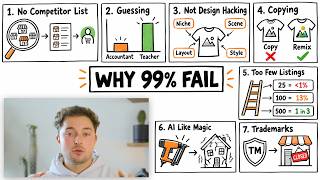
Successful shops avoid seven common mistakes; success is more about what you avoid doing than what you do.
It's not just Etsy or TikTok; it's making good designs and putting them on clickable mockups. Design and mockup account for 80% of success.
Build a list of 5-20 shops selling to the same buyer. Note their bestsellers, prices, mockups, and niches. Study recent successes, not old ones.
Competition is proof of demand. Use sales data to find profitable niches and subniches. Look for concepts with proven sales and less competition.
Break down bestsellers into four elements: niche, scene, layout, art style. Remix these to create original designs that target the same customer.
99% of shop shutdowns are due to infringement. Avoid copying artwork; borrow ideas, format, and style, but never the artwork directly.
At 25 listings, chance of $1,000/month is <1%; at 100, 13%; at 500, ~1 in 3. Top 1% average 700+ listings. Focus on covering many search terms.
AI is a tool, not a magic solution. It can make slop or great designs; the seller's taste and direction matter. Don't flood your shop with random designs.
Always check trademarks on search terms and designs before posting. It's easier to check 20 at upload than to audit thousands later. AI can help, but it's your responsibility.
The key to success in print-on-demand is a systematic approach: research competitors, find proven niches, design hack to create original products, list in volume, use AI wisely, and always respect trademarks. Avoid these seven mistakes to give your shop a real chance to grow.
Avoidance over action
Frames success as a negative space—what you don't do matters more than what you do.
00:4380% is design and mockup
Provides a concrete allocation of effort, guiding beginners on where to focus.
01:37Competition is proof
Reverses a common beginner belief, turning a perceived obstacle into a validation signal.
06:08Design hacking as cooking
Uses a relatable metaphor to explain the process of learning from bestsellers without copying.
11:29Emotional connection drives sales
Highlights the psychological driver behind purchases, emphasizing feeling over features.
16:23[00:02] already doing thousands of sales per month and bringing in tens of thousands of dollars. So, why are some shops like these taking off while most new shops are left picking up the scraps left behind or even worse, making nothing at
[00:17] millions of dollars in profit. I'm talking about quit their day job money within a year. These shops didn't have some secret advantage. They don't have some complicated formula. They just avoid the seven biggest mistakes that
[00:31] almost every single beginner makes. And I know because I made every single one of these mistakes with my first t-shirt business. And now after I've done multiple seven figures with t-shirts alone, here's what I learned. Success
[00:43] has more to do with the things that you avoid doing than it does with the things that you actually do. So, I'm going to show you what the seven mistakes are and what the top shops are doing right now that everyone else simply isn't. Print
[00:56] on demand isn't an Etsy business. It isn't a Tik Tok shop or even an AI business either. It's really just two skills. Making good designs and putting those good designs on mock-ups that people actually click. Etsy is just one
[01:11] marketplace you can list your print on demand products for sale on. So, when search for the product that they're looking for, you can think of the search results page as sort of a digital clothing rack. The buyers have hundreds
[01:25] of options and there's probably going to be only one that gets them to stop and click. All they're ever going to see is the design that you've made on the product mockup. They can get a t-shirt from anyone, but the design is really
[01:37] what they're buying. Success is really 60% the design you make and about 20% the mockup. And that's 80% of the business. The SEO, pricing, branding, all the little details are sort of optimization. They do help you get more
[01:52] sales, but ultimately the design and mockup combination, that's what you should focus on more than anything else and more than any other advice in this video. So, for these seven mistakes, you can ask yourself one question. Does this
[02:06] make my design better or worse and my mockup more or less clickable? But the thing is, mistake one happens before you've ever even made a single design. It sounds really boring and that's why most beginners skip over it and that's
[02:20] building a competitor list. If you can't name the shops that your buyers are already buying from, then you don't know who your buyer is. So, every design is a guess, and that means every mockup is a guess, too. A competitor list isn't just
[02:34] about finding shops that are selling the same product as you. It's about finding shops that are selling to the same person that you want to have buy from your shop. The niche that you're building your designs for isn't really
[02:47] about a specific niche. It's about the person that you're making that design for and the things that they're interested in. So, for each shop in your competitor list, you want to note down their bestselling products, their
[02:59] prices, the mock-ups that they're using, and what niches they're targeting with their designs. Right now, I track between 15 to 20 shops at any given time. Your list can grow and shrink over time, and you don't need that many to
[03:13] start. In fact, I'd recommend around five to get going. But the more shops that you follow that took off recently, the more success that you'll typically have. If you look at the bestselling shops that blew up 5 years ago, that's
[03:26] going to show you what worked best 5 years ago. But one that took off this now. You can kind of think of it like opening up a restaurant. You don't study the diner that's been around for 40 years. You eat at the new restaurant
[03:41] that has a line out the door and down the block. Now, I do all my market research in a tool called Listing View. It's a company I have stake in. That not just saving yourself time, you're also helping out the channel. I build up
[03:54] my competitor list by using the research database, looking at shops, and filtering these shops by the category of product that they sell in. For example, t-shirts. This shows me all of the t-shirt shops that are selling best on
[04:09] Etsy. That's the marketplace that I've had most success on. We could also add another filter such as age and say within the last 12 months. And now we're getting all of the shops that opened up within the last year. We're able to sort
[04:22] them by monthly sales or monthly revenue or basically any metric that we want. exactly what's working right now today. You can open up each one of these shops and ask yourself a question. If this were your shop 1 year from now, would
[04:37] you be happy with it? And so if the answer to that question is yes, then you can star that and add it to a t-shirt competitor's watch list, building up your competitor list over time. Just to be very clear, this is not about copying
[04:49] what these shops are doing. And also, you'll see a lot of new shops that are doing very well, but they sell a lot of trademarked products like Disney or Pixar Designs. Skip over all of those shops. We'll talk about that more in
[05:02] mistake number four. But this method is exactly how I found the three shops from found one shop that blew up in the last they might have had luck on their side. But when you find three, five, or 10
[05:16] shops and you're able to line them up, you'll start to identify the patterns between them and figure out exactly who they're creating products for that are actually coming to their shops and buying. That's the same person you want
[05:28] to make designs for. This helps you figure out who they are, what makes them laugh, how much they'll pay for the product, or whether it's a gift. Your competitor list helps you figure out exactly who you're selling to. Now, the
[05:41] thing is, it doesn't tell you exactly what to make next, and that's where most beginner shops start guessing. And the thing is, the answer to it isn't only on Etsy. Mistake number two is making what you think is going to sell. So, here's
[05:55] what most beginners get backwards about niche research. Most beginners come up search for it to see what the competition looks like. But when they find that there's hundreds or even thousands of listings all targeting the
[06:08] same concept, they start to back off. Beginners think that competition is a problem when a lot of successful sellers see it as proof. I've seen bad designs on bad mock-ups that still sell anyway. And if you're wondering why, it's
[06:22] because they were still posted in a profitable niche. When you actually do niche research, it doesn't just give you the product direction. It also gives you the subniches and the concepts within that niche that people are actually
[06:35] don't believe me, you can do it on any platform where you can see sales data. So, for example, if we take a look at this listing on Amazon, it's a design of some ghosts, obviously targeting the trick-or-treating Halloween niche. It
[06:50] sold around 500 times just this month. And so that's a pretty strong demand platform like Tik Tok shop. So on my browser, I've got the listing view plug-in installed and I made a search for nurse shirt and then filtered these
[07:04] see here is a lot of these products are bringing in a few thousand per month in their simple print ondemand designs that we could have made and posted for sale. The cool thing about Tik Tok shop is you can always see the amount of units sold
[07:19] although this is helpful to sort of calculate revenue figures, you can still out exactly what customers are buying and how much it's selling. Of course, this works the exact same way on Etsy. When you make a search, you can filter
[07:33] out by sales or revenue. And this helps you answer the most important question, [music] which is what are people already paying for right now? If you make a search for something like an accountant shirt and then you sort them by sales or
[07:45] revenue, you'll notice that the top listings on this page, [music] sure, they're making a few sales and a few hundred bucks every month. But if you something like a teacher shirt, there is a lot more competition. But once we
[07:58] filter out these results, what you'll notice is that the top listings on this page, they're not only making a few hundred, they're actually bringing in thousands of dollars per month. And there's a lot more listings doing that,
[08:10] a mockup is going to take you the same amount of effort whether you target a profitable niche or a niche that hardly makes any sales. But I always like to go one level deeper. So instead of just
[08:22] finding ideas based on this page, when you find a product that's selling pretty well, like this one for example, it just says you can do hard things. We can make one more search for that same concept to see if more listings are selling the
[08:35] same idea. When we filter this out, you can see that there's a lot of listings all targeting the same sort of concept using their own version of this slogan and design. And not only are there a lot more listings on this page that are all
[08:48] bringing in revenue every month, but there's a lot less competition for this specific concept. This targets the exact same teacher niche, except this angle isn't crowded. It's proven to work. This is all the data you need to get started.
[09:03] you found a concept that's working right now today and you know exactly who's buying it between the keywords, the sales data, and the overall just listing images that you'll see. Before you design anything, look at what's already
[09:17] bestselling, and you'll have a huge head start when you go to make your own versions. If you want more details on how exactly I do niche research, I've got my completely free course linked right below that big shiny subscribe
[09:29] button. But now that you've got a list of products that already sell well, what you do with that list decides whether your shop grows or gets shut down. This next mistake isn't obvious, but it can genuinely be the difference between
[09:42] success and failure. And that's not design hacking. When most people who are beginners see a best seller, they just see a shirt with a design on it. The shops that actually scale, they see that design in four different parts. Design
[09:57] hacking is how you put your niche research to work. You take the products that are already selling best and you break them down into four core elements. You lay out the pieces in your own digital workspace and that's what allows
[10:10] you to go build your own original versions. Here's a design that's selling really well right now. If you pull the design off the shirt and forget that the mockup is there for just a second, every design that sells has the same four
[10:23] elements. First is going to be the niche. That's who the product is for. In this case, it's obviously for nurses. Now, I can infer that by looking at the design, but you can also look at the keywords to tell you who exactly the
[10:37] product is for. Second is going to be the scene. So, this is the specific the scene. So, this is the specific slogan, the characters in the design, or both. In this case, it's a few different graphics that a nurse would recognize
[10:49] along with a slogan. The third element is the layout. So, that's how these specific elements are arranged in the design. In this case, it's just a simple graphic above the slogan. The fourth element is the art style, and this is
[11:01] how you would describe the way that the design looks. Is it handdrawn? Is it distressed? In this case, it's sort of a handdrawn vector graphic with a cursive style font. The niche, the layout, the art style, these are all of the patterns
[11:16] that you learn from over time. And this is where some of your skill starts to develop. And the scene is the actual art, and it's usually their words. So the scene is the part that you always make unique and original to yourself. I
[11:29] like to think about it like cooking. So if you've never made an egg roll, it's going to feel impossible. You don't even know what goes in it. But if you eat enough egg rolls and you taste a really good one, you can start to list out the
[11:42] ingredients. Once you know exactly what goes in it and you learn the steps you have to take to cook it, after hopefully not too long, you can make your own. That's basically design hacking. You're not stealing the recipe. You're learning
[11:55] every step of the process and exactly what goes into something good so that you can modify those individual steps to create your own that you feel is better. In my opinion, selling t-shirts is a lot easier than being a chef because a chef
[12:09] going to like as they make modifications. But you can see what's selling before you go and make that type of product. This is practically how it looks on my canvas. I upload reference designs from bestsellers and then I
[12:23] start to label out the niche, the layout, the art style, and the scene so that I can decide which element I want to remix. I then plug it into a pipeline like this one. I build out my own original references on the left, connect
[12:37] them to image generators, and write a prompt telling it how I want to remix it and which design element I want to remix. In this case, adding a new niche, I was able to turn these book lover designs into the nurse niche. This is
[12:50] cool cuz I'm able to do it at scale, so I can create lots of designs in a few easy, but you shouldn't confuse that with simple. 60% of your business's success comes down to making good
[13:02] product is and what the customer is building up a strong competitor list is the backbone for making good designs. And when you do that and you follow the design hacking process, you can
[13:15] definitely use AI to make good design. Just remember, AI can make total slop, but it can also make excellent designs that people are genuinely happy buying. So, every time you design hack, just ask yourself one question. Why is someone
[13:28] yourself one question. Why is someone buying this? What's the actual joke? Who is the person that I'm making this for? How is the actual design drawn and put together? And when you're able to answer those questions, you really can stop
[13:40] guessing and start making designs that can become your own bestsellers. When I making my first few products, I made what I thought would look good. I was making designs based on my own personal interests. And honestly, that is a great
[13:52] place to start if you're able to and if your own interests are already selling as niches on marketplaces like Tik Tok shop or Etsy. But the reason that it held me back is because I wasn't able to understand the style and the niches that
[14:07] were actually doing really well on these marketplaces where I was posting my to just design whatever you feel like and whatever you're most interested in, I'm a firm believer in just reading the data and giving people what they're
[14:20] looking for. Design hacking is the only step-by-step process that I've seen that helps you replicate what made a bestseller a bestseller in the first place into something genuinely original that you're safe to post in your shop.
[14:34] But there is a line here and if you cross it, then you end up losing your shop and all of the work that you've put in. Most people hear design hacking and they think it means stealing someone's design. And that's mistake number four.
[14:47] 99% of shops that get shut down get closed because of one reason, trademark and copyright infringement. They created and posted a design that they weren't have to ask yourself a question, is it worth losing your entire ability to sell
[15:04] to make a few thousand? Don't get me wrong, some of these shops make a ton of money in year one, like this shop we looked at that's 2 months old and making an estimated $30,000 a month. That's
[15:16] revenue, not profit. But the point still stands. They're doing quite well in a really only because they're selling a bunch of trademark style designs. This is sort of the obvious lowhanging fruit. This shop is definitely going to get
[15:29] shut down. These shops are infringing on trademark, which I'll touch on briefly at the end. This mistake is more about copying, which is what most people get backwards about design hacking. They think that it means you're copying
[15:42] doesn't. It means you're trying to target the same customer who's buying that product. It means making a new product for that same customer, giving them another option where if they bought yours, they'd also love the product.
[15:57] It's a balance. And you have to ask, what makes someone buy without copying someone else's listing? When you look at a product and you ask, why is someone buying this? What's the art style? What's the mockup? Those questions help,
[16:11] but ultimately it's how does this product make someone feel? If your product doesn't make the customer feel something, they're not going to buy it. I like to think that you make money in this business by the level of emotional
[16:23] connection that your design makes with the customer, not because AI was able to think about it, a buyer might be handing you two and a half hours worth of their paycheck. Your job is to identify which products are already creating an
[16:38] emotional connection. Again, you do that by design hacking and looking at the sales data in your research. And then you remix and you iterate in your own way. This is how we're able to have Burger King and McDonald's or Lyft and
[16:51] Burger King and McDonald's or Lyft and Uber, Target and Walmart, Hershey's and options and variations of the same thing is because these companies and businesses take something that works, remix it, adding value in a few key
[17:05] product that can target the same customer in a unique way without ripping someone off. The rule of thumb that I like to follow is borrowing the idea, the format, and the style, but never the artwork directly. The cool part is once
[17:20] you have your own original products that sell in your own shop, you get to make more iterations and more variations of those products, which is what compounds your success over time. When you have one bestseller, you can replicate that
[17:33] exact same style into other niches or with other characters or other scenes. And that lets you build out your own original catalog a lot faster. That's why the first 100 bestsellers are way harder than any other designs that
[17:47] you'll make. And that's why in my merch maker community, I have every beginner who's starting out go through the same 21-day challenge. They all have to post a 100 designs in 21 days, which is exactly what the challenge helps them
[18:01] do. Building out a system so that it's not a ton of guesswork. And after that point, making designs is just about showing up and taking the same checklist actions every day. And that really helps you build up a strong large catalog over
[18:16] time, which if you've seen any of my videos, you'll know that over the last few years, I've constantly told you that quantity beats quality every time. But now, I feel like I have an even clearer way to explain what the quantity rule
[18:31] truly does in your shop. Mistake number five is a mistake that I've made at different steps in my journey, and that's making too few listings. Now, I want to be clear. The fix isn't just raw quantity and raw slop. Put in a better
[18:47] way, it's having a larger or bigger net to cast. If you come on listing view, you'll see that there's over 150 million listings and over 3.5 million shops. For perspective on the whole quantity math, at 25 listings, your shop has a less
[19:03] than 1% chance of ever making $1,000 per month. But at 100 listings, that chance month. But at 100 listings, that chance is 13%. At 500 listings, you're at about a one in three shop. Now, nothing is ever guaranteed, and it's entirely based
[19:18] on the quality of products that you're posting for sale. It's not just pure numbers. If you posted the same listing 500 times, it's not going to sell. But the key is that every listing and every unique person that you're targeting with
[19:32] those listings moves your odds in your favor. I studied over 1,500 shops that favor. I studied over 1,500 shops that hit $1,000 a month in their first year, and they all had a median of over 200 listings each. Now, some of those shops
[19:47] had a lot more listings, and some of those shops had a lot less and targeted the trademarked niches, but most beginners give up around 10, 20, or 50 listings. They never even give their shop a proper chance to make any
[20:01] actually see this for yourself. So, all of the t-shirt shops that are under a year old, you can see that the ones making the most monthly revenue always have at least 100 listings, but on average, they'll have closer to 3, 4,
[20:15] 500, or even over a,000 listings in their shop. The top 1% of shops average at least 700 listings in their shop. To be clear, it's not about posting 50 versions of one design. It's about covering 50 different niches with unique
[20:30] designs. Quantity drives a ton of sales when you have a lot of raw coverage. If you look at this design, for example, switching out one of the icons in the set isn't going to drive a ton of new nurses to buy this product, but you
[20:43] could switch out the entire niche and concept to a bunch of other professions and the design might sell. Instead of just raw listing quantity, think about it in terms of how many search terms you're actually covering with the
[20:56] listings in your shop. If you're making good designs and putting them on good mockups and you cover a lot of different search terms, eventually your listings will get picked up by the algorithm. So, yeah, you want to list more, but listing
[21:10] more doesn't mean just list anything. And especially now, the AI can help you make genuinely unique and interesting graphics. It's definitely more about the targeting than anything. [music] And that's exactly where mistake number
[21:25] six catches almost every beginner. Treating AI like magic. Almost every business. But as I said at the beginning, this isn't an AI only business. Some people think that AI just makes slop. And some people think that
[21:40] the only reason products sell is because AI made it. Both people are ultimately wrong. Just because AI made something doesn't make it slop. And it also by no beginning, the design and mockup combination make up 80% of your success.
[21:58] That is what the customer is buying. They're not buying the tool that made it. And so customers buy good products with good designs, whether or not AI is helping the seller make that design. AI is just another tool. It can help you
[22:12] make really bad designs. A nail gun doesn't make you a good carpenter. It makes a good carpenter faster and it helps a bad carpenter build a crooked house faster. That's why the fundamental
[22:25] steps are still up to you as the business owner and the seller. AI can help you do good research. It can also help you do really bad research. It doesn't know what the difference is between a good design and a bad design
[22:37] niche. That's where you come in as the seller and add your own taste. AI will leading it. So, if you're leading it in the wrong direction, you'll end up at the wrong destination. So, that's why I always say, don't use it to just flood
[22:52] your shop with random designs. You have to have a sustainable brand and be moving in the right direction and use it to build out highquality products. Which nobody wants to hear, honestly. And that's the one that can end a shop
[23:05] overnight, which is why I saved it for last. And that's skipping the trademark checks. Okay, this assumes that you're even going to do this business, which most people never even post their first product, let alone a 100 products. But
[23:18] if you are, doing a simple trademark check on the search terms and the designs that you're actually making and posting in your shop will save you hours few of their designs, but then they get lazy over time, and this is probably the
[23:34] number one thing that gets a shop shut down. I've gotten a few products taken down over the last few years because I wasn't thorough enough about checking trademarks, but trust me, it's a lot easier to check 20 trademarks as you
[23:48] upload 20 designs than it is to go back across a,000 listings or 3,000 listings when you've already posted them to doublech checkck all your work. This is one area that AI is a lot more helpful at. It can help you sort of analyze your
[24:03] listings as a whole and maybe find a few more of the more obvious trademarks that you might have missed. But at the end of the day, it is ultimately up to you to make sure that you're not copying anyone's designs or posting designs with
[24:15] trademarks on them. That's why in my last design hacking tutorial that I posted a couple weeks ago, I go so deep into remixing and creating your own original designs in the design hacking process. Because at the end of the day,
[24:29] it's better to spend a little more time upfront and build a safe brand than scale for faster sales and end up getting your shop shut down because you weren't thorough in the trademark process. Like these shops, man, it's not
[24:43] worth it. like they're making a lot of sales today, but when they lose their shop tomorrow, like you can check, is this shop still open at the time that I posted this video, it's very rare that they last more than a few months. And
[24:56] so, yeah, I've made that mistake. Luckily for me, I didn't lose my entire shop by making that mistake. It cost me so much time to have to go back through thousands of listings, checking them one by one to make sure that the shop as a
[25:09] whole was still safe. Hopefully, you can avoid that mistake as well. So anyway, avoid that mistake as well. So anyway, that's about it. Hope these helped.
⚡ Saved you 0h 25m reading this? Transcribe any YouTube video for free — no signup needed.