

79,000 layoffs: Why your job is at risk
40sOpens with shocking layoff statistics that create urgency and fear of job loss, making viewers immediately want to learn how to protect themselves.
▶ Play Clip"Delivers a solid 90-day roadmap, but heavy promotion of the YouTube Academy and repeated 'don't quit' advice dilute the promise."
The video argues that having a job is a reason to start a YouTube channel, framing employment as a paid internship for building a scalable business. It presents a 90-day roadmap to turn professional experience into an asset that generates income independently of an employer, using YouTube as a traffic source and emphasizing the importance of an owned audience and a clear offer.
Nearly 79,000 people were laid off in the industry in Q1 2026, with Amazon laying off 14,000 in 2025. Entire departments are disappearing, making specialists dependent on company decisions. Starting a YouTube channel is presented as a way to protect your future by turning experience into a scalable asset.
At work, you get paid to learn how to solve problems and build processes. When you have your own business or product, your experience generates income repeatedly without constant time-for-money exchange. The speaker shares a personal story of replacing employment income using YouTube as a traffic source.
Most businesses fail due to desperation, not bad ideas. A job provides stability, allowing strategic decisions without panic. The main advice is to test hypotheses while employed, not to quit right away.
Posting everywhere without understanding what you're selling and to whom is noise. You must clearly define the problem you solve, for whom, and why you are an expert. Lack of time can be a plus, forcing focus.
Sergey, an entrepreneur, focused on entrepreneurs like himself, sharing specific tips on scaling. He made $25,000 in sales from a channel with only 10,000 subscribers by clearly understanding his audience's pain.
Big reach doesn't equal big money. Money comes from specificity—people understanding who you are for, what you help with, and why they should buy. YouTube brings people with specific requests, unlike social media feeds.
Every YouTube video becomes an asset that brings customers for months or years. You don't need hundreds of thousands of subscribers; a small, relevant audience is enough. YouTube helps attract exactly those people.
Think of YouTube as a front door; the real value is the system (business) behind it. You don't need an audience at all if you create strategic content that people find through search, SEO, and AI platforms.
Views and subscribers don't equal sales. People who see you for 5 seconds won't remember you. You need to transfer people to platforms you own, like an email list or Telegram channel, using lead magnets (PDF, guide, webinar, checklist, mini-course).
By giving valuable material, you collect emails or Telegram subscribers, building trust over time. This is an owned audience, not dependent on algorithms. Engagement increases when you send videos to your list.
The scheme is content → audience → offer. This turns knowledge into stable income. You don't have to quit your job; test hypotheses first.
Don't try to sell immediately. Talk to 10-20 people in your field, ask about their biggest problems and desired changes. People tell you what product to create.
Don't create a huge course. Make a simple plan showing where the person is, where they want to go, and steps to get there. People pay for speed and a clear path, not information volume.
Sell the program before it's fully created. Use simple formats like Google Docs or live Zoom calls. Lead people live weekly, improve based on feedback. Questions from training become ideas for YouTube videos.
One video a week or even two a month is enough. Each video becomes an asset. The system: YouTube brings people, content brings them into your database, database is warmed up in Telegram, offer brings sales.
The world is changing fast; AI is changing the market, companies are laying off people. The only real protection is when your expertise generates income on its own, without a company intermediary. Ask yourself: what will happen in 10 years?
The video concludes that in a rapidly changing job market, turning your expertise into an independent income stream via YouTube is the only real protection. It encourages viewers to start building this asset now, rather than waiting for job loss.
What was the number of layoffs in the industry in Q1 2026?
Almost 79,000 people were laid off in that industry.
00:02
What is the main advice regarding quitting your job?
Don't quit immediately; test your hypotheses first while employed.
02:13
What is the 'follower trap'?
Spending years building a following and assuming they will buy from you, but views and subscribers don't equal sales.
05:22
What is an 'owned audience'?
An audience you own, such as an email list or Telegram channel, that you are not dependent on algorithms for.
06:06
What are the three parts of the system that turns knowledge into income?
Content, your audience, and an offer.
06:45
What should you do in the first 30 days of the 90-day plan?
Conduct market research: talk to 10-20 people in your field to understand their problems and desired outcomes.
07:14
Why do people pay you according to the video?
They pay for speed and a clear path to results, not for the amount of information.
08:05
What is the recommended frequency for YouTube videos?
One video a week or even two videos a month is enough.
09:15
Job insecurity statistics
Provides concrete data on layoffs, making the case for building an independent income stream urgent.
00:02Don't quit your job
Counterintuitive advice that emphasizes stability and strategic testing over impulsive action.
02:13Sergey's success case
Demonstrates that a small, targeted audience can generate significant sales, debunking the need for massive reach.
03:07The follower trap
Highlights a common mistake and redirects focus to building an owned audience.
05:2290-day plan: market research first
Provides a concrete, actionable first step that prevents building a product on assumptions.
07:14[00:02] to start a YouTube channel. Not to become a blogger or for the sake of views, but to protect your future. In the first quarter of 2026 alone, almost 79,000 people were laid off in that industry . Amazon laid off 14,000
[00:16] 2025. Officially, this was called a redistribution of resources in favor of the I infrastructure. You see, entire departments are disappearing, and most specialists are completely dependent on whether the company decides that it still needs them. In this
[00:30] video, I'll show you how to turn your experience and skills you've accumulated on the job into a scalable asset so your income is n't tied to one employer. not ready yet," or I don't have an audience, this [music] video is for you because
[00:43] funds your expertise. In this video, I'll lay out a 90-day roadmap, step-by-step, on how to turn your work into your own we've already helped people do this [music] . If you want to do more than just manage
[00:57] that brings in customers and sales, apply to the YouTube [music] academy . There we help build a channel, content, and monetization from scratch. At work, you get paid to learn how to solve problems, build processes
[01:09] [music] and become stronger as a specialist. But for all this you get paid while you work. And when you have your own business, product or system, your experience starts bringing in money again and again, even without your
[01:21] constant involvement, without the constant exchange of time for money. I had exactly the same story. I worked for hire. There was income, but it was tied to you want more money, work more, go on vacation, lose money. And there were
[01:34] see normal life. A huge workload, deadlines and the feeling that you are constantly spinning in a wheel, like a squirrel. And at some point, I took all of my accumulated experience, everything I knew [about music], and turned it into a
[01:48] I used YouTube as a source of traffic to promote it, and gradually it started to grow. As a result, I replaced my income from employment, not having a huge audience and not chasing views. Simple, clear
[02:00] positioning, structure and content for specific people. Therefore, if you start to look at your work not as a cage from which you need to escape, but as a paid internship for your future business, everything changes. If
[02:13] join the YouTube Academy using the link in the description. Most businesses fail not because of a bad idea, but because of desperation. When you urgently need money, you start rushing, taking on the wrong clients, making weak
[02:27] decisions. And when you have a job, it gives you stability. So, you strategically [music] and without all this panic, right? to quit. This is the main advice. Content may seem like such a
[02:41] fun game at first, but if you jump into social media too early, you're building a business on a weak foundation. Most people think that they need to be everywhere: on TikTok, on Instagram, on YouTube, but constantly posting without understanding what
[02:53] exactly you're selling and who you're selling it to is just noise and a waste of your time. You must clearly understand what problem you are solving, for whom, and why you are an expert in this. And the most interesting thing is that work and lack of
[03:07] time are even a plus, yes, this will help you, because you simply won’t have time to waste on everything, so you will be forced to be students, Sergey, is an entrepreneur, and instead of trying to make
[03:21] on entrepreneurs like himself and began sharing specific tips on scaling a business, growing companies, audience, a specific problem and a specific solution. And this is what
[03:35] program and make 25,000 [music] dollars in sales from a channel that at that time had only 10,000 subscribers. He was able to make such sales because he clearly understood his audience and their pain. Many people think that if I
[03:49] go wide, I will reach more people. But big reach doesn't equal big money. Money comes from specificity, when people clearly understand who you are for, what you help with, and why they should buy from you. And it doesn’t matter whether you’re selling an
[04:03] online course or something else. YouTube is just a tool that brings you the people you need because YouTube works differently than social media. If on Instagram, people just scroll and come across any content,
[04:15] then on YouTube, well, people themselves come there with specific requests and problems. you. So, it turns out that you don’t try to constantly appear in the feed and post hundreds of videos for the sake of reach. Every YouTube video becomes an
[04:29] asset that continues to bring in customers months and even years later. You don't need, again, hundreds of thousands of subscribers to make money, right? You huge audience to start monetizing your knowledge. This is a myth.
[04:42] You need a small but relevant audience, people who really need your experience and solutions. It is YouTube that helps us constantly attract exactly these kinds of into a system? Think of YouTube as a front door, and the real
[04:55] value is the system, the business, yes, that you build behind it. That's huge audience. Moreover, you don't need to have an audience at all in the that will bring the right people to you, those who really
[05:09] need your experience. And it all starts, of course, with strategic YouTube content. Content that people can find through search. The same thing works through blogging, SEO, and even AI platforms. Yes, the internet is becoming more and
[05:22] more search-driven. And here is the second important point: you need to almost everyone makes. People spend years building up a following and think, "Well, they're watching me, so they'll probably buy something from me one day ." But views and subscribers
[05:37] saw you in their feed for 5 seconds, it doesn't mean they remembered you. Therefore, you social networks. You need to transfer people somewhere that belongs to you. Usually, it's through some kind of useful material, yes, a lead magnet, what we call a PDF, a
[05:52] guide, a webinar, a checklist, a mini-course, anything that helps a person delve deeper into your world and understand why you're the expert. And here the third email database. So, you give someone valuable material, they leave an
[06:06] Telegram channel, and then you gradually build trust through emails, content, and benefits. And this is a huge advantage, because now you have not just random subscribers, but a database of people who are genuinely interested in your
[06:19] topic. You are no longer completely dependent on algorithms and sitting in the hope that social networks will show your content again. This is called an owned audience, an audience that you own. I see this all the time on YouTube. If you send a video
[06:31] to your Telegram channel or to your email list, engagement will immediately increase. And so to perceive you as an expert. And there comes a point when they think, "I need to work with you." And the fourth part of the system is the offer, what
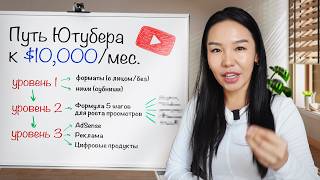
[06:45] online program. We help people turn their experience, knowledge, [music] To put it simply, our scheme looks like this: content, your audience, an offer— that’s how knowledge turns into a stable income. If you are employed, you don't
[07:00] have to quit right away. You need to test your hypotheses first, right? Don't just start posting, that's often the worst approach. First, makes your income and your expertise more sustainable in the long run.
[07:14] Now let's break down a simple 90-day plan to get a sense of how it all works. Again, in the first 30 days, most people make the same mistake: they try to sell something right away. But the problem is that if
[07:26] you don’t understand who needs what, people simply won’t buy it. Therefore, the first 30 days are a kind of market research. Talk to 10-20 people in your field, colleagues, acquaintances, potential
[07:39] clients. Listen to what questions are repeated, what worries them, what they lack to achieve results. Ask what is the biggest problem for you now change in your life if you solved this problem. And this is very important,
[07:52] because people literally tell you what kind of product you need to create. It turns out that you are not guessing, but building a product based on a real From day thirty to day sixty, you don’t create a huge course, that’s a
[08:05] mistake. You just make a simple transformation plan, where the person is now, where he wants to go and what steps will help him [music] go through this path as quickly as possible. The thing to remember here is that people don't pay you for the amount of information. There is already
[08:17] , yes, we know. They pay you for speed and a clear path to results. A results. After that, you sell the program even before you have completely created it. And that's okay. This is normal practice in the market. You don't need to create a
[08:32] perfect 100-lesson course; a simple Google Docs version or live Zoom calls will suffice. This is more than enough. Then, from day sixty to day ninety, you start leading people live, every week, improving the program
[08:45] based on real feedback. Because until you start working with teach properly. And only after all this do you turn all your experience into a people asked during the training become great ideas for
[09:01] your future YouTube videos. And this is where the YouTube magic begins. If you , YouTube will start bringing you customers through search and recommendations. You don't need to release 100 videos a week. Generally,
[09:15] one video a week or even two videos a month, as I do, is enough. And each video becomes an asset that continues to bring people in for years, even months. I have videos that I filmed there 3 years ago. They still
[09:28] system is built. YouTube brings people in, the content [music] brings them into your database, the database is warmed up in the Telegram channel, and the offer, yes, the product, brings in sales. And in the end, this is how your knowledge and expertise
[09:44] turn into a real asset that can bring in money regardless of your work. Because the world is changing really fast now, artificial intelligence is changing the market. Companies are laying off people. And the only real protection is
[09:57] when your expertise [music] can generate income on its own, without this intermediary in the form of a company. And ask yourself the main question: what will happen in 10 years? Yes, there are two options. Your knowledge can turn into an asset
[10:10] thanks to YouTube and can generate you money, turn it into a scalable business, or it can simply disappear with work. I certainly first scenario, so if you want to understand more deeply about [music] and how to
[10:24] build all this with our support, we are waiting for you at the YouTube Academy. Link in the description. That's all. See you in the next video. Bye bye.

⚡ Saved you 0h 10m reading this? Transcribe any YouTube video for free — no signup needed.