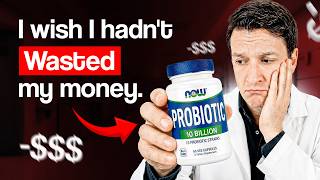

Stop Taking Probiotics Now?
45sChallenges a common belief with a bold claim, sparking curiosity and debate.
▶ Play Clip"The title is slightly exaggerated but mostly accurate—the video does argue that probiotics are overhyped and may not help, but it also explains specific cases where they are useful."
A doctor and scientist explains why probiotic supplements are often overhyped and may not benefit most people. The video covers the lack of regulation, microbe sensitivity, and oversimplification of gut biology, and highlights when probiotics can actually cause harm. It concludes by recommending fermented foods as a better alternative for gut health.
The supplement industry has turned probiotics into a marketing gimmick; your gut is more complex than a few bacterial species in a pill.
There is almost no regulation; studies show contents often don't match labels. Always choose third-party certified brands.
Microbes are sensitive to heat, oxygen, and stomach acid; up to two-thirds of people show no evidence of colonization or benefit.
Your gut contains hundreds of strains in equilibrium; adding a few random ones can be counterproductive.
A study found that probiotics after antibiotics delayed gut recovery compared to placebo.
Saccharomyces boulardii may help prevent C. diff infection in antibiotic users; probiotics are also used for pouchitis and pre-term infants.
Fermented foods like kefir contain diverse ecosystems, prebiotics, and postbiotics, and improve microbiome diversity and reduce inflammation.
Healthy individuals should choose fermented foods; those with specific conditions should research strains and consult a doctor.
What percentage of people show no benefit from probiotic supplements?
Up to two-thirds of people show no evidence of probiotic supplements colonizing their gut or providing digestive benefits.
2:32
Which specific probiotic strain may help prevent C. diff infection?
Saccharomyces boulardii, a type of yeast, can help prevent C. diff infection in people taking antibiotics.
5:25
What is a key advantage of fermented foods over probiotic pills?
Fermented foods like kefir contain dozens of bacterial and yeast strains, providing a diverse ecosystem.
6:56
What are common side effects of probiotic supplements?
Probiotic supplements can cause gas, bloating, and discomfort, though usually mild and temporary.
4:45
What did a landmark trial find about fermented foods?
A landmark trial showed that fermented foods improved microbiome diversity and reduced inflammation in healthy people.
9:41
Low Efficacy of Probiotics
Up to two-thirds of people show no evidence of probiotic colonization or benefit, challenging the common assumption that they work for everyone.
2:32Probiotics Can Delay Recovery After Antibiotics
A study found that probiotics actually slowed gut microbiome recovery after antibiotics, contrary to popular belief.
3:51Fermented Foods vs. Pills
Fermented foods provide a diverse ecosystem of microbes, prebiotics, and postbiotics, making them a superior option for most people.
6:30Actionable Decision Guide
Provides clear, practical advice: healthy individuals should choose fermented foods; those with specific conditions should research strains and consult a doctor.
10:16[00:00] I don't take probiotic supplements as a
[00:02] doctor and a scientist and if you take
[00:04] them daily, the latest science is
[00:06] telling us they're probably not doing
[00:09] much and they might even cause harm.
[00:11] I've been interested in gut health for
[00:13] many years, both during and after
[00:16] medical school, and I've recommended
[00:18] probiotic supplements in some very
[00:20] specific cases, but the supplement
[00:22] industry has turned this into a complete
[00:24] marketing gimmick. and your gut's much
[00:27] more complex than a couple bacterial
[00:30] species crammed into a pill. So, today I
[00:32] want to show you when probiotic
[00:34] supplements actually make sense versus
[00:36] when they're just a waste of money and
[00:39] when they can actually backfire. And
[00:41] we'll also talk about a much better
[00:43] option for most people. For more
[00:45] breakdowns of science and popular trends
[00:48] and different supplements with no sales,
[00:50] subscribe. When we hear probiotic, we
[00:53] usually associate that with a healthy
[00:55] gut. And there's some truth to that.
[00:58] Your gut contains trillions of microbes
[01:01] that help break down food. They talk to
[01:03] your immune system and they also nourish
[01:06] your gut wall. But the supplement
[01:07] industry wants you to make this logical
[01:09] leap that if gut bacteria are a good
[01:12] thing, then adding more bacteria in a
[01:15] pill must be good for you. And the
[01:17] scientific evidence is showing us this
[01:19] is a big mistake because probiotic
[01:21] supplements have a number of problems.
[01:24] Number one, there's almost no
[01:25] regulation. The seller doesn't need to
[01:27] show that the product works or even that
[01:30] it contains what's advertised on the
[01:32] bottle. Studies have shown that it's
[01:34] quite common for the content of these
[01:36] pills to not match what's advertised.
[01:39] Sometimes the concentration is wrong.
[01:42] Sometimes the species don't match. So,
[01:45] for anyone going for a probiotic
[01:46] supplement, it's always better to go
[01:48] with a third-party certified brand. That
[01:51] way, you know what's on the bottle is
[01:53] what's in the pill. Also, you want to
[01:55] get used to the fact that all of these
[01:56] claims on the bottles gut health, immune
[02:00] support, immune boost, that's marketing.
[02:04] It's not science. Okay. The second
[02:05] problem with probiotic pills is that a
[02:08] lot of these microorganisms are actually
[02:11] very sensitive to heat, to oxygen, and
[02:14] to the acid in your stomach. So, even if
[02:16] the pill does contain what the
[02:18] manufacturer says, by the time it's been
[02:21] stored in a warehouse and shipped and
[02:23] sits in a shelf and you take it and it
[02:26] crosses your stomach, there might be
[02:28] very little or nothing left to get to
[02:31] where it needs to be. Studies have found
[02:32] that up to twothirds of people show no
[02:36] evidence of probiotic supplements
[02:38] actually working, actually colonizing
[02:39] their gut, or reported any digestive
[02:41] benefits. And finally, these pills
[02:44] hugely oversimplify gut biology. Your
[02:47] gut contains hundreds up to a thousand
[02:49] different strains of microorganisms, all
[02:52] interacting in an equilibrium with each
[02:55] other, all with individual different
[02:57] roles. And so picking two or three or
[03:00] five random ones and cramming them into
[03:02] a pill, that might not be what you need.
[03:05] Could even be counterproductive. A
[03:06] famous study from a couple years ago
[03:08] found that the effect of probiotics
[03:10] varies enormously from one person to the
[03:13] next. Some people show colonization by
[03:16] these microbes. Other people are really
[03:18] resistant. The microbes just don't take
[03:20] hold. So you want to be careful with a
[03:22] friend or a neighbor saying, "Hey,
[03:24] probiotics worked really well for me.
[03:27] the same pill might not do anything for
[03:29] you. But the most surprising part is
[03:31] that in some contexts, probiotic pills
[03:34] can actually harm you. They can actually
[03:36] work against you. So when we take an
[03:39] antibiotic for some infection, it's very
[03:41] common for the antibiotic to wipe out
[03:44] some of our gut microbiome and then that
[03:47] will recover gradually over time
[03:49] depending on diet and other factors. But
[03:51] in a fascinating study, scientists found
[03:54] that when they gave the participants a
[03:56] probiotic, a pill containing 11 species
[03:59] of microbes that they selected, it
[04:01] actually delayed their recovery. So they
[04:04] did worse. They recovered slower than
[04:06] the folks who got nothing, who just got
[04:08] a placebo. So this was a shocking
[04:10] finding because this is exactly the
[04:12] context where you'll assume that it
[04:15] makes sense to take a probiotic. you
[04:17] just took an antibiotic, your gut
[04:18] doesn't feel right. And so you buy a
[04:20] probiotic that says gut health on it
[04:22] because you're trying to rebuild your
[04:24] gut, right? But like we said, our gut
[04:26] microbiome, it's a living organism in a
[04:29] balance. And so throwing in the wrong
[04:31] microorganism,
[04:33] can actually mess up that balance, can
[04:35] actually be worse. We're going to talk
[04:37] about which probiotic strains can help
[04:40] in that situation in specific cases.
[04:43] Just want to point out that probiotics
[04:45] can also cause some side effects. Gas,
[04:48] bloating, discomfort, although usually
[04:51] it's mild and temporary. Now, everything
[04:54] we're saying doesn't mean that
[04:56] probiotics are poison for everyone at
[04:59] all times. I'm not anti-supplements. I'm
[05:02] anti-arketing
[05:03] that's taking advantage of you. So, you
[05:05] want to take the right thing for you at
[05:08] the right time. Medicine isn't cookie
[05:10] cutter. This is why it's good that I
[05:13] reject all sponsors and I don't sell
[05:15] anything on the channel because when
[05:16] something like this comes up, I don't
[05:19] care. I can just tell you the truth,
[05:20] what works, what doesn't work. There's
[05:22] no financial pressure. So, for example,
[05:25] in people taking antibiotics, this
[05:27] specific strain of probiotic sacroyces
[05:31] bulardi, it's a type of yeast, and
[05:34] there's some evidence that that can help
[05:36] prevent cadiff infection. It's not the
[05:39] highest level evidence, but it's
[05:40] defensible. Someone in that situation to
[05:42] give that specific probiotic to prevent
[05:46] CIFF infection. That's a defensible
[05:49] medical decision. There's also some
[05:50] specific GI conditions. There's
[05:52] something called pouchitis if you have
[05:54] that. Pre-term infants sometimes are
[05:56] given probiotics as well. So, very
[05:58] specific situations. Notice how
[06:00] different that is from everybody go take
[06:03] this random probiotic pill. Healthy,
[06:05] unhealthy, doesn't matter. Also, if you
[06:07] have specific conditions, if you're
[06:09] immuno compromised, for example, if you
[06:12] have cancer and you're going through
[06:13] treatment through chemotherapy, you want
[06:15] to be especially careful with
[06:17] probiotics. In some cases, they can
[06:19] actually cause infections if the immune
[06:22] system is weakened. Okay, so we've
[06:24] covered a lot of the myths and the facts
[06:27] around probiotics, but here's a twist.
[06:30] If probiotic pills are overhyped and
[06:32] they're not needed by most healthy
[06:34] people, what about probiotic foods?
[06:36] Kafir, yogurt, kombucha. You've heard me
[06:39] talk about these foods in many videos in
[06:42] the past. I've told you that I eat them
[06:44] on a regular basis. So, am I just a
[06:46] hypocrite? So, there's a number of
[06:48] fundamental differences between a
[06:50] probiotic pill and a probiotic food like
[06:53] some fermented foods. Fermented foods
[06:56] contain an entire ecosystem of
[06:58] microorganisms. Kafir, for example, has
[07:01] been shown to contain dozens of
[07:03] bacterial strains and yeast strains. And
[07:05] we know that one key feature of a
[07:07] healthy microbiome is diversity. So
[07:11] these fermented foods already come with
[07:13] that diversity built in that natural
[07:16] ecosystem. You can't get that. You can't
[07:18] replicate that with a pill that has
[07:21] three or four strains in it. But also
[07:23] the types of strains that you're getting
[07:25] in the fermented food are the ones that
[07:27] survived and that evolved in that
[07:30] ecosystem, right? interacting with each
[07:32] other. Not a couple strains that were
[07:35] artificially chosen because they're
[07:37] easier to manufacture at scale or to
[07:39] ship or something like that. But also
[07:41] the concentration and the proportion of
[07:43] the microbes to each other that's
[07:45] already built in because a fermented
[07:48] food is a living organism. It's
[07:51] literally fermenting all the way up and
[07:54] growing all the way up to you consuming
[07:56] it. That's assuming it's not killed by
[07:58] heat, right? That's a common question
[07:59] and that can happen if it's heated then
[08:02] the microbes are killed. So this depends
[08:04] on the food. Kafir for example it's done
[08:06] from pasteurized milk but the
[08:08] pasteurization happens before the
[08:11] fermentation process. So it doesn't kill
[08:14] the bunks. Make sense? And one last
[08:16] point I want to make with the fermented
[08:18] food with the probiotic food you're also
[08:21] getting the entire food matrix. It's not
[08:23] just the microbes by themselves. You're
[08:26] also getting in addition to the
[08:28] probiotics, you're getting the
[08:30] prebiotics. So that's specific types of
[08:33] fiber and specific types of starch that
[08:36] the microbes consume. Those come in
[08:38] there as well. You're also getting the
[08:40] postbiotics. So those are fermentation
[08:43] products, metabolites of the microbes
[08:46] that are in there as well that have all
[08:48] kinds of physiological effects on your
[08:50] body and many other compounds like fatty
[08:52] acids and amino acids. So they're
[08:54] fundamentally different products. A pill
[08:57] with two or three species crammed in,
[09:00] concentrated, isolated versus this
[09:04] complex ecosystem of the fermented food.
[09:06] So this goes back to a principle we've
[09:08] talked about in many previous videos,
[09:10] which is we don't just want to get
[09:13] microbes in there. We also want to feed
[09:16] them properly. It's like planting a
[09:17] seed, but then you got to water it and
[09:19] give it light. Otherwise, it doesn't
[09:22] sprout. It's useless. So, if you're new
[09:23] to the channel, we have a lot of content
[09:25] covering all of this, all the
[09:26] actionables, how to maintain a healthy
[09:28] microbiome. Also, notice that the this
[09:30] matrix, this food matrix wraps the
[09:33] microbes so that they're not directly
[09:35] exposed to the acidity of the stomach,
[09:37] not as much as they are in a pill where
[09:40] they're isolated. And so, there's a
[09:41] landmark trial that showed that
[09:43] generally healthy people given fermented
[09:46] foods, their microbiome diversity
[09:48] improved and their inflammation came
[09:50] down as well. So, this is the twist.
[09:53] People get these probiotic pills to have
[09:55] a healthier gut, a healthier microbiome.
[09:58] But for most people, there are actual
[10:00] foods that are much more likely to
[10:02] deliver that result. Now, bear in mind,
[10:04] fermented foods also have some caveats.
[10:06] So, for example, people with a weakened
[10:09] immune system, people with specific
[10:11] sensitivities like histamine
[10:12] intolerance, talk to your doctor before
[10:14] you start fermented foods. Okay, so
[10:16] let's make this actionable. How do you
[10:17] actually make that decision? You're
[10:19] standing in the store. Look at the shelf
[10:21] with all the probiotics. This is what I
[10:23] tell a friend of mine if they ask me
[10:25] about this. If you're healthy
[10:26] individual, you just heard the
[10:28] probiotics are good for your gut. Save
[10:30] your money. Spend it on some yogurt with
[10:33] probiotic cultures or some kafir or some
[10:36] kombucha or something like that. If you
[10:38] have a specific health condition or a
[10:41] gut issue, then it's possible that
[10:43] probiotics might be right for you. But
[10:46] don't grab a random strain. You want to
[10:48] look up the exact strain and the dose
[10:51] that was shown to help your situation
[10:53] and ideally talk to a
[10:55] gastroenterenterologist. And remember,
[10:56] for specific medical issues, weakened
[10:59] immune system, cancer, going through
[11:01] treatment, talk to your doctor before
[11:02] you start probiotics. For more
[11:04] evidence-based breakdowns of common
[11:06] questions with no sponsors and no sales,
[11:09] subscribe and I'll see you on the next
[11:10] video. Actually, I'll link one right
[11:12] here.


⚡ Saved you 0h 11m reading this? Transcribe any YouTube video for free — no signup needed.