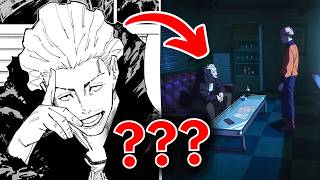

Is JJK Season 3 a Bad Adaptation?
43sDirectly addresses the controversial claim, sparking curiosity and debate among fans.
▶ Play Clip"The title asks a question the video answers thoroughly, but the content is heavily opinionated and padded with self-indulgent rants, making it a 50/50 split between substance and fluff."
The video defends Jujutsu Kaisen Season 3 against accusations of being a bad adaptation, arguing that director Shota Goshozono's creative choices elevate the anime as an original work. It categorizes the changes from the manga and explains why they are beneficial, while also addressing fan complaints.
The video introduces the controversy surrounding JJK Season 3, with fans complaining about lack of manga accuracy and the director's ego.
The director, Shota Goshozono, is described as unapologetically creative, refusing to follow traditional adaptation routes, which upsets fans expecting a one-to-one recreation.
The video argues that JJK is made by nerds for nerds, prioritizing artistic expression over mainstream marketability.
The first type of change is the lack of manga panel recreations, with Goshozono's compositions being more spacious and dynamic, which the video prefers.
The second type is minor chapter rearrangements, with one instance (Yaga's death and Maki's massacre in the same episode) feeling tone-deaf.
The third type is anime-only additions, like the extended Yuji action sequence, which are generally well-received.
The fourth type is complete scene transformations, like the Maki fight becoming a Kill Bill reference, which are risky but can enhance the source if done right.
Who is the director of Jujutsu Kaisen Season 3?
Shota Goshozono
02:42
What are the four types of changes the anime made to the manga?
Four types: lack of panel recreations, minor chapter rearrangements, anime-only additions, and complete scene transformations.
05:47
What is an example of a complete scene transformation in JJK Season 3?
The Maki fight was turned into a funky, stylish, upbeat Kill Bill reference.
11:11
What was the thematic point of the Maki fight in the manga?
The point was Maki's liberation, her breaking free of the shackles imposed by Jujutsu Society.
11:51
What was the negative effect of the chapter rearrangement in the anime?
The Yaga death scene and the Maki Zenin clan massacre were placed in the same episode, feeling tone-deaf.
09:44
Adaptation vs. Recreation
The video argues that an anime should be an original work, not a panel-by-panel copy, which is a core principle for understanding the controversy.
06:53Change Itself Is Good
The video posits that even inferior changes are preferable to a one-to-one adaptation, emphasizing the value of artistic expression.
09:05Criteria for Successful Scene Transformations
It outlines two conditions for major changes to benefit a show: being superior to the source and not contradicting its themes.
11:38Anime-Only Action Additions
The video highlights how the anime added nearly two minutes of original action to a simple manga sequence, showcasing creative expansion.
10:22[00:02] to the manga. Jujutsu Kaisen season 3 is a bad adaptation. The director of Jujutsu Kaisen season 3 has too much of an ego. Jujutsu Kaisen season 3 is butchering iconic manga panels. These are all things real breathing human
[00:15] Although I guess that is a bit of an oxymoron, real breathing human beings on the internet. Anyway, the point is, much like any other creative work of art controversies and ill feelings surrounding the most recent season of
[00:29] Jujutsu Kaisen. From complaints about the lack of manga accuracy to complaints about the lack of manga accuracy, JJK season 3 certainly is a polarizing show and as such has a video going over all of that stuff. I'll talk about Jujutsu
[00:43] Kaisen and its tendency to ignore manga panels. I'll talk about many of the complaints fans online have. I'll give my two cents on this whole issue. I'll content in there to make a video long enough to have midroll ads in it. Let's
[00:56] get to it. Make sure to subscribe. As promised, the Jujutsu Kaisen milk train is barreling down the tracks head on this channel. So, if a grotesquely large amount of JJK content sounds enticing to you, you know what to do. Press that
[01:08] subscribe button. You can also become a member of this channel. Members get at least two exclusive videos per month, custom badges and emojis, shout-outs and join button. So, Jujutsu Kaisen season 3, what a
[01:21] show, what an experience, right? There's so much personality and artistic flair in every episode, every scene, every shot, every composition, every audio-visual idea. It feels too good to be true. It does. Seeing one of the most
[01:34] creative directors ever execute his vision with a reasonable amount of especially in an industry that's known for crushing artistic expression instead of encouraging it. I apologize if this sounds too snobby and pretentious,
[01:48] although that is part of my brand. But JJK season 3 is the kind of show that over the globe together in mutual appreciation, in collective awe. Or it would be if not for that pesky little thing, that thing that some fans refuse
[02:02] effectively poisoned the discourse surrounding this season, that thing known as the manga. At the end of the day, Jujutsu Kaisen is a manga adaptation, a mainstream battle shonen manga adaptation at that, meaning
[02:15] from the get-go it was burdened with all sorts of unrealistic expectations. I'll spare you the details, but basically it was expected to be normal, it was expected to be a glorified commercial for the manga. Fans, some fans wanted
[02:29] good animation and direction, but within the confines of the source material. God own thing artistically. Oh, no, that's their worst nightmare. Now, what happens when an anime with a fanbase like that gets entrusted to a
[02:42] director whose entire MO is refusing to be normal, refusing to go down the traditional route? What happens when an unapologetically creative director like that, Shota Goshozono, decides to break the unwritten rules of mainstream manga
[02:55] adaptations and do his own thing? Well, people get really upset over panels no apparently. Jujutsu Kaisen season 3 is an art enthusiast's anime. Not saying it's inaccessible to casual viewers, but at
[03:09] its core it's made for people who are passionate about artistry. Like it or not, it's not made with mainstream fans and our marketability in mind, and why would it be? Jujutsu Kaisen might be a mainstream IP, but it's made by nerds,
[03:23] and I mean that in the best way possible. The animators, the director, even mangaka Gege Akutami himself was a bigger sakuga enthusiast than half of every step of this production. Is it
[03:35] final product reflects that? It shouldn't be. Even before I address fan complaints, and trust me, I will do that, I need to get this point across as clearly as I can. Jujutsu Kaisen, from a production POV, is made by nerds, and
[03:49] that includes the mangaka, for nerds. Again, like it or not, that's just the about it. Here's the thing, if you are a fan who's Jujutsu Kaisen looks, there are basically two paths you can go down. You
[04:04] and Reddit till the cows come home or you can open your mind a tiny bit and try to engage with this work of art, try to appreciate the artistry and hey, criticism that's more than just this does not look like the manga, therefore
[04:18] it's bad, that is. That's the path I personally recommend. Sadly, we as a fan base aren't that artistically progressive yet. There are words different and bad are synonyms,
[04:31] people who expect that anime adaptations to simply convert the format from PNG to MP4 and call it a day. And when these people are presented with an adaptation that refuses to be that straightforward, they just spontaneously combust, really,
[04:43] they blow the [ __ ] up. Now, credit where credit is due, the mainstream discourse surrounding JJK season 3 is a lot better than the absolute [ __ ] show that was season 2. At least modern fans know stuff like this and this and this
[04:56] just that they don't agree with it stylistically, which is a personal preference thing at the end of the day. That to me is a lot better than labeling creative videos and critic animation as bad and or unfinished, which is what
[05:08] fans did back when season 2 aired. Yes, the progress isn't massive, but we as a direction. Complaints about the lack of manga accuracy is a lot better than complete cluelessness as to what constitutes good animation.
[05:22] And speaking of complaints regarding the lack of manga accuracy, let's finally go through the many, many gripes fans online have with this adaptation. Who knows, maybe I'll even agree with some of them. I won't. I won't. Anyway, let's
[05:34] jump into the pseudo anime manga comparison section of the video. Like I said earlier, a vast majority of the complaints surrounding JJK season 3 accuracy and as such, let's talk about the changes the anime made to its source
[05:47] material, mainly from a visual point of view. Broadly speaking, there are four different kinds of these changes, each eliciting a different degree of outrage from the fans. Let's go through them in order of significance. The first type of
[06:00] change, and the least significant one in my opinion, is the lack of manga panel recreations. Basically, since every single episode of season 3 so far has been storyboarded by the insanely creative Shota Goshozono,
[06:12] who refuses to use the manga as a storyboard, most shots don't really look like their manga counterparts. The anime compositions are a lot more spacious, dynamic, eye-catching, unique, and to be very honest, better. Koyoharu Gotouge is
[06:26] a fantastic artist, but when it comes to framing and compositions, Goshozono is >> Now, if you know what I think of anime adaptations, you'd know that not only do I not have a problem with Goshozono's approach, I actually prefer it over your
[06:39] standard adaptation. In my mind, a manga and an anime are two different works of with two different sets of rules, and as such, there's absolutely no reason whatsoever for one to look like the other. Look, it's called an adaptation,
[06:53] not a recreation. Regardless of how good the manga is, I just I don't want to see the same thing twice. I don't, and I fail to comprehend why anyone would. Also, people online act like studios burn every existing copy of a manga in a
[07:06] ritualistic sacrifice to the animation gods to create an anime. They don't. Believe it or not, the manga still exists. If you like it so much, just go read it again. In fact, don't stop there. Download the pages, print them
[07:18] out, hang them on your bedroom wall, and jack off to them. I don't care. Do entirely different group of artists sacrifice their artistic sensibilities and blindly recreate someone else's work. That's stupid.
[07:31] Ideally, I think an anime adaptation should change every single composition and do its own thing from front to back, but that's just me being an art snob. In or two being recreated as is. Although,
[07:44] [music] A standard close-up of Kashimo isn't iconic. A random ass panel of Naoya isn't iconic. Iconic is freedom from Attack on Titan. It's Hyime Ghoul from Tokyo Ghoul. It's Naoya Itadori from
[07:58] Jujutsu Kaisen. That's iconic and that's the stuff that should be recreated as is, not every other cool-looking panel. Now, one of the most prominent arguments against this opinion of mine seems to be, "Oh, if the director is so creative,
[08:11] why isn't he making an original? Why is he directing adaptations?" And to that, I say he is. He is making originals. Did a Jujutsu Kaisen anime exist prior to this one? No. That means it's an original anime, right? It's the first
[08:25] original. I rest my case. All right, look. I know that argument is a bit disingenuous, but the point I'm trying to make is that a manga and an art. So much so that the anime adaptation might as well be an original.
[08:39] What's the point of having both do the exact same things? Why would you want that? Here's the thing. Holding the two mediums to the same standards and isn't just disrespectful to the art of animation, it's also disrespectful to
[08:52] manga. You're basically saying a manga panel isn't complete unless it gets recreated by an anime, that a manga cannot be its own standalone thing. Look, here's my overall opinion on this whole manga one-to-one thing. I'll say
[09:05] this and I'll move on. In my opinion, when it comes to framing and paneling, not only is positive change good, change itself is good as well, even if said change is inferior. In other words, even if the anime version looks weaker, which
[09:18] is rarely the case with JJK, I'd still prefer it over a manga one-to-one approach. That's how highly I value artistic expression and I think you should too. Anyway, moving on. The second type of
[09:30] change is minor chapter rearrangements meant to fit the pace and structure of TV episodes with predetermined lengths, and most fans are fine with it, myself things around a bit, although there has been one instance in which this
[09:44] rearrangement has negatively affected the story in my opinion, the stuff with In the manga, Yaga's death occurred before the Maki Zenin clan massacre, meaning this sad scene and these goofy moments had a few chapters in between
[09:57] them, but in the anime, both scenes were included in the same episode, which felt a bit tone-deaf. Of course, it's not a big deal, but I just I felt like it was worth mentioning. The third kind of change is anime-only
[10:09] department, and once again, I haven't seen anyone complain about them, thank god. Here are a few examples. In the manga, Yuji clapped, the curses showed up, he started running, and five panels later, he was at the tunnel. But in the
[10:22] anime, they added nearly two whole minutes of original action, including Yuji running up the broken bridge, drop-kicking a curse midair, taking a joyride through the city, using a curse's tooth to stop himself, and much
[10:34] Similarly, the manga version of Yuji versus Panda consisted of just five basic panels, but the anime turned it into an entire minute and change of exaggerated high-level action with a plethora of animation styles and
[10:46] intricate choreography. Fashion-driven additions like those are common in JJK, and once again, thankfully, no one seems to have a problem with them. The fourth, final, and most significant type of change is where the scene is
[10:58] completely transformed from the ground up. This goes beyond changing compositions and adding stuff. The scene is recreated altogether in a different image. Not only is the visual aspect altered, the thematic component is as
[11:11] Examples of these changes include turning the visceral Maki versus Kokoro squad into a funky, stylish, upbeat Kill Bill reference, and transforming the any office conversation and subsequent confrontation between Yuji and Hakari
[11:24] into a 4-minute ultra-wide runner with methodical rotoscoped aided character composition switch-ups I talked about a while back. Changes like these aren't either. I'll explain. In my opinion, changes of
[11:38] this magnitude benefit a show only when one, they are unquestionably superior to the source, and two, they don't directly contradict the source at a thematic level, and neither is the case with those two scenes I just talked about.
[11:51] With the Maki fight, the point wasn't the raw violence. Instead, it was Maki's liberation, her breaking free of the shackles imposed on her by Jujutsu Society. Kind of like that KFC breakup scene from season two, which was told
[12:03] the fight actually benefited from Gojo's own sub-beat presentation. Similarly, this scene being presented in this manner helped Sukuna as an unpredictable entity and added a much-needed sense of tension in this conversation. The slow,
[12:18] that things could go wrong at any second, which they did, and I think that was perfect. Like I said, massive changes like these are risky, but if done right, they can greatly enhance the source. And so far, Gojo and team have a
[12:32] perfect track record, so I'll continue to trust them. Sure, if they mess up in call them out, but for now, just look at this. It's so cool. And that's it. A bit of a random one, but given the sheer amount of bad faith
[12:45] anti-art opinions circulating online, I had to get around to this at some point. Might as well do it now. Hope you enjoyed. And that's it. A special thanks to Noob Zero Three, Amir, The Gallus 90, and Shiki San for becoming tier three
[12:58] and Shiki San for becoming tier three members. And until next time.
⚡ Saved you 0h 13m reading this? Transcribe any YouTube video for free — no signup needed.