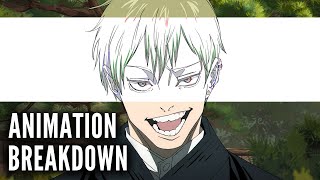

This Episode Was Insane!
45sThe opening hype sets an exciting tone and promises a breakdown of an incredible episode, hooking viewers immediately.
▶ Play Clip"Title accurately reflects the video's content: a detailed breakdown praising the episode as a masterpiece."
This video provides a detailed breakdown of the animation in Jujutsu Kaisen Season 3 Episode 4, praising its visual spectacle and the immense effort by the production team. The host analyzes key scenes, highlights the work of specific animators and directors, and offers both praise and minor criticism.
The episode is described as a high-priority Sakuga festival with incredible visuals, especially in the second half.
Storyboards by series director Goshono, episode directors Risa Suzuki, Yusukeuchi, and Goshono. Four chief animation directors: Yusk Yajima, Hiomi Nea, Sota Yamazaki, and Takushi Mizu.
Stacked list including Tadashiramatsu, Shinsaku Koua, Kisuchami, Hakugo, Hon, and Koh Hiota, with around 40 key animators.
First half had inconsistent animation but strong composition and directorial ideas, like diagetic piano and flashback integration.
Praised for aesthetic, aspect ratio usage, creative color, and hand-drawn characters. Animated by Izkisuchami with quick cuts and volumetric drawings.
The rest of the fight is a homage to Yotaka Nakamura, with sequences by Mochm Mo and Julian Bentley featuring speedlines, kinetic sparks, and cubic effects.
Aspect ratio change used purposefully with muted colors and higher contrast, featuring stylized shots and direct references to Naruto vs. Pain.
The episode is considered insane even by JJK standards, a visual peak due to talented artists and creative direction.
The episode is a visual masterpiece, showcasing the best of JJK's animation with creative direction and top-tier talent, likely a peak for the season.
Goshono
person
Risa Suzuki
person
Yusukeuchi
person
Yusk Yajima
person
Hiomi Nea
person
Sota Yamazaki
person
Takushi Mizu
person
Tadashiramatsu
person
Shinsaku Koua
person
Kisuchami
person
Hakugo
person
Hon
person
Koh Hiota
person
Aya Suzuki
person
Iki
person
C Hiro Mini
person
Hayat Kurosaki
person
Mochm Mo
person
Julian Bentley
person
Kajino
person
Nakaya onen
person
Shinsaku Kosuma
person
Daniel Kim
person
China
person
Who storyboarded Jujutsu Kaisen Season 3 Episode 4?
Series director Goshono.
1:13
How many chief animation directors worked on this episode?
Four: Yusk Yajima, Hiomi Nea, Sota Yamazaki, and Takushi Mizu.
1:58
What is the name of the pen name animator who animated the first Nakamura homage sequence?
Mochm Mo.
10:39
Which animator is known for the 'cube man' style that was heavily referenced in this episode?
Yotaka Nakamura.
10:24
What visual technique was used to convey the force against Maki during the fight?
Expanding concentric circles on the ground and hair.
12:19
How many uniquely animated characters did Julian Bentley have to animate in one scene?
Eight (seven plus Maki).
14:52
What aspect ratio change occurs during the cinemascope section?
The aspect ratio changes to cinemascope (wider), with muted colors and higher contrast.
16:31
Which famous fight from Naruto is referenced in this episode?
Naruto vs. Pain.
17:30
Episode as a Sakuga Festival
Sets the tone that this episode is a visual spectacle with high production effort.
Goshono's Composition Genius
Highlights the director's skill in framing and directorial ideas.
3:52Nakamura Homage
The entire second half is a love letter to Yotaka Nakamura's style, showing deep appreciation for sakuga history.
10:24Cinemascope Usage
The aspect ratio change is used purposefully to enhance the scene's mood, not as a gimmick.
16:31Visual Peak of the Season
The host declares this episode a potential visual peak for the season, emphasizing its significance.
19:55[00:00] Jiujutsu Kaisen season 3 episode 4 was
[00:02] the episode. It was the episode the
[00:04] production team went all out for putting
[00:06] in lots and lots of effort and resources
[00:08] a lot more so than usual. And the
[00:10] results spoke for themselves. This
[00:12] episode was absolutely ridiculous,
[00:14] especially the second half. It was one
[00:16] of the most visually interesting things
[00:18] across all of JJK. And I hope you
[00:20] understand how monumental a feat like
[00:22] that is. It looked incredible. Right
[00:24] from the get- go, you could tell that
[00:26] this was about to be special. It had
[00:28] that big episode feel, if that makes
[00:29] sense. And that's saying something
[00:31] because in a production like JJK, nearly
[00:33] every episode has a big episode feel.
[00:35] Like come on, when has JJK ever looked
[00:37] normal? I guess the point I'm trying to
[00:39] make is high priority Sakuga Festival.
[00:42] The big big episode, whatever you want
[00:44] to call it, this episode was one for the
[00:46] history books. And as such, you guessed
[00:48] it, let's break down the visuals. Make
[00:50] sure to subscribe. This episode fried my
[00:52] brain to the point where I can't come up
[00:53] with a clever call to action. So just
[00:55] subscribe. the buttons right there. It
[00:57] takes a second. Go on, do it. You can
[00:59] also become a member of this channel.
[01:01] Members get at least two exclusive
[01:03] videos per month, custom badges and
[01:04] emojis, shoutouts, and more. Just go
[01:06] down there and press the join button. As
[01:09] always, let's go over the staff list
[01:11] first. Starting with the storyboards,
[01:13] which were once again handled by series
[01:15] director Goshono, making this the fourth
[01:17] consecutive episode he has solo
[01:19] storyboarded for this season with many
[01:20] more on the way if the leaks are to be
[01:22] trusted. Goshono's unsurprisingly
[01:25] fantastic storyboards were processed by
[01:27] three episode directors, Risa Suzuki,
[01:29] Yusukeuchi, and Goshono himself. And the
[01:32] overall direction was again
[01:33] unsurprisingly stellar. I'll talk about
[01:36] it in detail in a bit obviously, but
[01:38] long story short, it was Koshono
[01:39] reiterating just how good he is at
[01:41] non-action storyboards, just in case
[01:43] some of you suffer from short-term
[01:44] memory loss and forgot what last week's
[01:46] episode was like, and shutting down all
[01:48] talk of him not being good at action
[01:50] storyboards. Also, of course, his
[01:52] amazing storyboards were processed
[01:53] wonderfully by the episode directors.
[01:55] Shout out to them as well. Over on the
[01:58] animation front, we had four chief
[01:59] animation directors. The two character
[02:01] designers Yusk Yajima and Hiomi Nea.
[02:04] Character artist extraordinaire Sota
[02:05] Yamazaki and JJK regular Takushi Mizu.
[02:08] Four animation directors and three
[02:10] assistant animation directors, which is
[02:11] neither good nor bad in a vacuum. But
[02:13] considering the sheer amount of movement
[02:15] this episode had to offer, aka the sheer
[02:17] number of frames that had to be
[02:19] corrected and the complexity of the
[02:21] shots, it's actually quite decent. More
[02:23] about the animation. The key animator
[02:25] list for this episode was absolutely
[02:27] stacked. Industry-leading talent galore,
[02:29] which isn't exactly new for a project
[02:31] like JJK, but that doesn't make it any
[02:33] less insane. Mega veterans like
[02:35] Tadashiramatsu and Shinsaku Koua,
[02:37] industryleading names like its
[02:39] Kisuchami, Hakugo, and more. exciting
[02:41] new talent like Hon and Koh Hiota around
[02:44] 40 second key animators on cleanup be
[02:46] duty because it is a sichimo line
[02:48] production at the end of the day this
[02:49] episode had it all now yes I can't
[02:52] exactly call this episode perfect by
[02:54] nitpicky eyes won't allow that but this
[02:56] episode was really really well animated
[02:59] that's the headline here not some of the
[03:00] jank I'll point out in a bit please
[03:02] don't let my nitpicking cloud your
[03:04] judgment this episode was amazing with
[03:07] all that being said let's finally do the
[03:09] thing you guys clicked for let's go
[03:11] through this episode scene by scene.
[03:13] Unfortunately, I have to gloss over the
[03:15] first half of this episode a bit. Not
[03:17] only was the main bulk of animation
[03:19] muscle packed into the second half, the
[03:21] first half wasn't the most consistent
[03:23] thing in the world. Let's put it that
[03:24] way. It had issues. First things first,
[03:27] though, composition sense, Koshono has
[03:29] an unfair amount of it. Every shot was
[03:31] incredibly interesting to look at. Even
[03:33] when there wasn't much happening
[03:34] animation wise, I have said all of this
[03:37] before, but it bears repeating. His
[03:39] framing is always spacious and dynamic.
[03:41] There are layers of complexity. There's
[03:43] a pronounced sense of space. There are
[03:45] exaggerated perspectives. As per usual,
[03:47] Koshono is allergic to framing things
[03:49] normally. And as per usual, I love that.
[03:52] We also had so many cool directorial
[03:54] ideas, introducing the piano as a
[03:56] diagetic audio cue, including this
[03:58] flashback as a part of the present scene
[04:00] instead of simply cutting to it and
[04:02] making it look distant and blurry to
[04:03] show how things aren't the same anymore.
[04:05] That man is a genius. Speaking of
[04:08] flashbacks, the flashbacks throughout
[04:09] this entire episode or this season in
[04:11] general had this bloody, choppy look
[04:13] that I loved. It made them seem less
[04:16] like a different, unrelated scene and
[04:18] more like a hazy recollection of
[04:19] memories, which is the whole point.
[04:21] Really good stuff. Back to the scene at
[04:23] hand. Animation wise, there wasn't all
[04:25] that much going on. It was above
[04:27] average, but for a high-profile
[04:28] production like Jiutsu Kaisen, it was
[04:30] typical, if that makes sense. This fight
[04:33] was cool, though. It was very stopand go
[04:35] with quick unorthodox cuts. But unlike
[04:37] most of Yuji versus Utah, this actually
[04:39] worked in my opinion. The timing felt
[04:41] right. It conveyed the chaos of the
[04:43] whole thing well. Plus, the strategic
[04:45] use of close-ups and slow motion shots
[04:47] allowed them to save some of that
[04:48] animation power for later. Shortly
[04:50] afterwards, we got this eerily lielike
[04:52] ragd dolling followed by this meticulous
[04:54] and mostly consistent acting sequence
[04:57] presumably animated by Aya Suzuki. Very
[04:59] subtle stiffness aside, you could feel
[05:01] the weight of every small action, the
[05:03] movement of the fingers, the hair
[05:04] motion, the body mechanics. It was
[05:06] incredibly well animated fundamentally
[05:08] speaking. Also really well-drawn short
[05:11] hair. A really cool stylized sequence
[05:13] drawn by Iki then brought us to the beat
[05:16] scene animated by Tadashiramatsu which
[05:18] is quite funny because he also animated
[05:20] a melancholic beat scene for the
[05:21] Chainsaw Man movie. The acting here
[05:24] wasn't over the top, but as you would
[05:25] expect from the penmanship of a veteran,
[05:27] the fundamentals were on point. The
[05:30] motion was heavy with each action being
[05:31] accompanied by the perfect amount of
[05:33] weight distribution, plus the three to
[05:35] four tone liquid animation, beautiful
[05:37] drawings thanks to C Hiro Mini's
[05:39] corrections, top-notch backgrounds, and
[05:41] that gorgeous compositing shift made
[05:42] this scene incredibly cinematic. Oh, and
[05:45] also Goshono Storyboard's skirt,
[05:47] obviously. Following the beat scene, we
[05:49] got some cool action adjacent shots.
[05:52] Lovely effects there followed by a solid
[05:54] close-up and a large amount of
[05:56] background animation. Really fun stuff.
[05:59] Now, with all that being said, here
[06:01] comes the uncomfortable part. Like I
[06:02] hinted at earlier, this section wasn't
[06:04] perfect. It had issues. I know some
[06:07] people on Twitter get upset at me for
[06:08] pointing out things they themselves
[06:10] don't have the eyesight to notice, but
[06:11] it is an animation breakdown, so deal
[06:14] with it, I guess. Was this walk cycle
[06:16] fairly inconsistent with distracting
[06:18] shifty lines? I'm afraid so. Was this
[06:20] other walk cycle fairly stiff,
[06:22] especially around the arms, despite the
[06:24] cool volutric background work? I'm
[06:26] afraid so. Do May and Maki being dragged
[06:28] by Yogi melt a fair bit? I'm afraid so.
[06:31] Do some of these shots clearly suffer
[06:32] from subpar second key animation? I'm
[06:35] afraid so. Did they linger on this
[06:36] non-animated zoom for a bit too long?
[06:38] I'm afraid so. You get the idea. Really
[06:41] cool, really creative, but not perfect,
[06:43] which is quite on brand to be honest.
[06:46] Anyway, let's now move on to part B, aka
[06:49] the start of this episode. Before we get
[06:51] to the action though, let me get this
[06:53] out of the way. I loved the overall
[06:54] aesthetic during the Maki Kukuru Squad
[06:56] fight. The compositions, the aspect
[06:59] ratio usage, the creative color used,
[07:01] the general look and feel of the whole
[07:02] thing. It was insanely good. I know
[07:05] people who expect their anime
[07:06] adaptations to be strictly one to one,
[07:08] and the entire population of mainland
[07:10] Japan apparently hated this fight, but I
[07:12] personally loved it. The cool visual
[07:14] ideas and composition choices, the
[07:16] tremendous drawings, the dissonant
[07:18] soundtrack choices, so good. All of it
[07:20] gold sticker from me. Anyway, the first
[07:23] minute or so of the action was animated
[07:25] by Izkisuchami, and it was incredible.
[07:28] First off, that's a lot of hand-drawn
[07:30] characters. Of course, not all of them
[07:31] are animated. Moving that is, but still,
[07:33] drawing that many cell components is
[07:35] tedious work, and that's doubly true
[07:38] when they actually move. This shot, for
[07:40] example, this is obviously a throwaway
[07:42] character who almost certainly doesn't
[07:44] even have a design sheet. But through
[07:45] conservative yet meticulous line
[07:47] placement, Sujigami made his face and
[07:49] movement feel incredibly volutric and
[07:51] alive, which is something he excels at.
[07:54] More about the action. This fight used a
[07:56] ton of quick cuts, but once again, it
[07:58] worked. It flowed well. Partially due to
[08:00] the incredible animation and partially
[08:01] due to Sujigami, presumably modifying
[08:04] the storyboards a bit based on his own
[08:06] preferences. The shots had so much
[08:08] volume both in terms of the composition
[08:10] and the drawings themselves. There were
[08:12] layers of mob characters, both static
[08:14] and animated. Plus, the drawings and
[08:16] backgrounds were about as
[08:17] three-dimensional as you'd expect from a
[08:19] Goshon Sujigami sequence. This windup
[08:22] looked amazing. Maki moving was actually
[08:24] animated while the characters in the
[08:26] back were a static cell layer being
[08:28] panned across the screen. And we then
[08:29] got a quick overhead shot followed by a
[08:31] side profile complete with these really
[08:33] cool blood effects with varying degrees
[08:35] of opacity and another overhead shot.
[08:37] Like I said, quick cuts. Of course, the
[08:40] actual movement was on point throughout.
[08:42] The lines and contours were masterfully
[08:44] placed and the drawings were incredible.
[08:46] Even a simple shot of Maki taking a step
[08:49] had fantastic forcehortening and volume
[08:51] control. Also loved Koshono going full
[08:54] Gohans with this underground shot. Now,
[08:56] yes, it is practically impossible to
[08:58] animate 50 guys moving constantly. It's
[09:01] a weekly TV episode, not a Ghibli movie.
[09:03] But Koshono and team came up with clever
[09:05] ways to get around that. Be it the cell
[09:08] parallaxing, be it strategically placed
[09:10] still shots, be it going down the
[09:11] idiosyncritic shorthand drawings route
[09:13] instead of proper character models,
[09:15] something shot sequence did a lot of. It
[09:18] didn't feel like the background
[09:19] characters were unnaturally stiff. I
[09:21] remember that being an issue in an
[09:23] episode from season 2, but not this time
[09:25] around. Also, of course, shorthand
[09:27] drawings or not, animating a rotation
[09:29] with multiple moving characters is an
[09:31] insanely difficult thing to do. And so
[09:33] is animating these buttery smooth body
[09:35] mechanics and these insanely complicated
[09:37] warped compositions. So, props to B. Not
[09:40] the biggest fan of the non-animated zoom
[09:42] on these mobs. But overall, really well
[09:44] animated sequence. Of course, we can't
[09:46] go over every single shot given the
[09:47] confines of time, but really good work.
[09:50] We then got a Hayat Kurosaki sequence
[09:52] and the sheer density of the effects was
[09:55] insane. Why have one layer of gorgeous
[09:57] thick smoke when you can have another
[09:59] and another and another and another and
[10:02] another? Has some eye-catching liquid
[10:04] effects. Has some tone liquid animation
[10:06] that's like the most beautiful thing
[10:07] ever. Has some handdrawn debris so large
[10:09] scale that it almost counts as
[10:11] background animation. More liquid and
[10:13] smoke. Such an insane sequence all
[10:15] around. It'll probably get overshadowed
[10:17] by the insanity that followed, which is
[10:19] a shame because just look at it. It's so
[10:21] cool. From this point on, the episode
[10:24] went full Yotaka Nakamura. The rest of
[10:27] the fight was one big unapologetic
[10:29] homage/lo letter to the cube man, and it
[10:32] was perfect. I was genuinely surprised
[10:34] by how convincing Goshono's Nakamura
[10:36] impression was. The first sequence here
[10:39] was animated by Mochm Mo, which is
[10:41] obviously a pen name. It's not a real
[10:43] person. And I'm pretty sure I know who
[10:45] that is, but let's not delve on that
[10:46] stuff. The scene started with some
[10:48] incredibly cool rawl lookinging smoke
[10:50] and satisfying fabric and hair animation
[10:53] followed by this section, which again is
[10:55] extremely Nakamura. The speedline
[10:57] background conveying a never-ending
[10:59] sense of space, these almost comical
[11:01] poses, the energetic fabric animation,
[11:03] these slow animated zoomins with
[11:05] exponential forcehortening. Fantastic
[11:07] stuff. The background animation here was
[11:10] insane. The shapes were almost identical
[11:12] to the way modern Nakamura draws
[11:14] backgrounds. Plus, the kinetic sparks
[11:16] were a nice addition. Loved this
[11:18] exchange. Fast motion buffered perfectly
[11:20] by the zoom into her hand. It's not all
[11:23] one speed. There's variation in the
[11:25] tempo. There's rising and falling
[11:26] actions. Again, amazing. Really cool
[11:29] lifelike acting here followed by some
[11:31] large scale background animation and
[11:32] this amazing rotation. It's very short,
[11:35] but the animator had to drop both
[11:36] characters in unorthodox poses at every
[11:39] perspective between the starting and
[11:41] finishing points. I hope I don't have to
[11:43] explain why that's an incredibly
[11:44] difficult thing to do. [music] By the
[11:46] way, I loved how in the midst of all
[11:48] this insane movement, they literally
[11:50] zoomed into a still frame. I don't think
[11:52] it's meant to be comedic, but it cracked
[11:54] me up. Now, yes, some of you might say
[11:56] that stuff like this clashes with the
[11:58] tone this episode was trying to convey,
[12:00] and there is some validity to that
[12:02] complaint. However, in my mind, it
[12:04] wasn't a sad, hate-filled massacre.
[12:06] Rather, it was a triumphant moment where
[12:08] Maki broke free of the metaphorical
[12:10] shackles around her ankles. And as such,
[12:12] from that point of view, I felt like the
[12:14] upbeat tone worked perfectly. Anyway,
[12:17] back to the action. This guy's ability
[12:19] was visualized extremely well. The force
[12:21] against Maki was conveyed through
[12:23] expanding concentric circles on the
[12:25] ground hair. Another Nakamura build
[12:27] storyboarding choice followed by
[12:28] constant energetic fabric and hair
[12:30] animation. And speaking of force, this
[12:33] sequence was amazing. The way each
[12:35] muscle on her body was animated to show
[12:36] the sheer weight she was under.
[12:38] Fantastic understanding of weight and
[12:40] anatomy. Reminded me of that one shot
[12:42] from Ghost in the Shell. Also worth
[12:44] mentioning, the head and fabric
[12:46] animation throughout the section was
[12:47] absolutely stellar. It made every
[12:49] action, even the simple ones, feel heavy
[12:51] and powerful. Also also worth
[12:53] mentioning, this shot was incredible.
[12:55] Loved the strong foreshortening effect
[12:57] and the organic shading. Yusuke Yajima
[12:59] corrections if I'm not mistaken. This
[13:02] guy's attack was pure Nakamura goodness
[13:04] with tens of individually drawn fists
[13:06] complete with actual animated shadows
[13:08] literally descending from the sky and
[13:10] raining down on Maki conveyed via a
[13:12] large amount of effects and debris
[13:13] instead of actual physical impact. Did I
[13:16] mention this fight was one big Utaka
[13:18] Nakamura reference? It was overall a
[13:21] very very impressive sequence by a mo
[13:24] which is definitely not just someone
[13:26] else. Was every drawing perfect? No.
[13:28] There were a few rough shots, most
[13:30] likely due to second case scattering,
[13:32] aka poor cleanup, [music] but all things
[13:34] considered, it was ridiculously good.
[13:37] Moving on, some incredible Sotamazaki
[13:39] corrections and a slightly inconsistent
[13:41] bit of acting then brought us to Maki
[13:43] versus Na, and it too was one big Utakan
[13:46] Nakamura reference. We started with a
[13:48] quick exchange of strikes followed by
[13:50] this eye close-up. And not only was the
[13:52] eye wonderfully drawn and animated, you
[13:54] could see a separately animated
[13:55] reflection of the action on it. This was
[13:58] in turn followed by another strike
[14:00] exchange. And neither of these two
[14:01] exchanges were looped. Every strike was
[14:04] uniquely animated, which is quite cool.
[14:06] Also love how the camera actually moves
[14:08] there. They had to draw the speedline
[14:10] backgrounds in a manner in which they
[14:12] had two opposite directions and met in
[14:14] the middle, allowing the camera to pan.
[14:16] We then got a few slow motion shots
[14:18] ensuring the viewer doesn't get
[14:20] overwhelmed. And this sequence, which I
[14:22] know I'm repeating myself, but come on,
[14:24] it doesn't get more Utakan Nakamura
[14:26] built than that, does it? The spiky
[14:28] effects, the literal Utapon cubes with
[14:30] the appropriate timing and everything.
[14:32] The dynamic unidirectional background
[14:34] animation, the slow body movement with
[14:36] extremely fast-paced head and fabric
[14:38] animation, even the use of moving after
[14:40] images and solid one color backgrounds.
[14:42] Hey, I think Nakamura should get
[14:43] royalties for this episode. Anyway, this
[14:46] scene was animated by Julian Bentley.
[14:48] Makes sense given the tremendous volume
[14:50] control on Maki and he had to
[14:52] effectively animate eight different
[14:53] characters here. I counted seven
[14:55] different uniquely animated now each
[14:57] drawn from a different perspective. We
[15:00] then got proto sequence which included
[15:02] some gorgeous debris and smoke
[15:04] animation. This really cool effect where
[15:05] they split the background into several
[15:07] layers and moved them up separately and
[15:09] another after image based shot. I
[15:11] counted four uniquely animated
[15:13] characters here. This gorgeous close-up
[15:16] then brought us to more action because
[15:17] of course we weren't done. We had a ton
[15:20] of Nakamura pill effects followed by Hon
[15:22] sequence which started off with this
[15:24] mind-blowing shot. Maki's body hair kept
[15:27] rotating meaning he had to continuously
[15:29] animate Maki from all sorts of
[15:30] perspectives and this was followed by
[15:32] some large scale background animation
[15:34] with the camera actually moving along
[15:36] with the cell layers and changing angles
[15:37] because the shot wasn't complicated
[15:39] enough as is. I guess now was basically
[15:42] a smear throughout the section. His
[15:44] movement was too fast for our eyes. But
[15:46] again, like always, we were then
[15:48] presented with slower paced shots
[15:49] because visual buffers are important.
[15:52] Also, quick shout out to the literal
[15:53] animation time sheet that shows up for
[15:55] the split second. [music]
[15:56] Loved the smooth camera movement here.
[15:58] The slow partial rotation/an animated
[16:00] zoom in was really fun to look at. We
[16:03] then got some really cool shapes and
[16:05] effects drawn by Kajino and these fun
[16:08] shots with shifting lines on the
[16:09] background meant to convey speed and
[16:11] motion. This shot was amazing as Maki
[16:14] closed in towards the camera. The
[16:15] implied distance between her head and
[16:17] the rest of her body increased thanks to
[16:19] the forcehortening giving it this
[16:21] three-dimensional look. Also, the actual
[16:23] drawings were amazing with those blacked
[16:25] out eyes. Two different styles of
[16:27] lingering smoke effects then brought us
[16:29] to the cinemascope section. And it
[16:31] wasn't a cheap gimmick. [music] This
[16:32] time around, it was actually used with
[16:34] purpose. The entire style of compositing
[16:37] changed the second those black bars
[16:39] appeared. The vibrance and saturation
[16:41] went down. The colors became more muted
[16:43] with war for war for warmer tones taking
[16:44] over. And the color contrast went up.
[16:46] Even the character drawing stood out.
[16:48] This entire section felt like a
[16:50] different scene if that makes sense.
[16:52] Near the start of the sequence, we got
[16:54] this stylized na shot almost certainly
[16:57] drawn by Soyazaki. Those thick inky
[16:59] lines looked amazing and the proportions
[17:01] of the face kept stretching and
[17:03] squashing giving it a satisfying sense
[17:05] of flow. We then got these shots which
[17:07] were presumably animated by Nakaya onen
[17:10] given the elongated facial structure and
[17:12] they looked gorgeous. The placement of
[17:14] each line was purposeful and the overall
[17:16] aesthetic sense was off the charts. Some
[17:19] cool effects followed most likely drawn
[17:21] by Shinsaku Kosuma given those geometric
[17:23] edges and that trademark timing wherein
[17:25] the structure was intact in one frame
[17:27] and completely gone in the next. This
[17:30] shot was straight out of Naruto versus
[17:32] Spain with the Looney Tunes like smeari
[17:34] body language. Not exactly a surprise
[17:36] since this entire setpiece both in the
[17:38] manga and the anime was a reference to
[17:40] that fight. The anime version that is
[17:42] because Kay is a massive sakuga nerd.
[17:45] This shot was cool. Some solid
[17:46] pre-animation. Although I'm not the
[17:48] biggest fan of the texturing on the
[17:50] animation layer. Funny because Naruto
[17:52] versus Spain actually didn't have those
[17:54] textures but it looked weird too. I
[17:56] guess it's just a losing formula. This
[17:58] really cool shot with multi-layered
[18:00] reverse background parallaxing, some
[18:02] solid drawings and cool effects then
[18:04] brought us to another direct
[18:05] utakanakamura reference. Those high
[18:08] energy flickering effects on the wall
[18:10] followed by the cubic to pre exploding
[18:11] out as straight out of concrete revolio.
[18:14] We then got what I think is Daniel Kim's
[18:17] sequence with the background effects
[18:18] having these alternating vertical lines
[18:20] which later transformed into actual
[18:22] smoke. this buttery smooth punching
[18:24] animation and this part where everything
[18:26] besides Maky's mouth froze. We then
[18:29] returned to our regular aspect ratio and
[18:31] compositing and got these highly
[18:33] ambitious partial rotations. Like I said
[18:35] earlier, rotations are inherently
[18:37] difficult to animate, especially when
[18:39] the character has an unorthodox pose.
[18:40] And that's doubly true for slow
[18:42] rotations like these. Think about it. If
[18:45] the rotation is fast, the animator has
[18:46] to draw less frames. But if the rotation
[18:48] is slow, the number of intermediate
[18:50] frames between point A and point B
[18:52] skyrockets, making it incredibly
[18:54] difficult to maintain volume and line
[18:56] consistency. [music]
[18:58] With all that in mind, the sequence
[19:00] wasn't the most consistent thing in the
[19:01] world, but it was an admirable effort.
[19:03] Not sure if it was Daniel Kim as well.
[19:06] [music] We then got the big punch with a
[19:08] brand new buildup, four different
[19:10] angles, and a couple of meticulously
[19:12] animated slow motion shots, including
[19:13] this X-ray view of his skull getting
[19:15] crushed. I believe parts of the section
[19:17] were animated by its suchami since it
[19:20] was his idea to begin with. Such a
[19:22] fantastic sequence all around filled
[19:24] with insanely highlevel talent. Even
[19:27] Hakugo was in there somewhere. I'm not
[19:29] entirely sure where. Perhaps some of the
[19:30] effects, but I'm not sure. But he was
[19:32] there. Insane stuff. And with that, the
[19:36] fight came to a close. Daniel Kim's
[19:38] presumed penmanship served as the
[19:40] immediate aftermath, which was then
[19:42] followed by a hefty amount of slightly
[19:43] stiff but ultimately solid character
[19:45] acting, partially animated by China, and
[19:48] finally by the same composition as the
[19:50] first shot we saw, making it a full
[19:52] cycle moment. Amazing stuff. And that
[19:55] was the episode again for the millionth
[19:57] time. This was insane, even by JJK's
[19:59] standards. A group of incredibly
[20:01] talented artists working under a
[20:03] tremendously creative director and not
[20:05] horrible production conditions usually
[20:07] tend to make magic and this was no
[20:09] different. Of course, I am looking
[20:11] forward to the rest of the core, but I
[20:13] wouldn't be surprised if this ends up
[20:14] being the visual peak. I heard the last
[20:17] episode is supposed to be incredible as
[20:18] well, so who knows? Exciting stuff
[20:20] either way. And that's it. A special
[20:23] thanks to N03, Amir, the Galas 90, and
[20:26] Shiki for becoming tier three members.
[20:28] And until next time.
⚡ Saved you 0h 20m reading this? Transcribe any YouTube video for free — no signup needed.