
AI Summary
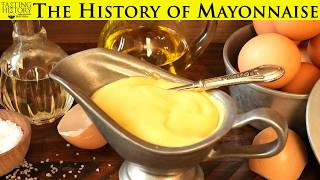
This episode of Tasting History explores a 200-year-old mayonnaise recipe from the famous French chef Marie-Antoine Carême. The host, Max Miller, demonstrates how to make the sauce step-by-step, discusses the science of emulsification, and delves into the debated origins of mayonnaise, from French dukes to Carthaginian generals. He contrasts the historical recipe with modern commercial mayonnaises and gives his taste verdict.
Chapters
Max chooses Carême's 1828 recipe for 'White magnonnaise sauce' from 'Le Cuisinier Parisien', avoiding earlier versions with calf brains.
The recipe includes two egg yolks, white salt and pepper, tarragon vinegar, oil from Aix, and aspic jelly (gelatin).
For home cooks: 2 egg yolks, salt, white pepper, tarragon vinegar, olive oil, and optional gelatin (1 tsp powder dissolved in water, use 2 tbsp).
Whisk yolks until pale, add vinegar, then drip oil very slowly (teaspoon by teaspoon) to form an emulsion. Lecithin in yolk acts as emulsifier.
Max emphasizes that speed is critical: 'however slow you think you need to do it, slow it down by half.'
If mayo breaks, make a new batch and slowly incorporate the broken one into the new emulsion.
Grimod de la Reynière in 1808 proposed the name came from Bayonne, famous for hams, but had no evidence.
Carême claimed the name came from 'manier' (to stir), as the sauce requires constant stirring.
A 1589 tale: Duke of Mayenne insisted on cold chicken with sauce before battle; sauce named after him.
In 1756, Richelieu's chef substituted olive oil for cream and named the sauce after Port Mahon in Minorca.
Delmonico's in NYC claimed mayonnaise as early as 1838; confirmed on 1850s menus.
Amelia Schlorer sold 12 jars in 1907; Richard Hellmann started selling bottled Hellmann's in 1913 with a blue ribbon label.
Hellmann's sold east, Best Foods west; after merger, recipes combined but brands stayed separate regionally.
The 200-year-old mayo is thick (from gelatin), yellow, with a strong tarragon vinegar tang—much more complex than modern mayo.
Carême's 200-year-old mayonnaise is surprisingly delicious and different from modern store-bought versions, with a complex flavor from tarragon vinegar. While the gelatin is optional, the careful emulsification technique remains crucial for success.
Mentioned in this Video
Tutorial Checklist
Study Flashcards (10)
What is the key emulsifier in egg yolks that allows mayonnaise to form?
easy
Click to reveal answer
What is the key emulsifier in egg yolks that allows mayonnaise to form?
Lecithin
06:07
According to Carême, what is the etymology of 'magnonnaise'?
medium
Click to reveal answer
According to Carême, what is the etymology of 'magnonnaise'?
It comes from the French verb 'manier', meaning to handle or stir.
09:26
What city does the Duke of Richelieu story claim mayonnaise is named after?
easy
Click to reveal answer
What city does the Duke of Richelieu story claim mayonnaise is named after?
Port Mahon on the island of Minorca.
11:25
Who sold the first commercially bottled mayonnaise in 1907?
medium
Click to reveal answer
Who sold the first commercially bottled mayonnaise in 1907?
Amelia Schlorer of Philadelphia.
14:10
What is the main difference between Carême's mayonnaise and modern versions?
medium
Click to reveal answer
What is the main difference between Carême's mayonnaise and modern versions?
Carême's recipe includes gelatin (aspic jelly) and uses tarragon vinegar.
04:38
How can you save a broken mayonnaise emulsion?
hard
Click to reveal answer
How can you save a broken mayonnaise emulsion?
Make a new batch of properly emulsified mayonnaise, then slowly whisk the broken mixture into the new emulsion.
06:41
Which French chef classified mayonnaise as a 'mother sauce'?
medium
Click to reveal answer
Which French chef classified mayonnaise as a 'mother sauce'?
Augustus Escoffier
13:42
In which US regions are Hellmann's and Best Foods mayonnaise sold?
easy
Click to reveal answer
In which US regions are Hellmann's and Best Foods mayonnaise sold?
Hellmann's is sold in the eastern US; Best Foods in the western US.
15:12
What does the name 'mayonnaise' possibly derive from, according to the Carthaginian theory?
hard
Click to reveal answer
What does the name 'mayonnaise' possibly derive from, according to the Carthaginian theory?
The Carthaginian general Mago Barca, brother of Hannibal.
12:38
What is tarragon vinegar?
easy
Click to reveal answer
What is tarragon vinegar?
Vinegar infused with the herb tarragon, popular in 19th-century French cuisine.
03:57
💡 Key Takeaways
Carême's original recipe
Provides a direct historical recipe with authentic ingredients like aspic jelly and tarragon vinegar.
01:18Emulsification science
Explains how lecithin allows oil and vinegar to mix, a key culinary chemistry concept.
05:40First commercial mayonnaise
Details the obscure origin of commercial mayo by Amelia Schlorer, predating Hellmann's.
14:10Taste comparison
Contrasts the tangy, tarragon-forward historic mayo with bland modern versions.
17:02Mayonnaise shelf life
Notes that homemade historic mayo spoils quickly without preservatives, unlike commercial products.
19:13Full Transcript
[00:00] Mayonnaise is a very contentious condiment. Some people love it, other people hate it. But I think that most people will enjoy this 200year-old recipe for mayonnaise So thank you to Babel for sponsoring this video as we try to find the origins of this most polarizing of sauces, mayonnaise,
[00:20] this time on Tasting History. In the 1906 'The Devil's Dictionary', Ambrose Bierce defines mayonnaise as
[00:32] "One of the sauces which serve the French in place of a state religion." And while some will claim that it was actually invented in Spain, its popularity most definitely came from the French. And so, I wanted to find a French recipe when I was deciding which version to make today.
[00:48] I also wanted to find a version that was at least somewhat like what we would call mayonnaise today because some of the very early recipes are quite different. One in fact includescalf brains and
[01:02] So I decided to go with a recipe from the greatest French chef of the early 19th century Marie-Antoine Carême. In 1828, he published 'Le Cuisinier Parisien', 'The Parisian Cook' or 'The art of French Cuisine' cuisine in the 19th century.
[01:18] And in it, he has several variations on mayonnaise, including what he calls "White magnonnaise sauce. Place into a medium bowl two egg yolks (as pale as possible), a large pinch of white salt, and the same of white pepper, and a/4 of a tablespoon of tarragon vinegar.
[01:33] You briskly stir this mixture with a wooden spoon; and as soon as it begins to thicken, you add half a tablespoon of oil from Aix. As soon as the sauce thickens, you add a few drops of vinegar, then oil, and so on, taking care to work it constantly... As it thickens, you add a little oil at a time,
[01:49] as well as vinegar and a small amount of aspic jelly... By adding the oil and vinegar little by little... you see it gradually come together, becoming firm and velvety like a well-set cream. Finally, after having incorporated two glasses of oil, half a glass of aspic jelly,
[02:04] and the necessary vinegar to make it pleasantly tangy, you use it immediately." I left out a good bit of it because the recipe is actually two pages with very very small type. It's quite long. But that is the general sense of it. What's interesting is just a few years after Carême published this recipe
[02:21] in London there was an English version published and it is quite different, and it leaves out a lot of things and it makes a totally different sauce which is why I like to do my own translations whenever possible.
[02:33] And I'm pretty good at translating French, not so great with Spanish, which is why I have been working on my Spanish with help from today's sponsor, Babbel. Babbel is one of the top language learning apps in the world. And the lessons are designed by real life language teachers,
[02:49] actual humans. And they're nice and short, usually about 15 minutes or so, so you can practice just a little bit each day or even throughout the day. That's what I'm doing with Spanish. And so in no time, I'll be able to tell people "Quiero hacer un viaje."
[03:03] See, one of the reasons I want to work on my Spanish is because I went to Spain a few months ago and I was frankly appalled at how little Spanish I knew.
[03:15] And I really appreciate knowing some of a language when I go to a place. And let me tell you, knowing even just the basics, just a few key phrases really can transform travel. So whether you have some international travel planned or if you just want to start speaking a new language
[03:31] because it helps improve your mind, then you can start speaking a new language in just 3 weeks with Babbel. And right now you can get up to 55% off of your subscription when you use my link in the description or scan this QR code.
[03:45] So for this recipe, what you'll need is two egg yolks at room temperature, a pinch of salt, a pinch of white pepper, 3/4 of a teaspoon of tarragon vinegar, plus another couple teaspoons more or less to your taste.
[03:57] And tarragon vinegar is just that. It's vinegar that has some tarragon, which is an herb, And it was very popular in French cuisine in the 19th century.
[04:09] It is still popular today, and you can get it at a lot of stores or online, and I'll put a link in the description to where you can get that. Then 1 and 1/2 teaspoons of olive oil, another cup or 235 ml of olive oil,
[04:21] and 2 tablespoons of liquid gelatin. And you're going to make that using powdered gelatin by dissolving 1 teaspoon of it into a 1/2 cup of water. And you're not going to use the full 1/2 cup, but just 2 tablespoons of it. And frankly, if you're making this at home, I think you can probably leave it out because
[04:38] it is going to help thicken it, but it is not necessary to get the proper emulsion. And so, you'll get a nice thick mayonnaise even without using it, or at least you should. But most of the old recipes do use gelatin up to about the 20th century.
[04:54] And since that's kind of what I do here on the channel, I'm using the gelatin. So you want to start out by whisking the egg yolks until they lighten in color a little bit. And Carême says to use a wooden spoon, and you can, but it is exponentially harder than using a whisk.
[05:08] Then add in the pinch of salt and white pepper and keep beating until it lightens up a bit more. And then you can add the 3/4 of a teaspoon of tarragon vinegar. And once it's well incorporated, drip in the 1 and 1/2 teaspoon of olive oil.
[05:23] The thing with this recipe isdoing it all by hand is exhausting. From beginning to end So you can feel free to switch to an immersion blender at some point. Some people even use a regular blender, and that works as well.
[05:40] But what you're looking for here in the early stages is for the mixture to get considerably thicker than the individual ingredients would suggest. And this is what is known as an emulsion. And it's essentially when liquids that wouldn't normally come together, in this case oil, vinegar, and egg yolk,
[05:55] do mix by dispersing and suspending tiny droplets of one liquid into another. And in this case, the egg yolk contains something called lecithin, which is the magic emulsifier that does the job.
[06:07] Anyway, the only really hard part about doing this, other than your hand is going to get tired, is adding in the olive oil because you have to do it painfully slowly if you want to get the emulsion correct. Like, however slow you think you need to do it,
[06:24] slow it down by half. So, when you start adding in that cup of olive oil, I suggest doing it just one teaspoon at a time in a little stream. And if you're making it in a blender, you can do it slightly faster, but if you go too quickly, you'll lose the thickness of the mayonnaise like I did the first time I tried it.
[06:41] It was thick and then all of a sudden it wasn't thick anymore. It was just a liquid. Fortunately, there is a way to save it if this happens. You can either send it to the Mayo Clinic
[06:53] you can make another batch of mayonnaise properly and if you get the right emulsion then you can add the bad emulsion to it and it all comes together. But I'll show you how to do that later. Now first we continue to add the oil just a little bit at a time
[07:08] and then every so often add a few more drops of the tarragon vinegar. This is really going to be more to taste than everything. So eventually you can start tasting the mayo to see if you want to add more or less. Also, when about half the oil was added,
[07:22] I started to use the immersion blender because the whisking is exhausting. But you still want to go back to that whisk every once in a while just to scrape down the sides of the bowl. And you don't want to add all two tablespoons at once because that will break the emulsion.
[07:39] No, I would say one teaspoon, maybe one and 1/2 teaspoons at a time. And then go back to the oil before adding any more gelatin. And then just keep this up until you have added all of the ingredients, making sure it stays nice and thick the entire time.
[07:57] And as you whisk in one hand, you can subscribe to Tasting History with the other. It really does help out the channel as we look at the dubious origins of this condiment and see how mayonnaise spread across the world.
[08:14] There are many origin stories behind mayonnaise and most of them have little to no evidence to back them up other than the name kind of sounds like another word. So, In 1808, the lawyer and first professional food critic Grimod de la Reynière
[08:32] wrote about all of the different dishes that are served with this sauce that would one day be called mayonnaise. But at that time he said that "Purists in cooking are not in agreement on the name of these kinds of dishes:
[08:44] some say mayonnaise, others mahonnaise, and still others bayonnaise. and the second indicates a town [Mahon] that is not at all renowned for fine dining;
[08:58] that is why we have settled on bayonnaise, whose etymology lies in the name of a city [Bayonne] that contains many inventive gourmands and which, moreover, gives birth each year to the finest hams in Europe."
[09:11] So his only evidence for it being called bayonnaise is that the city of Bayonne makes good ham. Not really a convincing story. Just as convincing is that someone actually called it mayonnaise, but they had a cold and it came out bayonnaise.
[09:26] I would like to say that Carême's etmology of the word holds a little more water, but only just a little bit because he in his writings is responding to la Reynière
[09:38] and his claim that purists can't decide on the name. "I will readily admit that these words [mayonnaise, mahonnaise, and bayonnaise] may be used by ordinary cooks,
[09:50] but for my part, I protest that never, in our great kitchens (where the purists reside), are these three terms ever used, and that we always denote this sauce by the epithet magnonnaise."
[10:03] He goes on to claim that that word actually came from the French verb manier, meaning to handle or kind of to stir. And that at least makes somewhat more sense because you do stir mayonnaise for a very long time.
[10:16] But yeah, not a lot more sense than the fact that Bayonne makes good ham. Yet another theory says it actually comes from the old French moyeu meaning egg yolk. Again, it makes sense, but there is no actual documentation to back it up.
[10:33] So, if we are going to entertain theories about the origin of mayonnaise then let's at least go with two other theories that are more entertaining.
[10:46] The first is that the sauce was actually named after Charles de Lorraine, Duke of Mayenne. At the end of the 16th century, Charles was a military leader of the Catholic League during the wars against the Protestant King Henri IV;
[10:58] Well, in September of 1589, the Duke of Mayenne was attempting to recapture the town of Arques, but before going into battle, he insisted on eating his favorite meal of cold chicken with sauce.
[11:10] That sauce would later be named after him, Duke de Mayonnaise. I guess there's no evidence to support this, but it's a lovely little story. Now the second story which is just as undocumented
[11:25] is also about a French duke and also takes place during a battle but in this case it is during the 7 Years War. This is when the Duke of Richelieu in 1756 expelled the British from the small Mediterranean island
[11:39] of Minorca by capturing the stronghold of San Filipe. Well, following the battle, the Duke chef wanted to make him one of his favorite dishes, which included a sauce of egg and cream. But zut alors
[11:54] he walked around the island and couldn't find any cream. So instead, he substituted some olive oil and voila created a brand new sauce, which he named after the port Mahon,
[12:07] This is probably the most often told story, but that doesn't necessarily make it true. It's just the most common story that gets told. I couldn't find any contemporary evidence to support it.
[12:22] But what we do know is that about 50 years later at the beginning of the 19th century, What's interesting is that if the story is true at all, we could perhaps say
[12:38] that mayonnaise is named not after a Frenchman or a French place, but after a Carthaginian general, Mago Barca, brother of the more famous Hannibal Barca, But regardless of the name, it doesn't seem that the sauce actually became popular, at least in any form that we would recognize,
[12:59] until the early 19th century. And it did become popular first in France before spreading to Spain, Germany, England, and even the United States. The restaurant Delmonico's in New York City used to claim that as early as 1838,
[13:14] mayonnaise sauce was served with lobster and chicken on their menu. Now, I couldn't find any menu to actually confirm that from the 1830s, but it definitely is on the menus of the 1850s going forward.
[13:29] It's also around the 1850s when many cookbooks outside of France begin to include recipes for mayonnaise. And by the end of the century, the recipe looks very similar to our modern version with no gelatin included.
[13:42] Though there would often be many variations on mayonnaise as a sauce, and that is why it was considered a mother sauce by Augustus Escoffier, meaning mayonnaise was the basis of an entire family of cold sauces
[13:54] Then in the early 20th century, mayonnaise found a new home outside of cookbooks, and that was on store shelves. Credit for the first commercially sold mayonnaise traditionally goes to Amelia Schlorer of Philadelphia
[14:10] when in 1907 she sold 12 jars with typewritten labels held on by rubber bands. And by 1917, Mrs. Schlorer's mayonnaise and Mrs. Schlorer's olive-naise
[14:25] was being sold throughout Pennsylvania and New Jersey. But her mayo, while it may have been a favorite regionally, always played second fiddle to the mayo of a German immigrant who owned a delicatessen in New York City.
[14:38] Here, Richard Hellmann served his mayonnaise on sandwiches and in salads starting in 1905. But it was only several years later that he began to bottle it and sell it on its own. Then in 1913, he slapped a blue ribbon on the jar and began selling Hellmann's Blue Ribbon Mayonnaise.
[14:55] By the mid 1920s, it was for sale all over the east coast. And in 1927, Hellmann was able to retire a wealthy man when he sold his mayonnaise to Postum Foods, who merged Hellmann's with their current line of Best Foods products, which were more popular west of Chicago.
[15:12] Both Hellmann's and Best Foods mayonnaise remained two separate brands with two separate recipes for quite some time, but eventually the recipes merged, but the branding stayed separate. And today in general, Hellmann's is sold in the eastern United States while out west it is Best Foods.
[15:28] And that makes me glad that I grew up in Arizona because one of my favorite jingles growing up was bring out the Best Foods and bring out the best! But I tell you, while Best Foods may be the most popular mayonnaise to use on most people's sandwiches and in
[15:44] different kind of mayonnaise-based salads and whatnot, it doesn't taste anything like actual homemade mayonnaise. To get closer to that, I think you got to go with the Japanese mayonnaise.
[15:56] And actually, Japan is the leading consumer, I believe, of mayonnaise, at least on a per capita basis. But those don't taste anything, like I'm going to guess, this mayonnaise or mahonnaise that I made using a 200-year-old recipe.
[16:10] So once you've added all of the oil to the mayonnaise, you can give it a taste and see if you want to add any more vinegar or not. Also, here is when you can very slowly add that first batch of mayo that-
[16:22] Then if you want Carême actually gives different variations on mayonnaise including one that adds in Dijon mustard. He says this is what is usually used in the country or one that is a green mayonnaise,
[16:37] and he uses different herbs like chervil, and chives, and tarragon, Then he adds in a little bit of spinach juice to really make it green.
[16:49] For me, I am going to go with the basic recipe because why not? And here we are, Carême's 1828 recipe for white mayonnaise sauce.
[17:02] First off, I would not call this white. It is more of a yellowish, but maybe that's just the egg yolks that I used. So, you can see that it is quite thick and and stiff, and that's because of the gelatin. It is
[17:14] thicker than just a normal mayonnaise. Not a lot thicker, but it is a little bit more firm. But let's give it a taste. I'm going to take a tiny taste just with the spoon. Hm!
[17:31] That vinegar is really nice. more often with lemon juice or maybe it doesn't have as much vinegar typically today 'cus
[17:43] I don't know that I've ever had a mayonnaise that has, you know, that kind of zing to it. What is really really nice is the tarragon. That little bit of herbiness comes through at the end,
[17:56] and so it makes it much more complex. Now I also have some French fries because I- well I don't need an excuse to eat French fries, but I'm gonna try them with French fries. Hmmm.
[18:13] I've been working on that for a while. Yeah, this is- Wow. I'm not going to eat all this right now, but I could. That's so good. So good.
[18:26] Yeah. I think if you don't like mayonnaise, you should still try to make this because it's totally different. It's a totally different sauce. You can leave out the gelatin. It doesn't affect the flavor. It's not necessary. By the end of the 19th century, you don't see it in recipes anymore.
[18:42] Makes it thicker, but you don't need it. Especially if you're using it as a dipping sauce. No reason, but you should make it because the flavor is so much more complex. It doesn't last very long, this will split...
[18:59] if I just leave it out. And Carême talks about that. He's like it will split very very quickly.
[19:13] And if it changes temperature a lot, it's very finicky, but it is delicious, and you can always bring it back to to the to the right texture. 'cus who doesn't want fries? I should do a video on fries.
[19:28] And I will see you next time on Tasting History.