
What William the Conqueror Ate at Hastings
44sReveals the surprising historical diet of a famous conqueror, blending history and food curiosity.
▶ Play Clip"The title promises a meal from the Bayeux Tapestry, and the video delivers exactly that, though it's a brief teaser rather than a full tutorial."
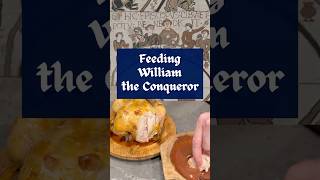
This video recreates a meal from the Bayeux Tapestry, specifically the feast depicted during William the Conqueror's invasion of England in 1066. The host prepares a lard-soaked roast chicken and a spiced sauce called cameline, based on medieval recipes and the tapestry's imagery, offering a taste of history.
The video sets the scene: William the Conqueror and his men invaded England in 1066, and the meal is inspired by the Bayeux Tapestry and medieval French cookbook 'Le Viandier de Taillevent'.
The main dish is roast chicken larded with fat (pieces of fat inserted into the meat), served with cameline, a sauce spiced mainly with cinnamon.
After a month of provisioning his army from his own treasury, William's forces would arrive in England and forage for food, as depicted on the tapestry with pigs, cattle, and stew cooking in a cauldron.
The tapestry shows food being served on kite-shaped shields used by William's men, followed by a feast where William enjoys food, fish, and wine, while his half-brother Odo, Bishop of Bayeux, blesses the meal.
The chicken turns out incredibly tender, and the sauce is very spicy and aromatic, though it is not cooked; it works well as a dipping sauce, which is how it was likely used.
More information on feeding the Norman army in 1066 is available in the full video on YouTube, and the recipe is posted at tastinghistory.com.
The video successfully brings history to life by recreating a meal from the Bayeux Tapestry, offering both a culinary and historical experience. It highlights the practicalities of medieval military provisioning and the cultural significance of food in historical events.
What event is depicted in the Bayeux Tapestry that this video recreates a meal from?
The Norman invasion of England in 1066, specifically the landing and feast.
00:01
What is the name of the medieval French cookbook mentioned in the video?
Le Viandier de Taillevent
00:01
What is 'larding' in cooking?
Inserting pieces of fat into meat to keep it moist and add flavor.
00:13
What is cameline sauce and what is its main spice?
A sauce spiced mainly with cinnamon, used as a dipping sauce.
00:13
How did William's army get food after arriving in England?
They foraged and raided the countryside for provisions.
00:26
What unusual items were used as serving dishes in the tapestry?
Kite-shaped shields used by William's men.
00:40
Who blessed the meal in the tapestry's feast scene?
Odo, Bishop of Bayeux, William's half-brother.
00:52
What was the texture and flavor of the recreated chicken?
Incredibly tender, and the sauce was very spicy and aromatic.
01:04
Historical Meal Recreation
Demonstrates a practical method to connect with history through food, using primary sources.
00:01Medieval Military Logistics
Reveals the practical challenges of feeding an army in the 11th century, adding depth to historical understanding.
00:26Tapestry as Historical Evidence
Shows how art can serve as a valuable source for historical details, including food culture.
00:40Culinary Authenticity
The successful recreation of a medieval dish provides a tangible link to the past.
01:04[00:01] ели Вильгельм Завоеватель и его люди во время вторжения в Англию в 1066 году, или, по крайней мере, во время его части. Вдохновившись изображениями с Байёского гобелена и рецептами из первой кулинарной книги средневековой Франции, «Le Viandier de Taillevent», я приготовил жареную курицу, пропитанную салом,
[00:13] то есть в нее воткнуты кусочки жира, и подал ее с камелином — соусом, приправленным специями, в основном корицей, и лишь один из многих продуктов питания, показанных во время высадки норманнов в
[00:26] Гастингсе. Видите ли, после месяца расходов на пропитание своей армии из собственной казны они прибудут в Англию, разорять окрестности в поисках продовольствия. А на гобелене изображено, как они заводят свиней и крупный рогатый скот, а затем варят рагу в котле. Затем
[00:40] затем варят рагу в котле. Затем затем выкладывают на блюда, которые на самом деле представляют собой щиты в форме воздушного змея, которыми пользовались люди Вильгельма. Затем следует пир, где Вильям наслаждается едой, рыбой и
[00:52] вином, а его сводный брат Одо, епископ Байё, благословляет трапезу. Этот гобелен, который на самом деле является вышивкой, — одно из моих любимых произведений искусства, и на нем изображено мое любимое событие в истории. Поэтому я рад, что наконец-то смог
[01:04] воссоздать часть того, чем питались Вильгельм и его люди. Курица получается невероятно нежной, а соус очень пряным и ароматным, но поскольку он не подвергается термической обработке, он приготовленном варианте, однако он все равно отлично подходит в качестве соуса для макания, именно так его и
[01:16] информацию о том, как накормить нормандскую армию в 1066 году, можно найти в полном видео на YouTube and this recipe is at tastinghistory.com.

⚡ Saved you 0h 01m reading this? Transcribe any YouTube video for free — no signup needed.