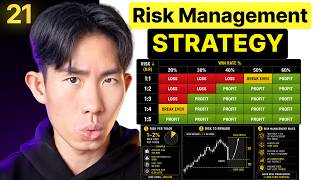

Risk management = love letter to future self
45sThis unique metaphor reframes risk management as a personal, emotional act, making it highly relatable and shareable for traders.
▶ Play Clip"The title is generic but the content delivers a solid, actionable risk management framework, though it includes a lengthy product pitch for EdgeFlow."
This video presents a comprehensive risk management framework for traders, emphasizing the importance of protecting capital and maintaining discipline to achieve long-term profitability. The speaker outlines five core principles and a practical framework, including specific rules for risk per trade, daily loss limits, and trade frequency, and introduces a trading app called EdgeFlow that automates these rules.
Risk management is framed as a commitment to your future self, ensuring you stay in the game long enough to win. Protecting capital and keeping losses small are essential for survival and consistent profitability.
The first rule is to not lose money, echoing Warren Buffett's advice. Your primary job as a trader is to protect your capital, as running out of chips ends the game.
Before entering any trade, you must know your maximum potential loss. Failing to define risk can lead to emotional decision-making and account blow-ups.
Do not change your risk based on feelings or recent wins/losses. Consistent risk leads to cleaner data, stable emotions, and consistent profits.
Set hard rules for max daily loss, max profit, and max trades per day to prevent emotional decisions and unnecessary losses. This framework helps you stick to your plan.
No setup is guaranteed; losses are part of trading. Even the best traders lose. The goal is to keep losses small and wins big, leveraging the law of large numbers for profitability.
Beyond financial loss, poor risk management damages your morale and confidence, leading to self-doubt and a negative trading identity. This emotional toll is a significant hidden cost.
The speaker recommends risking 1% of your account per trade, allowing for 100 losses before blowing up. Lower percentages (0.5%, 0.25%) are also acceptable, especially for larger accounts.
Set a max daily loss of 2-3% and stop trading for the day once hit. This prevents revenge trading and emotional decisions that lead to further losses.
A max drawdown of 5-10% is recommended before reducing size or pausing. This ensures you don't dig a deeper hole and can recover.
Limit the number of trades per day to prevent overtrading and giving back profits. This forces selectivity and protects your capital.
Protect capital by being selective, only risking on high-probability setups (A+). This is more effective than simply sizing smaller.
EdgeFlow is a trading app that automates risk management rules, including auto risk calculation, guardrails for max loss/profit/trades, and daily loss caps, making discipline easier to maintain.
Most traders know these principles but fail to execute. Building discipline into your trading environment, rather than relying on willpower, is crucial for consistent results.
The video concludes that risk management is not just about avoiding losses but about building a system that ensures survival and consistency. By automating discipline through tools like EdgeFlow, traders can focus on executing their edge and achieving long-term profitability.
What is the first rule of risk management according to the video?
Protect capital first; do not lose money.
02:22
What is the recommended risk per trade as a percentage of your account?
1% of your entire account.
12:17
What is the recommended max daily loss before stopping trading?
2% to 3% of your account.
14:25
What is the recommended max drawdown before reducing size or pausing?
5% to 10% of your account.
16:42
Why is it important to keep risk consistent?
Consistent risk leads to cleaner data, stable emotions, and consistent profits.
05:09
What is the hidden cost of not adhering to risk parameters?
Emotional damage, including lower morale and self-doubt.
10:12
What is the purpose of setting a max daily loss?
To prevent revenge trading and emotional decisions after losses.
14:25
What is the benefit of risking 0.5% instead of 1% per trade?
You have twice the number of trades (200 bullets) before blowing up.
13:46
What is the 'holy grail' of trading according to the video?
To survive in the game long enough for your edge to play out.
01:38
What does the video say about the market's nature?
The market is random; anything can happen, so you must think in probabilities.
08:21
Risk Management as a Love Letter
Frames risk management as a proactive, self-caring practice that ensures long-term survival in trading.
00:02Protect Capital First
Cites Warren Buffett's rule, emphasizing that capital preservation is the foundation of trading success.
02:22Consistent Risk for Consistent Profits
Explains the mathematical link between consistent risk and consistent profitability.
05:09Hidden Emotional Cost of Losses
Highlights the psychological damage of poor risk management, which is often overlooked.
10:121% Risk Rule
Provides a concrete, actionable rule for risk per trade that is widely applicable.
11:50Automating Discipline with EdgeFlow
Introduces a tool that automates risk management, reducing reliance on willpower.
20:44[00:02] future self. And you're the only one responsible for delivering it. When I say risk management is a love letter to your future self, what I mean is this. Every single time you protect your
[00:15] capital, every single time you keep your losses small, every single time you follow your trading rules, you are doing something today that your future self will thank you for. Because good risk management keeps you
[00:28] alive in the game. Just think about it. The only way to win the game is to have chips to play with. But if you run out of chips, you literally cannot continue playing the game. Good risk management does just that,
[00:42] right? It allows you to be alive in this game long enough so that you can win big, so that you can win consistently. It helps you preserve your capital, your confidence, and your ability to keep executing your edge.
[00:56] And the key here is nobody else is going to do that for you. Nobody is coming to save you. You're the only one who has to deliver it through your actions, your deliver it through your actions, your discipline, and your decisions in real
[01:09] Which is something that I always say to my students. Right? Because every everybody is thinking about how to get rich fast, how to make as much money as of time. I want to become a millionaire trader in 6 months. I want to buy the
[01:22] Lamborghini in a year from now. Buddy, the fastest way to blow up is to try to win faster. The fastest way to become profitable is to try to lose faster. Because in trading, the goal is not to
[01:38] avoid losses. The goal is to keep them small, controlled, and consistent long enough for your edge to play out. That's the holy grail right there. It's to survive in the game long enough for your edge to play out so that you can
[01:54] consistently. So, this lesson incredibly important, right? So, make sure you actually internalize these principles which I'm about to share with you and apply this risk management framework that I'm about
[02:08] all, let's talk about risk management principles. These are like the golden laws, right? These are the golden rules, right? You have to follow these rules in you manage your money well.
[02:22] First rule is to protect capital first. All right? So, that's the first rule first. Warren Buffett famously said, "Rule number one is not to make money. Rule number one is do not lose money.
[02:38] And then rule number two is to never forget rule number one." Your first job as a trader is not to make money. Is to not lose money. It's to protect your capital so you can stay in the game long enough for your
[02:52] Right? Like I said earlier, if you run out of chips, you cannot continue playing, then you cannot win actually win the game long-term, not just one time or two times, but
[03:07] long-term, is to play the long game. And the only way you can play the long game is if you have capital to play with. Right? So, protect your downside, protect your capital, and sure that, you know, you're
[03:19] not blowing everything on one trade. You're not risking your entire account on one trade. Because if you do just that, all it takes is one loss to wipe you out. Right? All it takes is one loss to get you out of the game.
[03:35] is to define your risk before every single trade. Before you enter for a buy or sell the position, you always need to know to lose. Is it $100? Is it $1,000? Is it $500? Is
[03:50] it $300? Whatever it is, you need to clearly define a risk before every single trade. If you do not define the risk before the trade. What I basically mean by that is that
[04:04] let's say today you're obsessed with making money, right? So, you're thinking to yourself if you win this trade, you are going to make 1,000 bucks and then brand new MacBook. But what you failed to take into account
[04:17] before you enter for the trade is how much you could potentially lose So, as a result, you enter for the trade, price start going against you, you're down $500, you're down $700, price keep
[04:31] going against you, your heart keep on beating faster and faster, your palms start sweating as you watch your loss compound, and now you're down $1,000. Now you're down $2,000. And now you're down $5,000. And next
[04:44] thing you know, you blew your entire account on one trade because you haven't single trade. Okay? So, always make sure you only Okay? So, always make sure you only trade with money you can afford to lose.
[04:57] actually define how much money are you willing to risk on any given trade itself. Next is to keep your risk consistent. Do
[05:09] not change your risk based on feelings, based on confidence, or based on should be doing is the sizing up because you just got a winning streak. Or sizing up just because you lost a trade and now you want to make back the loss.
[05:24] Do not trade your emotions, trade the market. Okay? So, make sure you keep your risk consistent. Consistent risk leads to cleaner data, more stable emotions, and better long-term execution.
[05:38] Right? So, another reason to keep your risk consistent is so that you can keep your profits consistent. Think about it, right? Consistent profits require consistent actions. If today you're risking 5% of your
[05:51] your account, next next day you're risking 2% of your account, sometimes you're going to lose 2%, sometimes you're going to lose 3% because your risk is variable, it's always changing,
[06:05] always changing, because of how you feel, then guess what? You cannot expect your profits to be consistent. Right? Like mathematically, the only way for your profits to be consistent is if
[06:18] you have your risk consistent. If you're risking the same amount of money every you're wrong, every single time you lose, you are only losing this small amount of your account. And every single time you
[06:31] money, which outweigh your little losses. play out, it's going to work in your favor. Right? So, you need to make sure you keep your risk consistent, so that you can keep your losses small,
[06:44] and you can have big wins. Next is the use guardrails to control yourself. Set hard rules for max daily loss, max I'm going to show you how to do this later. I'm going to show you how to
[06:57] actually implement this into your trading system later. You cannot just rely on your emotions, you cannot just rely on your gut feeling in the heat of the moment. You have to define rules. You have to have like a
[07:11] framework to prevent you from blowing up. Because good risk management is not just about avoiding big losses. It is also about preventing emotional decisions. Okay? When you have like a very clear defined rule
[07:26] that you stick to on a daily basis, you are less likely to deviate from your trade plan. You are less likely to make stupid decisions in the heat of the moment, which means you are less likely to take unnecessary losses.
[07:41] Right? Play stupid game, win stupid prizes. That's it. it's not certainty. No setup is guaranteed. Losses are part of trading. Risk management works when you accept uncertainty and focus on executing your
[07:55] edge over a series of trades. So, like what I mentioned right here, no matter how confident you are, no matter how many confluences you have attained from the market itself, you got a liquidity sweep, market shift, freaking
[08:09] uh chart patterns, whatever, right? The most confluence trade, right? You are so confident in the trade idea, there's no At least that's what you thought. Next thing you know, price reverse
[08:21] against you. Even though you have all the confluences, even though you checked your entry checklist. Well, because the market is random, right? At the end of the day, anything can happen in the market.
[08:34] Right? So, you want to make sure that you're thinking in probability, it's not Losses are part of the trading. It's just a cost of doing business, which right? You got to get comfortable with it.
[08:49] Warren Buffett loses, Ray Dalio loses, Paul Tudor Jones loses, George Soros loses. All of these billionaire traders lose from time to time. It's not about how often you lose.
[09:03] It's about how much money you make when you are right, and how much money you Because like I said, if you can keep your losses small, and you can keep your wins big, mathematically, over the law of large numbers, over the long term,
[09:16] you will be profitable. That's the secret right there. I lose money, Warren Buffett lose money, every single person who trades lose money. Not because we are at trading, but because that's just the nature of the
[09:30] some is going to be losses, no matter how good or profitable your trading strategy is. Nobody on this God's green earth has a 100% win rate. Which means that you will incur losses. So, like I said, it's all about keeping the losses
[09:44] small. All about minimizing the losses and maximizing the profits. So, those are the five principles, right, that I adopt on a daily basis. This is how you should approach money,
[09:59] right? It's to always have the survival mentality. Before you can think about thriving, you should first think about surviving. You cannot thrive if you don't even survive in this game, right? So, think about protecting your
[10:12] account. Think about protecting yourself. Because the hidden cost of not adhering to your risk parameters is emotional. It's emotional. And the reason why I say
[10:26] this is because let's say you lose money on your first few accounts, right? Like you lose money trading, no matter how hard you try. You keep on losing money. The obvious loss is the money, right?
[10:39] you have lost to the market. But the not so obvious loss is your morale. Now you will have a lower morale, and now all of these losses will feed into your identity. You will start to feel like, "Oh my god,
[10:54] trading is not for me. Trading is a scam. I'm bad at trading. Maybe I'm not born for trading." All of these infectious belief, doubts, is going to creep in your mind. That's the hidden cost of losses. That's the hidden cost
[11:09] of not adhering to your risk parameters. When you do not follow your risk management, yes, your account will suffer, but more importantly, you will suffer, right? You will suffer. Your mental well-being is going to go
[11:24] be able to trade the market for what it is. So, yes, it's very simple. Go and do them, especially when you don't feel like it. what risk management is. It's about just adhering to these rules even when you
[11:38] don't feel like it. Now, I'm going to give you a framework. All right? So, this is the framework that I personally use to manage my multi seven figure account and it's the same framework that allowed me
[11:50] to scale from five figures to six figures to now multi seven figures. It's the same framework that got so many of my students funded. It's the same framework that got most of my students to the stage where
[12:02] they are consistently profitable and they're making anywhere from 5K a month to $50,000 a month. It's all using this set of risk management rules right here. per trade. Right? Like I said, keep your risk consistent.
[12:17] risk consistent. And the rule of thumb is to risk like 1% of your entire account on any given trade. Okay? So, Right? Because if you risk 1% on each trade, guess what? You can be wrong 100
[12:31] 1% * 100 before you actually blow your entire Right? So, it give you more breathing room to take a bunch of losses and still stay in the game. So, 1% is pretty good.
[12:49] 0.5% is pretty decent as well. 0.25% is pretty decent as well. managing, the lower your risk per trade should be. Like for example, right now I'm managing like a $5 million account. And I'm still risking 1% a trade. Right?
[13:04] I'm willing to lose. But, if I'm risking $10 million, which I that yet, but let's say I get to that point where I'm risking $10 million No, where I'm trading a $10 million account. I'm probably not going to be risking 1%
[13:19] on that the trade itself because 1% on a $10 million account is a lot a lot of money. So, that That where I might consider risking 0.5%. right? So you want to like just ask yourself what is your risk tolerance?
[13:32] What is the amount of money that you are willing to lose on any given trade? Okay, the maximum is 1% anywhere below 1% that's great. The lower the better right because the lower the more room you can afford to lose
[13:46] before you actually blow up right? Like I think about it risking 1% per trade you have 100 bullets in your gun. But if you risk 0.5% on on a trade now you have 200 bullets. You have twice the amount of trades right?
[14:00] play with right? But the downside of risking a small amount of money is that you make less money. So once again ask your risk tolerance I just introspect about your risk tolerance if you are more aggressive 1%
[14:13] is the right way to go if you're more conservative consider risking 0.25 or even 0.5% of your entire account on any given trade. given trade. Next is to set a max daily loss.
[14:25] So this is usually 2% to 3% max then stop for the day. Now the reason why I actually encourage you to set this rule is because you are going to get emotional when you get big losses. It's just part of being
[14:38] a human. You hate to be wrong. You hate the feeling of uncertainty. You hate it. Your ego hates it right? So when you take losses which is inevitable you are going to start feeling emotional.
[14:53] And if you don't have a gut rule that prevents you from making stupid decisions taking stupid trades what tends to happen next is that you're going to revenge trade. You're going to try to continue trading to make back the
[15:05] money that you have lost. You're going to over trade. You're going opportunities. And when you do that you are no longer trading the market. You are simply trading your mental well-being.
[15:19] You're simply trading your emotions. And when you're trading your emotions, And when you're trading your emotions, you are not looking at price. You are not rational. You are not logical. You are not executing your trade plan.
[15:32] going to punish you. The market is going to punish you with a Next thing you know, you lose 1K initially. Now you take this other other trade. Now you are down 2K. And
[15:45] know, you you have blown your entire account. Because in the heat of the moment, the emotional part of your brain overpowered the rational part of the brain. As a result, you were unconscious. You don't even realize that
[15:59] you are actually emotional, but your emotions were driving your And that's a very dangerous way to be trading. loss, right? So 2% to 3% of your account, right? So for
[16:14] example, if your account got 100K, if you lose 3K, assuming you're risking 1% on on any given trade, which means for the day. Okay, you stop trading for the day. You
[16:28] sit back, re-evaluate what's going on, journal that I trade, reflect, and then get back to the charts when you are ready mentally. Okay, so yeah, having like a max daily loss helps out a lot. And also respect
[16:42] your max drawdown. Usually 5% to 10% max before reducing size or pausing. actually stick to rule number one and rule number two If you have a max daily loss and you have a fixed risk per trade, your
[16:55] drawdown shouldn't be anywhere more than 1%. Right? On any given trade. And if you have five different open positions, then you'll probably be like 5% max. Right? So drawdown is like the amount of
[17:09] money that you are going to rate before you actually go back into break even or profitable. Right? So I'll say a good amount is like 5% to 10% before you're reducing size or pausing. So, once again,
[17:22] and you have rule number four, you should be fine. Which brings us to rule number four, which is to limit total trades per day. Do not let one day turn into emotional over trading. Like I say, your job is to make sure that you
[17:36] minimize your losses. And you can minimize your losses in two ways. Quali- quantitatively, right? Which is ensuring that whenever you lose, you lose a little bit of money, and that is
[17:49] adhering to your risk per trade. And also, another way is to And also, another way is to limit the number of losses you incur on And that's what two, three, four is about. Right? It's about just ensuring
[18:03] the most amount of money that I could lose for the day is 3% of your account, or even 5% of your account. And once you hit that, you're done. Or, you know, once you take three trades for today, you're done.
[18:17] trades, you still stop trading for the day because three is three, right? lose those three trades. As long as you've taken three trades, you stop trading for the day. This prevents you from
[18:31] over trading, it prevents you from revenge trading, from giving back the profits that you've Just think about it. How many times have you
[18:43] Let's say you win a trade, right? And that's another thing that I believe, losing. I think the hard part is winning. Because when you start winning a trade, now your ego starts stepping into your
[18:56] overconfident, you start feeling this euphoria. And now you are inclined to just disregard the risk management because you're on top of the world, the trading industry. You're the best trader in the entire world. Next thing
[19:11] you know, you continue trading and on the next trade itself, you end up giving back the profits that you have made back to the market. and now you're back to square one. Or even worse, you are in a loss than you
[19:23] started in the first place. Right? All because you don't have like really just ensure that you limit the amount of trades that you're taking on any given day.
[19:35] Last but not least, is only risk on A quality setups. Protect capital by being selective, not just by sizing smaller. Okay? So, you want to make sure that you're protecting your capital by ensuring that you are only risking it on
[19:50] the setups that are worth taking. On the setups that has a high chance of working out. And that is the A+ setups. about in the last few lessons, how to define an A+ setup. So, those are the
[20:02] setups that is worth deploying the capital for. Okay? Because once again, price is not going to suddenly go in a way because those models appear, but it has a higher chance of working out
[20:16] compared to if you take a setup that is a B setup or like a C setup. Now, thing. Actually following it real time is another thing. And that's where so many traders struggle. They know what they
[20:31] should do, but they don't do it because in the heat of the moment, emotions cloud their judgment. In the heat of the moment, they forget their trade management. They forget their risk management rules. They ignore it.
[20:44] And that's exactly why we built all of these risk management features inside Edge Flow, my trading super app. Once again, most traders already know what to do, but they just don't do it. Edge Flow helps you close that gap by
[20:58] turning risk management from an ideal, from a rule you have written down on a paper, into a trading system. You literally have no choice but to build all of these trading rules that I just showed you here into your trading
[21:11] system. Let me show you what it looks like. So, the first feature that we have is the auto risk calculator. Right? So, the single trade is sized properly. So, for example, today if I were to enter a
[21:24] trade on EUR/USD, I come in here and I press trade. This is where the minute I place my stop loss, EdgeFlow automatically calculate the lot size for me based on my stop loss distance, based on my account size, and my risk per
[21:38] All right. So, in this case, I'm risking 1% per trade because that's the god rail that I've set for myself in my settings. So, if I come here and I place my stop loss at let's say 1.170 85, right? You can see my stop loss
[21:53] right here. Look, the lot size automatically get calculated for me. And it's automatically updating in real time based on the fluctuations of price. This way, I'm always risking 1% of my account on any given trade.
[22:07] All right. So, this is the very amazing sort of feature for me when I started using it because I don't have to go to another website, spend so much time trying to figure out my lot size. The system literally does it for me.
[22:20] And if you don't like to place the price of the stop loss, you can also place it example, I want to have like a three pip stop loss. Boom, lot size automatically get calculated. Or even just like a one pip stop loss. Boom, lot size get auto
[22:33] calculated. Right? So, very useful feature to have. It pretty much reduces the friction that is needed for you to be disciplined, right? For you to actually adhere to your risk parameters.
[22:46] guessing a lot size or eyeballing your exposure. You're entering every single trade with a defined risk amount that matches your trade plan. Which brings us to the god rails that we have right here. Okay? So, if you notice
[23:01] all of these guard rails, you can configure them in your settings. This allows you to have a max loss, a max profit target, and also the max trades per day, and also your
[23:14] call the guard rails. All right, so if preferences, this is where you can set your guard rails. amount of trades that you're taking on any given day. So, this is where you can
[23:27] take three trades a day, put that in. If you want to take two, put that in. Whatever it is, just put it in right here. So, once again, this is very important, right? Because this helps us reduce
[23:39] overtrading, reduce impulsive trades, reduce bottom entries, reduce low quality setups that is outside of our entry model. When you know you only have a limited amount of bullets, which is five in this
[23:52] case, you become much more selective. Now, you're just thinking through every single trade before you actually enter for the trade itself. for the trade itself. And that selectivity improve execution.
[24:04] right here, I'm only have three bullets for today. So, I want to be very mindful. I want to really make sure that I think through before I enter for the I'm done for the day. Another thing is the max daily loss,
[24:20] right? So, once again, this helps you protect yourself from turning one red day into a destructive day. Once your signal to stop. This rule right here exists to protect
[24:34] you from revenge trading, emotional sizing, forcing setups after losses, and just digging a deeper hole for yourself. Right? So, once again, if this account that I'm using right now is a million dollars, right? So, if that's the case,
[24:49] my risk per trade is usually about 1%, so let's say I only want to be losing a total of 2% or 3% on any given trade, this is where I can just put the max daily loss as 20k or 30k or whatever I want to set for the day. And then once
[25:03] I actually lose more than 30k or near 30k, this is where EdgeFlow will automatically block me from trading. I will not be able to continue trading because my max loss has been triggered. So, this way it prevents me from revenge
[25:16] trading. And also max profit, which prevents you from giving back your I said earlier, the problem right here is with winning. A lot of traders, they make money early and then they keep trading out of greed, out of boredom,
[25:30] out of overconfidence, and they end up giving it back. Sometimes the most disciplined decision is to stop after a strong session. Once you make money, know when enough is enough and just stop. And this got real
[25:45] right here allows you to protect a green day. Allows you to protect your profits Right? So, I usually like to set it at around like 5% to 10%. Once I hit 5% or 10% on any given day, I'm done for the day. Right? Like that's the most amount
[26:00] of money that I'm willing to uh make before I just stop because I this amount, I will just end up, you know, making stupid mistakes and giving back the profits back to the market. And also like the risk per trade right
[26:12] where you can define how much money you want to risk on any given trade based on In this case, 1% is where I usually like to risk. I can even go to 0.5% as well and the lot size will automatically adjust by itself to match the risk.
[26:28] Right? So, let's say 0.5% in this case right here. you realize that the risk per trade has been changed to 0.5% and if you set a stop loss, you will see that it's a lot more lesser right now,
[26:42] right? Because once again, this is calculated based on the stop loss trade. So, all of these features that we have in place helps to reduce the it takes to trade in a disciplined manner.
[26:56] Okay, like if you don't have these guardrails in a system, it just make it a lot more difficult for you to become consistently profitable. Right? Because when you are trying to be disciplined,
[27:09] it requires a lot of willpower. It It requires a lot of mental energy. trying to be disciplined, it's going to be very hard for you to actually just trade profitably. For you to just trade fast.
[27:24] So, with EdgeFlow, instead of relying on discipline in the moment, you literally build discipline into your environment. Right? So, once you hit the max trades per day, this trade button get grayed out. You are not allowed to trade. You
[27:36] can override it, but it will require you to input a reason. Same thing, if you target, you will not be allowed to trade.
[27:48] Every single time you are risking the same amount of trade, 0.5% or 1% based which means that you will have a consistent risk equal consistent Also means that your risk is always defined before the trade. Right? You are
[28:04] about, "Oh, what lot size should I use for this trade?" No, because it's automatically calculated for you. Once again, you have no choice but to like just stick to your risk parameters. Your daily loss has a hard cap. Right?
[28:17] So, once you hit this amount, you're done for the day. Your daily profit can finally be protected. Your total number of trades is controlled. Once again, all of these guardrails just makes it so much easier to stay aligned
[28:29] with your rules even when the market is moving fast. Most traders do not fail guys watching this video right here already know about these principles. You already know that you shouldn't be risking your entire account on one trade
[28:41] because that's gambling. That's not trading. And consistency is so difficult to maintain
[28:53] when you are trading independently by yourself. But it becomes so much easier when your trading environment supports that discipline. So instead of relying on willpower,
[29:06] uh, you know, energy, or your emotions, or guesswork, your trading environment literally support that discipline, right? Literally build it into your system itself. So now you have no choice but to
[29:18] be disciplined on a daily basis. And like I said, consistent actions lead to consistent results. When you're consistent in terms of the way you manage your capital,
[29:31] it's only a matter of time till you see consistent profits. That's why Edge Flow is not just about analysis. It's also about execution and behavior. Because your edge is not in your
[29:45] strategy. Your edge is also in your ability to Your edge is also in your ability to manage risk, protect capital, and stay disciplined over a large sample size of trades.
[29:59] everything you need to think, act, and feel like a professional trader is in So if you want to get your hands on this awesome trading software, click the link in bio. Because at the end of the day, risk management should not live only in
[30:11] your head. It should be built into the way you trade. Okay? And that's the real purpose of having all of these risk calculators and got real sense in Edge Flow. To make discipline execution easier, to
[30:24] reduce the friction it's needed to be disciplined, to do the right things, so that it can become more consistent, so that your results can become more repeatable and more predictable, and more scalable.
[30:38] guys have enjoyed this lesson. And as always, remember you're just one trade always, remember you're just one trade away.

⚡ Saved you 0h 30m reading this? Transcribe any YouTube video for free — no signup needed.