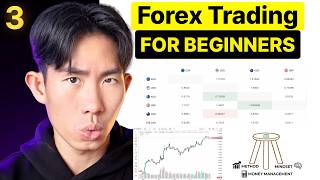

Forex is SIMPLE: Buy One Currency, Sell Another
44sDebunks the myth that Forex is complex, offering a simple, relatable explanation that hooks beginners.
▶ Play Clip"Delivers a solid beginner's guide to Forex, but the title promises 'Ep 3' while content is clearly episode two, and the pacing is slow."
This video is the second episode of a mentorship series aimed at simplifying Forex trading for beginners. It covers the basics of what Forex is, how currency pairs work, how to calculate profits and losses, and introduces key concepts like pips, lot sizes, trading sessions, and different trading styles.
Forex trading is often overcomplicated; at its core, it's simply buying one currency and selling another.
Forex stands for foreign exchange, a global marketplace where currencies are traded at exchange rates that fluctuate constantly.
The Forex market is the largest financial market globally, with a daily trading volume of $6.6 trillion, 200 times larger than the New York Stock Exchange.
The Forex market is open 24 hours a day, 5 days a week, from Monday to Friday, closing only on weekends.
Currency pairs have a base currency (left) and a quote currency (right). The price indicates how much of the quote currency is needed to buy one unit of the base currency.
For EUR/USD = 1.35361, it takes 1.35361 US dollars to purchase 1 euro. Buying the pair means expecting the euro to rise; selling means expecting it to fall.
All currencies cannot go up at the same time; there is always a winner and a loser, which is what traders bet on.
Market participants include big banks, large financial institutions, governments, commercial companies, and retail traders. Retail traders are at a disadvantage without understanding the game.
You cannot predict the market with 100% certainty, but you don't need to. Trading is a probability game, and an 'edge' increases your chances of winning.
To achieve consistent profitability, you need Method (a profitable strategy), Money Management (high risk-to-reward ratio with consistent risk), and Mindset (executing trades based on rules, not emotions).
There are major pairs (include USD), minor pairs (no USD), and exotic pairs (one major, one from a developing economy). Beginners should stick to major pairs.
Experiment with all major pairs, then stick to 3-4 on your watchlist. Focus on analyzing only one pair at a time.
A pip (percentage in point) is the smallest price movement, typically the fourth decimal place. For JPY pairs, it's the second decimal place.
A standard lot is 100,000 units ($10 per pip), a mini lot is 10,000 units ($1 per pip), and a micro lot is 1,000 units ($0.10 per pip).
Bullish means expecting price to increase, bearish means expecting a fall. Long = buy, short = sell. Stop loss and take profit are exit strategies.
You make money by correctly predicting a currency pair's price movement. For example, buying EUR/USD and the euro strengthens against the dollar.
Profit/loss is determined by lot size and pip movement. Example: 1 standard lot, 10 pips move = $100 profit (10 pips x $10/pip).
The Forex market has three main sessions: Asia (slow, low volatility), London (active, clean moves), and New York (high volatility, news events). Best times to trade are during London and New York sessions.
Avoid trading all day. Pick one session that fits your lifestyle and become an expert in that specific time window.
Technical analysis (chart patterns), fundamental analysis (economic news), and sentiment analysis (market mood) are the three main approaches.
Scalping (seconds to minutes), intraday (within 24 hours), swing (days to weeks), and position trading (weeks to months). Choose based on schedule, goals, and personality.
A broker should be licensed, regulated, secure, offer low costs, good support, and a reliable platform. Always do your own due diligence.
Connect broker to a trading platform like cTrader, analyze charts on TradingView, and execute trades on MetaTrader or cTrader. Optionally use a super app like Edge Flow for journaling.
Costs include bid-ask spread, commissions, and swap/rollover fees. These are unavoidable but can be minimized by choosing a low-cost broker.
The next episode will cover market structure and how to read charts to develop a daily bias.
Forex trading is fundamentally simple: you're betting on the exchange rate between two currencies. Success comes from mastering the three M's (method, money management, mindset), focusing on a specific trading session, and choosing a reliable broker with low costs.
What does Forex stand for?
Foreign exchange.
00:58
What is the daily trading volume of the Forex market?
$6.6 trillion.
01:38
What is the base currency in a currency pair?
The currency on the left, which is always equal to one.
03:09
What does a pip stand for?
Percentage in point.
15:44
How many units are in a standard lot?
100,000 units of the base currency.
20:10
What are the three M's of trading?
Method, money management, and mindset.
09:24
What is the pip value for a mini lot?
$1 per pip.
20:28
What is the difference between a major and a minor currency pair?
Major pairs include the US dollar; minor pairs do not.
12:03
What is the spread in Forex trading?
The difference between the bid and ask price.
41:43
What is the swap fee?
A fee paid for holding a trade overnight.
43:52
What is the pip value for a standard lot?
$10 per pip.
20:10
What are the three main trading sessions?
Asia, London, and New York.
28:35
What is the recommended number of currency pairs to focus on?
Three to four on your watchlist, but analyze only one at a time.
14:50
What is the difference between a scalper and a swing trader?
Scalpers trade in seconds to minutes, while swing traders hold for days to weeks.
34:08
Forex Market Size
Provides a concrete scale of the market, emphasizing its liquidity and opportunities.
01:38Trading is a Probability Game
Reframes trading from prediction to probability, a fundamental mindset shift for beginners.
07:26The Three M's Framework
Introduces a structured approach to achieving consistent profitability.
09:10Stick to Major Pairs
Practical advice for beginners to avoid unnecessary risk and focus on liquid markets.
14:25Trading Sessions Matter
Highlights the importance of timing and volatility, a key factor often overlooked by beginners.
28:20[00:01] complicate Forex. They think that they need 20 indicators, 10 different monitors, some secret strategy, and years of experience just to place a trade. When in reality, Forex is actually very simple when you understand
[00:18] the end of the day, you are just buying one currency and selling another. Welcome to episode two of my Market Mechanics mentorship series. In the first episode, I showed you how the
[00:31] market actually move. Now, in this second episode, I want to simplify Forex actually understand what you are trading, how the different currency pairs move, what even is a currency pair, and how money is made or lost in
[00:46] trade, how to pick a different trading style. Basically, I'll walk you through everything you need to know about Forex With that being said, let's get right into it.
[00:58] So, what is Forex? The term Forex basically stands for The term Forex basically stands for foreign exchange. The foreign exchange market is the global marketplace where the world's currencies exchange hands at
[01:12] the world's currencies exchange hands at a mutually agreed rate, exchange rate. This exchange rate changes every single second, so the market is constantly fluctuating. So, as Forex traders, what we are pretty
[01:26] much trading is this exchange rate. We are betting on whether it's going to go are betting on whether it's going to go up or down, and then we are trying to make money off our bet itself. That's it.
[01:38] The Forex market is the largest financial market in the entire world with a daily trading volume of $6.6 trillion. Not a million dollars, not a billion dollars, but trillion dollars with a T.
[01:52] It is also 200 times bigger than the largest stock exchange, which is the New York Stock Exchange. So, there's a lot of trading volume, which means there's a lot of market participants, which also means there's a lot of liquidity, a lot
[02:07] means there's a lot of liquidity, a lot of trading opportunities. of trading opportunities. So, the market is open 24/7, unlike the stock market, which is only open when the stock exchange is open,
[02:22] the Forex market is open 24 hours a day, 5 days a week from Monday to Friday. So, it's only closed during the weekends. So, Forex trading is pretty much the conversion of one currency into another.
[02:39] So, an example, you travel from Singapore to Australia, dollars in Australia, right? So, as a result, you will go to a nearby currency booth at the airport, and then you will exchange your Singapore dollars into the
[02:55] Australian dollars. And with the exchange, there's the exchange rate, right? For example, one Singapore dollars equal X amount of And what we are essentially trading, like I mentioned earlier, is the
[03:09] Forex markets are always quoted in on the left of a currency pair, while the quote currency is on the right. The base currency is always equal to
[03:22] one, and the quote currency is equal to the current quote price of the pair. This means that the price for a pair is how much of the quote currency it costs how much of the quote currency it costs to buy one unit of the base currency.
[03:37] So, when you trade Forex, you are essentially buying one currency while selling the other. For example, in this example, it shows For example, in this example, it shows EUR/USD = 1.35361.
[03:55] Euro is the base currency. USD, US dollar, is the quote currency. So, what this means is that it would take 1.35361 take 1.35361 US dollars to purchase 1 euro.
[04:08] This is the exchange rate. So, this is something that you have to know because every single currency pair, it comes in pairs, right? That you can't just like, pairs, right? That you can't just like, you know, buy or sell like euro or USD.
[04:21] you are going to be dealing with currency pairs, right? They come So, once again, that's just how the market works in forex trading, right? So, when you go on to Google and you search up how much uh conversion, like
[04:37] convert euro to USD, that's the exchange rate and that's what we are trading. When you buy your USD, what you're doing is that you're expecting the price of euro to rise. So, you buy euro, which is
[04:50] once again, the base currency, and you sell USD, which is the quote currency. USD, That's it. And if you sell your USD, what you're
[05:03] doing is that you're expecting the price of euro to fall. So, you sell euro, which is the base currency, and you buy USD, which is the quote currency. So, if the euro weakens against the US dollar, you make money.
[05:18] That's just how forex trading works. So, when you buy a pair just like this, you are predicting that the base currency is going to go up and the quote currency is going to go down. And if your prediction turns out to be right,
[05:32] you make money. If you sell, then you are literally betting that euro is going to go down, USD is going to go up. there will be another weakening against it. All currencies cannot go up at the
[05:49] same time. Just like in life, there is always going to be a winner and a loser. Forex traders weigh up whether a currency looks likely to strengthen or weaken against another, and then they
[06:03] trade that pair accordingly. So, if I think euro is going to strengthen uh you against US dollar, this is where I'm going to be buying EUR/USD. If I think euro is going to weaken against the US dollar, I'm going to be selling
[06:18] EUR/USD. So, who trades Forex? There's a few market participants. Number one, we've got the big banks and large financial right? These are the people who are trading with millions or if not billions
[06:31] of dollars. They have a lot of liquidity, they have deep pockets. And government. You've even got large commercial companies, because you must understand that when companies they are paying their employees overseas, they
[06:45] might want to convert the salary into that particular country's currency before paying them out, right? So, simple things just like this means that they are essentially still participating in the Forex exchange, right? The Forex
[06:59] market. And also, you've got the retail traders, which is us. participants. These are the people that are playing in the game in which you are playing. So, if you do not understand the game, you are going to be losing to
[07:12] the people who does, which is the big banks, the large financial institutions with deep pockets who technically control the market. when to sell? How do you know whether the market is
[07:26] going up or down? You don't. The truth is, as retail traders, we cannot predict with 100% certainty where the market is going to go. And the best part is that we don't have
[07:42] to in order to make money. You heard that right. You don't need to predict what's going to happen next in order to make money in this market. Because trading is simply a probability game. Which means that every trade
[07:57] outcome is random. However, we can increase the probability of us winning a trade, of us predicting where the market is going to go, by developing an edge. An edge is what separates winning
[08:13] An edge is what separates winning traders from losing traders. That's what an edge is. An edge is not a guarantee you will win a trade. An edge is not a guarantee that price is going to go up just because you predicted it
[08:26] It's just something that puts the odds in your favor. Most beginner traders, they don't even have an edge. And as a result, they're not able to get consistent profits. They
[08:41] there because of beginners luck, but they find it incredibly difficult to profit consistently. But once you master the three M's, and you start to focus on the process rather than the outcome, this is where
[08:56] you can transcend from the randomness of the market and start making consistent I'm going to talk about the three M's in a bit. But that's all an edge is, right? Your edge is basically your trading strategy
[09:10] that allows you to make more profits than losses. That allows you to make more money when you are right than lose it. And in order for you to develop an edge,
[09:24] you need to master these three M's. In order for you to achieve consistent profitability, you need to have these three M's in your arsenal. And that is method, which is having a profitable trading strategy that works
[09:38] in every market condition, money management, which is the ability to take trades with high risk to reward ratio while keeping your risk consistent. To put it in plain English, it's to basically make more money when you are
[09:53] right compared to losing when you are wrong. right and lose less money when you are wrong. So, the wins, the profits are always outweighing your losses. And then, you need mindset, right? The
[10:07] ability to execute trades based on mechanical rules on your trading system rather than emotions. So, those are the three M's. And over the next 30 days, throughout this entire Market Mechanics
[10:23] Mentorship series, I'm going to be teaching you everything you need to know to build a profitable trading strategy, manage your risk, and develop the mindset of a professional trader, a profitable trader.
[10:37] that is catered towards each one of these core pillars. And once again, you need all three. Just like a stool that you can see on the screen right here, if you take one
[10:49] away from the stool, the stool is going to fall. You need all three legs to become consistently profitable. You need method, money management, and
[11:01] Now, let's take some time to talk about currency pairs. currency pairs. Currency pair is basically a price quote of the exchange rate for two different currencies traded in the Forex market.
[11:16] And all currencies are identified by its own ISO currency code. Here's what I mean, right? So, for example, the Great Britain or England, the currency is the Great Britain pound, which is, in short, GBP.
[11:33] And then for the Japan, which is using Japanese yen, which is using Japanese yen, their currency code is JPY, Japanese yen, Great Britain pound. And then for the US,
[11:47] they are using the dollar, which means it's US dollar. it's US dollar. So, this is the own individual ISO currency code. Every single country has one.
[12:03] pairs, your minor currency pairs, and your exotic currency pairs. Major currency pairs are the currency pairs that include the US dollar. So, I'm talking about your USD, GBP USD, NZD USD, USD JPY, USD CHF,
[12:19] USD CAD. So, this is the euro USD, uh the Great the New Zealand dollar against the US dollar, the US dollar against Japanese yen, the US dollar against Swiss franc,
[12:32] the US dollar against Canadian dollar. And then you've got the minor currency pairs, which is pairs that include any two of the major currencies except the USD. So, minor currency pairs do not have USD inside.
[12:44] have USD inside. So, it's stuff like euro JPY, euro Swiss franc, Great Britain pound Australian dollar, Great Britain pound Japanese yen, Australian dollar against the Canadian dollar, and Australian dollar
[12:57] against the Swiss franc. And then we've got the exotic currency pairs, which is the pairs that include one major currency and one currency from Now, for the majority of you guys watching this, I would advise you to
[13:11] pairs, but it's good for you to uh I just understand what they are. Just to give you some example, US dollar against the Singapore dollar, US dollar against the Thai baht, US dollar against the Hungarian dollar, uh US uh
[13:25] Australian dollar against the Mexican pesos, if I'm not wrong. Correct me if I'm wrong. But the Canadian dollar against the Singapore dollar, right? So, yeah, those are the list of some examples of the exotic currency pairs.
[13:39] And to be honest with you, I don't even know, like, damn, because I trading career. I've been trading for like 7 years right now, and never have I ever traded a single one of these exotic currency pairs. So, yeah, you're much
[13:54] better off just staying away from them and sticking to the major currency pairs. All right. So, for my beginners out there, you want to stick to the the currency pairs with the most amount of liquidity, volatility, and trading
[14:10] opportunities. So, I'm talking about your USD, GBP USD, So, I'm talking about your USD, GBP USD, NZD USD, USD JPY, USD CHF, and USD Canadian dollar. Right? So, yeah, stick to these, and you'll be good.
[14:25] And my advice for you is to experiment with all the major currency pairs. If you don't know what to choose, try all of them. Try different flavors. Try Western cuisine, Japanese cuisine, Australia cuisine,
[14:38] Turkish cuisine. Try everything, and then see what you like. And then once you have found out what you like, and which one is the best for you, you want to stick to one to four currency pairs. Right? So, I would advise you to have
[14:50] three to four currency pairs on the watch list. So, if one currency pair doesn't offer you opportunity, you can switch to another one. And if that one Yeah, so, you can have multiple, right? But at any
[15:04] given moment, you should only focus on analyzing the charts of one currency Okay? Next up, let's talk about some Forex language and lingo, which is some terminologies, which you might not be
[15:16] familiar with. That is exclusively for Forex traders. Okay? So, this is like the language we actually use as forex traders. So, it's like um
[15:28] different dialect, all right? So, you need to understand these terms because communicate with other forex traders and you will not be able to understand the terms that your forex trading platform and broker is using.
[15:44] Number one is pips. Now, what is pips? A pip stands for percentage in point. And it's the smallest price movement any exchange rate can make. It measures the amount of change in the
[15:59] exchange rate for a currency pair in the forex market. forex market. And a pip is basically the fourth number after the decimal point. Right, so in this case, this is the decimal point. 1
[16:13] 2 3 4, this is a pip, right? So, it's the fourth number after the decimal the fourth number after the decimal point. is basically what allow us to know how to calculate our profit and losses as
[16:29] All right, so if you look at this case in this right here, EUR/USD right now in this right here, EUR/USD right now the exchange rate is 1.0926. Which means that this right here is the pip, right? So,
[16:43] once again, it's the fourth number after the decimal place except for Japanese yen pairs, which I'm going to talk about later on. And in this case, if the price later on. And in this case, if the price of EUR/USD goes from 1.2468
[16:56] to 1.2470, you can see what changed was you can see what changed was this right here went from 68 to 70. two pips, right? We just gained two
[17:09] All right, so 2468 2470, you can see the difference is two pips, right? Because the only thing that changed was this last number right here. Another thing another example, 1.2576 to
[17:23] 1.2566. This time round, price went down by 10 This time round, price went down by 10 pips. All right, because 2576 - 2566, the difference is 10 pips. And then next you got 1.2176
[17:37] to 1.2276. This time round, which decimal which number after the decimal point actually change? It was this one right here, which is the hundredth pip. Okay, so if this is the pip, this
[17:51] the hundredth pip. So in this case, if So in this case, if it changed from 1.22 1.2176 to 1.2276, the difference is 100 pips. So, that's just how the math works in
[18:06] the Forex world, right? If you don't understand this, don't worry as with more practice, you'll get more familiar with it, right? Just like a language, the more you speak the same language, the more you you well versed you can
[18:19] language itself. So yeah, don't worry about this. Just know that this is how we calculate like the the the the pips, right? This is how we calculate the the dollar move in Forex.
[18:31] And like I said, the pips works a little bit differently on Japanese yen pairs. Because Japanese yen pairs only go out to two decimal places. to two decimal places. So one pip is the second number after
[18:46] Right, so in this case, it'll be this one right here, right? 1.70.67, if it goes to 170.68, then guess what? We just plus one pip.
[18:59] then guess what? We just plus one pip. As simple as that. If it goes to 170.77, then we just plus 10 pips, right? The difference is 10 pips. And then we got the pip pet, right? Which is this small little
[19:13] Which is this small little number that is attached to the entire exchange rate. This is the pipet, right? This is the micro pips. This is 1/10 of Right? So, yeah, if this is the pip, this is 1/10 of the pip.
[19:28] this is 1/10 of the pip. So, one pipet equal to 0.00001, So, one pipet equal to 0.00001, right? So, if price move from 1.0926 3 2 1.09265,
[19:41] guess what? We just plus 0.2 pips. We just plus two pipets. Okay? So, yeah, attached to the exchange rate itself. Next up, we got lot size.
[19:56] Lot size is like the amount of units of a certain or selling. lots.
[20:10] A standard lot is equivalent to 100,000 units of the base currency. This is $100,000 if you were trading in US dollars. And every time price move by one pip, you are making or losing $10. Right? So,
[20:28] it's $10 per pip. Now, mini lot is 0.1 lot, and that is 10,000 units. Every time price move by one pip, that's $1 per move.
[20:40] And micro lot is 0.01 lot, and if price move by 1,000 units, this is where you are making or losing 10 cents. Okay? So, that's the lot size itself.
[20:54] So, I'm going to show you how to combine the lot size and the pips to calculate your P&L later on, but for now, just understand that when we're talking about lots, we are I'm about the units in which you want to buy or sell a specific
[21:10] which you want to buy or sell a specific currency. want you to familiarize yourself with. Bullish basically means you expect price to increase. So, if I say I'm bullish, I'm expecting price to increase and I'm
[21:22] look for look to buy. If I'm bearish, that means I'm expecting price to fall. If I will say I want to enter for a long position, it means I want to enter for a buy order. If I want to
[21:35] enter for a short position, it means I want to sell. And then, you got stop loss and take profit, which is how you exit a trade. if you place a stop loss at a certain price point, that means you want to
[21:48] close the trade at that particular price if the trade does not go as planned. if that's the case, you want to set a take profit, which is a profit goal
[22:00] that once you hit you get out of the trade if the trade ideal when as planned. Now, let's talk about how you make money in forex trading. You do so by correctly predicting a
[22:12] You do so by correctly predicting a currency pair price movement. profit. Example, if you are bullish on euro, is going to go up. It's going to strengthen against the US dollar. As a
[22:28] Okay? Because, once again, you are betting that euro is going to strengthen to go up. And then, later on, a few minutes later, a few hours later EUR/USD did go up. So, your trade ideal
[22:45] when as planned. As a result, you make money. pound and you sell GBP/USD once again, betting GBP/USD is going to go down, and later on, GBP/USD does go down, the Great Britain pound does
[23:00] weaken against the US dollar, you make money. money. That's it. it. How do you actually like quantify the P&L?
[23:13] How much money can you potentially make or lose on any given trade? or lose on any given trade? Well, it's determined by a lot size, purchasing or selling, and whether you enter for a buy or sell, and however
[23:27] much does it go up or go down, which is determined by the pip distance. here. So, once again,
[23:40] this is how you determine however much does a particular currency go up or go difference, and also the lot size itself.
[23:52] All right, so those are the two concepts. So, let's look at an example. If you buy EUR/USD, and right now EUR/USD is sitting at 1.250, means you are thinking that EUR is going to strengthen against the US dollar. So,
[24:08] if EUR goes up, you make money. enter for the long position, EUR/USD went up by 10 pips. It moved
[24:20] from 1.2500 to 1.2510. So, as a result, guess what? You have potentially just made 10 pips. But, how do you turn that into P&L? Do I
[24:33] have to determine that how much money have you made on this trade itself? Well, the next thing we look at is the lot size, which is the amount of units So, in this case, let's say the lot size you used was the one lot, the standard
[24:46] lot, which means you have essentially purchased 100,000 units of EUR/USD. So, 100,000 units of EUR/USD, and price moved up by 10 pips.
[24:59] And every single time price moved by one pip, that is $10. You take 10 pips, which is however much it went up by, times $10 per move, right? Per pip move, and you get $100 itself.
[25:15] So, it's basically your lot size, the amount of units, the dollar per pip move. profit. Now, if you don't understand, let me
[25:28] just give you like a quick example. Okay, so in this case, let's say same exact scenario right here, guys, right? You enter for a buy. Price also moved by 10 pips. But this time round, instead of using one lot,
[25:44] instead of using a standard lot, you only use a 0.5 lot, which is half of a So, as a result, you can expect your profit to half. So, instead of making $100, you are making $50.
[25:57] Because you use 0.5 lots, right? Which is essentially you are entering for a buy for 50,000 units of EURUSD, and every time price moved by one pip, that is $5 per move, and you take $5 per move,
[26:11] per move, and you take $5 per move, times the amount of pips which the move actually entailed, which is 10 pips, and you made $50. Now, let's go another example just to reinforce your understanding of this.
[26:25] Let's say you sell GBPUSD. Right now, GBPUSD is 1.2828. And price went down by 20 pips. Okay, so you can see price went down from 2828 to 2808. So, in this case, the lot size you use
[26:40] is 0.2, right? Which is means you are just selling about 20,000 units of And every time price moved by one pip, that's $2 per pip. that's $2 per pip. So, this is where you can calculate your
[26:55] lot size, right? You can calculate your loss and you realize that you will lose 20 pips. Wait. If you are selling and price did move down by 20 pips, there's a mistake right here. You are actually making
[27:10] money. Okay, so in this case, if you actually end up for a buy instead of a short, this is where you will incur a loss of 20 pips and times $2 per pip, that is $40. All
[27:26] Just change this and replace it with buy. So, if you went for a buy for GBPUSD and the market move against you by 20 pips, and you take that times the dollars per pip, this is where
[27:39] you will lose $40. As simple as that. use, right? Which is pip movement, which is the pips times the position size, which is the dollars per pip, and that is where you get your profit and loss.
[27:53] So, that's how you can calculate it. But don't worry because of the modern age, we got a lot of tools and softwares that help you with identifying the pip Uh so, this shouldn't be a problem whatsoever.
[28:05] And also, with more practice, you will get a hang of this. Now, next question I get quite often is what time should you be trading Forex? Like I've shared with you earlier on, the Forex market is open 24 hours a day,
[28:20] 5 days a week. But not every hour has good movement. Not every session give you clean setups. Timing matters a lot in trading. The Forex market have three main sessions, right? There's the Asia
[28:35] session, which is a combination of the Sydney session and the Tokyo session. And then you got the London session, and then you got the New York session. And each session has the different personality, different speed, different
[28:48] level of volatility. The Asia session is usually much more slower. There's going to be lower volatility. Price can stay in consolidation for longer and it's like less active
[29:00] So, this session right here is not really ideal for beginners who is And then you got the London session, which is one of the most active session. This is the strong trading volume enters the market. This way you can expect much
[29:15] more cleaner move, much better trading opportunities. And it's a great session for many major currency pairs. I specialize in this session itself. All I really believe that this is one of the best sessions if you want to trade
[29:30] And then you got the New York session, which is also very active, right? Brings about strong volatility. And this is also a session where a lot of high impact news tends to happen. And this could be another key session
[29:44] that you might want to pay attention to. Now, the next question becomes which is the best time to trade? Now, in my humble opinion, I believe that the best times to trade are usually when the trading volume is the highest.
[29:58] And this is usually occurring within the London session or the New York session The reason why I want to trade when there's more trading volume is because more trading volume means more liquidity, means better price movement,
[30:13] means cleaner setups, means more predictable price movement, and also more trading opportunities. So, a big mistake that a lot of beginners tend to make is that they try to trade all day. They wake up, you
[30:27] then they trade all the way to 9:00 p.m. and then they go to sleep. They do it When you do this, what happens is that you tend to become tired mentally by staring at charts all day. And not only that, the hidden cost of
[30:41] doing that is also overtrading, which means you could and make money during the Asia session, and then during the London session you continue trading, and then you start getting lost and directionless, and now
[30:54] you give back the money that you have made in Asia session during the London So, yeah. You don't need to be at the charts all day to be profitable. A much smarter trading approach is to find one specific window and just focus on that
[31:09] session, the Asia session, or the New York session, but just stick to one. And you want to pick the trading session that fits your lifestyle. And once you do that, you want to learn how price behave during that time. Get
[31:24] really, really good at trading your specialized currency pair in that specialized currency pair in that particular trading window. different analysis in Forex trading. There's three types of analysis. There's
[31:38] your technical analysis, fundamental analysis, and sentiment analysis. Technical analysis is the chart work, right? It's basically the study of price past price and volume data. It's the ability to analyze charts to identify
[31:51] trends or patterns. So, this is where we pretty much implement market mechanics, where we look at the chart and try to predict where price is most likely going to go based on the price action.
[32:04] So, technical traders will often analyze the historical price data on the charts to identify trends or patterns which will help them predict future market behavior. And then you got fundamental analysis,
[32:17] which is the study of underlying economic and financial news and announcements that might impact the market. And there's a lot of different factors that actually influence how and why
[32:30] price move, and that is stuff like monetary policy, interest rates, inflation, gross domestic product, non-farm payroll, Federal Open Market Committee, any comments from feds and central banks, economic chaos or
[32:44] central banks, economic chaos or prosperity, war, right? You know, widespread sta- uh pandemics like the COVID-19 pandemic. All of this stuff causes the entire sentiment of the market to change, which causes the price
[33:00] sentiment analysis, we're actually gauging how the general public feel about something. And this is where we like to analyze people's emotions, opinions, and attitudes. Where we look at social media, where we look at
[33:13] reviews, where we look at articles. Right? For example, right now because of the World War III that is going on right now with Iran and the United States, there's a lot of fear in the market. So, if we know that, then that is where we
[33:26] if we know that, then that is where we can expect the prices of stocks, um other commodities. Now, for stocks and other assets, more risky assets like crypto to start falling. And then we can expect prices of oil to actually go up,
[33:41] prices of gold to actually go up. Right? So, that's pretty much using sentiment analysis. Using the sentiment of the market to kind of predict how like where price is most likely going to move based on how the general public feel about
[33:55] that particular asset. Next up, we got the different trading different trading styles that you can adopt as a trader. You got your scalping, you got your intraday trading, you got your position trading, and your
[34:08] swing trading. Scalpers are pretty much people who are getting in and out fast, right? Anywhere from a few seconds to a few minutes. Basically, less than an hour. And they're targeting a small amount of pips. And their entry time
[34:22] time frames. And then for intraday traders, these are people who are entering and exiting the trade within 24 hours. target a little bit more. They tend to target 10 to 100 pips. And then you got
[34:36] swing traders who are people who are holding the trade for days or even trade for so long, you can expect them to target like a much to target like a much more significant amount of pips.
[34:50] who are like not really like long-term investors, but these are the people who are holding the trade for weeks or even months. Right? So, they can expect them to target a lot more pips.
[35:04] you be a scalper? Should you be an intraday trader? Should you be a swing trader? It depends on these three things. It needs to fit into your schedule. Right? So, if you're working a 9-to-5
[35:17] job and you find it hard to scalp, you find it hard to concentrate on the charts and stay at for like a few hours after work, then you might be better off opting for intraday trading or even swing trading.
[35:30] It needs to align with your goals. Okay? So, based on what you want to achieve from the market, based on your desired outcome, you want to choose a trading you want to be a person that want to
[35:45] travel the world, enjoy life, then perhaps swing trading is perfect for you. You can enter a trade on Monday, check the charts here and there Friday. You don't have to stare at charts all day like a scalper. Right?
[35:58] So, align your trading style with your goals. And last but not least, you want to find a trading style that suits your personality. relaxed, you don't like to stare at charts all day because it's quite
[36:10] stressful, go for swing trading. adrenaline, who likes the excitement, who is very impulsive, right? Who is very aggressive, who has a high risk tolerance, you might want to go for
[36:24] scalping. So, based on these three criteria, ask yourself which is the trading style that suits you the most. pick. And I will always
[36:38] preach the importance of just experimenting with everything. Right? Like I said, try the different cuisines. See which one you like best. then you can define which is the one trading style that you want to focus on
[36:52] and then just continue to get better at mastering that particular trading style itself. And a lot of you guys have seen me catching these high RR trades, right? Where I'm catching 1:10 RR trades, 1:8
[37:05] RR trades, where I'm, you know, making $8,000 when I'm only risking $1,000. These are what we call sniper entries. These are high risk reward trades, and you can only catch these if you are either very good at entering and exiting
[37:20] trades, or you have a hybrid approach, which means you use the entry time frames of a scalper, but you use the higher time frames of an intraday trader. Right? So, as a result, you are able to enter, get all these
[37:35] you are able to enter, get all these tight stop loss, and able to target um a So, once again, we're we're going to cover more about this later on, but if you want to catch these high RR trades, it's going to be much easier for you to
[37:48] approach, like a scalper and also intraday trader or intraday trader or intraday trader or intraday trader or also like a swing trader. trading broker. Now, a broker, which is is basically a
[38:03] your trades. So, when you're choosing a broker, you It needs to be licensed and regulated. It needs to be at a safe and secure location. You need to be able to withdraw your money as and when you
[38:17] wish. It needs to have a quality customer support, which is able to help doubts. It needs to have low trading cost. It needs to have a minimum deposit and also leverage. And it needs to offer a
[38:30] platform. So, is do not use a broker because your favorite trading guru asked you to do so. Be it me or someone else on YouTube or Instagram, don't just use it because
[38:44] they promote it. Always do your own due diligence. Because it's your money, which is your responsibility. is you trust your hard-earned money with a
[38:58] broker and then the broker runs away with your money. The broker doesn't allow you to withdraw your money, which is ridiculous. So, I personally recommend Eightcap because you have super tight spreads, it
[39:11] really fast, you have deep liquidity, you have educ- educational resources, which is really good for beginners. It has an economic calendar and it allows Right? So, once again, this is just my personal recommendation for you.
[39:25] Still go and do your own due diligence. If you feel like Eightcap is the one for meets all the criteria that I just mentioned, then by all means go and create an account with them. And when in doubt, you're much better
[39:38] out there, which is the ones that you can see on the screen right now. So, here's my execution process. I tend to connect my broker to a trading cTrader. And then once I do that, I will analyze
[39:54] the charts on TradingView. And then once I develop my trade bias, whether I want to enter for a buy or enter for a sell, I like to execute my trades on either MetaTrader or cTrader, which is the trade execution platform.
[40:08] Now, here's an optional step. You can also connect your trading account to a trading super app like Edge Flow, so you can plan, execute, journal, and review our trades all in one place instead of juggling 10 different apps
[40:23] Edge Flow is a trading super app that I personally built to help retail traders trade in a much more disciplined manner so that they can actually achieve waste their time, you know, spreading themselves thin by using different apps
[40:38] to journal, calculate their lot size, review their trades, and execute their trades. Instead, they can have everything in one place. Link in the Now, the reason why I wouldn't recommend you to connect your broker to
[40:50] TradingView is because you might rush into trades without thinking through properly. You might enter into buy and sell orders or manage your open trades accidentally. And most importantly, you will get
[41:02] emotional when watching our profit and loss fluctuating as you analyze the Now, let's briefly talk about trading costs. Your broker makes money based on your trading volume. They want you to take as many trades as possible and take
[41:17] them as often as possible because of this, right? You got your bid and ask spread, you got your commissions, you got swap or carry or roll over fees. All of these are the fees that you will incur if you are
[41:30] actively day trading. The bid and ask spread for every buy order there must be an equivalent sell order for a trade to take place. Bid price is basically the price that you sell to the market. Ask price is the
[41:43] price that you buy from the market. And the difference between the bid and ask price is your spread. So, this is why a lot of times if you enter for a buy, you will almost immediately get into a drawdown.
[41:59] Like you will automatically lose money. You will automatically be down like $100 you at all. It's because of this. It's because of spreads. So, in this case, you can see the bid price is 1.38085.
[42:18] 1.30870. So, as a result, the difference of this is 1.5 pips, right? And that's the spread. So, if you enter for a buy in this case, you would immediately be in a
[42:30] drawdown of 1.5 pips, which is the spread. position, you have to sell at the bid price. is usually a fixed amount per trade by the broker. Example, $7 per lot on each
[42:44] trade. And round trip, which is two trades, right? Which means you buy and sell or vice versa. You're essentially paying $7, uh $14 in commission in this case itself, right? So, if you actually
[42:56] entered for a buy the first time round, right? And this is where you will pay $7 commission. And you enter for a sell, commission. So, the total commission cost for
[43:10] So, the total commission cost for trading one lot on EUR/USD is $14. So, that's This is like a fixed amount that your broker charge. which is the commission plus spread times the pip value, right? So, this is
[43:25] again, I'm not going to go too deep into this because this should be explained on your particular broker, and they should make it very, very clear on what's the transaction cost. And you want to make sure that you pick a broker with low
[43:39] transaction cost. So, you got the rollover, right? Which is moving open position from one trading day to another. And swap, which is the fee that you have to pay if you hold your trades overnight. And this only
[43:52] traders because these are the people who are holding the trade overnight. And this is calculated by adjusting the closing level of your open position with involved. And the rates can change daily as they
[44:05] are based on the underlying market price. If you buy currency with higher interest rate, you receive interest. If you buy pay interest. And this payment is known as the carry.
[44:18] So, for example, if you buy one lot of EUR/USD at the current price, bid and ask price is this, after 24 hours, the bid and ask price change to this. right, which is holding the trade overnight, you're going to be selling at
[44:35] 1.1378 and then buying back at 1.13805, which means you will have to pay the difference, which is the 2.5 points. And if you take that times the dollars per pip, right, which is $10 since you're
[44:49] buying one lot, the swap fee is $25. you have to incur as um if you're trading with a broker, and cost of doing business. You can't really avoid them if you're a trader. All you
[45:04] can do is to find a broker that have very low fees so that you can minimize like the amount of money you actually give to them so you can save more profits for yourself. My advice is don't worry too much about
[45:18] the transaction costs, right? I know, you know, this can be quite alarming. money, you know, all of these little costs add up, but in the long run, over the grand scheme of things, I would say it's pretty worth it uh since you're
[45:33] going to be making a lot more money than what you're paying to the broker itself. Like I said, you're much better off just finding a broker that offer you low transaction costs and fees and just stick to it.
[45:46] So, now that you understand what Forex is and how trading actually works, the next step is to learn how to read the chart itself. So, in episode three, I'm going to break down market structure and show you
[45:59] exactly how to tell whether the market is bullish, bearish, or simply pulling And this is where you can learn how to develop a daily bias to determine whether to buy or whether to sell. So, that next lesson, we go back to the
[46:12] charts, we get away from the slides, and we delve deeper into market mechanics. if you guys have enjoyed this longest so that you can get notified when the next episode of this Market Mechanics
[46:27] Mentorship Series actually gets released. And I look forward to seeing you guys in the next episode. And as always, remember, you're just one trade always, remember, you're just one trade away.

⚡ Saved you 0h 46m reading this? Transcribe any YouTube video for free — no signup needed.