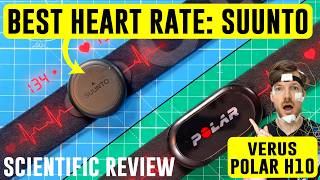

I Tested Suunto's New Heart Rate Belt
45sThe opening hook challenges the device's claims and sets up an objective test, which builds curiosity and trust.
▶ Play Clip"Title promises an objective test and delivers exactly that with rigorous methodology and clear results."
This video is an objective review of the Suunto Smart Heart Rate Belt 2 (HR-B2), an ECG chest strap. The reviewer, a postdoctoral scientist, tests its accuracy against the Polar H10 during various exercises, including cycling, running, and weightlifting. The video covers the belt's features, compatibility, and performance, concluding that it is highly accurate and comparable to the Polar H10.
Suunto launches the Smart Heart Rate Belt 2 alongside the Run 2 watch. The reviewer will test its accuracy objectively.
The reviewer is a postdoctoral scientist specializing in biological data analysis, adding credibility to the testing methodology.
The belt measures electrical activity of the heart, using an algorithm to identify R-peaks for heart rate and RR intervals.
Adds a 6-axis motion sensor, protected electrodes, improved strap, and support for three simultaneous Bluetooth connections.
Transmitter weighs 12.8g, uses a CR2032 battery with 210-460 hours of life, water-resistant to 30m, and can store data when out of range (with compatible Suunto watches).
Measures ground contact time, vertical oscillation, flight time, and left-right balance. Supports ZoneSense for threshold estimation.
Advanced features are limited to recent Suunto models. Running form is only on specific models. Can broadcast HR to other brands (Garmin, Polar, etc.) but not advanced features.
Compared against Polar H10 as reference, worn simultaneously during various exercises. The Suunto was placed slightly lower but this was validated with two H10s.
Correlation of 1.00, perfect agreement with Polar H10. No issues detected.
Correlation of 1.00, perfect agreement. One minor peak detection difference but likely a Polar H10 anomaly.
Correlation of 0.99, still excellent. Minor differences in low-to-mid heart rate ranges, likely algorithmic.
Correlation of 0.97, very good. Suunto detected slightly higher peaks, possibly due to heart rate definition differences.
HR-B2 outperformed 99% of devices in cycling, 97% in biking, 100% in running, and 83% in weightlifting. Some devices that did better had dropouts.
The HR-B2 is highly accurate and can be used interchangeably with the Polar H10. Recommended for all testing.
Recommended for Suunto watch owners for extra metrics. Price is similar to Polar H10 (€99). Both are interchangeable in performance.
The Suunto Smart Heart Rate Belt 2 delivers excellent accuracy across various exercises, matching the Polar H10's performance. It is a strong choice for Suunto ecosystem users and a viable alternative for others, though the Polar H10 remains a proven workhorse.
Rigorous Testing Methodology
Using a validated reference (Polar H10) and simultaneous wearing ensures reliable comparison.
03:23Outperformance Stats
Quantitative comparison shows HR-B2 beats 99% of devices in cycling, 100% in running.
08:21Interchangeable with Polar H10
The reviewer can use it interchangeably, indicating high trust in accuracy.
09:16Ecosystem Advantage
Suunto watch owners get extra metrics for free, making it a better choice than Polar H10.
09:40[00:00] Alongside its new Run 2 watch, Suunto is also launching a new ECG chest strap called the Suunto Smart Heart Rate Belt 2. Now, Suunto claims it provides highly accurate heart rate and RR interval measurements, but
[00:14] I'm not here to promote this device. Instead, I tested it objectively during many different types of exercise to see how reliable it actually is. Now, for those of you who are new to the channel, my name is Rob and I'm a postdoctoral scientist
[00:27] specializing in biological data analysis. Now, since Suunto Smart Heart Rate Belt 2 is quite long and also hard to pronounce for me,
[00:40] I will call it the Suunto HR-B2 in this review. Now, the Suunto HR-B2 measures the electrical activity of the heart and uses an algorithm to identify the R-peaks in the ECG signal.
[00:52] These are used to calculate heart rate and intervals between the individual heartbeats. Now, compared to the original Suunto belt, it also adds a 6-axis motion sensor for running for measurements, protected electrodes intended to provide a cleaner signal, and also an improved
[01:08] strap and support for three simultaneous Bluetooth connections. Now, the transmitter right here just clicks right off, and it's rather small. You can see it right here, and it weighs just 12.8 grams, and it automatically activates
[01:25] when you put it on and a physical button is still on there and for instance it lets you authorize new bluetooth devices now it uses one of those replaceable small button batteries so that's a cr2032 with a clean battery life between 210 and 460 hours depending on the enabled features and
[01:45] the number of devices you connect to it at the same time it is water resistant up to 30 meters and can be used for swimming although of course bluetooth does not transmit well through water and fault water may also interfere with the measurements,
[01:57] but its memory can store heartbeat data when the watch is out of range, but that particular function only works with compatible Suunto watches. The new running form features measure ground contact time, vertical oscillations, flight time,
[02:11] the ratio between ground contact and flight time, and the left-to-right ground contact balance, so if you're moving more on the left side or the right side. The belt also supports Suunto's ZoneSense feature,
[02:23] which uses RR interval data to estimate training intensity, anaerobic and anaerobic thresholds. However, these advanced features are not universally compatible. Heart rate, RR intervals, memory and zone sense are supported by recent models from Suunto,
[02:39] including the Suunto 9P Pro, Vertical, Vertical 2, Race Series, Run, Run 2 and Ocean. Now running form is limited to the vertical 2 race race 2 race S run and run 2 and on some watches it actually requires custom sports modes or Suunto Plus
[02:58] Now the belt can be connected to other compatible Bluetooth devices from for instance Garmin, Polar, Coros and Apple, although not every model has been tested. So in general it should be able to broadcast the heart rate data, but again not those Suunto
[03:11] specific features like memory, running form and zone sense. All their Suunto watches are also largely incompatible, even if some of them appear to pair with the belt. But okay, those are the specs of this device.
[03:23] But if we want to use it, we want it to be accurate. Now, to test its accuracy, I compared the Suunto HR-V2 against the Polar H10 ECG chest strap. Now, I use the Polar H10 as a reference because it's been extensively tested.
[03:38] And its ECG signals and heart rate estimates have been manually inspected for their scientific accuracy. check out this video if you want to know more about that study. Now, I wore the Polar H10 in its normal position, and I placed the Suunto directly below it.
[03:53] This does mean that the Suunto is in a slightly less ideal position, but I previously tested that with two Polar H10 chest straps in the same configuration, and there weren't any issues, so it should be fine.
[04:06] I then used both straps during many different types of exercise at the same time, and compared their heart rate values directly to determine whether the Cintu HR-B2 is as reliable as the Polar H10.
[04:18] So let's actually take a look at the results right here. And let's start with one of the easiest exercises for watches to track, which is indoor cycling. But now we're not comparing the Polar H10 here along the horizontal axis to a watch.
[04:31] But instead, of course, we're comparing it to the Cintu Smart HR belt here along the vertical axis. Now you will see this smart HR belt name here, that's just a name I put in for my algorithm, but this is the HRB2 as I called it before.
[04:45] And if the two would perfectly agree, all measurements should be on or close to the blue line, and this is as perfect as it gets. The correlation has a rounded value of 1.00, but you can see there's basically no deviation between the two,
[05:00] except a little bit in the lower range, but this is just an algorithm difference most likely. So we can see that if you look at some of the example sessions, so the Suntu is here in red and the reference in blue-green and they basically overlap perfectly for basically
[05:14] all of my spinning sessions. So here I have nothing to complain about, it's doing its job and that's what we should expect from the ECG chest strap. But what about running? Well this also looks basically perfect, we again have a correlation of 1.00 and all points
[05:30] are on or close to the blue line. And if we take a look at some of the example sessions, we see basically for all these, that has perfect agreement. Maybe one moment right here where the PolarH10 detected a peak that seemed to didn but this might as well be the Polar H10 being something weird Overall it basically perfect agreement But what about
[05:51] something harder, where there's a lot of bumpiness, a lot of movement also on the chest area, and that's biking outside? Well, this still looks really good. The correlation is a tiny bit lower now at 0.99 instead of 1.00, but basically perfect still. And we see in the higher heart rate range,
[06:07] there's perfect agreement, only in the medium to low heart rate range are there tiny differences. So let's actually take a look at some examples, but again, the reference in blue-green and the Su2 HRV2 in red, and this is basically perfect agreement, and we see some variation here in the
[06:25] lower heart rate ranges, and I expect these are algorithmic differences where you have to make a decision, how detailed do I make those changes in heart rate, and it actually appears that Su2 potentially retains a bit more of the details also here this session perfect agreement and we can go
[06:41] through all sessions and we basically have perfect agreement only the dips are usually a bit stronger detected by the polarity and sometimes some peaks again this could be algorithmic because it's always these peaks that are not fully detected and here we can actually see that the signal was lost
[06:57] by soon to for a bit i don't know why that was but you can see it based on these straight lines right here otherwise basically perfect agreement I would say with only these dips being slightly different
[07:09] so that still looks very good so basically as good as it gets and again I would hope this for an ECG chest rep to close off let's take a look at the hardest exercise weight lifting that's harder because normally there's a lot of tension on your wrist but it's harder now because we're looking in
[07:25] a more narrow range of heart rate so we're bound to get lower R values and indeed it's now 0.97 but that's still very good and interestingly here again the soon to detect slightly higher heart
[07:38] rate so a little bit more detail i would say at the peaks and also we see some of the dips are a little bit different and this might partially be due to how heart rate is defined so do you take the average of the last second two seconds like how do you define current heart rate that's not
[07:55] trivial so you can use different things there so honestly i then also would have expected both dips and peaks to be higher in soon to so interesting here only the peaks are bigger and some of the dips are not fully there we also see that here with slightly higher peaks of soon
[08:09] to and not the exact same dips but basically the same values again we can compare this to the competition but the competition are watches here but here you can see how much better it is to use
[08:21] a chest strap than a watch so regular viewers will notice but here we have all the exercises that we we looked at for indoor cycling outdoor cycling also running and weightlifting here on the very end and then I talked to the guys were looking at with a red dot and red line and they higher that value the better So this is that R value or correlation from before So I show the correlation and what percentage of devices I previously tested did worse
[08:47] So in this case, 99% of devices did worse for indoor cycling. 97% of devices did worse for biking. 100% of devices did worse for running. And 83% of devices did worse for weightlifting.
[09:02] This is interesting that there were still a few devices that struggled less, but these often then had dropouts. These will also include some Apple Watches, for instance, that stop measuring a heart rate when it cannot get a reliable signal, and this isn't the case for the Suunto HR-B2.
[09:16] So overall, the accuracy of the Suunto HR-B2 is just very good, at least for my testing. I can use it interchangeably with my Polaroid H10, and all my testing of smartwatches will remain the same.
[09:28] So I can really recommend it. It can also connect to the same number of devices as the Polar H10, so three, but the Polar H10 also has Ant+, which I don't believe that the Suunto HR-B2 has, but I'm not too sure.
[09:40] I don't have all the specifications overall, though. I can definitely recommend it. And if you want those extra metrics that I mentioned, so those specific to Suunto, and you already own a Suunto watch or you want to own a Suunto watch, like the Run 2, then, of course, the Suunto HR-B2 is a much better choice than the Polar H10.
[09:58] because then those extra metrics are available to you for free. Now, the price tag of the new Cintu Cashwrap is about the same as the Polar H10. So the Cintu HW2 sells for 99 euros or dollars, which is the normal price for these kind of things.
[10:12] You can find the Polar H10 usually for cheaper because that's been on sale for so long. But I think this was also the recommended price back in the day. Overall, though, I think in terms of performance, they're more or less interchangeable,
[10:24] and I can really recommend both of them. it just depends on your use cases. I think the Polar H10 is sort of the workhorse, the one that everybody knows and we will know will work for a long time, whereas this is still a bit of the new kid on the block. But in my testing, I see no issues with it
[10:40] at all. If you want to support, don't forget to like this video and subscribe to the channel if you haven't already. And if you do end up getting yourself a C2HRB2, maybe a Polar H10, another
[10:52] device like your Suunto Run 2, a Garmin device, or you want a Wolf strap, an Amazfit Helio strap, or anything at all on Amazon for that matter, even something as small as toilet paper or coffee beans, I have both a general Amazon affiliate link and specific affiliate
[11:07] links down below, and some of those give you the best discount possible, so you'll also be supporting your wallet at the same time. Now, given that you watched this video on the Suunto Smart Heart Rate Belt 2, I think
[11:19] you will like this video on the soon to run to the police at the same time and advice I can really recommend even without having a chest strap and also this video on my favorite sleep improvement device the H3 pod
⚡ Saved you 0h 11m reading this? Transcribe any YouTube video for free — no signup needed.