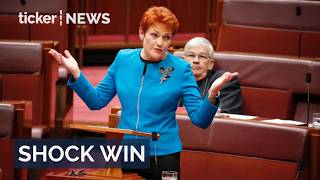

One Nation's Shocking Victory in Liberal Stronghold
43sThe unexpected win in a seat held since 1949 sparks debate about the Liberal Party's future and rising populism.
▶ Play Clip"Title accurately reflects the transcript's focus on One Nation's win and its political implications."
Chris Berg analyzes the shock victory of One Nation in the Farrer by-election, a seat held by the Coalition since 1949. He discusses the implications for the Liberal Party, the broader political landscape, and the economic factors driving populist movements.
One Nation's win in the Farrer by-election was a significant shock, especially given the seat's long history as a Coalition stronghold.
Susan Ley, the outgoing Liberal MP, criticized the new leadership team for failing to deliver promised change, leading to the loss of the seat.
The justification for rolling Susan Ley was to hold back One Nation, but the by-election result shows that Angus Taylor's leadership has not achieved this.
The Coalition is struggling to define its position on the political spectrum, with One Nation capturing the center-right vote.
To win elections, the Liberal Party must seriously reconsider its purpose, philosophy, and geographical positioning.
Unlike the Liberals, Labor has found an electoral equilibrium by bridging the working class and the intellectual middle class.
Populist movements are thriving because the economy is not performing well, leading to voter dissatisfaction.
Berg attributes economic stagnation to the anti-development movement from the 1970s, which slowed growth and development.
Immigration is controversial mainly because of the lack of expected economic growth, not as a standalone problem.
Entrepreneurs and business creators are most dissatisfied with the status quo, feeling abandoned by the Labor Party.
The Liberal Party faces an existential crisis as it loses ground to One Nation on the right, while Labor has adapted to changing demographics. Economic stagnation and anti-development policies are key drivers of populist discontent.
[00:04] One Nation winning a lower house seat over the weekend. So, let's break down results in Farrer and the by-election, how it intersects with the federal budget, impacting the Liberal Party as well. Let's bring in Chris Berg from
[00:17] Berg, great to see you. Talk to us about the outcomes you've seen from the One Well, of course, this is a really significant shock, probably to the political class. We've been seeing the One Nation um polls increase over the
[00:32] last 18 months, and uh that's been the subject of much discussion. I think the shock in the Farrer by-election is just how substantial a victory that One how substantial a victory that One Nation won, and in such a central or
[00:47] Nation won, and in such a central or such a long-standing coalition-held seat. The coalition, whether it's the Liberal Party or the National Party, has Liberal Party or the National Party, has held Farrer since its formation in 1949.
[00:59] Now, the fact that that has been handed off to One Nation, and in such a dramatic fashion, has a lot of people in the Liberal Party and the coalition more generally worried about what this means for national politics.
[01:11] The outgoing MP, uh Susan Ley, who of course was the Liberal leader up until three or four months ago, she put out a statement yesterday, uh which was quite essentially saying that the new leadership team had promised change, and
[01:26] here we are, and we've lost this seat after having held it for for decades, as you mentioned. What do you think the significance is for the party here, and do you believe Angus Taylor and Jane Hume, who spent much of Sunday telling
[01:39] that change is coming? Well, I I think that's exactly right, feels, well, pretty aggrieved about this, because the justification for rolling Susan Ley, or at least one of the main justifications, was we need to
[01:54] hold back One Nation. Susan Ley is unable to hold back One Nation. Only someone like Angus Taylor, who comes from the right of the party, would be able to do so. Now, this shows that well, maybe there's a
[02:07] grand plan coming, but as yet, that grand plan hasn't been enacted or implemented, and that the idea that Angus Taylor or anybody else in the Liberal Party really knows how to hold back One Nation seems to be quite false.
[02:23] I don't think it was ever very likely to be true. I think there are people in the party that are happier that Angus Taylor is the leader for lots of different reasons about interfractional warfare, but ultimately, what's happening on the
[02:36] center right is much larger than any particular leader, and probably much larger than any particular policy stance on something like immigration or economics. It really goes to the heart of where the coalition is positioned on
[02:50] the political spectrum itself. What sort of party or what sort of coalition is it? Is it Should it be a coalition at all? Should both parties be trying to carve out unique and distinctive identities? And One Nation is taking
[03:05] center right. As it currently stands, after what you believe it's possible for the Liberal Party, and in coalition or not in coalition, to win an election ever again
[03:19] in both Australia and also in places like Victoria, where there is a state election coming up? It can absolutely win elections again, but it can't win elections without making really serious reconsideration of
[03:32] its purpose as a party, what its philosophy is, what its position is relative to geographical questions. Is it a rural party? Is it an outer suburban party? Is it an inner suburban party? And right now, it seems to have
[03:47] made the decision that it's going to be not just all of those, but it's going to be the sort of worst version of every other
[03:59] going to be not as compelling as the Labour Party on the and the teals in the inner suburbs. It's not as compelling as the Labour Party in the outer suburbs and it's not as compelling as One Nation or the Nationals
[04:11] by itself on the in in the rural seats. At the moment, it doesn't know where it stands and until it comes to terms with what it's what its position is on the political spectrum, it's not going to be successful.
[04:24] I feel like we've been talking about this and this has been said for such a long time that the Liberal Party struggles to know what it is, but the Labour Party also faces struggles where on the one hand it represents
[04:36] blue-collar workers, many of them miners. On the other hand, it has to deal with the progressives in the inner cities who don't want any mining and want net zero. Yet, it has found a way to be popular in a way that Keir
[04:49] Starmer in the UK is not. That's very true and I think the Labour Party has actually sort of come to a conclusion about where it stands. It is less about the working class than it was at its original founding and it is more
[05:05] trying to bridge the the emerging intellectual middle class and and and so forth and it seems to have at least from an electoral perspective come to an equilibrium on on those questions. In the United Kingdom, United Kingdom is
[05:22] has very different political dynamics that allows for a lot more diversity and a lot more instability in many ways than the Australian political system, but
[05:34] in the UK, in part because the UK economy is doing so poorly, the Labour government is understandably struggling with that. And I think that really speaks to the
[05:47] And I think that really speaks to the underlying issue here that we have is an uncertainty about what the economic policy of the Australian and in fact the globe is going to be this far after the global financial crisis. If the economy
[06:02] was doing well, these populist movements would not be doing so well, but the economy isn't doing as well as people would like. Um, people are not satisfied with the economic performance of the country and we are seeing these
[06:15] political outcomes as a consequence. It's been really interesting to watch the local council elections over the weekend in the UK and the Farage by-election and the vox pops from all of the journalists who've been swamping
[06:27] these electorates trying to find out what the punters think and they could about immigration, they're worried about a stagnant economy, they're worried about small businesses closing down. Where do you think the key problem is
[06:42] for this? Is it migration? Is it the welfare state? Does it go back to the Labour Party policy in the UK of 1945 which brought together the report of the idea of creating a social welfare state that the problem with that is to pay for
[06:57] it you have to keep bringing immigration which then keeps adding either debt or more problems and everyone's worse off. Is that what's happened here? history, I would have blamed a period of history, I probably wouldn't blame the
[07:10] start of the welfare state. What I would blame is the anti-development movement that turned up in the 1970s. This was the idea that we needed to regulate the hell out of the economy. We needed to stop growth and development. We needed
[07:24] to slow down the building of houses. We needed to slow down the building of to slow down the development of building factories and mines and major projects, the sorts of things that bring economic
[07:38] the sorts of things that bring economic growth to the economy. I I across a huge range of public policy areas from the the incredibly sensitive issue of housing all the way to economic growth and technological
[07:52] economic growth and technological change. So much of what's holding back our economy, the global economy is ideas from the 1970s about the the need to slow down growth, the need to to shrink the economy, the need to protect
[08:09] anything but jobs from from the world around it. And I I I think we're now seeing the downstream consequences of that. I I I think immigration is absolutely a an an issue and is understandably controversial, but I
[08:22] think immigration would be nowhere near the same issue if it wasn't for the fact that we're not getting the economic growth that we have come to expect. It's interesting a lot of people are now saying that the Labor Party is for those
[08:36] who hold a union membership and One Nation is now for those who hold an ABN. I I don't think it's quite as simple as that. I don't think the Labor Party is the party for those who hold the union
[08:50] membership. Union membership has been in a rapid and steady decline over the last couple of decades. In fact, there's a very small fraction of the population a union are more likely to be concentrated in the public rather than
[09:04] the private sector. So, the idea that the Labor Party is based on the old blue collar working class voter population, I don't think really holds true. And the Labor Party has been coming to terms with that. It's been
[09:19] realizing that it's its supporter base is moving more towards the public sector, moving more towards the educated middle class, the university educated um population. That's that's where the
[09:32] Labor Party base is now, but it's absolutely the case that that that the Labour Party doesn't have a firm grip on the entrepreneurial side of the economy and it's those entrepreneurs, those people who actually
[09:47] create businesses, those people who create value and create jobs for the rest of the economy that are most dissatisfied, I think, by the status of the status quo. more as about creating tax revenue, it
[10:03] leave it there. We'll talk to you again soon. Thanks so much for your time. soon. Thanks so much for your time. Thank you.
⚡ Saved you 0h 10m reading this? Transcribe any YouTube video for free — no signup needed.