
Bird Dialects: Why Southern Cardinals Sound Different
60sThe surprising fact that birds have regional accents, with a personal story, sparks curiosity and relatability.
▶ Play Clip"Delivers exactly what the title promises: a professional birder answering a wide range of birding questions with expertise and charm."
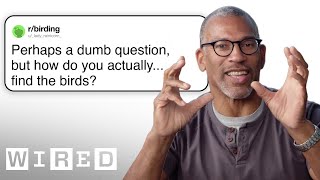
Christian Cooper, a professional birder and author, answers a variety of birding questions from the internet, covering topics such as bird dialects, finding birds, mating displays, bird identification, and conservation. He provides practical tips and insights based on his extensive experience.
Birds have regional dialects, especially in their songs. Apps with bird songs often include multiple examples from different regions to help match the accent you hear.
To find birds, achieve a zen state, silence your inner monologue, and use both eyes and ears. Look for sharp sudden motions in foliage and listen for sounds that draw your attention.
Find the bird with your naked eye, keep your eye on it, and bring binoculars to your eyes. Practice with stationary objects like signs or chimneys.
Birds perform elaborate mating dances to show off fitness. An example is the white-bearded manakin's 'lek' behavior, where males gather and perform popping displays to attract females.
Female birds are often cryptically colored to blend in while incubating eggs, while males are brightly colored to show fitness. This difference is called sexual dimorphism.
Birds know where they are going using instinct, landmarks, and possibly quantum entanglement in their eyes to sense magnetic poles.
Birding can be a solitary activity for deep personal connection with nature, or a communal activity with friends, sharing the awe of unexpected sightings.
Pigeons have remarkable visual processing, can sort artworks by school, and are important ambassadors to nature in urban areas.
Warblers are like butterflies with personality, small, active, and colorful. In the east, there are about 35 species, and their arrival times create a 'pageant'.
To identify an unknown bird sound, track down the bird and see it making the sound. Associate the song with the experience of finding it, which helps memory.
Carry optics (binoculars or camera), a field guide (often on phone), and record sightings on eBird. Also bring a hat, snacks, and water.
Hummingbirds are aggressive due to high metabolism. Placing feeders out of line of sight can reduce fighting.
Plant native plants that host insects, crucial for breeding birds. Organizations like Homegrown National Park promote this.
It's okay to put a baby bird back in its nest, but often parents are nearby and will care for it. Leave it alone if possible.
Hearing a bird but never seeing it is frustrating. Example: gray-breasted wood wren in Costa Rica.
Feeders are great for starting birding and for homebound people. But be careful about mold and disease; stop feeding during outbreaks.
Hummingbirds can fly backwards and enter torpor. Owls have silent flight feathers. Birds have efficient respiratory systems inherited from dinosaurs.
Ravens have wedge-shaped tails, heavier beaks, and croak; crows have fan-shaped tails and caw. Ravens soar, crows don't.
Use binoculars for active birds like warblers; use a spotting scope for distant, stationary birds like shorebirds.
Nests are like cradles, not houses. Different birds have different nesting strategies: cavity nesters, twig nests, ground scrapes.
Playing bird calls can disrupt natural behavior and annoy other birders. Avoid it, especially in crowded areas.
Record date, time, weather, moon phase, and list of birds with counts. This helps track personal sightings and contributes to citizen science.
Aggregated observations from amateurs help spot population trends. eBird from Cornell Lab is free and valuable for science and planning trips.
Cities on migration routes like New York offer daily wonders. Even in quiet times, you can see raptors like red-tailed hawks and kestrels.
Look for field marks, colors, size, shape, and flight patterns. For example, goldfinches have a 'potato chip' flight call; swallows swoop, swifts have stiff wings.
Birds will use well-constructed birdhouses with ventilation, drainage, and proper hole size. Only cavity nesters use them.
Don't trespass, don't point binoculars at homes, stay on paths, avoid playback, and be welcoming to other birders.
Merlin from Cornell Lab is free, listens to sounds, and identifies birds with 95-98% accuracy.
Early morning is best because birds are hungry and active. The dawn chorus provides a 'table of contents' of birds.
Look online for local Audubon chapters or Bird Alliance groups.
Cooper flew to Ecuador during COVID to see a harpy eagle, ruining hiking boots in the process.
Keep cats indoors, support bird-safe glass, and enforce leash laws for dogs in protected areas.
Cuba for bee hummingbird, Madagascar for endemics, and Bhutan for pheasants.
Birding is a rewarding activity that connects you with nature, whether alone or with others. Use tools like Merlin and eBird, respect wildlife and other birders, and enjoy the journey of discovery.
What is the difference between a bird's song and a call?
A song is long and gives information like territory and mating; a call is short and sharp, like an alarm.
01:14
Why are female birds often cryptically colored?
Because they brood eggs and are immobile, so they need to blend in to avoid predators.
05:34
What is a lek?
An area where male birds gather to perform displays to attract females.
05:06
How do birds navigate?
They use instinct, landmarks, and possibly quantum entanglement in their eyes to sense magnetic poles.
06:45
What is the best way to identify an unknown bird sound?
Track down the bird and see it making the sound, associating the song with the experience.
09:39
What is eBird?
A free app from Cornell Lab of Ornithology for recording bird sightings and contributing to citizen science.
11:31
Why are hummingbirds aggressive?
Because of their high metabolism, which gives them constant 'road rage'.
12:42
What is torpor?
A state of suspended animation hummingbirds enter at night to save energy.
17:22
How can you tell a crow from a raven?
Ravens have wedge-shaped tails, heavier beaks, and croak; crows have fan-shaped tails and caw. Ravens soar, crows don't.
18:49
What is the best time of day for birding?
Early morning, because birds are hungry and active, and the dawn chorus provides a 'table of contents' of birds.
29:54
Lekking Manakins
Vivid description of a surprising mating display in Trinidad.
04:11Sexual Dimorphism Explained
Clear explanation of why male and female birds look different.
05:34Pigeons as Art Critics
Reveals surprising intelligence of pigeons, changing common perceptions.
07:59Hummingbird Torpor
Explains a fascinating survival mechanism.
17:09Cats Kill Billions of Birds
Highlights a major conservation issue with a striking statistic.
31:51[00:01] human im imitation. It's kind of like a That's a bad imitation. Pretend I never said that. No bird will understand that. They'll think, "What's wrong with you? That's a raven. I hope you heard that." Hi, I'm Christian Cooper. I'm a birder,
[00:16] editor, and author of Better Living Through Birding. I'm here to answer your questions from the internet. This is birding support. [music]
[00:31] regional accents?" Absolutely. They have their particular dialects depending on where they are. Many of the apps that you find that have bird songs on them give you several different examples from several different places so that you can
[00:46] compare and find one that's closer to maybe the accent you're hearing. I remember the first time I went birding down south in like the Carolinas and a cardinal was singing and I didn't recognize it because its dialect was
[00:59] completely different from the cardinals I was used to hearing in New York. Mostly you'll notice that difference in songs. Basically a bird saying, "Hi, I'm Bob. I'm a yellow warbler and I'm the best looking yellow warbler ever. This
[01:14] is my territory. If you're a female, come check me out, baby. And if you're It's long. Gives you a lot of information. The call is typically short and sharp. It's like, hey, or hey, hey,
[01:27] danger. Danger. You will notice the accents in songs. Calls are too short. Next is from Lady Rainicorn. Perhaps a dumb question. Lady Rainicorn. There are no dumb questions. But how do you actually find the birds? What you want
[01:41] to do first of all is you've got to achieve a sort of zen state. And what do through all the different things that you're thinking about in the morning or whenever those have to get silenced. You're no longer paying attention to
[01:55] your inner monologue. You're totally engaged with the outdoors and what because you're using both your eyes and your ears. You're looking for any sort of sharp sudden motion in the greenery which is separate from like a leaf being
[02:09] tell the difference with a little practice. So you're looking for that through the foliage. Also, you're looking for shapes because there are some birds like owls who during the daytime are not going to move. So you're
[02:23] And then the other thing you want to be listening for sounds that draw your attention in a certain direction. And the great thing about using sound is it's multidirectional. Your eyes can only look in one direction at any given
[02:36] time, but your ears are scanning all around. So you'll hear something here here. Oh, there's a bird up here. That helps you find the birds. Let's go see if we can spot this Buick's ren. And if we can't, maybe we can see something
[02:49] we can't, maybe we can see something else. little high-pitched chirp and that got my attention. And then when I heard that, I started scanning in the general location of where the sound came from
[03:03] location of where the sound came from and I saw quick little darting motions through the foliage. And so that was my target. You find the bird with your target. You find the bird with your naked eye. You keep your eye on the bird
[03:15] and you bring your binoculars to your eyes. If you do this, see the bird. Practice with a stationary object like a sign or like that chimney there. I got the chimney with my naked eye and now I'm bring the binoculars to
[03:30] my eyes. Now, what I saw when I got this bird in the binoculars was a thin pointed bill, a small bird smaller than a sparrow, and basically drab grayish green all over, maybe with a couple of more yellowish areas on the underside.
[03:45] more yellowish areas on the underside. And maybe the hint of a of a line through the eye. And all of that, particularly the fact that I'm here in the west, tells me that that was an orangecrowned warbler. What we often do
[03:57] to help people find the bird we're talking about is we treat the tree like a clock. And so I'll say there's an orange crown warbler at 9:00 at the very edge of the tree. It's largely intuitive, largely common sense, and
[04:11] it's just a lot of fun, especially when you make all these sort of discoveries you make all these sort of discoveries on your own. At KTRH YH asks, "Birds on your own. At KTRH YH asks, "Birds live in a musical actually cuz WTF is a
[04:24] mating dance." I think that is a great way of looking at it. What is it? It's a way of looking at it. What is it? It's a way to show off that you are super hot and all that. One of the best ones I saw came on me totally by surprise. I was in
[04:37] Trinidad and I was walking through a forest and I came to a little clearing little bird. Basically, it looked like someone had took a penguin and shrunk it down. It was a white bearded mannequin and all of a sudden it popped like
[04:50] here to there and I didn't even see it. It just went pop. Pop. And then I bearded mannequins and they were all doing it. Pop. Teleporting little penguins. Pop. I just stood there stunned. I had
[05:06] stumbled on to what they call a le l e k. And a le is an area where males go as a group to show off to try to get a female to say, "Yeah, that that guy's
[05:18] pretty amazing what these birds will do to get a mate. Lord Phoenix81 asks, "Why are male birds mammals so beautiful and majestic? They do all kinds of display of art to attract females while the females are just plain color." All
[05:34] right, I'm going in. There's a thing that the female bird typically does that the male bird does not. They brood the eggs. So, the female has to sit on the
[05:47] nest and incubate the eggs with the warmth of her body. And when she's doing that, she is basically immobile. She is completely vulnerable to potential completely vulnerable to potential predators. So, female birds typically
[06:01] are what we call cryptically colored. They're colored in plain drab ways to help them blend in so they're not as vulnerable to predation. The male birds, on the other hand, typically do not have that problem because a lot of male birds
[06:15] don't brood the eggs. So they can be all kinds of bright festive colors which show their fitness. And so that's a way for the female to judge the fitness of the male. So that's why you get in birds
[06:28] that what we call sexual dimmorphism, a difference in the form of the bird based on the sex of the bird. Catal C asks, "Do birds know exactly where they're going or are they just winging it?" They know. They have a certain instinctual
[06:45] knowledge of where to go, but then they also have all these different ways of is the quantum entanglement in their eyes that lets them see the magnetic poles, navigating by landmarks like mountain chains or coastlines. They can
[06:59] north from south. So, they have a lot of ways of telling where they're going. Willing today 1059. Do you bird alone or with others? You know, the answer is birding is that if you're a solitary kind of person, it is the perfect
[07:15] solitary activity. You just walk around and you get to experience the solitude and commune with nature on a very deep personal solo level. One of my favorite personal solo level. One of my favorite things is when I stumble on a bird, when
[07:30] nature is revealing a little bit of herself just to me in that moment, and it's it's glorious. And then there's the communal aspect. um you know the the camaraderie, the birding with friends, that joined experience of seeing a bird
[07:45] together that you were not expecting and you're high-fiving and you're just in a communal state of awe. So, you get a little bit of both, but it's really it is completely up to you and what your temperament uh allows. Penguin Sex Party
[07:59] asks, "What's your guys opinion about pigeons?" I used to be like, "Oh my god, birds?" And then I found out a little bit more. Their visual processing abilities are so great that they've done tests where the pigeons have been able
[08:15] tests where the pigeons have been able to sort human artworks by school of art like Impressionist versus another school of art. So many amazing things about pigeons including their ability to home in on heading back to a certain place.
[08:28] And most important of all, pigeons are in all our major cities. And so they are the bird ambassador to so many people who are just stuck in urban areas and maybe don't get to go out into a beautiful green setting like this. They
[08:43] are the window into the natural world, into the wild world. So I have nothing more and more about them, and so should you. Cameron M. Archer asks, "Birding is because warblers." Well, that's not a
[08:58] question, but it is the correct answer. Warblers are like butterflies with personality. They're small, they're very active, and they come in an incredible range of colors and patterns. And so, in the east, where you have about 35
[09:10] different kinds, it's like a pageant cuz they all come at different times of the calculate when each group is going to arrive. And then there's a moment when and the late ones. And you can have like a 25 warbler day and you are in heaven
[09:26] because you're just seeing so many gorgeous, beautiful birds. So yeah, it's all about the warblers. Jello Cakewalk. When I hear a bird sound I have never heard before, what steps do I take to identify it? This is a great question
[09:39] because this is how I learned my bird songs. If you try to learn it by, you know, playing recordings, it's like northern mockingb bird, eastern bluebird, and it all becomes just a big mish mash.
[09:54] Whenever I hear a bird I don't recognize, I take the time to track down the bird and put my eyes on it. I have to see the bird with its mouth opening
[10:06] and its throat vibrating and its tail bobbing as it makes the sound because the bird that's making the sound when really it's actually another bird in the bush. You've spent 20 minutes crawling through the shrubs trying to see this
[10:21] darn bird that has been making this darn sound that has you frantic with curiosity, hearing the song over and over and over again. And then you over and over again. And then you associate the song with that experience
[10:36] of crawling through the shrubs in the Hudson Valley on a Sunday with the sun beating down on you and getting your knees muddy. And the next time you hear back to that moment and you're going to be, "Oh, that's a northern mockingb bird
[10:50] singing cuz you've made the association." So, this question is from association." So, this question is from AJ Holmes. # Ask a Blackbird. What do you all carry in your birding pack when you go out birding? We don't all carry
[11:03] the same things, but of course, we're going to bring our optics. In my case, that's a pair of binoculars. Um, other people will bring cameras. Some will bring a field guide. And what a field guide does is it's a kind of a
[11:17] compendium of all the different birds you might find in a particular area. Most of us these days carry a field guide on our phone electronically. Um similarly, we don't typically carry journals these days. What we do do is we
[11:31] um record our sightings electronically on Cornell Labs EIRD and uh that lets all that data get aggregated both for you to look at later and for Cornell Labs to crunch so they find out more about the birds. Couple other things are
[11:46] going to be a hat for either sun protection or to keep the rain off my head and snacks and water. I do not bird hungry because birding hungry is no fun. So, how long I bird on any given outing really depends on where I am and the
[12:02] you can be out there and you're not seeing that much, in which case you other times when you're just having the time of your life, in which case I'm going to be out there for hours. I've spent up to six hours at a stretch
[12:15] birding Central Park alone. So, it really depends on on the day and the birds. This question is from Ms. Bonnie0414. Will buying more hummingbird feeders keep those little exploitative deleteds
[12:28] from fighting? Maybe. Hummingbirds are notoriously canankerous. They are aggressive and they are in often a constant state of war as they fight for territory and for food sources. I always think that
[12:42] up because of their high metabolism and it gives them constant road rage. So, will putting up more hummingbird feeders have them not fight as much? It'll probably help. It'll especially help if you put those feeders up sort of spaced
[12:57] this feeder and another bird can come to that feeder and they're not necessarily in line of sight of each other. Bleached Tattoo asks, "How do I attract more birds to my garden?" There are all kinds of native plants for your area that you
[13:13] can plant in your garden that will bring the birds. nectar for hummingbirds, the natural seeds it produces for other kinds of birds, seed eating birds, but also a lot of these plants host insects. And those insect hosts are crucial to
[13:27] birds, particularly during the breeding season when they need good protein to feed their young. So far better than just relying on feeders, is to actually grow the plants that these birds evolved with over millions of years to eat. In
[13:42] fact, there's an organization called Homegrown National Park creating a whole network of people who are growing native plants to help support the birds and other wildlife. I do it myself on my rooftop in Manhattan. I got a bunch of
[13:54] pots up there and I grow plants that are native to the region to attract the birds and the bugs. Drake4 asks, "Is it okay to put a baby bird back in its nest?" Yes, but you could also just leave it where it is and let
[14:10] nature run its course because very often the parents are not far away and they are keeping an eye on the baby bird and they will coax it to where it needs to be. And also all birds reach that point where they're fledging where they are
[14:25] and they're going to fall and they're going to be awkward and they're not take them a little bit. If it were me, I would probably just leave it where it is. So, from Jadem, we have the question, a question for
[14:39] #birders. What's a bird you've heard plenty of times but never seen? This is the most frustrating thing for us burers is when we've heard it many times but
[14:51] never seen it. The one I always go back to is the gray breasted wood ren in Costa Rica. I was in a place called Monte Verde and I heard this bird over and over and over again. never saw the bird. Very frustrating, but hopefully
[15:07] eventually with enough patience and work, you'll get to actually see whatever the bird is. Next question is from budget sun6186. from budget sun6186. Bird feeder. Yay or nay? My answer, yay.
[15:21] Bird feeder. Yay or nay? My answer, yay. And I say that because I started birding because I put up a bird feeder in the backyard. So, I think it is a great way to get an introduction to birding. It is a great way for people who are
[15:33] a great way for people who are homebound, for elderly people um to have the birds come to them. I put up hummingbird feeders all over the place and that's a great joy because those birds are are so unique and so special
[15:45] wonderful. I've actually had hummingbirds feed from a little feeder in the palm of my hand. And one time I was changing a hummingbird feeder and the male hummingbird came over and was like, "No, no, I'm not done yet." And
[15:59] there he is feeding it. And I had to dutifully hold it while he fed until he and change it. I think some people don't want the birds to associate humans with food. I don't think there's too much trouble from that because they associate
[16:15] the feeders with food, not necessarily the person. Also, you have to be careful out. You don't want to let seed sit there for too long and then it gets moldy and and then you're just spreading disease. And if there is an outbreak of
[16:29] disease in your area, then you definitely want to stop feeding for a while because feeders can artificially congregate birds in one spot where they normally wouldn't be and then they can spread disease amongst each other. So,
[16:42] um, you know, feed with care. This bird feeder is great. You'll be able to see close. And you know, whatever kind of feed you put in is going to alter what kind of birds come to your feeder. Um, cardinals love sunflower seeds. American
[16:56] goldfinches love thistle seeds. You put in peanuts and a lot of birds love the peanuts. You know, the woodpeckers, the blue jays, cracked corn for blackbirds. Gorilla in the ring. What are some cool unique abilities certain birds have?
[17:09] Hummingbirds. The only birds that can fly backwards. that incredibly fast metabolism that lets them beat their wings like 60 beats per second or more. They'd starve to death if that metabolism stayed at this that same rate
[17:22] overnight. So every night their heartbeat goes down to almost nothing. Their body temperature goes down to almost nothing. They literally enter a form of suspended animation called torper. And then the next morning they
[17:35] have to jumpstart their entire life system back into life. Owls have special feathers on the leading edge of their wing, which breaks up the air, which allows them to fly silently. A great grey owl hunts by sound in the
[17:52] winter, listening for the sounds of rodents under the snow pack. And by that sound alone, they punch down through the snow and grab the rodent with their talons. I mean, just wild, crazy stuff. When we breathe, [sighs]
[18:08] breathing in the fresh air and some of it mingles in our lungs. That's not particularly efficient. Birds have a much more efficient uh respiratory system so that that air doesn't mingle. So the fresh air stays fresh and they
[18:20] get a lot more bang for the buck from their breathing. They need that because of their high energy activity of flying. But the thing is that system goes all the way back to the dinosaurs. And in fact birds are dinosaurs, living
[18:36] survived the extinction. And that's probably the coolest thing about them of probably the coolest thing about them of all. Jmax 1087 asks, "How can you tell if a bird is a crow or a raven?" If you have them side by side, it's easy cuz a
[18:49] raven is huge bird. But if you don't have them side by side, it's hard to judge size. So, how can you tell? For one thing, a raven will have a wedge-shaped tail where a crow has kind of a fan-shaped tail. Raven has a big
[19:01] of a fan-shaped tail. Raven has a big schnoz, like this really heavy beak, whereas the crow's beak is going to be a lot thinner. But probably the best way to tell is by the voice. A crow will make those classic crow sounds. Short or
[19:14] long cause or raven doesn't make those sounds. Typical raven sound is a croak. Like a crow raven sound is a croak. Like a crow maybe with a sore throat. Kind of like a
[19:27] That's a bad imitation. Pretend I never said that. No bird will understand that. They'll think, "What's wrong with you? That's a raven. I hope you heard that. That's a raven. I hope you heard that. Maybe he was fooled.
[19:44] Now he's like, "No, you're just stupid." The other way to tell, ravens will soar, The other way to tell, ravens will soar, crows will not. So if you see a big crows will not. So if you see a big blackbird making lazy circles in the sky
[19:58] for a long period of time, it's a raven. Crows at most will glide for a couple of seconds and then they're flapping again. Next question is from Ask Mato 1995. Spotting scope or binoculars? Depends. If you are going for warblers, warblers
[20:15] are very small, very active birds that are constantly flitting around in the foliage. You're going to want binoculars cuz you're not going to be able to get hold still long enough. On the other hand, if you're going for shore birds,
[20:28] very often they're at a great distance and they're usually often in a rather fixed position or only moving around sort of along the shoreline in a fixed scope a lot more easily. So, you know, it's a combination. Know what you're
[20:43] most likely to see and equip yourself accordingly. Our next question is from notorious Sasha. Can you tell what type of bird from its nest eggs? Some people of bird from its nest eggs? Some people can. I cannot. As far as the nests go,
[20:58] two things to know. First of all, a nest is not a house. A nest is the equivalent of a cradle or a crib for almost all birds. They use it for raising the the young and then they're done. That's it. They don't use it after that. The second
[21:13] thing to know is that different birds have different nesting strategies. There are birds that are cavity nesters. They nest in holes and trees and that's who cavity nesters are things like woodpeckers. Compare that to say a
[21:27] cardinal or a robin. A cardinal's nest, I think, is generally made out of twigs, whereas a robin's nest is made out of typically grass and mud. And then there are birds that nest just like on a scrape in the ground. And that would be
[21:39] some of your shore birds. And then morning doves are notoriously bad nest makers. They'll like throw a couple of twigs down on top of an air conditioner and then think that's a nest. And half the times their nests fail because the
[21:51] eggs are rolling off and that's that. And yet they're prolific beyond words. whole North American continent. Next question is from Square Music 1695. Is it true you can attract birds playing their calls on a speaker or phone? It is
[22:07] true and you don't want to do it because you're disrupting the bird's natural behavior. Usually what you're playing is the song of arrival and that's going to get the other bird agitated and come forward to try to confront this
[22:20] opponent. Another reason is courtesy to the other birders around you. If you're in a place that's birded with a lot of people and you start playing this call, thinking, "Oh, I just heard a ceruan warbler singing." And you got to
[22:32] warbler singing." And you got to sheepishly go, "Oh, sorry, that was me." etiquette in general. And then there's just the sounds we can make with our own mouths. That disturbs me less. You know, if you've got the skill to fake the bird
[22:46] voice. Yeah. Again, you don't want to do a blue moon, it's not the end of the world. Important advisor 545. H. What do you write in a birden journal? The date, the time, the weather. I'll even
[23:03] sometimes write the phase of the moon and then of course a list of what birds I've seen in the course of the walk and I'll put numbers to approximate how many of those birds I saw. And that's a great sort of snapshot of the day. If you go
[23:19] back you can see exactly how many of these did I see this year on this date as opposed to say a year later, five years later. One of the things that has really come to the four in studying birds is citizen science. The
[23:34] observations of just regular old amateur birders. If we can aggregate them and put them together and review them over time, we can spot trends in what's happening to the bird population. Good example, Christmas bird count in my
[23:48] example, Christmas bird count in my hometown of New York back in say 1920. It would show very different birds than a Christmas bird count in New York today. For example, you would not see cardinals. And now cardinals are a
[24:01] common bird all over New York City. By keeping lists, journals like this, you can keep track of that personally. And if you keep those lists on an app called EIRD, which is totally free. It's from the Cornell Lab of Ornithology. All that
[24:14] data from all these different people goes to the lab and they crunch the numbers to be able to tell you all kinds of things about bird populations over time in different areas. And that's tremendously helpful to science. That's
[24:27] also totally helpful on an individual level. Let's say I'm planning to take a trip to Salelo. I can look up EIRD reports for Salelo and I can see where people saw, what they saw, and how many. EIRD is fantastic. Vespacianis 26 asks
[24:44] to all you big city dwellers. That's me. How many different birds do you actually see in your everyday life? How many different kinds of birds you see really city [clears throat] you're in. If your big city happens to sit on a migration
[24:59] route like New York City does, your everyday life becomes a wonder during the migration times. It's like a tide washing in new stuff and it turns every morning into a treasure hunt. But even in the quiet times, there were more
[25:13] birds than you would think. I remember just on a regular average every old day, I was on top of my roof and I saw big old red tail talk sitting on the next roof over and I thought that's pretty cool. And then I heard this click
[25:28] because there was a pair of American kestrels, our smallest falcon, and they were doing basically tag team wrestling. One would swoop down and take a run at the red tail talk, which is like many times the size of the kestrel. And then
[25:43] the other one would take a turn and the poor red tail talks are like as they're taking turns. And then suddenly the kestrel stopped and I hear k and a paragrin falcon comes dive bombing in coming after the red tail
[25:58] we're not getting involved in this. We're sitting this one out. And it just turned into this raptor warfare on the streets above New York with everyone I'm like bring me the popcorn cuz this is a show I want to see. Javez
[26:15] asks how to ID birds when they are flying. You're looking for many of the same things as you're looking for when the bird is perched in that you're looking for field march where the colors are, the size and shape of the bird, the
[26:27] patterns, um any sounds it might make. For example, in flight, American goldfinches have a flight call that they make that kind of goes potato chip, potato chip, potato chip. Also, the way they fly can often help you identify
[26:41] what the bird is. Swallows and swifts, they're both aerial specialists catching bugs on the wing, but they have different ways of flying. Whereas swifts have a very stiff winged flight, so it's kind of like a bat. Swallows have a very
[26:54] swooping flight where they're pulling the wings in with every stroke. So all especially what family the bird is in. And then you can get some of the plumage details to find out exactly which bird you're looking at. Lateral Sus 420 asks,
[27:09] "Will birds actually use birdhouses made by people?" Yes. But here's the thing. Depending on what kind of birdhouse you make or put up, that's going to determine whether or not birds use it and what birds use it. So, take this
[27:23] birdhouse for example. This is actually a pretty well- constructed birdhouse. You'll notice it has ventilation at the top so that it doesn't turn into a sauna. It's got some drainage at the bottom so that any water that gets in
[27:35] can drain out. It's made so that you can open it up at the end of the season and clean the old nest out. It's got an overhang to help prevent any water from getting in. The size of the hole is going to determine what kind of bird is
[27:49] going to use the house. You want this hole to be only as big as necessary for the kind of bird that you want to use the nest box to go in and out because the bigger it gets, the more other things can get in. Whether that's other
[28:03] kinds of birds that you're not looking to have use the box or predators. Now, the thing you have to remember is not all birds nest in birdhouses. A lot of them will build nests on twigs and branches. The only kind that will use a
[28:16] birdhouse are cavity nesters. Busy base 2753. Lack of respect in birding and too many twitchers. There are etiquette rules to birding and we should all don't trespass on private property without getting permission. You don't
[28:31] point your binoculars in the direction of somebody's house or apartment. You do not go trampling off the path in a sensitive area and destroy the better look at the bird. Do not use playback where you play the song of a
[28:45] bird to try to bring it into you. and being respectful to the other burers around you and being welcoming to other burers around you regardless of who they are, what their background is. So, what is a Twitcher? A Twitcher is somebody
[28:58] who will drop everything because there's a rare bird and they have got to see it. We all twitch to greater or lesser extents. It's not a bad thing. It's it's extents. It's not a bad thing. It's it's um can be a little obsessive and if
[29:11] that's all you're about with your birding, it's probably not the best way birding, it's probably not the best way to be. Mitch 311343 asks, "Best birding app?" Without a doubt, Merlin. Merlin is an app put out
[29:24] by the Cornell Lab of Ornithology. It is free. You can hold up your phone and it will listen around you and then based on what it picks up, it will tell you exactly where birds are around you. It is not 100% accurate, but it gets better
[29:39] and better and better. It is, I would say, probably about 95 to 98% accurate. and it's changed the birding world. This question is from Quor. What time of day opinion, the earlier the better cuz the birds are just like us. They wake up and
[29:54] they're hungry. They want breakfast. Birds are warm-blooded animals like us, maintaining a certain body temperature. To do that, you need to burn calories. need to be eating. So, they are most active first thing in the morning.
[30:09] the day. A lot of birds will take a siesta around noon time. And there will be a second pulse of activity in the afternoon. I like to get there like right before dawn because sometimes there's uh something that we call the
[30:23] dawn chorus and we don't know why but for some reason a whole bunch of birds will start singing all at once right before or at dawn. And if I'm there to hear it, it's like getting a table of contents of what birds are in the park
[30:38] that morning. Then I go out and find them. Pious trickster 1089. Where can I find local bird watching groups and communities? You can always look online. The local groups pop up pretty quickly. The most obvious ones are typically the
[30:51] The most obvious ones are typically the local chapters of Audabon/Bird Alliance cuz a lot of the local Audabon chapters have changed their names now to Bird Alliance at Bird Motor asks birding question. What is the most effort you've
[31:05] put into seeing a species? Whether it be harsh conditions, distance, [music] harsh conditions, distance, [music] or any other things in the height of the COVID epidemic, I hopped on a plane when nobody was traveling to go anywhere
[31:19] solely because I had the opportunity to see finally a harpy eagle. And so I got on a plane to Ecuador. One ruined pair of hiking boots later, I was staring up at the nest of a harpy eagle with this big ass female sitting there looking
[31:35] glorious. Sup, Benedict. If you had the power, what laws would you make enforce to protect birds? That's too easy. Leash laws for unleashed dogs in protected That's all I'll say on that subject matter. In addition, keep your cats
[31:51] >> [sighs] >> Household cats are non-native predators. Our birds have not evolved to deal with them and they kill billions of birds in
[32:03] North America every year. So, please keep your cat indoors. Another big hazard to our birds is skyscrapers. Birds don't see the glass or if they do see the glass, they see a reflection of the green space around it and they smash
[32:17] into it, break their necks and die. There was a building in Chicago that was this massive bird killer in a single day killed something like 2,000 birds. Bird safe glass looks the same to our eye, but the birds can see it. And so it
[32:30] dramatically reduces the number of collisions. Bear beam bear. What birding locations are on your bucket list? Cuba cuz I want to see the bee hummingbird, the smallest bird in the world. Madagascar because they are chopping
[32:42] down those rainforests there and I want to see all the wildlife but particularly the unique birds there, the endemics before that's gone. And probably highest on my list is Bhutan, a Himalayan kingdom that for decades was closed off
[32:55] to the west and now it's open. I hear it's wonderful. The people are wonderful I know who have birded Bhutan and come back have just raved about what they've seen, particularly the feeasants. So, Bhutan, that's all the time we have for
[33:09] today. Hopefully, I've answered some of your questions, but more important is to develop new questions, more things you want to know because you've been out there and seeing and hearing things like this Buick Ren that is singing over my
[33:22] shoulder. Just go out, you know, grab a pair of binoculars. If you don't have binoculars, use your own two eyes and see what you can see, hear what you can hear. Use your Merlin app. Use whatever you got and just enjoy it. That's the
[33:35] next time, folks, for more bird support. Thanks so much for watching and I'll see Thanks so much for watching and I'll see you next time. [music]
⚡ Saved you 0h 33m reading this? Transcribe any YouTube video for free — no signup needed.