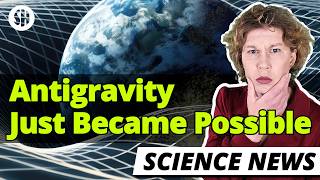

Antigravity is possible?
42sThe claim of making antigravity contradicts common physics knowledge, sparking curiosity and debate.
▶ Play Clip"Title promises anti-gravity but delivers a speculative physics paper with no practical application; still, it's on-topic."
The video discusses a new scientific paper proposing that quantum mechanics could allow for effective repulsive gravity under specific conditions, potentially offering a way to test whether gravity is quantum. The host explains the theoretical basis, the experimental challenges, and gives a personal rating of the paper.
Scientists have proposed a way to make anti-gravity, but it's not what you think. In general relativity, gravity is always attractive because energy plays the role of charge, and with only positive masses/energies, they attract. However, quantum mechanics might offer a loophole.
Under the right conditions, two attractive gravitational poles can combine into an effective repulsion. This conclusion came from studying how to test if gravity itself is quantum.
Quantum mechanics and general relativity are both extremely successful but incompatible. Testing quantum gravity was thought to require extreme energies, but recent ideas suggest lab tests are possible.
The most discussed idea is to use an entanglement witness: create entanglement using only gravitational interaction. If possible, gravity must have quantum properties. This requires putting massive objects in quantum superposition.
The new paper suggests using one massive source in superposition and a probe particle. The probe feels gravity from both locations, and destructive interference can lead to net repulsion.
The repulsive effect doesn't violate conservation laws; on average, the probe is attracted to the average position. But in single runs, repulsion can occur.
The repulsion arises because quantum particles are waves; a particle in two places has multiple momenta, and their interference can push away. It's an effective force for specially prepared states.
The gravitational interaction is extremely weak. With Cesium atoms as probes, the source mass would need to be ~20 micrograms, 2 million times larger than current tech allows. Improvements in decoherence time, force measurement, or distance resolution could help.
The host gives the paper 2/10 on the 'bogus meter', citing difficulty in ruling out other interactions and inconclusive null results. Still, it's a neat contribution.
The video concludes that while the idea of repulsive gravity is theoretically interesting, it's far from practical application. The host remains skeptical but appreciates the contribution to quantum gravity research.
What is the main idea of the new paper on anti-gravity?
Under certain quantum conditions, two attractive gravitational poles can combine into an effective repulsion.
00:42
Why is gravity always attractive in general relativity?
Because energy plays the role of charge, and with only positive masses/energies, they attract.
What is an entanglement witness?
A test that creates entanglement using only gravitational interaction; if possible, gravity must have quantum properties.
01:48
What is the estimated source mass needed for the experiment with Cesium atoms?
About 20 micrograms, which is 2 million times larger than current technology allows.
05:53
What is the host's rating of the paper?
2 out of 10 on the 'bogus meter'.
06:33
Quantum loophole
Introduces the core idea that quantum mechanics could allow repulsive gravity, a stunning conclusion.
00:42Testing quantum gravity
Explains a practical approach to test quantum gravity, a major unsolved problem.
01:48Wave interference explanation
Clarifies how repulsion arises from wave nature, making the concept more intuitive.
05:09Skeptical rating
Provides a critical perspective on the feasibility and interpretation of the experiment.
06:33[00:00] Scientists have figured out how to make anti-gravity. Sounds crazy, yet I think it might actually work. But before you go and buy ceiling furniture, let's have a look at the "ifs and buts." In Einstein's theory of general relativity, gravity is always attractive.
[00:18] The reason is quite simple. In gravity, energy plays the role that electric charges play in electromagnetism. It's just that since gravity is mediated by a spin-2 field, like charges attract
[00:30] and unlike charges repel. And since there are only positive masses and only positive energies, they all attract each other. But according to the new paper, quantum mechanics offers a loophole. Under
[00:42] the right conditions, two attractive gravitational poles can combine into an effective repulsion. That's a stunning conclusion they arrived at by studying an entirely different question, namely
[00:56] how to find out whether gravity itself is quantum. This is one of the biggest unsolved problems in physics. We have quantum mechanics which describes atoms and elementary particles through quantum
[01:11] fields and we have general relativity which describes gravity as the curvature of spaceime. Both theories work extremely well. Unfortunately, they don't fit together. It's like having two
[01:23] instruction manuals for the universe. One that says, "Assemble with screws," and the other says, "There are no screws." And then a theorist walks in and says, "Have you tried 11 dimensions?" For
[01:36] a long time, most people thought that testing quantum gravity require absurdly high energies, like inside of black holes or at the big bang. But in recent years, physicists have finally realized
[01:48] that it's possible to test quantum gravity in the laboratory. The currently most discussed ideas to use what's called an entanglement witness. That's if you create entanglement using only the
[02:00] gravitational interaction. If this is possible, then you can conclude that gravity must also have had quantum properties. It's a difficult test because for this you have to put massive
[02:12] objects into a Quantum Superposition. They have to be massive enough so that the gravitational interaction has a measurable effect. The problem is that the quantum properties of massive objects
[02:24] go away very quickly. This is why we don't normally see people being in two places at once. It's also why the experiment has not yet been done. The authors of the new paper now suggest
[02:37] a slightly different route. Their proposal is to use one massive object, the source in a superposition of two places and nearby is another particle, the probe. The source mass is put
[02:51] into two possible locations at once. The probe then feels gravity from both possible locations of the source. If the source were in just the first place, the probe would be attracted towards
[03:04] that. If the source were in the other place, the probe would also be attracted just towards this different place. The twist is that if you have the source in two places at once, you can create
[03:17] a destructive interference that leads to a net repulsion. Wait, what? Doesn't this violate some sort of conservation law? No, it's fine, really, if you average over many runs of the experiment,
[03:30] you get what you expect, namely that the probe particle is attracted to the average of the source particle. But in single runs, you can get this repulsive effect. Have you ever taken an online
[03:43] IQ test and instantly gotten a genius level score? Hate to break it to you, but most of those tests are designed to inflate your score for profit. They sell you a flattering number, not the truth.
[03:58] That's exactly why cognitivetesting.org was created. Born out of a massive Reddit community tired of online scams, it's the internet's home for legitimate professionally validated IQ tests
[04:12] developed by licensed psychologists. Their team uses properly normed culture fair exams modeled directly after the proctor tests used by psychologists, school districts, and electoral
[04:26] bodies. Unlike the clickbait quizzes, they don't inflate your score for profit. They even use adaptive technology that gives you fresh questions daily to measure your raw pattern recognition
[04:38] accurately. No ego boosts, no fake results, just credential transparent science. If you want to know your real cognitive baseline, stop wasting time on the scams. Get a scientifically rigorous
[04:52] assessment today. Head over to cognitivetesting.org to take a legitimate IQ test. That's cognitivetesting.org. And now back to the science news. It looks like gravity became repulsive, but really it happens
[05:09] because quantum particles are not just particles. They're also waves, and waves can interfere. If you have a particle in two places at once, then the particle has not one particular momentum, but many different ones. And if these add up in a weird way, the result can push you away rather
[05:25] than, as you would expect, make a pole. It's not a new fundamental force. It's an effective force that only occurs for specially prepared quantum states. But that's exactly why it's
[05:37] interesting. If the gravitational interaction didn't have quantum properties, it could not produce this effect. If the wrong-way kick is observed and all ordinary forces are ruled out, it would be evidence that gravity has quantum properties. That said, the experiment is still
[05:53] hard because the gravitational interaction between small objects is ridiculously weak. The authors make an estimate with Cesium atoms as the probe particles and find that the source mass would have
[06:06] to be about 20 micrograms. That's about 2 million times larger than what current technology allows. Though the masses might go down if either a) the decoherence time increases, b) force measurements
[06:19] become more accurate or c) shorter distances can be resolved. So no, you can't yet float to work. But given the current state of public transport, I understand why you asked. I give this paper a
[06:33] 2 out of 10 on the [ __ ] meter. I have misgivings about this sort of experiment in general because even if the effect is observed, I think it'll be extremely difficult to rule out it was some other
[06:47] interaction. And if it isn't observed, the result is inconclusive because that wouldn't mean gravity has no quantum properties. It'd just mean it doesn't have these particular quantum properties. Still,
[07:00] I have to say that this is a neat contribution to the literature and I hope the question of repulsive gravity will receive more attention. And if this works, I finally have a scientific excuse
[07:14] for why my hair does not obey gravity. Thanks for watching. See you tomorrow.



⚡ Saved you 0h 07m reading this? Transcribe any YouTube video for free — no signup needed.