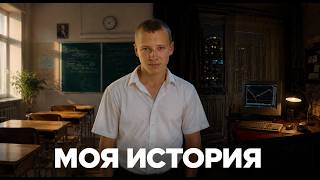

My Crypto Origin Story
42sPersonal stories with a relatable 'boy meets numbers' narrative hook viewers into the creator's journey.
▶ Play Clip"An authentic, unvarnished personal biography that delivers exactly what the title promises — a genuine life story with real lessons, though some philosophical tangents pad the runtime."
Sergey, author of the SR Crypto channel, shares his personal life story at age 37 — from a schoolboy who disliked studying to a full-time crypto trader and YouTuber. The narrative traces how his grandmother, a retired math teacher, used a clever 10-15 minute study trick that gave him a strong mathematical foundation, which later set him apart at the institute and eventually in trading.
Sergey, 37, introduces his life story as 'one long story about how to make money out of money,' promising an unvarnished account of his wins and losses.
Sergey's grandmother, a retired math teacher, used a clever method: she offered 10-15 minute study sessions, after which he was free. This made complex math topics understandable.
At the institute, the higher mathematics teacher immediately recognized Sergey's strong school math foundation, and he was regularly called to the blackboard.
Sergey trained as a mechanical engineer and worked at an automobile plant, but broke down the career into numbers — salary, prospects, promotions — and saw it as a ceiling for an 'unsaturated life.'
At age 16, Sergey completed his first trading course from a Forex broker, borrowing money from a friend's brother to pay for it. He learned technical analysis and compared his forecasts with top analysts.
While working, Sergey took investment courses, earned certificates, opened a broker account, and traded stocks — but found it slow and capital-intensive, a 'measured game over the long term.'
Sergey worked as a graphic designer, then retrained as a 3D modeler. He realized freelancing was still linear income — 'what you do is what you get' — with no potential for multiplication.
A taxi driver in a brand-new Ford told Sergey he'd earned enough trading crypto via a Telegram channel to buy a car and apartment. This chance encounter drew Sergey headlong into crypto.
Sergey set up Binance, funded his account, and joined a paid Telegram channel with one-time lifetime access. He traded signals during the late-2021 bull market with a ~$1,000 deposit.
Sergey withdrew his funds at the highs by pure chance, just before Bitcoin plummeted. Others in the channel who ignored stop-losses fell into deep, long drawdowns.
After the crash, Sergey realized crypto obeys the same technical analysis principles as traditional markets. He applied Fibonacci, RSI, MACD, volumes, and his own strategy — much calmer than the Telegram lottery.
Sergey discovered trading bots and still works with them today, conducting tests and different risk management approaches. He's been refining them for about 4 years.
Sergey's core advice: don't take unnecessary risks, don't go all-in. Risk only a small part you can afford to lose, gain experience, then slightly overestimate risks with a cool head.
After turning 30, Sergey began prioritizing physical and mental health — exercise, meditation, books, and removing negative thinking. He describes his daily routine: push-ups, horizontal bar, language learning, audiobooks.
Sergey's two dreams: making money from money (now realized) and having a clear head. YouTube, which started as a hobby, became his full-time job within six months to a year.
Sergey's story shows that a strong analytical foundation, a willingness to learn from mistakes, and disciplined risk management are the real keys to trading success. He credits his grandmother's early math teaching — the 'grandmother effect' — as the root of his entire career path.
What clever method did Sergey's grandmother use to make him study math?
She offered to help with homework for just 10-15 minutes, after which he was free to go play.
02:58
What profession did Sergey train for at the institute?
Mechanical engineer, at the faculty of automobiles and automotive industry.
06:38
At what age did Sergey complete his first trading training, and how did he pay for it?
Around age 16, with a Forex broker, borrowing money from a friend's brother.
08:18
What was the turning point story that drew Sergey into crypto?
A taxi driver in a new Ford told him he'd earned enough trading crypto via a Telegram channel to buy a car and apartment.
15:10
What was Sergey's deposit size when he started trading crypto signals?
Around $1,000.
18:00
Why did Sergey avoid losses in the 2021 crypto crash?
He withdrew his funds at the highs by pure chance, just before Bitcoin's price plummeted.
18:15
What technical analysis tools did Sergey apply to crypto trading?
Fibonacci, RSI, MACD, volumes, levels and trends.
19:51
What is Sergey's key advice about risk in trading?
Don't take unnecessary risks or go all-in; risk only a small part you can afford to lose, then gain experience before increasing risk.
23:17
What are Sergey's two dreams?
Making money from money (now realized) and having a clear head.
28:12
What does Sergey call the influence of his grandmother on his life?
The 'grandmother effect' — analogous to the butterfly effect.
29:23
The 15-Minute Study Method
Demonstrates that short, focused sessions with clear explanations can outperform long unfocused study — a principle applicable to any skill.
02:31Chance Encounters Shape Careers
A single random taxi ride completely redirected Sergey's professional life, illustrating how unexpected connections can change trajectories.
13:14Materialization of Thoughts
Sergey's belief that focused intention makes the subconscious build a path toward a goal — not magic, but directed attention and effort.
14:11Crypto Follows the Same Laws
After the crash, Sergey realized crypto markets obey the same technical analysis principles as traditional markets — a key lesson for new traders.
19:37Trading Is Real Work
Sergey emphasizes that trading requires daily discipline and mastery like any profession — there are no shortcuts or 'magic rabbits.'
20:29Risk Management Above All
The core takeaway of the entire story: never risk more than you can afford to lose, and protect your deposit above all.
23:17[00:02] got me into cryptocurrency. Although at that time there was no trace of any cryptocurrency. It sounds like fiction. Yes, everything will come together now. I'm 37, and my whole
[00:14] life from first grade to today is essentially one long story about how to make money out of money. Who infected me with this obsession with numbers? A
[00:26] suspect. [music] And what did it lead to in the end? I'll show you how it is. Without embellishment, where he took off, where he got burned and lost. So make yourself comfortable. This is not a guide or an analysis. This is the story of how a boy in love with numbers
[00:42] got into crypto. My name is Sergey. I am the author of the SR Crypto channel, and this is my story. Let's go. So, I have prepared a short story of my life, step by step. Where I started, what happened in the process, some interesting facts. short
[00:59] stories. Well, let's start, of course, with school. It is from there that our conscious life begins, and many things that, let's say, fundamentally influence our lives, come from school. So, I studied
[01:15] in an ordinary school, like many others, and didn’t show any special talents. That is, like everyone else, I was lazy in some places, and a little successful in others. In general, I slowly struggled in this educational environment, learned to
[01:31] write, read, and learned a little about various sciences. And then it was time to count, because the basic skills in school are writing, reading and counting. Further, having these basic skills, you can learn anything. And here, let's say
[01:48] , I was lucky, [music] probably even big time. I had a grandmother who was a very important person in the life of my child, that's for sure. And my grandmother was a math teacher. Well, by the time I was in school, she
[02:03] was already retired, but she had worked as a math teacher her whole life. And I’m not afraid, let’s say, to praise her, she was a good teacher, she knew how to find an approach. That is, there are teachers who simply teach. I
[02:17] think everyone has encountered these. Well, the person is just reading, teaching a lesson. But there are teachers who can find an approach to everyone. I think my grandmother could find an approach, because she found an approach to me.
[02:31] Basically, I was, well, a bit of a slacker, I guess. My level of intelligence was sufficient, but I did n’t have much desire to study. Well, that is, I wanted to go for a walk, play, do anything , but not sit down and
[02:45] study. So grandma had to work hard. She had such a cunning method. Now I understand him. She offered to help me do my homework, for example, study math with her. I tried in every possible way to get off the
[02:58] topic. And grandma did this clever trick: 10-15 minutes and you’re free. Well, basically, what's the point of fighting there anymore? I think, well, 10-15 minutes, for God's sake, okay, they'll wait for me there in the yard or wherever, where I was rushing, running to. And I sat down. Yes,
[03:14] indeed, I didn’t do anything more with her . Maybe it was 15-20 minutes. During this time, my grandmother managed to explain to me in the simplest possible language those very same complex, seemingly incomprehensible things, all those
[03:28] formulas. Naturally, in the elementary grades it was quite simple, let's say, but when the senior grades started, everything became more complicated. Tangents, cotangents and other derivative integrals. Of
[03:42] course, I have already forgotten a lot, but such complex things, yes, my grandmother really did explain them to me, and in 15-20 minutes we could figure out some topic that seemed insurmountable for a child’s brain. And I left with a full understanding of what it was
[03:56] And I left with a full understanding of what it was . I wasn't particularly active in class. He was flying, let's say, somewhere in the clouds, and could have a chat with someone there. An ordinary teenager who tasted life. But nevertheless, naturally, when the
[04:09] teacher there asked me something about math or we had tests, I mostly got A’s. Her teacher was very surprised by this, because during lessons I could really just sit there, well, I don’t know,
[04:22] do my own thing. Here she is, telling me and seeing that I’m not really listening to her. But nevertheless, for some reason, my assessments and answers, when she asked me something there , were extremely clear. And this, it would seem, is such an
[04:35] my grandmother is a teacher, I studied mathematics there. But when I was preparing for this video, and this video for me is still , well, let's say, one of the most exciting, because it's not every day that you sit down to film some kind of
[04:49] biography, or something like that, your story. I looked at the whole chain of events, that is, how this influenced my further development, because after school, institute we had higher mathematics, and the teacher there
[05:04] immediately realized that I was practically the only one in the class who had all these school math tricks from school, let's say, squares, roots math tricks from school, let's say, squares, roots and other fractions. He knows and can solve these
[05:18] simple examples, there are more complex ones. And so I fell in love with this teacher at the institute. And, well, roughly speaking, every lesson my place at the blackboard was reserved for me. no matter what happens. And at the institute, I think everyone understands that sometimes
[05:30] you go out somewhere, don’t get enough sleep, but when you come back, please go to the board anyway. Well, naturally, for this I was, let's say, rewarded in the form of good grades in mathematics at the highest level. and subsequently, how this influenced, in
[05:42] principle, my life and me, the formation of, well, my personality, so to speak, when I came across any, let's call it that , project, that is, some kind of business, some kind of undertaking, some kind of work, anything, I always broke it down into
[05:58] numbers. That is, I sat down, for example, to go to work, okay, how much is the salary per month, how much per year, how much is it for the whole life, roughly speaking, I calculated there, how much time I spent, one-two, I quickly calculated everything, it’s not interesting. some kind of
[06:10] business. OK. What is the consumption there? How much is net, what do we get, what is the possibility of scaling over a distance in a year, in two, in five years, I calculated it, spread it out. This skill began to appear in me and become stronger and stronger. That
[06:24] is, everything that came my way in life, I easily and quickly broke down into numbers. I think it will be interesting to know what kind of institute I studied at. I studied to be a mechanical engineer, in the faculty of automobiles and automotive industry. That is, after graduating from
[06:38] college, as expected, I went to work as an engineer at an automobile plant . Echoes, probably, of some Soviet Union. This is the actually, it's not a bad job at all. It’s just that abroad
[06:52] , I think, it’s valued more highly. Well, since work in this space [clears throat] was paid for back then. Now, of course, everything is changing little by little, but back then they were paid modestly. Naturally, when I
[07:06] came to these engineering jobs, I again broke everything down into numbers, it’s hard for me to guess, and I took my salary, prospects, promotions, for five, for 10, for a lifetime. Well, I understood that this was simply the
[07:21] ceiling of living such a, well, ordinary, not bad, but such a smooth, unsaturated life for me again. That is, for some people people are different. I won’t say anything there, I won’t put any labels on it, yes, there are different people. And in
[07:36] fact, the main skill is to be content with what you have. That is, if you are not starving, if you are not living on the street, not deprived of freedom, for example, that is, you have everything, here are your arms, legs, there is a head, yes, on your shoulders, that is already happiness.
[07:50] head, yes, on your shoulders, that is already happiness. [music] will not make you happier. That is, happiness is an internal state. I just tried to explain that any road is
[08:03] neither good nor bad, it is personal to each person. Everyone chooses their own path. In its own way, every person’s path is good, because he chose it for himself. But I didn’t see such a path for myself, so I naturally began to think. We still
[08:18] have to earn our daily bread somehow, so to speak . Although at the age of 16 I completed my first training in trading. That is, right at the junction of school and college, I don’t remember anymore, or I was in the first years of college or
[08:33] finishing school. Well, somewhere around 16, [music] well, basically somewhere in between, let's say . And then I still remember that I even borrowed money for these courses. They didn't cost a lot of money. This was all from the Forex broker. But nevertheless, some
[08:47] money was still needed. Naturally, I didn’t have them, as a schoolboy I borrowed this money from my friend's brother. Naturally, he gave them back later . But that's how it is, even for my first training in trading I needed the
[09:00] necessary funds. Then I finished it, yes, I tried, trained, sat at the computer, drew some graphs there. Back then, there was no community, no community at all , like now with YouTube
[09:14] , where there are some channels, telegrams, chats, a lot of information. Then there is this broker and that’s it. Based on this broker, there was a platform, a Based on this broker, there was a platform, a website, and there were different sections. And there was an
[09:26] analytics section where leading analysts from this broker posted their market forecasts. I selected a few for myself . As I remember now, there was a top one there, and a woman at the top, a trading analyst. I followed her and, I think
[09:42] , drew up some kind of forecast, simply scattered my analysis across the fundamental analysis. Naturally, I looked at some news there, but it was mostly technical analysis. So I did technical analysis and then looked at what the
[09:57] analysts wrote. That is, in this way. First I do it myself, then I look to see whether my forecast was confirmed or not, well, whether it coincided with the vision of these analysts. That is, the levels there, this is how I conducted them, not like that. This was the simplest training I had, in my
[10:11] is, over time, I began to conduct this technical analysis, to look, and these top analysts often did exactly the same thing as me. But then, as I already told you, I fell into the cycle of samsara. This life path, work, home,
[10:26] saving for holidays and all these delights. But all the time I understood that some kind of vision was emerging in me then, that with the help of money you can make money. I still couldn’t fully , let’s say, form this
[10:40] vision and understanding. That is, but I understood that simply going to work and living some kind of life, work, home, sleep and that’s it, and vacation is not the limit. That is, there is something further, there is something beyond this, there are
[10:55] many more possibilities, and it is worth looking for them, at the very least. Therefore, for a long time, while I was working, I was simultaneously interested in investments and took various educational courses. I took several courses specifically on
[11:10] investments, received various certificates there, and, of course, also additional courses on trading. I also opened an account with a broker and even traded shares for a certain time. That is, I was interested in this for some time. But
[11:24] I still didn’t see any particular progress. Stock trading is quite, well, not exactly boring, but it is a long-term activity. First of all, capital is needed, and it needs to be systematically and gradually increased. That
[11:36] is, a measured game over the long term. That's why the years dragged on [music]. Some huge part of my life has been spent exactly like this. I changed jobs too. I didn't sit in one place. I was interested in trying something new
[11:50] . Going to the office, going to work, irritated me all the time. And when this [music] freelancing appeared, that is, when it was already possible to work from home, I mastered the profession of graphic designer. In principle, I have
[12:04] some creative inclinations, so it wasn’t difficult. And for a long time I worked as a graphic designer, then I retrained as a 3D modeler. That is, I modeled all sorts of 3D things, objects, cars, anything you like.
[12:18] Since I have an engineering education and a vision, as they say, of this perspective of volume, I also had it. It wasn't difficult either, but it's work, and anyway, here, so to speak, the earnings are linear, or something. What you do is what you
[12:33] get. That is, there is no potential to increase it, again. For example, if you invest in investments and make 3-5x, or if you use some kind of algorithmic trading, launch a trading bot and somehow automate your
[12:47] trading, this is also a non-linear income. That is, you don’t have to sit for hours and do something yourself to get money. And so, understanding this, I was always drawn towards some tools that could be made to
[13:01] work for money, rather than work for money, so to speak. And at some point in my life, a very interesting story happened that drew interesting story happened that drew me headlong into working with finance.
[13:14] me headlong into working with finance. As always, the story is very unusual, and I would never have thought that such an event could lead to such consequences as it happens in life. I think everyone has had this experience many times
[13:26] , when you look back and look at some events in your life, and it seems like it’s some kind of magic, some kind of sorcery. By chance, everything turned out exactly the way you could n't have imagined. This, by the way, is also
[13:41] one of the discoveries of my entire life, which is no longer so short. 37 years is a long time, I think. A little, but also a lot. You 've already seen something, so you can draw some conclusions if you want something. really want and try to understand
[13:55] it, reach out there and somehow move at least a little in this direction, it will be attracted one way or another. There are many books, all sorts of transurfing and so on, about how thoughts are material, but the point of all these books is not that
[14:11] we imagined something and it appeared in front of us. Everything is much simpler. , we really want to earn money there, for example, or get rid of some bad habits. And we, so to speak, day
[14:26] after day somehow visualize this, imagine, think about what paths there might be , and gradually, imperceptibly for us, the subconscious begins to work. And this subconscious, again, this is how I see all this happening, this very
[14:41] subconscious, unnoticed by us, calculates, finds and builds a path to achieving this desired goal. That is, this is where all the magic lies. Materialization of thoughts. It's not like we imagined a banana appearing on the
[14:55] table, and we simply focus on what we want, and then we inevitably achieve it. And then one fine day I was driving home from the maternity hospital. I was visiting my wife at the maternity hospital, was returning home, and decided to call myself a taxi to get there faster.
[15:10] It was probably a brand new Ford sports jeep . Well, it looked really cool when I got into the salon, well, here is a new salon, as they say, the salon smells like a new car. And I became interested, I was just at that moment
[15:25] continuing my search for where what, how to spin this money, how to some kind of earnings there, passive, active, but not just
[15:37] working linearly, but with some kind of multiplication and for the money to work. Without thinking twice, I asked the taxi driver where he got such a car. Is it really possible to earn, well, a lot of money working as a taxi driver,
[15:53] [clears throat] enough to buy a new car? The taxi driver told me that he worked in a restaurant as a waiter, I think. Then he got into some Telegram channel and started trading stocks and cryptocurrency there.
[16:08] And that’s how I earned enough money for a car and an apartment. So, it turned out to be such an interesting story. I started thinking about shares. I was already dabbling in cryptocurrency back then and had only heard about it, but I heard, like all of us, some incredible
[16:23] stories of huge earnings. And it all clicked for me: "Oh, crypto is my thing. I need it here, and there's some Telegram there, they tell me everything I need to do." So, I got the contact information from this taxi driver , came home,
[16:37] , came home, set up Binance, topped up my account, and contacted this taxi driver. Anyway, he gave me this Telegram channel there. This was, of course, a paid Telegram channel . Well, it wasn't a huge amount
[16:49] . That is, literally within a day or two, I had everything ready. My Benanse account is funded, there's a deposit for trading, and this my opinion, there was a one-time fee and lifetime access. So, within a few
[17:04] days, I was already sitting there, trading crypto using signals from a Telegram channel. That was just it. Now let's open the chart and take a look. I always look here when I remember this story on the chart, because it was clearly on the last bull market. Yes. Here
[17:19] we are in the twenty-first year, somewhere around the end, I think, if I’m not mistaken, the end of the twenty-first year. That is, it was autumn, there was winter, that is, several months, I don’t remember exactly. Well, for some time I traded there for more than a
[17:32] month, probably, and everything was growing. Indeed, there was a bull market. These signals, let's say, they even worked, because everything is growing. I don't know, there was absolutely no description of how these transactions were carried out,
[17:46] but yes, you go in, sit for a while, hop, you get some percentage, there's an extra 10-20 bucks, 30. That is, it was nice. My deposit was small at the time, I think around $1,000. And it was all fun, quite
[18:00] good. The only thing is, stop losses, in my opinion, somewhere in their signals they wrote about stop losses, and somewhere they wrote something like , like, I don’t set stop losses. at a certain point I needed money, and I withdrew all these
[18:15] funds. I even noticed a small plus there, it seems. I withdrew this money, eh, I withdrew it at the highs, it just happened by chance, at the highs of the previous growth. And after that, the price of Bitcoin began to plummet, and
[18:29] naturally, the entire market was pulled down along with it. As I already said, stop-losses were not particularly welcome in this channel, so people all ended up in such a deep, long drawdown. I purely by chance jumped out just before the
[18:42] fall and missed that drop. But I observed all this and understood that yes, I could have sat there and the deposit would have simply rolled away to zero. Of course, it’s a reasonable question why I didn’t start trading there myself right away using technical analysis.
[18:56] I basically had a pretty good trading strategy, but when I got into crypto, and it was really taking off at the end of cryptocurrency market seemed completely different to me. That is, if,
[19:10] for example, you trade currency pairs, like the euro-dollar or the pound-dollar and so on, or the euro-dollar, and they don't just have the dollar, they have other different ratios, everything happens slowly, they rise a little, fall a little,
[19:24] that is, there are no pumps or dumps, these are very rare events, let's say. Volatility is much less in stocks, actually I haven’t encountered anything like that either [music] somehow in particular. When I got into crypto, I realized that it has its own
[19:37] rules, so to speak. But after all this, when everything took off and collapsed, it slowly began to dawn on me that the laws here are exactly the same. I remembered all my skills, started to draw the usual levels and
[19:51] trends here, took out Fibonacci from my pocket, remembered some basic indicators there remembered some basic indicators there , here RSI, MACD, well, also top indicators, volumes and slowly began to trade there according to my strategy. It
[20:03] turned out to be much calmer than the lottery I played on the Telegram channel . and more understandable, that is, when you trade according to your strategy, you clearly understand what you are doing, why you are doing it, why you entered a trade here,
[20:16] blind signals, simply where they write: "Such-and-such entry price, such-and-such stop-loss, such-and-such take-profit." And as I said, if a stop-loss is written, then it’s like trading with your eyes closed, like a blind kitten. And
[20:29] I started selling pens there myself. Well, naturally, here again everyone is carried in their own direction. I was carried away again in my direction. Trading is a job. work, trade,
[20:43] monitor every day, every hour. If anyone sees it differently, here's what I've understood over all this time. There's nothing really super-tricky about trading . There is one condition - it is real work. It's like you just sit down in the morning and
[20:56] a profession, naturally, that needs to be mastered, that needs to be trained and that needs to be practiced. There are no rabbits jumping out of thought that the hares would jump out, but then I started discovering trading bots.
[21:09] I still work with them to this day. I still see some prospects in them too. I already see progress in them now. I conduct a lot of different tests, different risk management approaches, naturally, there are videos of everything on the channel, it’s all documented.
[21:24] channel, it’s all documented. And I started delving into long-term crypto trading. You can call it something else: investments. Investing in crypto is also an interesting activity. The best thing , this is what gives the most
[21:37] understanding, is to survive one cycle, to hold out, I don’t know, buying something, not buying, but the main thing is not to take too many risks, because when people take a risk, they give up, then become disappointed and simply leave in a negative mood. That is, here you
[21:50] need, of course, to limit the risks of your deposit, that’s all the joy. Well, just some risk management, if you several separate videos there. But when I experienced it, it turns out that I was right in the market
[22:04] growth, the end of some last, the growth before last, we already had this whole growth in Bitcoin, the last one also decided this growth before last, then a fall, there was some accumulation here, then a long, long [music] growth. Well,
[22:17] basically, it always goes like this on Bitcoin , there are 3-4 years, then there is a small distribution again, and now we have a bearish fall. That is, having lived through this full production cycle,
[22:32] began to take shape. The same goes for trading bots. I've been shaking their legs for 4 years now . Just like Pinocchio, so that the money starts pouring in. Well, I'm joking, of course. I try different approaches like this. Of course, there were both losses and gains, let's say
[22:47] . Here, without losses in the financial sector, well, it’s naive to think that there won’t be any. Especially when these are some first attempts, the first tests of some tools, for example, the same trading bots or the first attempts at
[23:02] investing in crypto or even in trading. Losses. Well, there is, of course, someone can come in and immediately, hop, he gets it, but that’s more of an exception. More often than not, this is the way to go, of course. The path is thorny, let's say. And the main thing on this whole path
[23:17] that I would like to convey is, again, not to take unnecessary risks, not to lose your head, that is, not to get carried away. Well, if we use our language, yes, there is always the understanding that money, if it is limited, let's say, in quantity,
[23:30] usually it is still limited by something, some part is always needed for living, some for rest, some for treatment, some here and there and many other needs. You shouldn't forget about this and don't try to go all in here, I'll risk everything,
[23:44] shove it in, and then fight back. No, it’s better to have some small part there that can be spent and even lost, to take a risk and get a better experience. When you gain experience and understanding, then you can somehow, somewhere, slightly
[23:58] overestimate these risks, and only with a cool head, because to this day they still hit themselves on the hands in some places. But the skill is acquired, it strengthens the market, it strengthens the spirit. All these instruments, when you drive them so
[24:11] well, you’ll get a little bit of a kick here and there, you’ll earn a little bit of money there, you’ll feel all these psychological moments. Now regarding health. I would like to say a few words . After turning 30, something in my head turned upside down. Previously, when
[24:24] I worked at various companies, especially in the automobile industry, there were already grown-up guys there, who seemed to me to be some of them in their late 40s, some of them over 40. And they tried to convey to me some kind of truth, that after 30,
[24:39] couldn't understand what this turning over was, what this process was and how it happened. But really, when that age passed, maybe on my birthday, well, after 30 years, when I crossed that line, yes, something in my head
[24:53] began to change little by little, and I began to understand that you need to take care of your health, and not just your physical health, but your mental health, the health of your thinking, that is, throw all sorts of nasty things out of your head,
[25:08] analyze, somehow work on your brain. That is, if there are pull-ups, parallel bars, I don’t know, some dumbbells, kettlebells, all this is
[25:20] physical health, then our head is , in principle, books, meditations. And, in fact, I am doing all of this now. This is what a typical day is like for me. I get up in the morning, do push-ups, go to the horizontal bar, parallel bars, crunches, then I learn a
[25:36] foreign language, then I go for a walk, listening to an audiobook on the way. Audiobooks are a good thing, by the way, when, well, you can’t sit and read, walk somewhere, climb somewhere. That's it, I threw myself an audiobook. And yes, assimilation may
[25:51] differ from reading, although I didn’t notice it in my case. It’s as if what I read and what I listen to are the same, but one way or another, something gets absorbed. That is, it is better than simply doing nothing. And it’s not just some little thing that will be absorbed, it’s
[26:05] really different for everyone, but the majority of the entire book, or the audiobook that the context of a year, this is a pretty good repair of your brain. We all, yes, want to be successful people. We all look at these successful
[26:19] people on the screens, yes, who have achieved something in life , who have earned their millions. And what do these successful people do? If you ask how a successful person's Day is celebrated, they do n't do anything unusual. They are doing
[26:32] exactly what I told them to do. They simply lead a healthy lifestyle, uh, they take care of their physical fitness, their psychological state, again , and they develop their brain, their thinking, that is, they read something, they study something. That's actually
[26:46] all the magic. That is, as they say, these successful people don’t do anything so clever. Naturally, I don’t abuse, or rather, I don’t use any substances at all, including alcohol, nicotine, and other highs. Some people
[27:01] might find this boring. I guess I could have had a blast there too, in my wild youth. And then it seemed really boring to me. But now, it seems to me, it’s not boring at all , but rather very fun. It's fun to
[27:15] climb the mountains there on the weekend, go out into nature somewhere, and have some shashlik and mashlik. Well, just wander somewhere in the forest, go to some other city and see something new . You have to get used to this. But it's
[27:28] really not that hard to get used to. I would like to briefly convey this state, feeling and understanding of a healthy lifestyle. But again, since I love to philosophize and I love philosophy, by the way, I
[27:42] also got an A in philosophy at the institute . I understand that everyone has their own path. Some people like to have fun, unwind, and relax. That is, this is also its own path. And we all choose our own path. That is, let's put it this way, uh, I
[27:58] don't insist on my own way of life there, I respect everyone's choice. I completely forgot to say that this was also my second dream. The first dream, as I already said, is material thoughts. Everything we dream about is sooner or later
[28:12] attracted to us. And so my first dream was to make money out of money, which is now being realized. And the second is to have a clear head, as clear as possible. Because when I personally have a clear head, I feel like some kind of
[28:25] Superman. And it was precisely this final stage, when I burst into crypto, that I learned all of this, roughly speaking, from scratch. Exchanges, transfers, wallets, some bots wild beast. I launched it. I thought that he would now go and plow and sow himself, he
[28:41] would simply work for me. Everything seemed so magical and unknown to me, this world. Well, and accordingly, I decided to start a YouTube channel so that I could simultaneously post my research on YouTube. At that time
[28:56] I was still working in parallel, but over time, after six months, maybe, I don’t remember exactly, somewhere between six months and a year, YouTube completely absorbed me, and YouTube became, so to speak, my job. So, essentially, YouTube is
[29:09] my hobby that has become my job. That is, thanks to YouTube, I can do what I like, research all these financial instruments, test them, and record videos about them. And I feel
[29:23] , well, roughly speaking, like a fish in water in my place. That's why there's this grandmother effect. We have the butterfly effect, yes, when a butterfly on one side of the world, in one corner of the planet, flapped its wing, and in another corner of
[29:38] the planet a whole tsunami arose. It's the butterfly effect. And I got the grandmother effect, for which I am, of course, very grateful to her [music]. Well, now, if you watched this video to the end, now you already know who I am, what I
[29:52] did, what I do. Of course, as a blogger, I can't help but say: like, leave comments, share something about your life, your observations, what you subscribe to the channel so you don't get lost. And also the Telegram channel in
[30:08] the description below the video. That's all from me. I wish everyone goodness and financial well-being.
⚡ Saved you 0h 30m reading this? Transcribe any YouTube video for free — no signup needed.