
Retail vs Smart Money: The Nifty Reversal
45sHighlights a common retail trader mistake and reveals a pro-level reversal strategy, sparking curiosity and debate.
▶ Play Clip"Title accurately reflects the content: an introductory lesson on Smart Money Concepts with step-by-step price action."
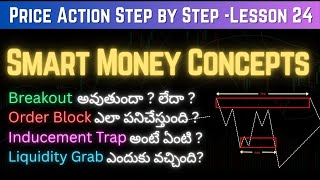
This video introduces Smart Money Concepts (SMC) for trading the Nifty index, contrasting it with basic price action. The instructor explains how pro traders interpret market structure, order blocks, and inducements to anticipate reversals, and outlines a three-part course covering market structure, order blocks, and market imbalance.
On a 5-minute Nifty chart, most retail traders expect a fall and buy put options, but pro traders using SMC see an incentive and order block, anticipating a rise.
Basic patterns like bullish/bearish engulfing work only sometimes, leading to psychological mistakes. SMC offers a different methodology.
Includes break of structure, change of character, major/minor trends, strong/weak highs/lows, valid/invalid pullbacks, and supply-demand flips.
Covers normal, swing, internal order blocks, breaker blocks, mitigation blocks, rejection blocks, and refined order blocks in lower timeframes.
Includes external/internal liquidity, liquidity zones, liquidity pool, inducement, fair value gaps, and discount/premium zones.
A wick becomes an inducement only when the market reverses direction at that point. Pro traders ignore other wicks.
A red candle's body before a sharp reversal green candle acts as an order block, acting as future support/resistance.
Paid courses cost ₹1,00,000 and books ₹45,000 (500-800 pages). This free course covers 50-60% of book knowledge, sufficient for profitable trading.
Technical analysis is useless without psychology. Students must unlearn basic concepts and keep an open mind for SMC.
The video sets the stage for a three-part SMC course, emphasizing that practice (90%) is more important than instruction (10%). Success requires unlearning basic concepts and maintaining psychological discipline.
What is the difference between a wick and an inducement in SMC?
A wick becomes an inducement only when the market reverses direction at that point; otherwise it is ignored.
04:41
What is an order block?
The body of the candle immediately before a sharp reversal candle, acting as future support or resistance.
06:02
List three topics covered under market structure mapping.
Break of structure, change of character, strong highs and lows.
02:32
What is the recommended ratio of practice to instruction in this course?
90% practice, 10% instruction.
09:33
Why must students unlearn basic concepts before learning SMC?
Because SMC often reverses basic concepts (e.g., support becomes resistance) and requires an open mind.
09:08
What is the estimated cost of paid SMC courses and books mentioned?
Courses cost around ₹1,00,000; books cost around ₹45,000 and are 500-800 pages.
07:03
What percentage of book knowledge does the instructor claim to teach?
50-60%.
07:15
Retail vs Pro Trader
Illustrates the core difference in market interpretation between retail and pro traders using SMC.
00:06Inducement Definition
Clarifies a key SMC concept that distinguishes it from basic wick analysis.
04:41Course Value Proposition
Highlights the high cost of alternative resources and the value of free content.
07:03Unlearning Required
Emphasizes the paradigm shift needed to adopt SMC, a critical psychological step.
09:08[00:06] you observe the five-minute time frame chart of Nifty today, August 19, . If you were to trade in this situation, what trade would you like to take? what trade would you like to take?
[00:19] think it will rise? Looking at a chart like this, most of the retail traders think that the Nifty will fall from here and should buy put options . But traders who have learned Smart Money concepts at an advanced or
[00:31] pro level will . Because there is an incentive here. And also, as previously mentioned, there is
[00:43] an order block here. So, on an intraday basis, pro traders clearly understand that Nifty will rise from here, taking a minor inducement and also the support of a minor outdoor block support of a minor outdoor block
[00:55] That's why we see the market reverse from there and rise again. In reality, whatever basics we learn in price action
[01:08] or bullish or bearish engulfing patterns work out a few times. Psychologically, we take many wrong steps after seeing that we are working out a few times. So, in this course, even though we have learned about
[01:23] basic price action and psychology so far, we are going to . However, the concept of smart money is
[01:37] make about the smart money concept from here on out practice, there are chances that you will understand it very easily. But if what I say is 10%, your practice should be 90%. So, if
[01:52] we look at the previous chart, a trader who has learned the basics here feels like buying a call option. The reason why it seems like this is that even though the subject they both study is almost the same, the way they look at it is very
[02:07] different. So, let's see what topics we need to discuss in the smart money concept to see how we can look at it with a different methodology we need to discuss in the smart money concept to see how we can look at it with a different methodology in the upcoming videos, we are going to teach you smart money concepts in three
[02:20] different parts.
[02:32] However, in market structure mapping, we learn about different segments . These include break of the structure, change of character, major and minor market trend, pro trend and counter trend, strong highs and strong lows, weak
[02:45] and counter trend, strong highs and strong lows, weak highs and weak lows, price valid and invalid pullback, supply demand flip, and so on. supply demand flip, and so on.
[02:59] how to interpret these structures, which are strong trends and which are weak trends, where large orders are placed in the market, the
[03:18] . So what do we mean by normal order block in this order block? What is a swing order block? What is an internal order block? And also, we will learn about Breaker Blocks and Mitigation Blocks, Rejection Blocks, Point of Interest in Higher Time Frame
[03:32] Refined Order Blocks in Lower Time Frame . And finally, we will discuss different concepts to learn about market imbalances, which can lead to sudden sharp reversals in the market or where large orders are placed in the market, causing the
[03:45] market to change direction. external liquidity, liquidity zones, liquidity pool, liquidity
[03:58] grab, inducement, fair value gaps, and also discount and premium zones. In this video course, we are going to learn about market structure, order blocks, and market imbalance .
[04:11] However, hearing all these names will obviously scare any new trader, but don't worry, many of these names match some of the common names in the basics that you already know names match some of the common names in the basics that you already know
[04:26] . It's just that the technical names change, but the . Maybe what we thought was support in the basics becomes resistance here at the advanced pro level . Let's
[04:41] learn how it works in further videos. But welcome to Smart Money Concepts. From here you are moving to the next stage of pro level trading. falls sharply like this and then reverses with a nice green candle and rises sharply.
[04:54] At lower levels, we call this a wick, while at pro levels, we call it an inducement. Otherwise, there is a big difference between Vic and Induction . What this means is that when the market is falling like this,
[05:08] lower wicks have formed many times. But we pronounce this lower wick as wick every time, but
[05:21] we only call it an induction where the market direction reverses, that is, . This single candle is only important where the market has reversed, so only the induction should be considered. They say that a pro trader should remember to ignore every single
[05:34] week, and they call it "induction." However, even within these inducements, there are strong inducements and weak inducements, depending
[05:48] on the time it was formed and also on its structure act as supports, and sometimes they act as resistance . We will discuss all of this further . And also,
[06:02] whenever the market reverses sharply and is going up, what we have here is a green candle formed. If we take the body of the red candle that formed before this green candle, then formed before this green candle, then
[06:19] from here by reversing . That is why this red colored candle is an order block for us. So, as usual, this order block will act as support and resistance for us in the future
[06:35] new names, don't be afraid to see all of these. If you slowly learn and practice step by step, see all of these. If you slowly learn and practice step by step, understand how to look at the market in the right direction . Yes, on an example,
[06:48] I have explained to you in a simple way what is inducement in the market and what is order block. In this way, let us no doubt be charged almost 100,000.
[07:03] And even any book that deals with this smart money concept will cost around around 45,000. And the book will be at least 500 to 800 pages long. But whatever course I'm going to teach, it will undoubtedly be better
[07:15] than those advanced courses that cost ₹1,00,000 . But it may not be better than the book . Because I also learned from books. If I teach 100% of the book, I might only understand 50 to 60%. I'm
[07:29] you may have a little less knowledge about it . But is it enough to understand just 50 to 60% of a book to become a pro trader ? That's enough for me. Because whenever I think I should trade the market, if there are
[07:44] 20 trading sessions in a month, I won't understand the market for 20 days. But it makes sense that a 7 to a day move will definitely be like this . I don't understand about 14 days, which means I understand 33 of the market very well, but I do
[07:59] n't understand 23. But psychologically speaking, even Einstein didn't know how to perform surgery, so it does n't mean everyone needs to know everything. If we understood this every day, we would undoubtedly become gods in the stock market. That's why
[08:13] we would undoubtedly become gods in the stock market. That's why understand the market. It moves in the direction I want . Everything I learned is working out very well.
[08:30] . I can teach you these classes today. In our last video on psychology, we also learned the
[08:43] how well we learn technical analysis, if we learn technical analysis, if we trades, whether we understand a trade or not.
[08:56] understand a trade or not. So, from now on,
[09:08] That is why the topics I mentioned today in Market Structure, Order Block and Market Imbalance are definitely the first time everyone has heard them. So what you are going to learn from now on is a very new concept and the reverse of what you learned before,
[09:21] concept and the reverse of what you learned before, so first you have to unlearn what you learned, that is, you have to forget what you learned. The concepts we will learn from here are
[09:33] . Even if you learn against it, keep an open mind and accept it, and only then will you be able to learn this subject . Hope this journey of our Smart Money concept from here will be very helpful to you.
[09:45] But I repeat again, what I teach is 10%, but the practice you do will be 90% helpful to you . No concept is that simple . Every concept that seems simple to us is
[10:01] difficult when it goes into the reality of the market. But all the best to everyone, if you want to watch the next videos as soon as I post them, then definitely don't forget to subscribe to this channel and also click the bell icon, you want to learn such concepts again, you will have to pay a lakh rupees outside
[10:15] and comment on this video. Thank you everyone comment on this video. Thank you everyone for watching.
⚡ Saved you 0h 10m reading this? Transcribe any YouTube video for free — no signup needed.