[00:00]
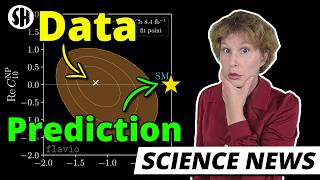
Particle physicists have put an anomaly to test. And it didn't go away. Rather, it has now increased in significance to 4.8 sigma, close to the discovery threshold of 5 sigma.
[00:14]
That is a welcome break from anomalies that are disappearing, so let’s have a look. Particle physicists collect all their knowledge about the fundamental constituents of matter in what is called the “standard model” of particle physics. It currently contains 25 particles.
[00:30]
But they believe that their collection is not complete because it’s got some loose ends. One is that the standard model does not contain dark matter which, particle physicists believe, is also made of particles, though there is no evidence that this is the case. Another problem is
[00:45]
that the standard model does not contain gravity. And so they are looking for any hint that the predictions of the standard model are not correct because that would be a clue to new physics. So far the standard model has stubbornly upheld. In the past decade,
[01:01]
all anomalies have gone away. The longstanding muon g-2 anomaly is gone, the W-boson mass anomaly is gone, and various neutrino anomalies are also gone. The standard model certainly likes attending its own funerals. But last month,
[01:14]
we had a big surprise. The b-meson anomaly has not only not disappeared. It has gotten stronger. These b-meson anomalies have been seen in particles containing bottom quarks
[01:26]
where some decays that produce muons have been observed less often than predicted. They were first reported in 2013 and researchers at CERN have now reinvestigated them.
[01:38]
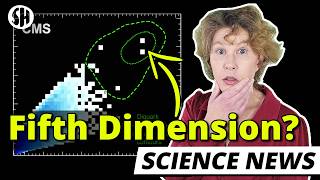
The collaboration from CERN’s CMS experiment for the first time looked for these anomalies using data from the run from 2022 to 2024. They again found rates in conflict with several standard model predictions but
[01:52]
they do not quantify the significance. The collaboration of another experiment, LHCb, meanwhile, reanalysed older data and reports a discrepancy of 4.3–4.8 standard deviations.
[02:07]
Nominally, the discovery threshold in particle physics is at 5 sigma. So this anomaly seems to fall just a little short of a discovery. But let me be honest, at this point I don’t think this anomaly is going to go away. I think this is the real thing. Something isn’t adding up.
[02:23]
The question is just: What could it be? The most widely considered explanation is a new exchange particle called the Z prime boson. That is similar to the Z-boson of the weak interaction but heavier. Another possibility is what is called a “leptoquark”, that is a
[02:39]
particle which behaves partly like a lepton – electrons or muons – and partly like a quark. A maybe more exciting possibility is that it would be a particle that is also a dark matter candidate, possibly supersymmetric. And some have
[02:54]
proposed it might be evidence for an additional dimension of space, which might also explain another anomaly, as I just talked about the other week. Or it could be a similar story to the muon g-2 anomaly. The problem might
[03:09]
not be the standard model itself, but that the prediction made with the standard model is just wrong because these calculations are really difficult. I give this a 1 out of 10 on the bullshit meter. Because what would be the fun of doing
[03:24]
these science news if I didn’t get to make a call on a discovery every once in a while. I think this is a real anomaly but I also think it will be resolved as a problem with the standard model prediction and no new physics after all.
[03:39]
I also have to warn you that particle physicists at the moment have very, very strong incentives to find any sort of discrepancy between observation and the predictions of the standard model that would justify further investments
[03:54]
into their dying discipline. I am not saying they would fabricate anomalies deliberately. I am just saying there is nothing in the current process of academic research that controls for cognitive biases. And if someone explains why this anomaly is an error in a calculation,
[04:11]
they’re not going to win a Nobel Prize. Rather, they will end a decade-long research effort. As usual though, keep in mind that this is just my opinion. Fact is, we have an anomaly at now nearly
[04:24]
5 sigma that doesn’t look like it’s going to go away. I think we will hear a lot about this in the coming years. At 4.8 sigma, you have an anomaly. But at 5 sigma, you have a press conference.
[04:36]
If it’s a new particle, I'll make another video. If it’s a calculation error, I'll also make another video. Now that I think about it, perhaps I shouldn’t be lecturing anyone about cognitive biases.
[04:49]
I spend a lot of time online and I haven't always been careful. It's happened repeatedly that some of my private data leaked. This is why I'm now signed up to Incogni. You see,
[05:02]
the problem is that big companies called data brokers make money from collecting and selling your private information. So, each time you open a website, it'll try to collect data about who you are and where you are and what other websites you've visited. Most countries have laws
[05:19]
against that and you can ask for your data to be removed. But doing this takes up a lot of time. Incogni will do it for you. They now cover more than 420 brokers and will get you out of their
[05:32]
databases. They'll keep on doing that and if you want send you a monthly risk assessment report. They now also have a custom removal feature where you can submit specific websites and I've used that a lot. Incogni made my life better in a simple and straightforward way.
[05:49]
If that sounds like something you could need too, use my code SABINE or the custom link in the info because that'll get you 60% off. Stay safe. Thanks for watching. See you tomorrow.