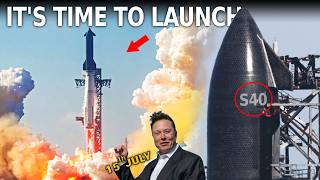

Starship Flight 13: Launching in Days?
47sReveals a shocking, imminent launch date that contradicts SpaceX's usual pace, sparking immediate curiosity and debate.
▶ Play Clip"Delivers on the promise of analyzing the upcoming launch with detailed technical insights, though the 'Never Seen Before' is a stretch."
The video discusses the imminent launch of SpaceX's Starship Flight 13, scheduled for July 14, 2026, based on FAA filings. It analyzes the accelerated turnaround time, the specific objectives for booster 20 and ship 40, and the extensive preparations at Starbase, including static fire tests and infrastructure upgrades. The video also touches on the broader context of SpaceX's scaling operations and the final Atlas V launch for Amazon's LEO constellation.
FAA operations plan advisory lists Starship Flight 13 with a primary target date of July 14, 2026, at 5:45 p.m. CST from Starbase, Texas.
The gap between Flight 12 and 13 is only 53 days, compared to 221 days between Flight 11 and 12, indicating a fourfold compression in turnaround time.
Elon Musk's response to FCC filing for 100,000 next-gen Starlink satellites: 'We're going to need a bigger Starship.'
The FAA hazard area map indicates a suborbital trajectory with ship re-entry in the Indian Ocean, similar to Flight 12, focusing on engine relight and boost back burn objectives.
Ship 40 aims for successful in-space engine relight; Booster 20 aims to nail the boost back burn that Booster 19 botched (only 20 of 33 engines lit, most shut down after ~20 seconds).
Booster 20 needs a 33-engine static fire by around July 9th to meet the July 14th launch date, based on Booster 19's 15-day pre-launch sequence.
FAA issued TFRs for Massey test site (July 8-16) and launchpad (July 9-15), aligning with expected static fire for Booster 20 and possible testing for Ship 41.
SpaceX could keep Booster 20 on the pad after static fire, avoiding rollback, to save two days, making July 14th feasible.
Water deluge system tested four times in a week, quick disconnects purged, and chopsticks rehearsed, indicating imminent launch readiness.
Ship quick disconnect arm extension removed for redesign; new flame trench under construction with water cooling, preparing pad 1 for Block 3 and higher cadence.
Atlas V launched 29 Amazon LEO satellites, completing the constellation with 224 satellites without failure. Remaining six Atlas V rockets are reserved for Starliner, never to carry fairings again.
SpaceX is aggressively accelerating Starship flights, with Flight 13 poised to demonstrate key capabilities and infrastructure upgrades. The launch on July 14th is plausible but hinges on successful static fire and rapid pad operations, signaling a shift toward operational launch tempo.
What is the primary target date for Starship Flight 13?
July 14, 2026, at 5:45 p.m. CST.
00:47
How many days between Flight 12 and Flight 13?
53 days.
01:55
What was the gap between Flight 11 and Flight 12?
221 days.
01:55
What are the two main objectives for Flight 13?
Successful in-space engine relight for Ship 40 and nailing the boost back burn for Booster 20.
03:05
What was the issue with Booster 19's boost back burn?
Only around 20 of 33 engines lit, and most shut down after roughly 20 seconds, far short of the planned full minute.
03:19
By what date does Booster 20 need its static fire to meet the July 14th launch?
Around July 9th.
04:32
What did Elon Musk say in response to the FCC filing for 100,000 Starlink satellites?
We're going to need a bigger Starship.
01:29
What is the significance of the FAA TFRs issued on July 7th?
They cover the Massey test site and launchpad, aligning with expected static fire for Booster 20 and possible testing for Ship 41.
04:47
How many Atlas V rockets remain in ULA's inventory and what are they reserved for?
Six rockets, all reserved for Boeing Starliner crew capsule missions to the ISS.
10:53
Need for Bigger Starship
Elon Musk's quote succinctly captures the scale of SpaceX's satellite deployment ambitions.
01:29Fourfold Turnaround Compression
The 53-day gap versus 221 days demonstrates a dramatic acceleration in launch cadence.
01:55Potential Compressed Launch Sequence
Explains a possible operational shortcut that could make the aggressive timeline feasible.
06:11Atlas V Final Fairing Launch
Marks the end of an era for a reliable rocket, highlighting the industry shift.
10:24[00:03] could be launching in less than a week. This isn't some random rumor. It's operations advisory with a primary target date of July 14th. But hold up, isn't this schedule ambitious for SpaceX? Will they actually have booster
[00:18] 20 and ship 40 ready in time? Let's break it down. As a rocket enthusiast, one of my favorite things to do in my free time is check the FAA's operations plan advisory page. It's just a plain boring table of text, but it's the best
[00:32] place to see what major launches are coming up. SpaceX is usually all over it with routine Starlink missions. But today, something new suddenly appeared that made the whole community do a double take. SpaceX Starship flight 13,
[00:47] Starbase, Texas, with a primary target date of July 14th, 2026 at 5:45 p.m. CTS, just a few days from now. And this isn't coming out of nowhere. Flight 12 wasn't that long ago, yet here we are already looking at a flight 13. SpaceX
[01:04] is clearly accelerating Starship flights for the rest of the year. Just like COO Gwyn Shotwell said, >> we will. So, the early satellites, we still have some very early satellites up in orbit. They're not as good as the
[01:16] latest ones, and they certainly don't have as much capacity as the V3s that we'll be flying later on this year on Starship. Elon Musk reinforced that point just yesterday when he replied to SpaceX's new FCC filing requesting
[01:29] approval for up to 100,000 next generation Starlink satellites. His response, "We're going to need a bigger Starship." That one line says everything. SpaceX isn't just flying Starship more often. They're scaling up
[01:42] the entire operation to support a satellite deployment plan so massive it requires a fundamentally bigger vehicle. And flight 13 is where that acceleration And flight 13 is where that acceleration becomes real. If July 14th holds, the
[01:55] gap between flight 12 and flight 13 will be just 53 days. The gap before that, be just 53 days. The gap before that, between flight 11 and flight 12 was 221 days. That's not incremental improvement. That's a four times
[02:09] compression in turnaround time. And it's happening right now. So, yes, this schedule feels aggressive, but it's the exact window SpaceX submitted to the FAA in advance, so air traffic controllers can reroute commercial flights away from
[02:23] the booster and ship's trajectory in real time. SpaceX doesn't file these unless they mean it. And the FAA filing tells us more than just the date. The launch hazard areas map for flight 13 reveals the full flight profile before
[02:37] SpaceX says a word about it. The stage one danger zone, that large elliptical corridor stretching from the Texas coast southeast toward the waters between Cuba and Jamaica, matches almost exactly what we saw on flight 12. And the ship
[02:51] re-entry hazard area, still the Indian Ocean, same corridor near Madagascar running toward Indonesia and Australia. That tells you this won't be a full orbital mission. Flight 13 is picking up where flight 12 left off, specifically
[03:05] targeting the two objectives that failed last time. For the ship 40, that means a successful inspace engine relight. For booster 20, it means nailing the boost back burn that booster 19 completely botched. In that flight, only around 20
[03:19] of 33 engines lit during the boost back sequence, and most of them shut down after roughly 20 seconds, far short of the planned full minute. The likely culprit was unstable engine startup, possibly triggered by propellant
[03:33] sloshing or early stage issues with the Raptor 3 ignition sequence. Which brings us to the most important question hanging over this whole timeline. Booster 20 still hasn't done a static fire with a net date this tight, how is
[03:46] that even possible? To understand what's at stake, look at what booster 19 went through. After its final successful 33 engine static fire on May 7th, SpaceX needed 15 days before flight 12 left the pad on May 22. That 15 days covered
[04:02] stacking, ship 39 on top, a wet dress rehearsal, destacking to fix damaged chopstick hardware, FTS installation, final flight checkouts, and one last roll out. And that was considered fast. Booster 19 had the added complication of
[04:18] being the first V3 booster on a brand new pad nobody had ever launched from before. If booster 20 follows even a compressed version of that same sequence, SpaceX needs its 33 engine static fire done no later than around
[04:32] July 9th to have any realistic shot at July 14th. And as it turns out, that's exactly what the FAA seems to be signaling. On July 7th, the agency quietly dropped two new TFRs. One covering the Massie test site from July
[04:47] 8th through July 16, and another over the launchpad from July 9 through July the launchpad from July 9 through July 15. The Massie TFR is interesting. The most likely candidate there is ship 41, which is next in line for flight 14.
[05:00] Last time ship 41 rolled out to Massis, it only performed flap actuations. No cryo test, no engine work, nothing structural. So, this new window could be covering either its first real cryo campaign or potentially even a static
[05:16] fire. Either way, SpaceX appears to be keeping the pipeline moving on, flight 14 hardware in parallel. But the launchpad TFR is the one that matters most for flight 13. That July 9th through 15 window lines up almost
[05:30] perfectly with what the community has been projecting for booster 20's 33 engine static fire with July 9th as the net date. The booster transport stand has been moved into Mega Bay 1, where booster 20 has been undergoing
[05:44] inspection since the evening of the 8th. By the time you're watching this, booster 20 may have already fired its engines, or it may not have. Either way, the timeline here is razor thin. We're talking less than a week from now, and
[05:56] every single day counts. Now, there is one way SpaceX could compress this dramatically. Instead of the standard back and forth static fire, roll back, install FTS, final checks, roll out again, booster 20 could theoretically
[06:11] arrive at pad 2 already in near-flight ready condition. FTS pre-installed in ready condition. FTS pre-installed in the mega bay. All 33 engines already on. Every checkout completed to the maximum extent possible before the booster ever
[06:24] leaves the building. Then it rolls out, does its static fire, and stays on the pad. No roll back. Engineers work the final checks right there on the launch mount while ship 40 is being stacked on top. If the data looks good, you go.
[06:38] That alone could claw back two days, maybe more, which on a timeline this tight is the difference between July 14th and slipping to the backup windows the FAA already filed, July 15th through July 21. So, do you think flight 13 will
[06:53] actually happen on the 14th? Drop a yes in the comments if you agree. Whether SpaceX is actually running that playbook right now, nobody outside Starbase knows, but the fact that they filed a primary date of July 14th at all
[07:07] suggests they believe it's possible. SpaceX doesn't submit FAA operations advisories as wishful thinking, and the launchpad itself tells the same story. This week alone, the water deluge system was put through four separate tests. Two
[07:21] on Monday, one on Tuesday, one on Wednesday. That's not routine maintenance. Flight 12's deluge worked well enough to get the vehicle off the ground. Yet SpaceX has been running it relentlessly ever since, which tells you
[07:33] they're not satisfied with its performance at the level they need. Two of those tests were notably different from previous ones. The community consensus is that SpaceX was deliberately simulating a booster or
[07:45] ship landing burn, similar to how pad 1 fires its plate during catch operations. That's a detail that points toward a team thinking well beyond just the next launch. Meanwhile, the booster quick disconnects, the clamp arms that handle
[07:59] propellant and data connections between the booster and the pad, have been purged and cleared. That only makes sense if a booster is coming soon. And up on the launch tower, the chopsticks have been put through repeated
[08:11] rehearsals. Moving up and down, testing positioning speed and precision. With the new shorter arm design and the switch from hydraulic to electric actuators, the team is clearly dialing in the system for both flight 13
[08:23] stacking operation and the catches that will follow. While all eyes are on pad 2, pad 1 has been quietly going through what the Starbase community is calling a major surgery. On July 7th, crews were spotted cutting and lowering the
[08:37] shipquick disconnect arm extension to the ground. Something the community immediately dubbed an amputation. But this isn't damage control, it's deliberate. That extension served its purpose across the first 11 flights, but
[08:50] it was designed around the block 2 configuration. With V3 now the standard, SpaceX is replacing it with a redesigned version built for what comes next. A shorter profile, faster retraction, tighter tower integration, and the
[09:04] propellant loading rates that orbital refueling missions will demand. The new arm follows the same design already proven on pad 2, meaning both pads will share a common interface, reducing risk and simplifying operations. At the same
[09:19] time, construction on the new flame trench is moving fast. Deep piles have been drilled, sheet piles installed, and deep soil mixing is underway to reinforce the foundation. Steel components for the trench walls and
[09:32] deflector system have started appearing on site. Instead of relying solely on a water- cooled steel plate, pad 1 will get a full flame trench with proper water cooling. The kind that can absorb and redirect the thrust of 33 Raptor
[09:45] engines without reflecting shock waves back into the vehicle or chewing up pad infrastructure. When you're targeting monthly or even weekly launch cadence, that's not optional. Pad one will be out of rotation for a few months, but when
[09:58] it comes back, it won't be the pad that flew flights 1 through 11. It'll essentially be a second pad 2, fully upgraded, block 3 ready, and built for the operational tempo SpaceX is now openly targeting. That's the clearest
[10:12] signal yet that the test program era is ending and something closer to a real launch operation is beginning. And if you want proof of just how fast the industry is shifting, look no further than what happened at Cape Canaveral
[10:24] last Thursday. An Atlas 5 lifted off carrying 29 Amazon LEO satellites and quietly closed a chapter. That was the ninth and final Atlas 5 launch for the constellation, completing a run of eight operational missions that put 224
[10:40] satellites into orbit without a single failure. A flawless record by any measure. But the Atlas V story isn't quite over. Six rockets remain in ULA's inventory. The problem is none of them are going anywhere near a satellite
[10:53] fairing ever again. Every last one is reserved for Boeing Starlininer crew capsule missions to the ISS. And because Starlininer flies in an exposed configuration, Thursday's launch was literally the last time an Atlas 5 will
[11:07] ever carry a payload fairing. The fairings are out of production. They're not interchangeable with Vulcans. And the dual engine upper stage configuration these remaining rockets carry is optimized for low Earth orbit,
[11:19] not the high energy trajectories other payloads would need. So those six Atlas V's are effectively locked in place waiting for a Starlininer program that may not even use all of them. For a rocket that spent 24 years as one of the
[11:32] most reliable launch vehicles ever built, it's a quietly anticlimactic ending. Not a bang, but a slow fade. Full power and liftoff of transporter Full power and liftoff of transporter 17. Go SpaceX. Go Falcon.



⚡ Saved you 0h 12m reading this? Transcribe any YouTube video for free — no signup needed.