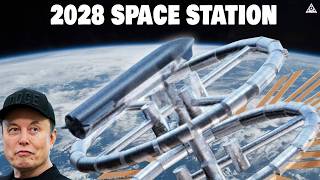

SpaceX's Starship Will Replace the ISS?
45sChallenges the common perception of space stations and hints at a revolutionary change, sparking curiosity.
▶ Play Clip"Delivers a detailed, balanced analysis of the Starship space station concept, though the title's 'not what you think' is a mild hook."
SpaceX is developing Starship to serve not only as a rocket but also as a potential space station in low Earth orbit, offering a spacious, comfortable alternative to the ISS. The video explores the feasibility, design, and challenges of this concept, including artificial gravity possibilities and safety concerns.
Existing space stations like the ISS are cramped, cluttered modules packed with pipes and equipment, unlike a comfortable home.
NASA selected seven companies to develop next-generation space stations, and SpaceX's proposal includes Starship as a destination in low Earth orbit.
Starship already has advanced life support systems designed for Mars missions, including air and water recycling, waste management, and radiation protection.
Instead of deep space travel, Starship only needs to reach 400 km orbit, avoiding re-entry and landing, making it a straightforward hop.
Starship version 3 is 52 m tall, 9 m diameter, with ~1,000 cubic meters of usable space, already larger than the ISS's 935 cubic meters.
Starship's monolithic design eliminates awkward corners and bottlenecks, allowing a vertical apartment layout with dedicated floors for labs, quarters, and gardens.
Inspired by Skylab, reusing fuel tanks could increase usable volume to ~3,000 cubic meters, accommodating 15-30 people comfortably.
Stainless steel is stronger, more repairable, and better handles micrometeoroids and temperature swings than aluminum used in the ISS.
A single Starship launch could cost under $10 million, compared to $150 billion for the ISS, enabling multiple launches and connected stations.
Multiple Starships docked in a circle could spin to create artificial gravity (0.3g to 1g), solving muscle atrophy and bone loss.
Decks include cargo hold, life support, hygiene/fitness, crew quarters, galley, lounge, research, and flight deck, with a central elevator.
Up to 93% of water is recycled, and CO2 is converted to oxygen via the Sabatier reaction, similar to a Dune stillsuit.
Astronauts must exercise at least 2 hours daily to prevent muscle atrophy and bone density loss, which can be severe in months.
Each astronaut gets a private cabin, a major upgrade from sleeping bags, with capacity for 20-24 people, possibly up to 100.
The nose cone can be a 360° observation lounge, and the flight deck serves as command center.
A monolithic structure means a leak cannot be isolated like on the ISS; the entire atmosphere could vent, requiring new leak detection systems.
Every crew member needs a guaranteed escape seat; for 20-24 crew, at least five Crew Dragons must be docked, complicating operations.
While Starship offers a revolutionary vision for space habitation with more space and comfort, significant safety and operational challenges remain, particularly regarding leak isolation and escape capacity.
What is the usable volume of Starship compared to the ISS?
Starship has ~1,000 cubic meters, larger than the ISS's 935 cubic meters.
03:27
What material is Starship built from, and why is it advantageous?
Stainless steel, which is stronger, more repairable, and better handles micrometeoroids and temperature swings than aluminum.
05:21
What is the estimated cost per Starship launch?
Under $10 million.
05:49
How does the closed-loop recycling system work?
It captures up to 93% of water from sweat, exhaled moisture, and urine, purifies it, and uses the Sabatier reaction to convert CO2 into oxygen and water.
07:10
What is the minimum daily exercise requirement for astronauts to prevent muscle atrophy?
At least 2 hours a day.
07:57
What is the main drawback of Starship's monolithic structure?
A leak cannot be isolated; the entire atmosphere could vent, requiring new leak detection systems.
09:51
How many Crew Dragons are needed for a 20-24 crew capacity?
At least five Crew Dragons docked at all times.
12:27
Simple Mission Profile
Shows that using Starship as a station is easier than Mars missions, making it a practical near-term goal.
02:34More Space Than ISS
Starship's usable volume exceeds the entire ISS, a key selling point.
03:27Dramatic Cost Reduction
Launch cost under $10M vs $150B for ISS highlights economic feasibility.
05:49Artificial Gravity Potential
Spinning multiple Starships could solve long-term health issues in space.
06:02Single Hull Vulnerability
Identifies a critical safety flaw that must be addressed.
09:51[00:01] today, your mind probably goes straight to those cramped, cluttered modules, the kind that look futuristic on the outside, but inside are an absolute mess. They're packed wall-to-wall with pipes, cables, computers, and scientific
[00:14] equipment. That's how we've been living and working in space for the past 30 years. But, SpaceX is about to change that forever. Imagine a space station that doesn't feel like a machine at all. Instead of the usual patchwork of
[00:27] modules, picture something that feels more like a real house back on Earth. Clean rooms, open layouts, very few visible wires or pipes, and a simple, elegant white and black color scheme. A place where you can actually live
[00:41] comfortably and do serious space research at the same time. It could even incorporate artificial gravity technology, so astronauts will no longer have to frantically exercise for several hours every day, all in a very human,
[00:53] down-to-earth style. So, how are they going to pull this off? Simple. They have something no one else has. Starship, the largest spacecraft ever built. But, wait, can Starship actually do that? Why not? Back in June 2023, as
[01:09] part of NASA's collaborations for commercial space capabilities, two program, basically NASA's urgent plan to deal with the ISS slowly dying day by day, they selected seven companies to help develop the next generation space
[01:23] station. And guess what? Right there on NASA's official website in plain black and white, it says, "SpaceX is collaborating with NASA on an integrated low Earth orbit architecture to provide a growing portfolio of technology with
[01:37] near-term Dragon evolution and concurrent Starship development. This architecture includes Starship as a transportation and in-space low Earth orbit destination element." So, yeah. NASA themselves already confirmed it.
[01:52] Starship isn't just a rocket anymore. It's also being developed to become an actual destination in orbit. And yes, this is genuinely feasible. In fact, it might be one of the most straightforward things SpaceX has ever attempted with
[02:05] Starship. Think about it. Starship was originally designed to keep humans alive journey to Mars. It's also meant to become part of permanent lunar bases. That means it already comes packed with advanced fully integrated life support
[02:20] systems. Everything needed to recycle air, water, manage waste, generate power, and protect the crew from radiation. All of that technology is already built in. But, here's what makes this idea so brilliant and surprisingly
[02:34] easy. Instead of flying hundreds of thousands or even millions of kilometers through deep space and then attempting a high stakes landing on another planet, this Starship only has to go up about 400 km. Basically, a quick hop into low
[02:48] Earth orbit. No dangerous re-entry, no landing burn, no interplanetary cruise. Just launch on Super Heavy, reach orbit, and stay there. It's almost embarrassingly simple. And it gets even more exciting when you look at the
[03:01] actual numbers for this incredibly versatile vehicle. Right now, we're only versatile vehicle. Right now, we're only on Starship version 3, 52 m tall and 9 m in diameter. But, Elon Musk is already planning version 4, which will stretch
[03:14] to a staggering 61 m long. That's like a 17-story skyscraper floating in space. The total internal volume, around 3,800 cubic meters. Sure, about 2,800 cubic
[03:27] meters of that will be taken up by the massive liquid methane and liquid oxygen tanks. But, even after that, you still have roughly 1,000 cubic meters of usable living space, already bigger than the entire International Space Station,
[03:41] the entire International Space Station, which only has 935 cubic meters. And the best part, we can launch the whole thing in one single flight instead of spending more than a decade launching dozens of modules, assembling them in orbit, and
[03:54] hoping everything connects properly. On top of that, the Starship space station completely solves one of the biggest weaknesses of today's stations, like the ISS and China's Tiangong, that patchwork
[04:08] modular design. All those awkward corners and narrow bottlenecks make living up there feel more like being stuck inside a submarine than exploring the final frontier. Starship fixes this problem once and for all thanks to its
[04:21] enormous size. It lets engineers design the interior like a vertical apartment building with multiple decks. You can have an entire floor dedicated to a state-of-the-art research lab, another for private sleeping quarters, and even
[04:34] a zero-gravity garden growing fresh vegetables. And the absolute highlight, the nose cone at the very top. That area can be transformed into a breathtaking 360° observation lounge where you can watch the Earth spin below you and stare
[04:50] out into the infinite cosmos like never before. Here's what's really clever. If we reuse those giant fuel tanks after reaching orbit, an idea directly inspired by NASA's Skylab project from the 1970s, the usable volume can jump
[05:05] all the way up to around 3,000 cubic meters. That's enough room for 15 to 30 people to live in serious comfort compared to the ISS's usual crew of just seven. Another huge advantage is the material. While the ISS is mostly made
[05:21] of aluminum, Starship is built from stainless steel, a far tougher material that handles micrometeoroid impacts and tense radiation and with extreme temperature swings much better. Stainless steel is not only stronger,
[05:35] it's also easier to repair and has a much longer lifespan in space. And then there's the part that still sounds insane, the cost. A single Starship launch could come in under $10 million, ridiculously cheap when you compare it
[05:49] to the 150 billion dollars it took to build and maintain the ISS. At that price, we won't just launch one. We could launch dozens of them and connect them together. And that opens the door to an even wilder idea. Imagine multiple
[06:02] Starships docked in a giant circle spinning to create artificial gravity through centrifugal force anywhere from 0.3g all the way up to 1g. That single feature could completely solve the
[06:15] biggest long-term problem in space, brittle bones and muscle atrophy after months in microgravity. And the story becomes truly fascinating once you step inside and see how life would actually feel aboard a Starship space station. As
[06:31] we've discussed, the interior is organized into multiple decks. At the very bottom, deck one serves as the cargo hold and unpressurized airlock. This is where EVA suits, surface rovers, and exploration equipment are stored. A
[06:44] central elevator runs through the core of the ship, making it easy to move between decks in microgravity. Right above it on deck two is the engineering heart of the station, the environmental control and life support system. This is
[06:57] where water recycling, oxygen generation, and air conditioning all come together. SpaceX engineers place these heavy systems low in the vehicle to keep the center of mass stable. One of the most impressive technologies here
[07:10] is the closed-loop recycling system. It works almost exactly like the stillsuit from Dune. Up to 93% of the crew's water from sweat, exhaled moisture, and even urine is captured, purified, and turned back into clean drinking water. Using
[07:26] the Sabatier reaction, CO2 is converted into fresh oxygen and more water, creating a highly efficient, nearly self-sustaining life support loop. Of reality. The air sometimes carries a faint recycled smell that crews jokingly
[07:42] call P air. The water tanks lining the walls also double as a natural radiation shield, giving the crew a safe place to hunker down during solar storms. Moving up to deck three, you reach the hygiene and fitness zone. Compact toilets and
[07:57] showers are placed along the curved walls to save space. Exercise here is mandatory at least 2 hours a day on resistance machines, treadmills with harnesses or stationary bikes. Without it, muscles atrophy rapidly and bones
[08:11] lose density at an alarming rate. In just a few months, an astronaut could return to Earth weaker than a healthy 7-year-old with bones as fragile as glass. Deck four is dedicated to private crew quarters. Thanks to Starship's
[08:24] massive volume, each astronaut gets their own private cabin, a huge upgrade from the sleeping bags Velcro to the walls on earlier stations. Realistic plans show a comfortable capacity of 20 to 24 people, though Elon has boldly
[08:39] suggested it could eventually support up to 100. Deck five houses the galley and dining area. You can't fry an egg in microgravity, but rehydrated meals, advanced food tech, and small hydroponic gardens will provide far more variety
[08:54] than today's astronauts enjoy. Imagine biting into fresh lettuce or tomatoes grown on board after months in space. That would feel like pure luxury. For relaxation and social time, head to deck six. The communal lounge, large windows,
[09:09] big screens, and VR systems help keep minds sharp during long missions. Right above that, deck seven functions as the research and operations level, a modern workspace for science data analysis and experiments. At the very top is the
[09:24] flight deck offering the best views and serving as the command center. This coffee that actually pours, and prevent most of the long-term health damage caused by weightlessness. To solve the challenge of docking while spinning,
[09:37] engineers envision a non-rotating central hub where visiting cargo and crew vehicles can connect smoothly before transferring into the rotating sections. But before you get completely swept away by that bright vision, let's
[09:51] hit the brakes for a moment because this idea does come with some serious drawbacks. The very thing that makes it so convenient is also its biggest weakness. It's one single monolithic structure. On the ISS, the station is
[10:05] made up of separate modules connected by hatches that can be completely sealed. It's complicated, but if one module starts leaking, you close the hatch, while the rest of the station stays safe. That's exactly what happened with
[10:21] Russia's Zvezda module. Launched in 2000, it began leaking air from the PRK transfer tunnel area in 2019. By April 2024, the leak had worsened to By April 2024, the leak had worsened to 3.7 lb of air per day. NASA rated it at
[10:36] the highest internal risk level, five out of five, but the crew was never in immediate danger because they could simply close the hatches and isolate that section. Starship doesn't have that luxury. With one giant continuous hull,
[10:49] if a pressure leak occurs, whether from a micro meteoroid strike, a fatigue crack after years of extreme thermal cycling, or a material failure, the entire 1,000-plus cubic meters of atmosphere inside would start venting
[11:03] into space. No hatches to close, no modules to isolate. You'd have one big house with a hole in it and the air rushing out. Even worse, detecting a leak in space is incredibly difficult. Air escaping from one atmosphere into
[11:18] vacuum doesn't make much audible noise inside the spacecraft. Unlike industrial leaks on Earth, it's nearly silent. With Starship, you'd have to design an entire internal leak detection and suppression system from scratch across
[11:32] one continuous volume. SpaceX could of course install internal pressure bulkheads to divide the Starship into separate sealable compartments. But that would essentially bring back the complexity of modular design just in
[11:45] a different form. And if they don't, then the only real backup plan in case of a major leak is rapid evacuation, which brings us to the second major challenge. There's an ironclad rule in crude space operations. Every person on
[11:59] the station must have a guaranteed seat on an escape vehicle at all times. If the station operates with seven crew members, same as the current ISS, SpaceX would need at least two Crew Dragons docked simultaneously since each Dragon
[12:13] carries a maximum of four people. That means two docking ports permanently occupied by rescue ships. Minimum. If we scale up to the more realistic 20-24 crew capacity, you'd need at least five
[12:27] Crew Dragons docked at all times. Five ships, five docking ports, and an extremely complex crew rotation schedule to make sure you never have more people on board than available escape seats. And if Elon's bolder vision of 100
[12:41] people ever comes true, then you'd need 25 Crew Dragons docked at once. In theory, it's possible. But in practice, your space station would start looking more like a giant metallic porcupine surrounded by dragons than a clean,
[12:57] elegant orbital habitat. So, what's your take on the Starship space station feasible? Drop your thoughts in the comments below. Thanks for watching.



⚡ Saved you 0h 13m reading this? Transcribe any YouTube video for free — no signup needed.