
SpaceX's Starship Space Station: A Real House in Orbit?
60sThe contrast between cramped ISS modules and a spacious, comfortable Starship station sparks curiosity and imagination.
▶ Play Clip"Delivers on the promise of explaining Starship's space station potential, but includes some speculative sections and promotional content."
The video discusses SpaceX's plan to transform Starship into a space station, highlighting its potential advantages over the ISS, including larger volume, lower cost, and possible artificial gravity. It also addresses significant challenges such as leak risks and crew escape requirements, and touches on the Artemis 3 mission's use of Starship HLS.
SpaceX is developing Starship to serve as a space station, offering a more comfortable and spacious interior compared to current modular stations like the ISS.
NASA's CCSC-2 program includes SpaceX's Starship as a low Earth orbit destination, confirming its role beyond a rocket.
Starship only needs to reach low Earth orbit (~400 km), avoiding complex deep space maneuvers, making it a straightforward application.
Starship V3 is 52m tall, 9m diameter, with ~1000 cubic meters usable volume, larger than the ISS's 935 cubic meters. Version 4 will be 61m long.
Inspired by Skylab, reusing fuel tanks could increase usable volume to ~3000 cubic meters, supporting 15-30 people comfortably.
Starship's stainless steel construction is tougher than aluminum, better handling micrometeoroids, radiation, and temperature swings, with longer lifespan.
A single Starship launch could cost under $10 million, versus $150 billion for the ISS, enabling multiple stations or larger configurations.
Multiple Starships docked in a rotating circle could generate artificial gravity (0.3G to 1G), mitigating health issues like bone density loss.
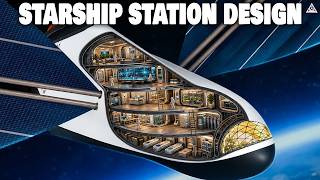
Decks include cargo hold, life support, hygiene/fitness, private quarters, galley, lounge, research, and flight deck with 360° views.
Up to 93% of water is recycled, and CO2 is converted to oxygen via Sabatier reaction, creating a nearly self-sustaining life support system.
A single monolithic hull means a leak could vent the entire atmosphere, unlike modular stations where sections can be isolated.
Every crew member needs a guaranteed escape seat; for 20-24 crew, at least five Crew Dragons must be docked, complicating operations.
Artemis 3 involves Blue Origin's Blue Moon, SLS/Orion, and Starship HLS, with Starship taking control after docking, testing critical maneuvers.
NASA's Neutral Buoyancy Lab has a full-scale Starship HLS mock-up for astronaut training, showing two airlocks and a longer elevator arm.
Two airlocks provide single failure tolerance and allow cross-venting to conserve atmosphere, a shift from Apollo's no-backup approach.
The elevator is a top risk; if it fails, astronauts have no backup way back into the vehicle. NASA is developing contingency options.
Underwater training simulates lunar gravity (1/6 G) using tungsten weights, verifying procedures and hardware before actual missions.
Starship HLS has a 9m diameter, with living area near the nose and propellant tanks below. Landing engines are mounted high to avoid regolith.
Slopes up to 20° at the lunar South Pole pose a tipping risk, but the center of mass is low due to engines and propellant, and self-leveling legs help.
Starship offers a promising, cost-effective path to a large space station, but significant engineering challenges like leak containment and crew escape must be solved. The Artemis 3 mission will test critical docking and control capabilities, while the NBL mock-up shows iterative design improvements.
What is the usable volume of Starship V3?
About 1,000 cubic meters, larger than the ISS's 935 cubic meters.
03:29
What material is Starship built from?
Stainless steel, which is tougher than aluminum and better for radiation and temperature swings.
05:26
What is the estimated cost per Starship launch?
Under $10 million, compared to $150 billion for the ISS.
05:40
How does the closed-loop recycling system work?
It captures up to 93% of water from sweat, exhaled moisture, and urine, and uses the Sabatier reaction to convert CO2 into oxygen and water.
07:18
What is the main risk of a monolithic hull?
A leak could vent the entire atmosphere, with no way to isolate sections.
09:53
How many Crew Dragons are needed for 20-24 crew?
At least five, each carrying a maximum of four people.
12:27
What is the purpose of two airlocks on Starship HLS?
Redundancy and cross-venting to conserve atmosphere.
17:18
What is the elevator risk on Starship HLS?
If it fails, astronauts have no backup way back into the vehicle.
20:12
How does the NBL simulate lunar gravity?
By adjusting buoyancy and adding tungsten weights to achieve 1/6 G.
21:48
NASA Confirms Starship as Destination
Official NASA documentation confirms Starship's role as a space station, lending credibility to the concept.
01:09Starship Volume Exceeds ISS
A single Starship has more usable volume than the entire ISS, enabling a paradigm shift in space habitat design.
03:29Cost Revolution
The potential sub-$10 million launch cost could make space stations economically viable for many more entities.
05:40Dune-like Water Recycling
The closed-loop system recovers 93% of water, a critical technology for long-duration missions.
07:18Monolithic Hull Risk
The single-hull design poses a unique safety challenge, contrasting with modular stations' isolation capability.
09:53Escape Seat Rule
The requirement for guaranteed escape seats significantly complicates crew capacity and operations.
12:00Two Airlocks for Redundancy
This design choice reflects a shift from Apollo's no-backup approach to modern single-failure tolerance.
17:18NBL Training
Underwater training with tungsten weights validates procedures and hardware before actual lunar missions.
21:48[00:01] today, your mind probably goes straight to those cramped, cluttered modules, the kind that look futuristic on the outside, but inside are an absolute mess. They're packed wall-to-wall with pipes, cables, computers, and scientific
[00:14] equipment. That's how we've been living and working in space for the past 30 years. But SpaceX is about to change that forever. Imagine a space station that doesn't feel like a machine at all. Instead of the usual patchwork of
[00:27] modules, picture something that feels more like a real house back on Earth. Clean rooms, open layouts, very few visible wires or pipes, and a simple, elegant white and black color scheme. A place where you can actually live
[00:41] comfortably and do serious space research at the same time. It could even incorporate artificial gravity technology, so astronauts will no longer have to frantically exercise for several hours every day, all in a very human,
[00:53] down-to-earth style. So, how are they going to pull this off? Simple. They have something no one else has. Starship, the largest spacecraft ever built. But, wait. Can Starship actually do that? Why not? Back in June 2023, as
[01:09] part of NASA's Collaborations for Commercial Space Capabilities 2 Program, basically NASA's urgent plan to deal with the ISS slowly dying day by day, develop the next generation space station. And guess what? Right there on
[01:25] NASA's official website, in plain black and white, it says, "SpaceX is collaborating with NASA on an integrated low Earth orbit architecture to provide a growing portfolio of technology with near-term Dragon evolution and
[01:39] concurrent Starship development. This architecture includes Starship as a transportation and in-space low Earth orbit destination element." So, yeah. NASA themselves already confirmed it. Starship isn't just a rocket anymore.
[01:54] It's also being developed to become an actual destination in orbit. And yes, this is genuinely feasible. In fact, it might be one of the most straightforward things SpaceX has ever attempted with Starship. Think about it. Starship was
[02:08] for 8 months straight on the long journey to Mars. It's also meant to become part of permanent lunar bases. That means it already comes packed with advanced fully integrated life support systems. Everything needed to recycle
[02:22] air, water, manage waste, generate power, and protect the crew from radiation. All of that technology is already built in. But, here's what makes this idea so brilliant and surprisingly easy. Instead of flying hundreds of
[02:36] thousands or even millions of kilometers through deep space and then attempting a high stakes landing on another planet, this Starship only has to go up about 400 km. Basically, a quick hop into low Earth orbit. No dangerous re-entry, no
[02:50] landing burn, no interplanetary cruise. Just launch on super heavy reach orbit there. It's almost embarrassingly simple. And it gets even more exciting when you look at the actual numbers for
[03:02] this incredibly versatile vehicle. Right now, we're only on Starship version 3 52 now, we're only on Starship version 3 52 m tall and 9 m in diameter. But, Elon Musk is already planning version 4, which will stretch to a staggering 61 m
[03:16] long. That's like a 17-story skyscraper floating in space. The total internal volume around 3,800 cubic meters. Sure, about 2,800 cubic meters of that will be
[03:29] taken up by the massive liquid methane and liquid oxygen tanks. But, even after that, you still have roughly 1,000 cubic meters of usable living space, already bigger than the entire International Space Station, which only has 935 cubic
[03:44] meters. And the best part, we can launch the whole thing in one single flight instead of spending more than a decade launching dozens of modules, assembling them in orbit, and hoping everything connects properly. On top of that, the
[03:58] Starship space station completely solves one of the biggest weaknesses of today's one of the biggest weaknesses of today's stations, like the ISS and China's Tiangong, that patchwork modular design. All those awkward corners and narrow
[04:11] bottlenecks make living up there feel more like being stuck inside a submarine than exploring the final frontier. Starship fixes this problem once and for all, thanks to its enormous size. It lets engineers design the interior like
[04:25] a vertical apartment building with multiple decks. You can have an entire floor dedicated to a state-of-the-art research lab, another for private zero-gravity garden growing fresh vegetables. And the absolute highlight,
[04:39] the nose cone at the very top. That area can be transformed into a breathtaking 360° observation lounge, where you can watch the Earth spin below you and stare out into the infinite cosmos like never before. Here's what's really clever. If
[04:55] we reuse those giant fuel tanks after reaching orbit, an idea directly inspired by NASA's Skylab project from the 1970s, the usable volume can jump all the way up to around 3,000 cubic meters. That's enough room for 15 to 30
[05:11] people to live in serious comfort compared to the ISS's usual crew of just seven. Another huge advantage is the material. While the ISS is mostly made of aluminum, Starship is built from stainless steel, a far tougher material
[05:26] that handles micrometeoroid impacts and tense radiation and with extreme temperature swings much better. Stainless steel is not only stronger, it's also easier to repair and has a much longer lifespan in space. And then
[05:40] there's the part that still sounds insane, the cost. A single Starship launch could come in under $10 million, ridiculously cheap when you compare it to the $150 billion it took to build and maintain the ISS. At that price, we
[05:55] dozens of them and connect them together. And that opens the door to an even wilder idea. Imagine multiple Starships docked in a giant circle spinning to create artificial gravity through centrifugal force anywhere from
[06:09] through centrifugal force anywhere from 0.3 G all the way up to 1 G. That single feature could completely solve the biggest long-term problem in space, brittle bones and muscle atrophy after months in microgravity. And the story
[06:23] becomes truly fascinating once you step inside and see how life would actually feel aboard a Starship space station. As we've discussed, the interior is organized into multiple decks. At the very bottom, deck one serves as the
[06:37] cargo hold and unpressurized airlock. This is where EVA suits, surface rovers, and exploration equipment are stored. A central elevator runs through the core of the ship, making it easy to move between decks in microgravity. Right
[06:51] above it on deck two is the engineering heart of the station, the environmental control and life support system. This is where water recycling, oxygen generation, and air conditioning all come together. SpaceX engineers place
[07:04] these heavy systems low in the vehicle to keep the center of mass stable. One of the most impressive technologies here is the closed-loop recycling system. It works almost exactly like the stillsuit from Dune. Up to 93% of the crew's water
[07:18] from sweat, exhaled moisture, and even urine is captured, purified, and turned back into clean drinking water. Using the Sabatier reaction, CO2 is converted into fresh oxygen and more water, creating a highly efficient, nearly
[07:33] self-sustaining life support loop. Of course, there's one less glamorous reality, the air sometimes carries a faint recycled smell that crews jokingly call pea air. The water tanks lining the walls also double as a natural radiation
[07:47] shield, giving the crew a safe place to hunker down during solar storms. Moving up to deck three, you reach the hygiene and fitness zone. Compact toilets and showers are placed along the curved walls to save space. Exercise here is
[08:01] mandatory at least two hours a day on resistance machines, treadmills with harnesses or stationary bikes. Without it, muscles atrophy rapidly and bones lose density at an alarming rate. In just a few months, an astronaut could
[08:15] return to Earth weaker than a healthy 7-year-old with bones as fragile as glass. Deck four is dedicated to private crew quarters. Thanks to Starship's massive volume, each astronaut gets their own private cabin, a huge upgrade
[08:29] from the sleeping bags Velcro'd to the walls on earlier stations. Realistic plans show a comfortable capacity of 20 to 24 people, though Elon has boldly suggested it could eventually support up to 100. Deck five houses the galley and
[08:44] dining area. You can't fry an egg in microgravity, but rehydrated meals, advanced food tech, and small hydroponic gardens will provide far more variety Imagine biting into fresh lettuce or
[08:58] tomatoes grown on board after months in space, that would feel like pure luxury. For relaxation and social time, head to deck six. The communal lounge, large windows, big screens, and VR systems help keep minds
[09:12] sharp during long missions. Right above that, deck seven functions as the research and operations level, a modern workspace for science data analysis and experiments. At the very top is the flight deck offering the best views and
[09:26] would let people walk normally, drink coffee that actually pours, and prevent most of the long-term health damage caused by weightlessness. To solve the challenge of docking while spinning, engineers envisioned a non-rotating
[09:40] central hub where visiting cargo and crew vehicles can connect smoothly before transferring into the rotating sections. But, before you get completely swept away by that bright vision, let's hit the brakes for a moment because this
[09:53] idea does come with some serious drawbacks. The very thing that makes it so convenient is also its biggest weakness. It's one single monolithic structure. On the ISS, the station is made up of dozens of separate modules
[10:07] connected by hatches that can be completely sealed. It's complicated, but if one module starts leaking, you close the hatch, isolate the problem, and deal with it while the rest of the station stays safe. That's exactly what happened
[10:21] with Russia's Zvezda module. Launched in 2000, it began leaking air from the PRK transfer tunnel area in 2019. By April 2024, the leak had worsened to By April 2024, the leak had worsened to 3.7 lb of air per day. NASA rated it at
[10:36] the highest internal risk level, five out of five, but the crew was never in immediate danger because they could simply close the hatches and isolate that section. Starship doesn't have that luxury. With one giant continuous hull,
[10:49] if a pressure leak occurs, whether from a micrometeoroid strike, a fatigue crack after years of extreme thermal cycling, or a material failure, the entire 1,000-plus cubic meters of atmosphere inside would start venting into space.
[11:04] No hatches to close, no modules to isolate. You'd have one big house with a hole in it and the air rushing out. Even worse, detecting a leak in space is incredibly difficult. Air escaping from one atmosphere into vacuum doesn't make
[11:19] much audible noise inside the spacecraft. Unlike industrial leaks on Earth, it's nearly silent. With Starship, you'd have to design an entire internal leak detection and suppression system from scratch across
[11:32] one continuous volume. SpaceX could of course install internal pressure bulkheads to divide the Starship into separate sealable compartments, but that would essentially bring back the complexity of modular design just in a
[11:45] different form. And if they don't, then the only real backup plan in case of a major leak is rapid evacuation, which brings us to the second major challenge. There's an ironclad rule in crude space operations. Every person on the station
[12:00] must have a guaranteed seat on an escape vehicle at all times. If the station operates with seven crew members, same as the current ISS, SpaceX would need at least two Crew Dragons docked simultaneously since each Dragon
[12:13] carries a maximum of four people. That means two docking ports permanently means two docking ports permanently occupied by rescue ships, minimum. If we scale up to the more realistic 20 to 24 crew capacity, you'd need at least five
[12:27] Crew Dragons docked at all times. Five ships, five docking ports, and an extremely complex crew rotation schedule to make sure you never have more people on board than available escape seats. And if Elon's bolder vision of 100
[12:41] people ever comes true, then you'd need 25 Crew Dragons docked at once. In theory, it's possible, but in practice, your space station would start looking more like a giant metallic porcupine surrounded by dragons than a clean
[12:57] elegant orbital habitat. So, what's your take on the Starship space station feasible? Drop your thoughts in the comments below. Thanks for watching. On July 15th, NASA published a detailed breakdown of exactly how Artemis 3 is
[13:13] going to work. And there's a part in there that I think is worth talking about. So, here's the plan. Within a relatively short window, three heavy-lift rockets will lift off from three separate launch pads. Blue Origin
[13:25] goes first, sending Blue Moon into orbit. Then, SLS launches carrying four actual astronauts aboard Orion. So, yes, real people are on this flight. SpaceX's
[13:37] Starship goes up last. From there, Orion has to find Blue Moon, dock with it, undock, then go find Starship, dock again, and only then bring the crew home. The reason for this order comes down to what
[13:50] each vehicle actually offers. Blue Moon has a real crew cabin, so the astronauts can go inside, move around, and gather actual data on the habitat environment. Starship, on the other hand, has no crew cabin, which sounds strange, right?
[14:05] And here's where it gets interesting. SpaceX isn't bringing the familiar white Starship HLS up to orbit. As NASA themselves put it, SpaceX plans to use their latest version of Starship, called
[14:18] version three, the basis of the future HLS. So, what shows up is essentially a standard Starship V3, steel hull, black heat shield tiles, control flaps, but
[14:30] with one key addition, a docking port mounted right at the nose. The most significant part, though, is what happens after docking. Starship takes over primary control of the entire combined stack. And this isn't just a
[14:43] handoff on paper. Starship is dramatically larger and heavier than Orion, with a completely different mass distribution and rotational inertia. Every maneuver, every attitude hold, every small orbital correction sends
[14:57] forces through that docking port. The software has to be precise enough that it doesn't cause the stack to oscillate, overstress the connection, or push Orion into an unsafe attitude. So, the real question this mission has to answer is,
[15:10] can Orion dock with Starship, hand over control, and still keep four astronauts safe throughout? That's the critical test. And if you want to follow how it plays out, make sure you're subscribed. Now, if you're wondering where the
[15:24] actual HLS is right now and what the interior looks like, for that, we need to go somewhere a little unexpected. A structure nearly the length of a football field. NASA bought an old McDonnell Douglas warehouse near
[15:37] Houston, poured in 6.2 million gallons of water, and sank full-scale replicas of ISS modules straight to the bottom. That became the Neutral Buoyancy Laboratory, the NBL. For nearly 30 years, every single ISS astronaut has
[15:51] trained here. But here's what's interesting. Sitting right next to those ISS modules at the bottom of that pool, there's now something new. A full-scale mock-up of the Starship HLS, the vehicle SpaceX built to put humans back on the
[16:05] moon within this decade. A video quietly circulating on social media shows that NASA and SpaceX are already training astronauts on that mock-up right here at this facility. But more importantly, the mock-up itself looks sig- nificantly
[16:20] different from anything we've seen before. Two details in particular have the community talking. First, there are now two airlocks sitting inside that 9-m stainless steel ring at the base of the HLS. And second, the elevator, the thing
[16:35] cabin all the way down to the lunar surface, looks noticeably longer than before. So, what does that actually mean? Let's start with the airlocks. If you've been following HLS Starship for a while, the confirmed design already
[16:50] called for two airlocks, each about 13 cubic meters, double the interior volume of the Apollo lunar module. But there's a big difference between seeing that on a render and seeing it physically built into a mock-up at the bottom of NASA's
[17:04] training pool. That means people are actually getting in in suits, running real procedures. So, why two airlocks? The obvious answer is speed. But the more important reason is redundancy. If one astronaut goes outside and gets
[17:18] stuck at the airlock door, the person inside needs another way out to help. That's single failure tolerance. The system absorbs one failure without it becoming a catastrophe. And this represents a fundamental shift from how
[17:31] NASA used to approach lunar missions. The night Armstrong and Aldrin landed on the moon, the White House already had a disaster speech ready. Nixon's speech writer had prepared in event of moon disaster. Nixon would call the widows
[17:43] personally. A priest would perform a burial at sea ceremony, and NASA would cut all communication with Eagle and leave them to die in silence. There was no backup lander, no second option. The technology and the Cold War timeline
[17:57] simply didn't allow for it. That's not acceptable anymore. Beyond redundancy, two airlocks also allow cross-venting. Instead of dumping the entire atmosphere to vacuum every time someone goes outside, you transfer it to the second
[18:10] airlock and recover most of it. On a mission where every kilogram had to be launched from Earth, refueled in orbit, and flown to the moon, that efficiency actually matters. And operationally, two airlocks give the two astronauts on the
[18:24] surface more flexibility. One goes out to prep, while the other monitors from inside, then they swap. Artemis third will only have two people on the lunar surface, no third crew member staying behind as backup. It's a deliberate
[18:37] calculation. The first crewed lunar landing in over 50 years is risky enough that you minimize exposure and build redundancy into the hardware instead. So, is two airlocks genuinely smart engineering, or is SpaceX
[18:50] overcomplicating things? What do you think? The second thing, and this one is actually more concerning, is the elevator. You can actually see it in the video. The elevator rail system protruding outward from the hole, right
[19:03] near those two airlocks, noticeably further out than anything we've seen in further out than anything we've seen in previous mock-ups or design renders. So, why the change? Picture Starship HLS standing on the moon. 50 m tall, landing
[19:17] legs spread wide, engine cluster sitting at the base. The elevator basket has to travel along the outside of that hole the entire way. From the crew cabin near the top all the way down to the lunar surface, fully exposed, running right
[19:31] alongside those landing legs at the bottom. If the arm isn't long enough, the basket risks clipping the legs on the way down or hitting a bad approach especially at the lunar South Pole, where terrain can slope up to 20°. And
[19:45] standing perfectly vertical after touchdown. A longer arm buys more clearance from the hole and the legs, improves the approach angle to the surface, and adds stability when the basket is carrying an astronaut in a
[19:58] full EVA suit weighing tens of kilograms. This is exactly the kind of small adjustment that only shows up after someone actually gets into the suit, goes underwater, and discovers the problem firsthand. But, there's a much
[20:12] bigger issue sitting underneath all of this. If the elevator fails while both astronauts are standing on the lunar surface, there is currently no other way back into the vehicle. No backup ladder, no external handholds, no secondary
[20:26] route. The HLS program has officially classified the elevator as a top risk and is actively working with SpaceX to develop contingency options. Redundant winches, detachable cable mechanisms that could theoretically be used to haul
[20:40] crew up manually. Not a perfect answer, but at least the thinking is going in the right direction. SpaceX says they're focused on a robust, redundant design, though the specific details haven't been made public yet. What makes this even
[20:54] more uncomfortable is what NASA's own Office of Inspector General put in its March 2026 report. The elevator will never have been tested in actual lunar conditions before crew who on it. The current uncrewed demonstration flight
[21:08] plan doesn't require the elevator to be included, which means the first time this system operates in a real lunar environment, real regolith, real thermal extremes, real 1/6 gravity, there will be two astronauts on the surface
[21:22] the question the community keeps coming back to. The longer arm in the NBL mock-up is a good sign. It means the hardware is evolving based on real feedback from real people in real suits.
[21:35] But the gap between tested in a pool in Houston and first use on the moon with no backup is still very much there. And while we're on the subject of the pool, someone always asks the obvious question, why use a swimming pool to
[21:48] in lunar gravity? The answer comes straight from NASA's own data. When an astronaut is suited up underwater, the buoyancy can be adjusted to simulate exactly 1/6 G, the same gravity as the
[22:01] moon. To achieve what they call a lunar way out, technicians have to strap roughly 90 lb of additional weight onto the suit. And because lead weights are too bulky, they switch to tungsten, twice the density, same mass, far less
[22:15] bulk on the suit. The NBL isn't just a training pool, it's the place where every judgment call gets verified before anyone sets foot on the moon for real. Is this space wide enough? Can an astronaut actually operate this in a
[22:28] pressurized suit? How long does this step actually take? All of it gets another question that keeps coming up in the community. What exactly are they doing with all that open space inside the vehicle? Starship HLS has a diameter
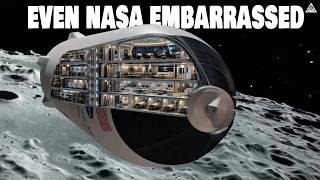
[22:43] of 9 m, roughly the width of a house. The crew living area sits up near the nose, but the entire lower section of the hull, that massive steel cylinder, is propellant tank, not living space. The vehicle looks hollow from the
[22:57] outside, and that's intentional. Starship HLS is a heavily modified variant of the standard Starship. Landing engines mounted high on the hull to avoid blasting lunar regolith during descent, airlocks and elevator for EVA
[23:10] operations, no heat shield or aerodynamic fins because it never returns to Earth, and a docking port for Orion. That design also explains why the stability question comes up so often. A 14-story structure standing on lunar
[23:24] terrain that can slope up to 20° at the South Pole. That sounds like a problem. The OIG report flagged it directly. Slopes of that angle present real navigation and landing challenges, and given Starship's height of 171 ft,
[23:38] there's a genuine risk that landing momentum could continue after touchdown and tip the vehicle over. But the counter argument holds up, too. The engines and thrust structure, the heaviest components on the vehicle, sit
[23:50] entirely at the base. Right above them is the liquid oxygen tank, which holds roughly 80% of the total ascent propellant mass. The vehicle looks top-heavy from the outside, but the actual center of mass sits much lower
[24:02] than it appears. Both concerns are legitimate. The tipping risk is real, and NASA has accounted for it through self-leveling landing legs. Whether be fully answered until the vehicle actually lands somewhere other than a
[24:16] actually lands somewhere other than a concrete pad in Texas.

⚡ Saved you 0h 24m reading this? Transcribe any YouTube video for free — no signup needed.