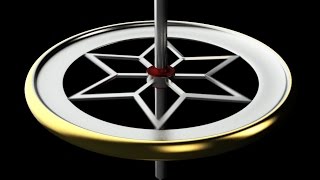

Gyroscope Defies Gravity?
59sThe visual of the gyroscope seeming to defy gravity is inherently fascinating and counterintuitive, making it perfect for shareable short-form content.
▶ Play Clip"Title is accurate but understated; content delivers solid physics explanations with some sponsor fluff."
This video from Vsauce explores the fascinating physics of spinning objects, focusing on gyroscopes, the Coriolis effect, and the Eötvös effect. Through demonstrations and clear explanations, it reveals why spinning things are so stable and how Earth's rotation influences motion and weight.
The video is sponsored by the Curiosity Box by Vsauce, which contains science gear. A portion of proceeds goes to Alzheimer's research.
A gyroscope appears to defy gravity when spun. Its axis remains fixed in space, allowing it to be used to observe Earth's rotation.
A ball swung on a rope follows a circular path due to centripetal force, which continuously changes the direction of velocity. There is no outward centrifugal force; it's an illusion from inertia.
When centripetal force is removed, an object continues on a tangent path. The initial separation appears radial but later shows a curved relative path due to the Coriolis effect.
A downward force on a spinning object produces a tilt 90° ahead in the direction of spin, causing precession. This is demonstrated with a cardboard disc and a bicycle wheel.
A spinning bicycle wheel supported by a string precesses instead of falling, illustrating how torque applied to a spinning object results in a perpendicular motion.
Due to Earth's rotation, objects moving north or south appear to drift east or west. This is because different latitudes have different rotational velocities.
Dropped objects from high altitude fall slightly east, and objects thrown upward curve west, because higher altitudes have higher tangential velocities.
A person weighs less when traveling east and more when traveling west due to the added or subtracted velocity relative to Earth's spin, changing the centripetal acceleration.
The physics of spinning objects reveals counterintuitive behaviors like precession and the Coriolis effect, which have practical implications from navigation to weight measurement.
What is a gyroscope?
A spinning device whose axis remains fixed in space, used to observe Earth's rotation.
01:30
Why does a gyroscope appear to defy gravity?
Due to precession: torque applied to a spinning object results in a motion 90° ahead in the direction of spin.
08:56
What is the difference between centripetal and centrifugal force?
Centripetal force is real and acts toward the center; centrifugal force is fictitious and arises from inertia in a rotating frame.
03:50
What happens to a ball in orbit if centripetal force is removed?
It continues on a tangent path, not directly outward.
04:36
What causes the Coriolis effect?
Different latitudes have different rotational velocities; moving objects retain their original velocity and appear to drift.
12:55
Why does an object thrown north from the equator drift east?
It retains the higher eastward velocity of the equator and moves ahead of slower-moving northern locations.
13:11
What is the Eötvös effect?
Apparent weight changes due to east-west travel; traveling east reduces weight, traveling west increases it.
14:30
How much does an airplane flying east at the equator weigh less?
About 0.9% less.
15:12
Who discovered the Eötvös effect?
Baron Roland von Eötvös in the early 1900s.
14:30
Centripetal force explanation
Clearly distinguishes real centripetal force from fictitious centrifugal force.
02:37Precession mechanism
Shows how torque on a spinning object acts 90° ahead, explaining gyroscope stability.
08:56Coriolis effect demonstration
Explains why north-south objects drift east-west due to differing rotational speeds.
11:57Eötvös effect
Reveals that weight depends on direction of travel relative to Earth's spin.
14:30[00:04] head delivered to your door in a box well too bad I only have one head and I already called dibs on it plus my neck is like pure muscle this head ain't never coming off the next best thing is what actually comes in the Curiosity Box
[00:21] by Vsauce it is chalk full of science gear designed by us it's pretty amazing and a portion of all proceeds go to alzheimer's research so a subscription
[00:34] isn't just good for your brain it's good for all of our brains now if you subscribe right now there's still time to get this box the latest one it is of this video a
[00:48] video a gyroscope if you hold a gyroscope in the gyroscope if you hold a gyroscope in the palm of your hand upright like this
[01:00] surprising you see the trick is to take the included string and thread it the included string and thread it through a hole and then spin the disc around so the string wraps around and around and around and around once it's
[01:14] sufficiently wound up hold the outside and give the string a firm and give the string a firm pull ah yeah now the gyroscope appears to defy gravity the axis it spins around is like glued in place almost
[01:30] cosmically if you could get this to spin long enough you could actually watch as that access did move but not because it actually moved because you and Earth moved around it that's actually where it gets its name Gyro scope you can use it
[01:47] gets its name Gyro scope you can use it to scope watch the gyro gyration rotation of the earth as Leon Fuko did in 1852 when the device got its name but how does it work why are spinning things so stable also
[02:04] watch this if I give it a good Spin and then hang it from its own string then hang it from its own string sideways it will remain parallel to the ground but process around to get to the bottom of what's up
[02:20] around to get to the bottom of what's up or what up as the cool kids are saying nowadays Begin by imagining yourself swinging a ball around your head on a rope even though the ball is following a curved path its velocity is at any given
[02:37] curved path its velocity is at any given instant straight tangent to its path you can demonstrate this to yourself by letting go the ball will shoot out at the velocity it had at the moment you let go it doesn't curve away or fly
[02:52] directly away while rotating the Rope keeps the ball always at the same distance from the center which means continuously changing the direction of the ball's velocity now that requires force and in this case that force is
[03:07] delivered by tension in the Rope the same intermolecular forces that attract neighboring rope molecules to each other and are the reason the Rope doesn't just disintegrate also resist the ball's momentum acting on it such that its
[03:23] velocity changes every next instant so as to always follow a circular path this Center seeking force that acts on the ball is called a centripedal force
[03:36] the ball is called a centripedal force it can be provided by a rope an entire disc of material something invisible like gravity or from The Other Side by a wall or banked track side note notice
[03:50] that there is no force acting on the ball that goes directly outward away from the center what we often hear called a centrifugal or centrifugal force you know the the force you seem to feel when you lock hands with someone
[04:05] and you both spin around and you feel pulled straight back or when a car you're in turns quickly and you're suddenly thrown away from the center the suddenly thrown away from the center the thing is this seemingly outward directed
[04:19] Force isn't a force at all it's actually just an object's inertia the path the object would take if no other forces acted on it being blocked by a force a centripetal force across sufficiently short time scales an inertial path can
[04:36] seem like it's opposite a centripetal force but if allowed to follow its ntial path for a while the difference becomes more clear here is a ball in orbit if the centripetal force is removed it will continue Along on a path tangent to its
[04:51] previous circular one the outline represents where the ball would be if it hadn't have been released now at first the separation between the two appears to occur directly away from the center straight out but if allowed to continue
[05:05] a more interesting path emerges from the perspective of the outline which is counterclockwise the solid ball appears to be receding and dragging behind
[05:17] clockwise this is due to the cholis effect which we will talk about soon but first let's push some stuff around it could really be anything but I would love to use this ball it's very cool that has fiber optic properties it would
[05:32] be awesome to get these into curiosity boxes down the line I will see what I can do anyway if I push the ball it will move in the direction of my Force pretty
[05:44] simple but if the ball is moving before I touch it its velocity doesn't just I touch it its velocity doesn't just disappear instead both combine and the ball moves according to their sum the lower its initial momentum the greater
[05:59] this Angle now let's go back to circular motion imagine a satellite orbiting Earth its velocity is as we showed before at all times tangent to its circular path a centripetal force from
[06:15] Gravity continuously swings its velocity around so that every 90° it starts pointing more and more in the opposite direction it used to be just like with the ball a downwards Force won't send it straight down instead the vectors
[06:32] combine resulting in A New Path like this 90° ahead it reaches the maximum distance it will travel in the direction of our Force before going back the key
[06:45] Point here is that a downwards Force at this location didn't move the orbit like this location didn't move the orbit like this it moved the orbit like this this it moved the orbit like this tilting it 90° ahead of where we acted
[06:58] now a imagine the satellite as a small piece of our gyroscope pushing down here will cause the piece to assume a path that would take it like this but of
[07:10] course since the disc is solid and all of its pieces quite rigidly push and pull each other the gyroscope itself tilts like this or if the gyro pivots tilts like this or if the gyro pivots around a point below its Center like
[07:25] this if the gyro wasn't spinning pushing it down here here would have just caused this to happen but when something is spinning its component parts have other vectors you need to consider I learned a fun demonstration of this from a great
[07:40] fun demonstration of this from a great video by Maas wandle this is a cardboard disc I cut it out myself now I can balance it on the end of a pen just like balance it on the end of a pen just like this and if I blow on the side nearest
[07:54] me it tilts to me not very surprising but if the disc me not very surprising but if the disc is spinning and I blow in the same
[08:09] blow on the side nearest you instead of tilting to you tilting to you well it tilts to the left if instead of well it tilts to the left if instead of applying my force in one location the
[08:23] whole time I instead apply the force wherever the Tilt is greatest down well the the Tilt will Glide around and around
[08:42] is this is exactly what is going on when a gyroscope here on Earth is spun up and
[08:56] called procession what's happening is actually very similar to my breath moving around except instead of my breath it's gravity no matter how perfectly upright a gyroscope is it will not stay that way forever any deviation
[09:11] no matter how slight will allow gravity to form a torque a torque occurs whenever a force rotates an object around a pivot point if the disc is
[09:24] spinning the effect of that torque will move 90° ahead in the rotation like so but now the torque is operating this way so its effect will have to be felt 90°
[09:36] ahead and so on and well what do you know the gyroscope processes now if it wasn't for friction and air resistance and other forces meddling with this disc it would just process at the same angle forever but of
[09:50] course well we live in a world with friction and air resistance and all that good stuff so the disc spins down in the same way that a slower moving ball is same way that a slower moving ball is deflected with a steeper angle as the
[10:03] disc slows down each piece of it is given a steeper and steeper orbit around the gyroscope tilts further and further down until it hits the ground and
[10:17] eventually slows to a stop take a look at this bicycle wheel it's like our gyroscope but bigger I have a string tied to its handle right here so when lifted like this a torque is applied by gravity like so it's
[10:34] equivalent to a force up here in this direction and a force on the wheel down here in this direction if I Let Go those two forces will do their work okay pretty predictable but if I get this wheel spinning there will be
[10:49] other vectors at play a piece of the wheel moving say counterclockwise along with the rest of the wheel down here we have a velocity t tent to its circular path but also a torque pushing it this way that will cause its orbit like in
[11:04] way that will cause its orbit like in our gyroscope to move like this this force will have its Maximum Impact 90° ahead in the rotation so the wheel will turn like this but well there's still a torque here pushing the bottom of the
[11:19] wheel this way moving that 90° ahead we see that the wheel will just keep turning and in fact that's what it will do if I can get it up to a fast enough do if I can get it up to a fast enough speed then
[11:40] the Earth and we are all on it strapped in by friction and gravity for the ride a ride with some surprising consequences a helicopter can't just lift up off the ground remain motionless and allow the Earth to rotate under it
[11:57] doesn't work that way this is because the helicopter the ground it used to be the helicopter the ground it used to be on and the air all around it are all also traveling with the Earth's spin but if you had a magic paper
[12:12] airplane that could be thrown really far and you decided to throw it directly and you decided to throw it directly north to your friend Earth's spin would come into play no matter how dead on your aim was every time you would find
[12:26] that the plane drifts a bit east as if pushed by some mysterious force and likewise your friend to the north would find that their plane thrown South directly at you would always drift a bit
[12:40] directly at you would always drift a bit West this is called the Coriolis effect you are both on Earth and you're both always north and south of each other but in a day your friend nearer the pole travels a shorter total distance around
[12:55] it's less distance in the same time your friend is moving slower than you your plane meanwhile is spinning at your faster velocity and it continues to have this velocity after you throw it as it moves towards the pole it finds itself
[13:11] amongst slower and slower things so it pulls ahead of them and drifts East in the direction of Earth's spin your friend's plane meanwhile finds itself amongst faster and faster moving things that it falls behind there's a vertical
[13:27] version of the Coriolis effect as well an object suspended very high right up above you will actually fall a bit to the east if dropped and anything you throw straight up at it will curve away to the West a bit the higher up object
[13:45] whose circular path around is bigger covers more distance in the same time than you these velocities don't just disappear when things are dropped or disappear when things are dropped or thrown up so you both miss your marks
[14:00] it's also why the directly outward pointing Force you feel when spinning is fictitious your inertial tendency to move in a straight line takes you further from the path you're on to where things have to have higher velocities to
[14:14] rotate at the same rate if you fly out long enough you'll notice yourself falling behind your original rotation Pace not with it always directly out finally lose weight fast but not mass with this one weird trick discovered by
[14:30] a Hungarian nobleman and physicist people who think the Earth is flat hate him it's called the utsh effect in the early 1900s Baron Roland Von utos was looking at gravity measurements taken on ships at Sea and noticed that readings
[14:45] were lower when ships were traveling East and higher when they were traveling west further investigations found that yes in fact when traveling on foot in a
[14:57] car on a bike in a plane doesn't matter you weigh less when traveling East and more when traveling west in fact an airplane flying East at the equator experiences an apparent weight reduction
[15:12] of about .9% so if you want to quickly lose a bit over a pound about half a kilo get on that plane what causes this effect well when you're spinning with the Earth you have a linear velocity but gravity a
[15:29] centripedal force is always resisting this If gravity was turned off and the Earth remained whole you'd be flung off on a tangent that Rose above your usual path for this reason your inertial tendency to take this tangent path is a
[15:45] tendency to take this tangent path is a sort of lift it's not enough to take you off the surface Earth doesn't spin fast enough for that to happen but just as I can lift something that's on a scale and make it way less without complet
[15:59] removing it from the scale so too does your inertial path lift you just a bit traveling East adds to the velocity earth spin gives you and provides more of this kind of lift in a direction away from the surface making you lighter
[16:15] conversely traveling west decreases your velocity in that direction lowering its velocity in that direction lowering its lifting effect on your weight I will be thinking about this and maybe even weighting myself very precisely while
[16:31] I'm traveling the country with brain candy live you got your tickets already candy live you got your tickets already right don't wait it is very very exciting and I cannot wait to get a chance to see you all in person and be
[16:45] more interactive with this kind of stuff and do so on a much bigger louder personal scale also subscribe to the Curiosity box for more mind Dynamite
[16:57] it's fantastic and it helps a very very good cause I so fully stand behind it good cause I so fully stand behind it I'm very proud of it and you know what go subscribe to dong while you're at it my latest video there is all about some
[17:11] of my favorite free physics simulators on the internet you are all great I appreciate your time and as always thanks for watching thanks for watching [Music]


⚡ Saved you 0h 17m reading this? Transcribe any YouTube video for free — no signup needed.