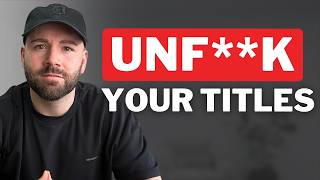

Your Titles Are Killing Your Views
45sDirectly addresses a common frustration for small YouTubers, promising a simple fix for low views.
▶ Play Clip"The title accurately reflects the video's focus on title strategies, though it's slightly exaggerated for effect."
The video explains that poor video titles, not content quality, are the main reason small YouTubers get few views. It emphasizes that titles must trigger an emotional response to make viewers click, and provides strategies like using open loops, emotional triggers, and keeping titles under 55 characters.
Small YouTubers sabotage their videos with bad titles; a simple tweak can make the difference between 10 and 10,000 views.
Viewers make split-second decisions based on how a title makes them feel; emotion drives action.
An open loop hints at something without giving full payoff, compelling viewers to click to resolve the tension.
Curiosity, fear/urgency, desire for reward, surprise/novelty, and FOMO are core triggers that power titles.
Titles should be under 55 characters to avoid being cut off on mobile; frontload key words.
Browse titles use curiosity to interrupt scrolling; search titles are clear and keyword-focused for active searchers.
Successful creators start with the title and thumbnail, then build the video around them to ensure alignment.
To grow on YouTube, prioritize creating titles that evoke emotion and curiosity, keep them short, and write them before filming the video.
What is the main reason small YouTubers get few views according to the video?
Bad titles, not bad content.
Is clicking on a video a logical or emotional decision?
Emotional.
0:32
What is an 'open loop' in a title?
A title that introduces a hint but doesn't give the full payoff, creating curiosity.
1:50
Name the five core emotional triggers mentioned for YouTube titles.
Curiosity, fear/urgency, desire for reward, surprise/novelty, and FOMO.
3:56
What is the 55 character rule?
Keep titles under 55 characters to avoid being cut off on mobile; frontload key words.
5:40
What is the difference between browse-optimized and search-optimized titles?
Browse titles use curiosity to interrupt scrolling; search titles are clear and keyword-focused for active searchers.
7:10
What should you do before filming a video according to the video?
Write the title and thumbnail first to ensure the content delivers on the promise.
9:24
Bad titles sabotage views
Directly addresses a common mistake and offers a simple fix.
Emotion drives clicks
Fundamental principle that shifts focus from content to packaging.
0:32Open loops create curiosity
Psychological technique that leverages human need for closure.
1:5055 character rule
Practical, data-driven tip to improve mobile visibility.
5:40Write title first
Mindset shift that aligns content with audience expectations.
9:24[00:00] The reason your videos aren't getting
[00:01] many views isn't because your content is
[00:03] bad. It's because your titles probably
[00:06] suck. I see it all the time. Small
[00:08] YouTubers like you putting hours and
[00:11] hours into editing great videos only to
[00:13] sabotage yourself at the final hurdle.
[00:16] Why? Because you're writing your titles
[00:18] the wrong way. Just one small simple
[00:21] tweak in how you write your title could
[00:23] be the difference between 10 views and
[00:25] 10,000 views. So, in this video, I'm
[00:28] going to show you exactly how to create
[00:30] your titles the right way. So, before we
[00:32] get into the tactics, let's zoom out a
[00:35] bit first and understand why people
[00:37] actually click on videos in the first
[00:39] place. Because a viewer clicking on a
[00:41] video isn't usually a logical decision.
[00:44] It's an emotional one. When a viewer
[00:46] lands on the YouTube home feed, they're
[00:48] not sat there carefully evaluating each
[00:50] individual video they see. Instead, what
[00:53] they are doing, they're usually
[00:54] scrolling really fast and making
[00:56] split-second decisions based on how a
[00:58] title thumbnail makes them feel. And
[01:00] that's the key. People don't click
[01:02] because your title is informative. They
[01:04] click because it triggers something
[01:06] inside of them. So, your job as a
[01:08] YouTuber isn't just to use your title as
[01:10] a way to like describe the video.
[01:13] Instead, it should be to create an
[01:15] emotional reaction. When someone decides
[01:17] to click on a video, it's because of a
[01:19] tiny spark in their brain that says
[01:21] like, "Wait, what is this?" That right
[01:23] there is an open loop, which we will
[01:25] discuss in the next section. But you
[01:27] just need to understand that until
[01:28] someone clicks, your content doesn't
[01:31] even exist to them. You could have the
[01:33] most valuable video in the world, but if
[01:35] your title doesn't make people stop and
[01:37] feel something, they're just going to
[01:38] scroll straight past it. So everything
[01:41] we talk about from here on out, open
[01:43] loops, emotional triggers, length,
[01:45] structure, all of that stuff, all of it
[01:48] feeds back to one core principle.
[01:50] Emotion drives action. So step two, open
[01:54] loops. So one of the most effective ways
[01:57] to trigger an emotion and drive clicks
[01:59] is by using something called an open
[02:01] loop. This is a powerful psychological
[02:04] tool that plays on human curiosity,
[02:06] which is the need to resolve unanswered
[02:08] questions. An open loop is when your
[02:11] title introduces a hint but doesn't give
[02:13] the full payoff. Now, open loops spark
[02:16] intrigue and leaves the viewer wondering
[02:18] like what happens next. Think about it.
[02:21] When you see a title like this one
[02:23] mistake killed my channel or I tried Mr.
[02:26] Beast strategy, here's what happened.
[02:28] Your brain should immediately start
[02:30] asking questions like what was that
[02:32] mistake? Did it really ruin his channel?
[02:35] Or what happened with the strategy? like
[02:37] that sense of unresolved tension creates
[02:40] discomfort and the only way to relieve
[02:43] that discomfort is to click on the video
[02:44] and find out. And open loops work
[02:46] because our brains are wired to seek
[02:48] closure. We hate unfinished thoughts. So
[02:52] when you hint at something like a
[02:53] mistake, a discovery, or a
[02:56] transformation, but don't reveal the
[02:58] full outcome, people are always
[03:00] compelled to click. You'll make them
[03:02] curious enough to stop scrolling and
[03:04] want to start watching your video. And
[03:07] this is why like vague or overly
[03:09] descriptive titles often fail. If you
[03:11] give everything away up front, then
[03:13] there's no reason for the viewer to
[03:14] click. But when you strategically leave
[03:17] something out or when you tease just
[03:19] enough to make people need the answer,
[03:21] that's when your titles start doing
[03:23] their job. And just to prove it to you,
[03:25] here are two examples. Number one, this
[03:28] one mistake killed my channel. Or number
[03:30] two, getting a copyright strike killed
[03:33] my channel. Well, the first one creates
[03:34] an open loop as it doesn't give you any
[03:36] information as to what that one mistake
[03:38] is. So, people are going to want to
[03:40] watch that video to find out. But the
[03:42] second one clearly already shows you
[03:44] that the reason their channel died is
[03:45] because of a copyright strike. So, now
[03:48] in this case, people are going to look
[03:49] at that and feel no urge whatsoever to
[03:51] watch it because the title has already
[03:53] answered the question. I hope that makes
[03:55] sense. So, next thing we need to look at
[03:56] is emotional triggers. And now that you
[03:59] understand how open loops work, let's
[04:01] look at the emotional triggers that
[04:02] power them. Your title basically has
[04:04] just a split second to make someone feel
[04:06] an emotion. And the stronger that
[04:08] emotional response, the higher the
[04:10] chance they'll click. That's why most
[04:13] effective titles aren't descriptive.
[04:15] They provoke people. They create
[04:17] tension. They make the viewer feel like
[04:19] they have to click in order to resolve
[04:21] something. Think about titles like stop
[04:24] making this one mistake or YouTube just
[04:27] changed. Are you ready? Or something
[04:29] like how I made $10,000 without
[04:32] monetization. These type of titles tap
[04:35] into real emotions. And there are five
[04:37] core emotional triggers that work time
[04:39] and time again on YouTube. So let me
[04:41] explain them now. So number one is
[04:43] curiosity. Number two is fear or
[04:46] urgency. Number three is desire for
[04:48] reward, surprise or novelty. and FOMO,
[04:51] which is fear of missing out. So, when
[04:53] you're writing your next title, I need
[04:55] you to ask yourself, which emotion am I
[04:57] tapping into? Is it curiosity? Is it
[04:59] fear? Is it desire? The more emotional
[05:02] charge it carries, the more powerful
[05:04] your title becomes. Also, don't forget
[05:06] about power words. These specific words
[05:09] are used to instantly enhance emotion.
[05:11] Words like warning, hidden, secret,
[05:14] explosive, proven. All of these types of
[05:16] words can elevate your title without
[05:18] changing the meaning. Like the most
[05:20] successful creators build these
[05:22] emotional hooks into every title they
[05:24] write, not by accident, but by design.
[05:27] So before you publish your next video,
[05:29] just ask yourself, will this title make
[05:31] someone feel something? If not, rewrite
[05:34] it because without emotion, there's no
[05:36] action, and without action, there's no
[05:38] views. Next thing we have to consider is
[05:40] the 55 character rule. So now, let's
[05:43] talk about a simple but powerful rule
[05:45] that can massively improve your
[05:47] click-through rate. The 55 character
[05:49] rule. Most inexperienced creators often
[05:52] overlook this, but it's crucial. As I
[05:54] said, when people scroll through
[05:56] YouTube, they're not carefully reading
[05:58] and evaluating every single title.
[06:00] They're basically like skim reading
[06:02] really, really fast, and their brains
[06:04] are wired for speed and simplicity. So,
[06:06] if your title is too long or too
[06:09] complex, it will get ignored. And here's
[06:11] the technical bit. YouTube will also cut
[06:13] off your title after about 55
[06:15] characters, especially on mobile. That
[06:18] means if your emotional hook or keyword
[06:21] is buried at the end of your title, it
[06:23] might not even be visible. You're
[06:25] basically hiding the most important part
[06:27] of your title behind the three dots at
[06:29] the end. So to avoid that, make sure you
[06:31] always frontload your titles with the
[06:33] most powerful keywords at the beginning
[06:36] and try to stay under 55 characters
[06:38] where possible. Now, long titles can
[06:41] work, but shorter ones are easy to read,
[06:44] easier to remember, and easier to spark
[06:46] emotion fast. And this is especially
[06:49] important because over 70% of YouTube
[06:52] views now come from mobile. So, if your
[06:55] title looks great on desktop, but then
[06:57] gets cut off on a mobile phone screen,
[06:59] you're shooting yourself in the foot.
[07:00] So, the takeaway point here is the best
[07:03] titles are the ones that can deliver
[07:04] impact when skimmed in half a second.
[07:07] Then browse versus search. So the next
[07:10] step is knowing what kind of title
[07:13] you're actually writing. And this is
[07:14] where a lot of small creators go wrong
[07:17] because you guys don't know the
[07:19] difference between browsebased titles
[07:21] and searchbased titles. So let me
[07:23] explain. But basically on YouTube
[07:26] viewers typically discover content in
[07:28] two ways. Either by searching for
[07:30] something specific or simply by
[07:32] scrolling through the homepage or
[07:34] suggested videos. But these two
[07:36] different types of viewer behavior are
[07:37] very different and they require two
[07:39] completely different types of
[07:40] strategies. So for instance, when
[07:43] someone's just scrolling through their
[07:44] home feed, they're not looking for
[07:46] anything specific. So your job here is
[07:48] to interrupt that scroll and grab their
[07:51] attention. That's where browse optimized
[07:53] titles do best. They lean heavily on
[07:56] like curiosity and emotional triggers.
[07:58] Titles like YouTube shorts just changed
[08:01] forever or this mistake is killing your
[08:04] channel. They'll work because they make
[08:06] people stop and ask questions. Even if
[08:08] those people weren't originally
[08:09] searching for that particular topic. On
[08:11] the other side, however, search
[08:13] optimized titles are written for people
[08:15] who already know what they want to see.
[08:17] They're actively going in and typing
[08:20] things into the search bar, and they
[08:21] will click on the results that come up
[08:23] first after they search for a specific
[08:25] term. So, the titles of these videos
[08:28] need to be clear, direct, and keyword
[08:30] focused. Think of formats like how to
[08:33] start a drop shipping business in 2025
[08:36] or best video cameras for beginners.
[08:38] Like those titles are educational,
[08:41] they're SEO driven, and they tend to
[08:43] perform well over time because they're
[08:45] evergreen and they rely on search
[08:47] traffic. Now, one isn't technically
[08:49] better than the other, but you do need
[08:51] to know what traffic source you're
[08:53] targeting before you upload the video.
[08:55] For example, one of my videos is titled
[08:57] How to Start a YouTube channel in 2025.
[09:00] And this one is optimized for search.
[09:02] And the analytics show that because most
[09:03] of the views come from YouTube search,
[09:06] but a different video of mine titled,
[09:07] "If your shorts get under 1,000 views,
[09:10] do this," is clearly optimized for
[09:12] brows. And it got over a million views
[09:14] even though no one is searching for that
[09:17] exact title phrase. So again, just try
[09:20] to understand how your title will be
[09:22] discovered and write it accordingly.
[09:24] Then we have write the title first. And
[09:27] here is one of the biggest mindset
[09:29] shifts that can completely change how
[09:30] you approach YouTube. And it's something
[09:32] that almost every struggling creator I
[09:34] see gets it wrong. Because most new
[09:37] people come up with a video idea,
[09:39] they'll film it, they'll edit it,
[09:41] they'll upload it, and then they'll
[09:42] quickly throw together a title and
[09:44] thumbnail right at the end. But that is
[09:46] completely backwards. Because the most
[09:49] successful creators in this game do the
[09:51] exact opposite. They start with the
[09:54] title first. Why? Because your title and
[09:57] thumbnail are the product. They're the
[09:59] first thing anyone sees. Your title and
[10:02] thumbnail are what people buy into with
[10:04] their attention. Like the content only
[10:06] matters after you've earned that click.
[10:09] So if you build the video first, you're
[10:11] trapped. Like you're stuck trying to
[10:13] retrofit a title and thumbnail onto
[10:15] something that's already been done. But
[10:17] when you begin with a title first that's
[10:20] designed to grab attention and then you
[10:21] build the video around that, you're
[10:24] making sure your content is aligned and
[10:26] primed to perform. So now on before you
[10:29] even press record, ask yourself what's
[10:32] the title? Like what's the promise of
[10:33] this video? Why should anyone care? If
[10:36] you can't answer those questions, don't
[10:38] start filming. Now, if all of this is
[10:40] finally starting to click and make sense
[10:42] to you, and if you're realizing just how
[10:45] much your title influences your success
[10:47] on YouTube, then I've got something that
[10:49] can take you even further. I've built a
[10:51] short, high impact, actionable course
[10:53] that walks you through exactly how to
[10:55] create high-erforming YouTube titles and
[10:58] design scroll stopping YouTube
[11:00] thumbnails. This mastery course is
[11:02] packed with real world examples, proven
[11:04] frameworks, title formulas, emotional
[11:06] trigger breakdowns like thumbnail design
[11:09] principles, and so much more. And as a
[11:11] thank you for making it to the end of
[11:12] this video, you'll receive the entire
[11:14] course for 50% off. Like, I've done it
[11:17] as cheap as I possibly can. So whether
[11:19] you're brand new or you're already
[11:21] making content, you've got a few
[11:22] subscribers, I promise you this mastery
[11:24] course will save you so much time. It
[11:26] will help you grow faster and it will
[11:28] finally show you how to get your videos
[11:30] the attention they deserve. Like
[11:32] hundreds of creators have already taken
[11:34] it and the feedback I've got has been
[11:36] incredible. So if you're ready to stop
[11:37] guessing and start growing, get 50% off
[11:40] now. Click on the link in the
[11:41] description or the pinned comment and
[11:42] I'll see you inside. Thanks very much
[11:44] for watching. See you later.


⚡ Saved you 0h 11m reading this? Transcribe any YouTube video for free — no signup needed.