
How Kafka Decouples Your Systems
60sExplains a core benefit of Kafka in simple terms, appealing to developers and tech enthusiasts.
▶ Play Clip"Delivers a solid, informative breakdown of Kafka's architecture and trade-offs, though the title is generic."
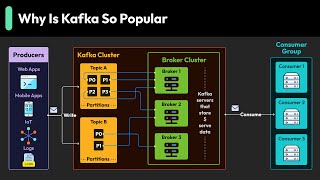
This video explains why Apache Kafka is popular in system design, focusing on its distributed log architecture that decouples services, absorbs traffic spikes, and enables event replay. It covers core concepts like partitions, brokers, consumer groups, and delivery guarantees, along with practical trade-offs and real-world use cases.
Kafka's main benefit is decoupling producers and consumers, allowing independent evolution and absorbing traffic spikes.
Messages are written to append-only log files called partitions, stored on brokers; multiple brokers form a cluster.
Messages contain key, value, timestamp, and headers. The key determines partition assignment, ensuring order for same-key messages.
A single broker can handle hundreds of thousands of messages per second, but network bandwidth is usually the bottleneck.
Poor partition key choice can cause hot partitions; compound keys (e.g., movie ID + hash of user ID) spread load.
Consumers track progress via offsets; commit timing affects message loss or duplication. Consumer groups ensure each message is processed once.
Three guarantees: at-most-once (fast, may lose), at-least-once (no loss, may duplicate), exactly-once (complex, slower).
Each partition has a leader and followers; with three replicas, you can survive one broker failure.
Uber uses Kafka for real-time location updates; event sourcing uses Kafka as source of truth by appending state changes.
Kafka optimizes for throughput, not latency; ordering is only per-partition; exactly-once requires careful setup.
Kafka's popularity stems from its ability to decouple systems, absorb spikes, and replay events, but it introduces operational complexity and trade-offs in latency and ordering.
What is the primary benefit of using Kafka?
Decoupling systems, allowing producers and consumers to evolve independently and absorbing traffic spikes.
00:16
What is a partition in Kafka?
An append-only log file on disk where messages are written.
00:45
How does the message key affect partitioning?
Messages with the same key go to the same partition, preserving order; without a key, messages are spread for load balancing.
01:13
What is a hot partition and how can it be avoided?
A hot partition occurs when one partition receives excessive load; use compound keys (e.g., movie ID + hash of user ID) to spread load.
02:37
What are the three delivery guarantees in Kafka?
At-most-once (may lose), at-least-once (may duplicate), exactly-once (complex, slower).
04:12
How does Kafka ensure durability?
Through replication: each partition has a leader and followers; with three replicas, you can survive one broker failure.
04:27
What is event sourcing?
A pattern where every state change is appended as an event to Kafka, allowing replay to reconstruct current state.
05:19
Why is Kafka not suitable for request-response patterns?
It optimizes for throughput, not latency; batching and buffering add delay.
05:33
Decoupling as core value
Explains the fundamental reason companies adopt Kafka: independent evolution and spike absorption.
00:16Hot partition problem
Illustrates a common pitfall with a concrete example (blockbuster movie) and a solution (compound keys).
02:37Delivery guarantees explained
Clearly distinguishes the three guarantees, a key concept for system design interviews.
04:12Real-world Uber example
Shows how Kafka scales in production with geographic partitioning for real-time pricing.
05:06Trade-offs: throughput vs latency
Highlights that Kafka is not a one-size-fits-all solution, important for architectural decisions.
05:33[00:02] use Kafka to handle billions of messages per day? It's not just about scale. Kafka's distributed log design offers something unique, the ability to replay events, decouple services, and absorb traffic spikes. In this video, we'll
[00:16] look at how Kafka achieves this and what trade-offs you are making when you use The main reason companies use Kafka is to decouple their systems. Instead of having services talk directly to each other, they communicate through Kafka.
[00:30] This means producers and consumers can evolve independently, and Kafka absorbs traffic spikes that would otherwise overwhelm your systems. It also enables things go wrong. So, how does this distributed log
[00:45] When you send a message to Kafka, it gets written to a partition, which is basically append-only log files sitting on disk. These partitions live on servers called brokers, and when you put multiple brokers together, you get a
[00:59] Kafka cluster. Partitions are organized into topics, which are categories for your messages. You might have a topic for payments, another for user clicks, and another for video uploads. Producers write messages into topics, and
[01:13] consumers read them. Every message contains a key, a value, a timestamp, and sometimes headers for metadata. The key determines which partition your message lands in. If you send multiple messages with the same key, they will
[01:27] always go to the same partition and stay in order. When you don't provide a key, Kafka spreads messages around to balance the load across partitions. A single broker on modern hardware can handle hundreds of thousands of messages
[01:40] per second and store as much data as your disk can hold. In practice, though, the broker will usually hit network bandwidth limits before CPU or disk bandwidth limits before CPU or disk becomes the bottleneck.
[01:55] best way to code with AI agents. Too often, agents write code that's almost right, leaving developers stuck debugging instead of shipping. Warp is different. Ranked top of terminal bench and sweet bench verified, Warp's agent
[02:09] understands your context and writes production-ready code out of the box. Prompt, review, and refine, all in one interface. No context switching, no wasted time. You stay in control. And it pays off. On average, users are saving
[02:23] over an hour a day with Warp. Download Warp by clicking the link in the Warp by clicking the link in the description. whether your system scales gracefully or falls apart under load. Pick the wrong
[02:37] partition key, and you'll end up with hot partitions, where one partition gets hammered while the others sit idle. Imagine you're building a streaming service and you partition by movie ID. Everything works fine until Friday night
[02:51] when a blockbuster drops, and suddenly millions of users are streaming the same movie. All these events hit the same partition, and your system starts choking. The solution is to use compound keys. Combine the movie ID with a hash
[03:05] of the user ID, and now events for that blockbuster get spread across multiple stay in order. There are other partitioning schemes, too, each with its own trade-offs. For example, time-based partitions work
[03:20] great for log data because they make retention policies simple, but they complicate real-time aggregation. Consumers track their progress through partitions using offsets, which are basically bookmarks to tell you which
[03:32] message you last processed. They save these offsets back to Kafka periodically, so if they crash, they know exactly where to pick up again. The timing of these commits matters. Commit too early, and you might lose messages
[03:45] if you crash. Commit too late, and you might process the same message twice. Consumer groups let multiple consumers work together, with Kafka making sure each message gets processed by exactly one consumer in the group. If a consumer
[03:59] fails, Kafka reassigns its partition to the surviving consumers through rebalancing. It handles most failure scenarios without any manual intervention. Kafka offers three delivery guarantees.
[04:12] At most once is fast, but might lose messages. At least once ensures no loss, but might produce duplicates. Exactly once is possible, but is complicated to set up and runs slower. Durability comes with replication. Every
[04:27] partition has one leader that handles all reads and writes, plus several followers that copy everything the leader does. If the leader fails, one of the followers takes over. Most production systems run with three
[04:39] replicas, which means you can lose a broker and still have backup. You can configure Kafka to wait for all active replicas to acknowledge writes before considering them successful. This gives you maximum safety, but slow things
[04:52] down. With three replicas, you can typically survive one broker failure without losing data. These mechanics enable powerful patterns in production. At Uber, location updates of millions of drivers reportedly flow
[05:06] through Kafka to calculate search pricing in real time. They partition geographically, so each region can scale independently. Some companies use Kafka as their source of truth for data. Instead of updating database records
[05:19] directly, they append every state change as an event to Kafka. Want the current state? Replay the events. This pattern, called event sourcing, gives you a complete audit trail of everything that happened in your system.
[05:33] But Kafka isn't the right choice for every use case. It optimizes for throughput, not latency. The batching and buffering that enables high throughput adds some delay, making it unsuitable for request-response
[05:45] Kafka only guarantees order within a single partition, not across an entire topic. If you absolutely need global ordering, you're stuck with a single partition, which kills your ability to parallelize. Most systems work around
[05:59] this by accepting partial ordering. Exactly once processing requires careful setup on both producer and consumer sides, but when you need it for financial transactions or critical data pipelines, the complexity is worth it.
[06:14] producers from consumers, letting them evolve independently without breaking each other. Traffic spikes that would overwhelm a direct connection get absorbed by the log. When something goes wrong in production, you can replay
[06:27] events to see exactly what happened. This power comes with a cost. Kafka adds significant operational complexity to your stack. Ready to ace your next technical interview? Join our community where we
[06:40] offer comprehensive courses on system design, coding, behavioral questions, machine learning, and object-oriented design. Learn more at bytebytego.com.

⚡ Saved you 0h 07m reading this? Transcribe any YouTube video for free — no signup needed.