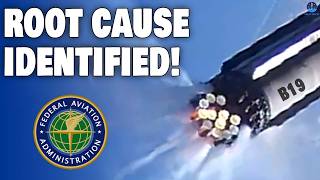

FAA Clears Starship Flight 12 Mishap
44sOfficial FAA approval is a major milestone for SpaceX, generating excitement and discussion among space enthusiasts.
▶ Play Clip"Title promises 'Problems Solved!' and 'Flight 13 in Hours' — the video delivers the FAA approval but the launch timeline is speculative, so it's mostly accurate with minor hype."
This video covers the latest developments in aerospace, focusing on SpaceX's Starship Flight 13 receiving FAA approval after the Flight 12 mishap investigation, NASA's assembly of the SLS for Artemis 3, and the FCC's controversial approval of Reflect Orbital's mirror satellite mission.
The FAA closed its investigation into Starship Flight 12 and authorized SpaceX to proceed with Flight 13, removing the final regulatory obstacle.
The FAA announced the Flight 12 mishap investigation is closed, with no public injury or property damage. Two root causes identified: heat effects on propulsion components and erroneous engine alarm settings.
SpaceX introduced four corrective actions, including hardware modifications and software updates to improve engine relight reliability and adjust alarm systems.
B20 rolled back for post-test inspections and flight termination system installation, expected to return to the pad by July 15. S40 remains in Mega Bay 2 for payload integration.
Flight 13 will carry 20 next-generation Starlink V3 satellites, fully functional with solar arrays, to communicate with the constellation and image the heat shield.
NASA began assembling the SLS for Artemis 3, with the first solid rocket booster segment delivered to the Vehicle Assembly Building. Boosters provide 7.2 million pounds of thrust.
Artemis 3 will spend ~2 weeks in Earth orbit testing rendezvous with Blue Origin's Blue Moon Lander and SpaceX's Starship, with the first crewed landing now targeted for Artemis 4 in late 2028.
FCC authorized Reflect Orbital's Arendelle 1, a 60-ft mirror satellite, to launch this year. The company plans 50,000 mirrors by 2035 to boost solar power, but critics worry about light pollution.
Flight 13 is cleared for launch pending hardware readiness, Artemis 3 progresses with SLS assembly, and Reflect Orbital's mirror mission sparks debate on space-based solar reflection.
What were the two root causes of the Starship Flight 12 booster loss?
Heat effects on propulsion system components during ascent and erroneous engine alarm system settings.
02:24
How many corrective actions did SpaceX introduce for Flight 13?
Four corrective actions.
02:37
What is the payload for Starship Flight 13?
20 next-generation Starlink V3 satellites.
05:08
How much thrust do the Artemis 3 solid rocket boosters generate?
Approximately 7.2 million pounds of thrust.
06:56
What is the target launch date for Artemis 3?
Mid to late 2027.
07:24
What is the name of Reflect Orbital's first demonstration satellite?
Arendelle 1.
09:46
How many mirror satellites does Reflect Orbital plan to deploy by 2035?
50,000 or more.
09:59
FAA Closes Flight 12 Investigation
This is the key regulatory milestone that allows Flight 13 to proceed, directly addressing the video's title.
01:41Root Causes Identified
Understanding the technical failures (heat and alarm settings) is crucial for aerospace engineers and enthusiasts.
02:37Starlink V3 Payload Details
The shift from dummy payloads to functional satellites marks a significant step for Starship's commercial utility.
05:08Artemis 3 Mission Profile Change
The decision to test docking in Earth orbit before lunar landing is a strategic shift in NASA's Artemis architecture.
08:35Reflect Orbital's Controversial License
This introduces a novel space application with significant ethical and environmental implications, sparking debate.
09:30[00:08] of the biggest hurdles standing in the way of flight 13 has just been cleared. The FAA has officially closed its investigation into flight 12 and authorized SpaceX to proceed with flight 13. The green light has officially been
[00:23] given. Meanwhile, NASA has begun assembling the space launch system for Artemis 3. And in another surprising development, the FCC has granted approval for a company planning to place giant mirrors
[00:35] into orbit, sparking a wave of controversy. Let's find out more on today's episode of Great SpaceX. Following aerospace isn't just about watching rockets launch, it's also about understanding everything that happens
[00:49] behind the scenes. Flight 13 is a perfect example of that. So, if you don't want to miss any updates on Starship, SpaceX, or the aerospace industry, be sure to subscribe to the channel. We cover every major
[01:01] development as it happens. Now, let's get back to flight 13. Over the past several weeks, we've watched SpaceX roll out hardware for testing while launch schedules gradually came together through NOTAMs, NOTAMRs,
[01:14] and road closures. But, amid all that excitement, one critical requirement was still missing: FAA approval. Following flight 12, the FAA required SpaceX to conduct a mishap investigation after Super Heavy B19 experienced multiple
[01:29] engine issues during its boost back burn. Those issues were also acknowledged by SpaceX in its recent technical update. Now that investigation has officially reached its conclusion. On July 13th, the FAA announced that the
[01:41] flight 12 mishap investigation had been closed and that SpaceX is authorized to move forward with flight 13. The agency stated, "The FAA required investigation of the SpaceX Starship flight 12 launch mishap is closed. There There no reports
[01:55] of public injury or damage to public property. That result matches what we observed during the mission as the booster ultimately impacted within the designated hazard area. The FAA also summarized the investigation's findings.
[02:09] The FAA oversaw and accepted the findings and corrective actions of the SpaceX led investigation. The final mishap report sites two most probable root causes for the loss of the Super Heavy booster. Heat effects on
[02:24] propulsion system components during the ascent and erroneous engine alarm system settings. SpaceX identified four corrective actions including vehicle hardware and software configuration updates to prevent a reoccurrence of the
[02:37] event. So, the investigation identified two primary causes. The first was heat affecting propulsion system components during ascent. The second was incorrect engine alarm system settings. Those findings closely match the improvements
[02:52] SpaceX recently described for flight 13. In its own update, the company explained, "After stage separation and the flip, the Super Heavy booster attempted its boostback burn. Five of its 33 engines experienced issues when
[03:06] attempting to relight, causing the boostback burn to end early." To prevent that from happening again, SpaceX introduced four corrective actions. investigations, that's actually a relatively small number of required
[03:19] changes, suggesting the company already had a solid understanding of what went wrong. Those corrective actions include hardware modifications and software updates. As SpaceX explained, "The Super Heavy on this upcoming flight has
[03:33] hardware modifications to improve relight reliability, along with updates to engine alarms and aborts to match the conditions seen in the multi-engine flight environment." With those changes accepted, the FAA officially removed the
[03:47] final regulatory obstacle. The agency concluded, "SpaceX can proceed with Starship flight 13 launch operations provided all safety and other licensing requirements are met. That's the moment everyone had been waiting for. Just 3
[04:00] 13 officially received its regulatory green light. Now the attention shifts almost entirely to the hardware. B20 rolled back to the production site on the morning of July 12th. There technicians are expected to perform post
[04:14] test inspections and install the flight termination system. Flight termination system. That work can usually be completed quickly. So B20 could return to the launch pad as early as July 15th. Attention is also turning towards ship
[04:26] 40. Since completing its static fire update static fire campaign earlier this month, S40 has remained inside Mega Bay 2 with very little visible activity. engineers perform inspections, install the flight termination system, and
[04:42] installation may be the most time-consuming competent time-consuming time-consuming competent time-consuming task this time. A payload loader arrived at the production site on the afternoon of July 7th, but was taken into Star
[04:55] Factory rather than Mega Bay 2, suggesting additional preparations are still underway. Recent updates from SpaceX help explain why. Flight 13 will carry 20 next generation Starlink V3 satellites. Unlike previous dummy
[05:08] payloads, these are fully functional spacecraft equipped with solar arrays, that will both communicate with the existing Starlink constellation and gather imagery of Starship's heat shield during flight. Naturally, integrating
[05:21] that payload requires extensive preparation before installation. Another question is whether S40 will make one final stop at Massey's before heading to the launch pad. Starbase has published a road closure from the production site to
[05:34] Massey's beginning at 11:59 p.m. on the 13th and lasting until 4:00 a.m. on the 14th. That could indicate another cryogenic or engine-related test for S40. On the other hand, the movement could involve S41 or B21 instead. If
[05:49] to the launchpad after final preparations. Personally, I think S40 will likely roll shortly before or perhaps shortly after B20 returns to the pad, possibly late on July 15th. Of course, there's still another
[06:03] possibility. If SpaceX decides to perform a full wet dress rehearsal before launch, both vehicles could return to the pad even earlier. We'll know more once additional road closure notices are released. So, are you ready
[06:15] for Starship flight 13? If so, leave a rocket emoji and US in the comment section to let me know you're ready. Now, let's move on to NASA's preparations for Artemis 3. NASA has officially begun assembling the SLS that
[06:31] will support the mission. Recently, one of the solid rocket booster segments arrived at the vehicle assembly building at Kennedy Space Center in Florida. NASA at Kennedy Space Center in Florida. NASA confirmed the milestone in a post on X.
[06:44] According to the agency, the bottom segment of the left-hand solid rocket booster that will help launch Artemis 3 has now been delivered to the vehicle assembly building. The two boosters together will generate approximately 7.2
[06:56] million pounds of thrust, providing more than 75% of the rocket's total lift-off power. NASA wrote, "Soon assembly of the rocket will begin as we prepare to send crew aboard Orion to test the rendezvous and docking capabilities needed for
[07:11] future lunar landings. For Artemis 2, it took roughly 1 year to assemble the SLS after all major components arrived at the vehicle assembly building. A similar timeline would still support NASA's current target of launching Artemis 3 in
[07:24] mid to late 2027." The Artemis 3 core stage actually arrived back in May. Unlike Artemis 2, however, it was delivered without its engine section. Once that section is attached, stacking of the remaining vehicle can begin. NASA
[07:38] administrator Jared Isaacman has also stated that the agency hopes to complete a wet dress rehearsal before the end of this year. Meanwhile, additional booster continue arriving at Kennedy Space Center. Each solid rocket booster stands
[07:53] Center. Each solid rocket booster stands approximately 177 ft or 54 m tall. Together, they contain 3.2 million pounds or 1.45 million kilograms of solid propellant composed of polybutadiene
[08:05] acrylonitrile ammonium perchlorate. Unlike liquid fueled engines, once these boosters ignite, they cannot be shut down. Without them, the SLS core stage's four RS-25 engines simply wouldn't generate
[08:20] enough thrust to lift the rocket off the pad. Artemis 3 is currently planned as the second crewed mission of NASA's Artemis program. Like Artemis 2, four astronauts will launch aboard Orion on top of the space launch system. However,
[08:35] under NASA's current architecture, they won't immediately head toward the moon. Instead, the crew will spend roughly 2 weeks in Earth orbit testing rendezvous and docking procedures with two lunar lander systems that NASA has been
[08:48] developing. The first docking will be with Blue Origin's Blue Moon Lander. Astronauts will enter the vehicle, inspect its crew cabin, and evaluate elements of the new Artemis lunar spacesuits. After that, Orion will
[09:00] According to SpaceX, this vehicle will be a boilerplate version 3 Starship equipped with a docking adapter, but without a crew cabin. If NASA maintains its current roadmap, the first crewed lunar landing under Artemis will now
[09:15] occur during Artemis 4, targeted for late 2028. There's still plenty of work ahead. Every major milestone, including fueling tests and wet dress rehearsals, must be completed successfully before launch. Now, let's move on to one of the
[09:30] most unusual space projects we've seen in quite some time. The FCC has officially authorized California startup Reflect Orbital to launch its first demonstration satellite. Known as Arendelle 1, the spacecraft will deploy
[09:46] a reflective surface measuring approximately 60 ft or 18 m on each side, effectively creating a giant mirror in space. The demonstration mission is scheduled to launch later this year, and if successful, it could
[09:59] be only the beginning. Reflect Orbital ultimately hopes to deploy 50,000 or more mirror satellites in low Earth orbit by 2035, directing reflected sunlight toward customers on Earth. Reflect Orbital co-founder and CEO Ben
[10:14] Nowak said in a statement on July 10th, "We're grateful to the FCC for recognizing the importance of testing novel technologies in space." He added, "This license is the first step toward rigorously testing our technology's
[10:28] efficacy and the safeguards we have developed. We're excited to demonstrate introduce transformational clean technology the world urgently needs." According to the company, the mirrors could increase the productivity of solar
[10:43] power facilities by extending useful daylight, reducing dependence on fossil-fuel generated electricity. But not everyone supports the concept. already controversial because of
[10:56] concerns about orbital congestion, atmospheric pollution, and the changing appearance of the night sky. Reflect Orbital introduces an entirely new concern, artificial light pollution. Critics worry that intentionally
[11:09] directing sunlight onto Earth could disrupt ecosystems, wildlife, astronomical observations, and even everyday life. The company insists that those risks have been carefully considered. Reflect Orbital says its
[11:23] system includes several safeguards. One, the light is contained within the spot. and at any time so that none of it reaches the earth, and three, we can deliberately avoid sensitive areas like
[11:36] research observatories or protected habitats. The company also states the light is not bright enough to start fires or harm eyes even when viewed through a telescope and cannot be concentrated past maximum natural
[11:49] sunlight irradiance. Whether those assurances will satisfy critics remains to be seen. One thing is certain, if successful, Arendelle 1 could introduce an entirely new category of spacecraft and another fascinating
[12:02] debate about the future of humanity's presence in orbit. And that brings us to much for tuning in. As always, this has been Kevin from Great Space X, and until next time, keep learning how to read new words. I mean, keep looking up.


⚡ Saved you 0h 12m reading this? Transcribe any YouTube video for free — no signup needed.