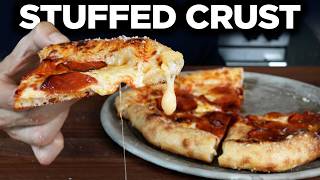

Pizza Hut’s Golden Era: Stuffed Crust & Buffet
41sNostalgia for the iconic $5 buffet and stuffed crust pizza hooks viewers, contrasting past glory with current decline.
▶ Play Clip"The title is slightly hyperbolic but the video does deliver a detailed recipe for the stuffed crust pizza."
This video is a detailed tutorial on recreating Pizza Hut's iconic stuffed crust pizza at home. The host walks through the entire process, from making a starter dough to assembling and baking the pizza, while also reflecting on Pizza Hut's decline and the cultural impact of its stuffed crust.
Pizza Hut introduced the $5 all-you-can-eat lunch buffet and the stuffed crust pizza, which were hugely popular and memorable.
Today, Pizza Hut is a shadow of its former self, and its fall is a case study in business.
Mix 120g water, 4g instant yeast, and 120g bread flour. Cover and refrigerate for 1-2 days.
Combine 220g starter, 345g warm water, 10g sugar, 15g olive oil, and 615g bread flour. Mix, rest 20 minutes, add salt, then mix 6-8 minutes.
Bulk ferment for 3-4 hours, then portion into 300g balls and refrigerate for 1-3 days.
Use passata or pureed tomatoes, season with salt, olive oil, and basil. Pizza Hut likely uses tomato paste.
Melt butter, add garlic powder and fresh parsley. Brush on the crust after baking.
Roll out dough, create a border, line with mozzarella sticks, fold and seal. Add sauce, cheese, and pepperoni.
Too much cheese in the crust caused blowouts and uneven cooking. Adjusted by halving and freezing cheese sticks.
Used diced cheese for slower melting, baked at 550°F, finished under broiler. Result was better than Pizza Hut.
The homemade stuffed crust pizza turned out better than the original, with higher quality ingredients and a perfectly sealed crust. The video demonstrates that with patience and technique, you can recreate a fast-food classic at home.
What two iconic food items did Pizza Hut introduce?
The $5 all-you-can-eat lunch buffet and the stuffed crust pizza.
00:02
What is the first step in making the starter?
Mix 120g water, 4g instant yeast, and 120g bread flour.
00:58
How long should the starter be refrigerated?
1 to 2 days.
01:13
What is the purpose of resting the dough after mixing flour?
To allow the dough to relax and hydrate before adding salt.
01:41
How long should the dough bulk ferment?
3 to 4 hours.
02:23
What weight should each dough ball be?
300 grams.
02:23
How long can the dough ferment in the fridge?
24, 48, or 72 hours.
02:37
What is the recommended oven temperature for baking?
500°F initially, then 550°F for the second attempt.
04:14
Why did the first attempt fail?
Too much cheese in the crust caused blowouts and uneven cooking.
06:30
How did the host fix the cheese issue?
He cut the mozzarella sticks in half and froze them, then used diced cheese on top.
06:45
Pizza Hut's Glory Days
Establishes the cultural significance of the stuffed crust pizza and sets up the nostalgic context.
00:02Pizza Hut's Decline
Provides a business case study on how a once-dominant brand fell from grace.
00:31Learning from Failure
Demonstrates the iterative process of cooking and problem-solving.
06:30Better than the Original
Highlights that homemade versions can surpass fast food with quality ingredients.
08:07[00:02] power. They were on the eve of delivering two of the best and most memorable gifts in food history. The $5 all you can eat lunch buffet, the humanity. When they said all you can eat, they meant please abuse this policy
[00:18] and we did. And then of course there was the stuffed crust pizza, the pizza that changed how you ate a slice, the pizza you ate crust first. >> To a 10-year-old kid, this was hard for
[00:31] and this one broke them all. >> Russ, [music] >> But today Pizza Hut is a shell of its former self. And its fall off will be studied. Now I hear today Pizza Hut's trying to make a comeback, bring itself
[00:43] back to life. [music] And today we're going to do the same, just a bit more refined like the cooks we are. This is the stuffed crust pizza. the stuffed crust pizza. >> [music]
[00:58] my dough with a starter. If you've got one, great. If you don't, you got to jump back one prior day to get this started by mixing 120 g of water and about 4 g of instant [music] yeast. With 120 g of bread flour, mix it all
[01:13] together, hydrate all the flour and then cover and place in the fridge for 1 to 2 days. Then you'll have a starter like this. In a mixer, [music] add 220 g of the starter with 345 g of warm water. Mix on low to break the
[01:28] starter up and then add [music] in 10 g of sugar. And we've got about 15 g of olive oil and begin slowly adding the 615 [music] g of bread flour. Once all the bread flour is mixed in, turn the machine off,
[01:41] cover the dough and let it rest for 20 minutes. After 20 minutes, it's relaxed, it's more hydrated and it's ready for the salt. Add the salt and let that mix for about 6 to 8 minutes [music] on a low speed. After 6 to 8 minutes,
[01:54] turn the machine off and let it rest for 5 to 10 minutes. Then we're just going to repeat that process of mixing, resting, and after about two to three start to test for the window pane. We want to make sure the dough can stretch
[02:08] through it without tearing. Then we're mixing bowl onto the table and perform a couple of slap and folds. Begin to shape the dough into a ball. Place that in a large bowl and cover it and allow it to
[02:23] bulk ferment for 3 to 4 hours. You're looking for it to rise a bit and show be generally nice and jiggly. [music] Then portion them into 300 g dough balls, place them in containers, cover and place in the fridge to ferment for 1
[02:37] to 3 days. So now it's the next day or 2 days. You can let this dough ferment for days. You can let this dough ferment for 24, 48, 72 hours. So plan accordingly, today, so it's about to come out and temper, rise a little bit, get nice and
[02:53] puffy, let the warmth of the room proof the doughs before we make them. Now, to could really use any type of sauce to make a pizza. And one of the basic ways to do it is you just take good tomatoes. You could fresh mill or puree some whole
[03:08] peeled or you can get a really good passata. This is nice cuz it's a nice controlled consistency, perfect for pizza. All we have to do to that is salt it, season it, a little of olive oil, can just perfume it with a little basil
[03:22] and stir it. I'm sure Pizza Hut almost makes their sauce out of tomato paste. And we're good to go with that. Next, we have the garlic butter. So I got about 3 Tbsp of butter. Just going to melt that really quickly. Not all the way. Just
[03:36] want to kind of get it warm and melty, stirrable, but not boiling. [music] And we're going to add some garlic powder and some fresh parsley. This goes around the rim of the crust at the edge. So you just like that and then I swirl it to
[03:49] just dissolve the rest of the butter and we can add some garlic powder, then some That's nice. We're just going to keep that warm on the back burner. And then of course we have cheese sticks. This is going to go around the crust and you
[04:02] kind of want them nice and room temp. And some more low moisture mozzarella shredded and some pepperoni. Now this is what the dough looks like. You've got these really gentle bubbles here, right? So you see that fermentation's going but
[04:14] it's not overly fermented. I'm going to pour some flour onto the board. We've got our oven that's been preheating for about 2 hours at 500°. First up I'm going to get a little scraper here. I'm going to get some flour on it. Drop it
[04:28] at the seam, cut it. Then pick it up and drop it in the flour. And then get it out of the flour. Now we sort of roll it out more like a New York style pizza. And what we're going to do
[04:41] is sort of have a crust but it's going to be like more of like a a little moat, a little wall. And I'm going to go on this side, press it out and then I'm on the other side. And then now I have the mound in the center. I can just sort
[04:53] of push it out. And we can flip it and do it again to Now we want to make sure we know where the top is. This is the top, this is the ugly is where we're going to make the pizza but we're going to kind of flip it
[05:07] throughout this. Now I'm going to take my hand here, kind of like that, not like that. I'm going to stretch it. Then fold it over and twist. You're tossing fold it over and twist. You're tossing it over your hand and then twisting.
[05:20] it over your hand and then twisting. >> [music] going to kind of try and get it as big as I can. I need a border to allow the mozzarella to be stuffed in. I'm going to get some cornmeal on my pizza peel. I
[05:34] find cornmeal is just a a bit of a safer bet at home. mozzarella sticks. >> [music] >> Line them up and then we're going to roll them over. Stretch that dough over
[05:46] >> [music] >> Trim to the bottom. You have to seal it the dough. Now, what I'm going to do is let this sort of rest. I want it to proof a little bit for like 5 minutes so that I can more easily seal
[06:00] [music] rest is doing, it's just allowing that to get a little stickier and allowing that seal to run all the way along the inside. You don't get it sealed, you're running the risk of a blowout. Now, on to the tomato sauce.
[06:16] it to the sides. Pepperoni. Into the oven, 500° until it looks crisp But, I made one mistake. I think a little too much cheese in the crust blew
[06:30] out too early and browned too fast before the dough could properly cook. Now, we're back the next day and I've worked shop a few things. For example, cut the mozzarella sticks in half and then froze them lined against the bowl
[06:45] I think the problem is just too much cheese in the dough. Not that we're too much going on. We're going to get one of our dough balls out. We're just going to press it out. Start to work it out a little bit. Get a nice shape with
[06:59] the slap and fold. It's almost like the same as spinning the dough except you're vertically. Onto the peel, start lining the Onto the peel, start lining the mozzarella. Water on the inside, fold
[07:12] over, press down. >> [music] >> Make sure again we have that really nice seal. On with the sauce. >> This time I diced the cheese to help it melt a little bit slower. Then the
[07:26] >> [music] >> Into a 550° oven, a little hotter than >> Into a 550° oven, a little hotter than yesterday.
[07:38] like any crazy blowouts, but I'm going to hit that broiler on top, try and get we'll pull it out. Should be [music] done. Hit it with that garlic butter, and the aroma hits you immediately. Then we'll take a little parm, just dust the
[07:52] crust. Remember, you eat the crust first. first. >> [music] doesn't taste like Pizza Hut, tastes better. Better cheese, better
[08:07] better. Better cheese, better ingredients, better pizza. Papa John's. going to be down in the description. That's all that I have today. I'll see yourself. Go feed yourself.
[08:19] Go feed yourself. >> [music]
⚡ Saved you 0h 08m reading this? Transcribe any YouTube video for free — no signup needed.