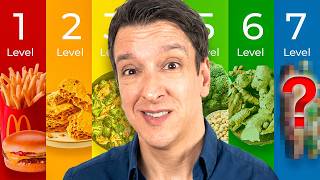

Why Healthy Eating Isn't Binary
45sChallenges binary mindset about diet, offering a spectrum approach that resonates with viewers stuck in all-or-nothing thinking.
▶ Play Clip"The title accurately reflects the content: the video indeed presents seven science-backed levels of eating for health transformation."
The video challenges the binary view of healthy eating, presenting it as a spectrum with seven progressive levels. It emphasizes that understanding one's current level is crucial for making sustainable dietary improvements.
The speaker explains that healthy eating is not binary (healthy/unhealthy) but a spectrum, and understanding where you are on this spectrum is key to progress.
The video introduces seven levels of a transformative diet, each building on the previous one, to help viewers identify their current level and move forward.
Hydration is crucial; drinking half a liter of water increases metabolic rate by 30%. Replacing sugary drinks, energy drinks, fruit juice, and alcohol with water, coffee, tea, or smoothies is key.
Ultra-processed foods cause overconsumption (500 extra calories daily). Swapping them for minimally processed options like homemade pizza, dates, and mixed nuts is recommended.
Protein is essential for satiety, organ function, and metabolism. Healthy sources include oily fish, lentils, poultry, and Greek yogurt. Most meals should center on protein.
Focus on quality over quantity of fats. Healthy fats (olive oil, nuts, avocado) improve heart health and insulin sensitivity, replacing refined starches and sugars.
Feed gut bacteria with fermented foods (kefir, kimchi) and prebiotics (resistant starch from beans, cooled potatoes; viscous fiber from apples, oats). This reduces inflammation and improves satiety.
Include foods rich in curcumin (turmeric with pepper), catechins (green tea, dark chocolate), ginger, cinnamon, and allicin (garlic) for anti-inflammatory benefits.
Avoid charring meat (forms carcinogens) and deep frying (destroys nutrients, creates trans fats). Use marinating, lower temperatures, pre-cooking, or steaming instead.
The video concludes that a truly transformative diet involves progressing through seven levels, from hydration to cooking methods, each backed by science. Mastering these levels can lead to significant health improvements.
What is the first level of a transformative diet according to the video?
Hydration
00:44
How much does drinking half a liter of water increase metabolic rate?
30%
01:00
What is the key benefit of replacing sugary drinks with water?
Improves hydration, satiety, insulin sensitivity, and metabolic rate.
00:44
What is the second level of the diet?
Minimally processed foods (swapping ultra-processed for real food).
03:00
How many extra calories did the ultra-processed food group consume daily in the randomized control trial?
500 extra calories
03:17
What is the third level of the diet?
Protein
04:50
How does protein help with satiety?
Amino acids in protein cause gut cells to release hormones like GLP1 that activate satiety centers in the brain.
05:31
What is the fourth level of the diet?
Healthy fats
06:35
What did a systematic review of 102 trials find about healthy fats?
They lowered hemoglobin A1C, fasting insulin, and HOMA-IR when replacing refined starch, added sugars, or saturated fats.
07:42
What is the fifth level of the diet?
Gut microbiome (feeding gut bacteria with fermented foods and prebiotics).
08:11
What two types of fiber do gut bacteria feed on?
Resistant starch and viscous fiber.
09:22
What did a 2014 trial find about the short-chain fatty acid propionate?
It stimulated satiety hormones, reduced caloric intake, and prevented weight gain, insulin resistance, and liver fat accumulation.
10:33
What is the sixth level of the diet?
Anti-inflammatory compounds (curcumin, catechins, ginger, cinnamon, allicin).
11:12
How can curcumin absorption be boosted?
By consuming it with pepper, which boosts absorption over a thousand times.
11:55
What is the seventh level of the diet?
Cooking methods (avoid charring and deep frying; use steaming, light grilling, or sautéing).
12:36
Healthy Eating is a Spectrum
Challenges the all-or-nothing mindset, offering a more nuanced and actionable approach to diet.
Water Boosts Metabolism by 30%
Provides a specific, science-backed benefit of hydration that is easy to implement.
01:00Ultra-Processed Foods Cause Overeating
Highlights a key mechanism (500 extra calories daily) linking processed foods to weight gain.
03:17Protein's Satiety Mechanism
Explains the biological process (GLP1 release) behind protein's filling effect, making it actionable.
05:31Gut Microbiome as a Health Lever
Emphasizes the importance of feeding gut bacteria for overall health, a less commonly discussed aspect of diet.
08:11Cooking Methods Matter
Reveals that even healthy foods can become unhealthy depending on preparation, offering practical solutions.
12:36[00:00] I used to think that eating a healthy diet was black and white, healthy or unhealthy, clean or junk. But honestly, that mindset kept me stuck for years, because healthy eating is not binary.
[00:14] It's not all or nothing. It's a spectrum. And if you don't understand exactly where you are along that spectrum, you can't move forward. You're just stuck repeating mistakes. So today, I want to show you the seven levels of a truly transformative diet where each level
[00:29] builds on the previous one. And we're going to figure out exactly where you are along that continuum and what it takes to move you to the next level. The first level is the most underrated part of eating a healthy diet, because we all know
[00:44] we are what we eat, but what we drink is at least as important. If your fluids are off, your lab work can look terrible, even if your foods are perfect. Because of our body is made up of water, as we all learned in school, and hydration improves
[01:00] satiety, insulin sensitivity, and metabolic rate. A team of scientists in Germany discovered that drinking half a liter of water, or about two cups, increased metabolic rate by 30%.
[01:14] That means your body is burning work galleries without you making any extra effort. Just sitting there. That happens because your body will heat up that water you just drank all the way up to body temperature, and that burns galleries.
[01:28] Now the common advice to just drink more water is okay, but it's not enough. The real benefit comes from replacing the worst fluids, sugary sodas, one of the worst things we can consume.
[01:40] But energy drinks, which have a lot better reputation, also have a number of concerns. Because in general they're very high in caffeine and added sugars, they can raise blood pressure,
[01:52] they can disrupt your heart rhythm. They can even lead to hospitalization, in some cases, with very high intake. Energy drinks are particularly problematic for children and young adults, and fruit juice.
[02:04] Most commercially available juices and fruit drinks have a lot of added sugars that can ultimately contribute to fatty liver and weight gain. Now if it's 100% fruit juice with no additives, that's much better.
[02:17] And alcohol is another concern. Alcohol is a known human carcinogen linked to seven different types of cancer. And recent studies have shown there's no completely safe level of consumption.
[02:29] So does that mean we have to drink nothing but water all day long? Absolutely not. That would be really boring. And we have so many healthy options. Coffee is fine, tea is great, smoothies, fantastic, water would slice fruit in it for flavor.
[02:44] Great option. Coconut water, matcha tea, all fantastic options. Now maybe you have your hydration, down pat, we're still not feeling right. That's not that surprising because we can ace the fluids and still ruin things with the
[03:00] wrong foods. A randomized control trial gave people meals made up of either unprocessed or ultra processed foods. And they let them eat as much as they wanted. The group given the ultra processed meals ended up eating 500 extra calories daily of their
[03:17] own choice. Nobody told them how much they eat. They just naturally ended up doing that. So something about these foods pushes us to over consume. And we're so used to these foods there everywhere. We don't even notice it anymore.
[03:29] And before you know it, a chunk of your calories over the course of the day came from this stuff. You can even ruin a salad with an ultra processed dressing loaded with salt and refined
[03:41] sugars that can end up raising your blood pressure and your triglycerides. Now, not all ultra processed foods are created equal. Soy milk, for example, the documented effects of soy milk seem to be quite positive.
[03:54] But if most of your meals have a barcode and they're all thawed in the microwave, it's a sign that it's probably time to reevaluate. So we want to swap these franken foods with minimally processed foods, what some people
[04:08] call real food, homemade pizza instead of a frozen ultra processed pizza, dates for snack instead of candy, mix nuts instead of potato chips. And as you can see, the replacements are just as delicious.
[04:21] Actually, I would say more yummy than the foods they replace. Okay, but who's got the time for all that, right? Homemade pizza. Okay, I don't have all day. The secret is batch cooking. So for a couple hours, once a week, to batch cook your staple meals, then with that hunger
[04:36] hits, you've got something ready to go and you can pop it in the microwave. That's fine. But now it's something that's going to improve your health instead of tanking it. So you see why this is the foundation. If these levels aren't solid, nothing above it is going to be steady.
[04:50] You can't out supplement or out fast a junk diet. Okay, maybe you got rid of all the junk from your diet and you're eating really clean but still feel a little off. It's totally possible to eat real foods only and still have some health issues if we
[05:05] don't get the next step right. A lot of people think that eating healthy is about super foods or about eating organic and they're really losing track of the basics. Let's talk about protein. Protein isn't just about getting jacked.
[05:19] Protein is about proper organ function and metabolism and protein is also filling. It creates that sense of satiety that helps you feel full and stop eating. Here's how it works.
[05:31] The amino acids in protein cause gut cells to release hormones like GLP1 that activate satiety centers in the brain. Now protein is not the only satiety signal. There are others but it's an important one and so eating too little protein can actually
[05:47] make you feel a hungerier. So try to make healthy sources of protein the center of most of your meals. That could be oily fish like sardines or salmon. It could be some lentils, a piece of poultry like turkey or grilled chicken breast or a black
[06:03] bean burger with a side of avocado, seafood like mussels, shrimp, oysters, satan, unsweetened Greek yogurt for breakfast is another option. Edamame with some garlic and pepper can be a side dish, can be a snack, absolutely delicious,
[06:21] all great protein sources. You don't need to obsess over the amount if most of your meals have a good source of protein, chances are you're getting enough. The obsession with amount also carries over to other nutrients where that can't get us
[06:35] in trouble. If you look at social media, most of the nutrition debates center on how much fat and how much carbs we should have, low carb, low fat, high fat, it's not low carb enough, it's too much
[06:47] fat, too much carb. This is a distraction from what truly matters. It's less about how much and more about how good, it's less about the quantity and more about the quality. In the 80s, people feared all fats, and to this day some people still associate eating fat
[07:03] with getting fat. But we now understand there are better and worse fats, and healthy fats are important for hormone homeostasis, for brain function, for membrane metabolism.
[07:16] We're talking about extra virgin olive oil, walnuts, seeds of different kinds, flax seeds, sesame seeds, chia seeds, fatty fish, which we've touched on in the protein step.
[07:30] Avocados are great as well, and fermenting dairy, like unsweetened, kefir or yogurt. Eating the healthiest fats is the number one factor for maintaining a healthy heart and healthy arteries.
[07:42] A systematic review and meta-analysis of 102 randomized controlled feeding trials found that healthy fats, like liquid vegetable oils, nuts, fish, or avocado, lowered hemoglobin
[07:56] in one C, fasting insulin, and Homa IR, which is a measure of insulin resistance, when replacing refined starch, added sugars, or saturated fats. OK, maybe you've got the protein in the fats, down pat, but you're still not feeling your
[08:11] best. That's likely a problem with level 5. As we nourish our body with the healthiest foods, we can't forget to feed our entire body. Because yeah, we are what we eat, but who's we really?
[08:24] Most of the cells in the human body are actually not human cells. They're bacterial cells, and most of those are in our intestine. They are our gut microbiome. They live in our guts, and they play fundamental physiological roles.
[08:38] We need to feed our bacterial passengers. Otherwise they just jump ship, and there's two basic ways we can keep them happy. First, fermented foods, like kefir, kombucha, miso, kimchi, or fermented cottage cheese,
[08:54] sauerkraut, tempeh is another option, and sourdough bread. These foods replenish and enrich our microbiome. A 2021 randomized controlled trial found that giving people fermented foods daily for 10 weeks
[09:10] not only improved their microbiome diversity, but it also decreased the inflammation in their bodies. And the second thing we can do for our microbiome health is we feed those gut bugs, their
[09:22] favorite snacks. And those healthy bugs in our gut eat mainly two things. The first is resistance starch. These are special carbohydrates that make it through the small intestine undigested, and
[09:34] they reach our colon, where our microbiome can break them up and feast on them. Tourses of resistance starch include pulses, like beans, and lentils, whole grains, like
[09:47] wild rice, and corn, but also starchy foods heated and then cooled down overnight in the fridge like potatoes, or pasta. And the other thing our microbiome likes to chomp on is viscous fiber.
[10:01] This is a specific type of fiber present in apples, and kiwis, and okra, and eggplant, and oranges, and chia seeds, and oats, and barley, and also asparagus, and psyllium husk.
[10:16] Ok, why would we want to feed these bacteria? Art bacteria is supposed to be bad for us. Well, these ones break up the viscous fiber into short chain fatty acids. In a randomized controlled trial published in 2014, the investigators delivered the short
[10:33] chain fatty acid propionate to the colon of participants. And the result was they stimulated the release of satiety hormones, they reduced chloric intake, and they prevented weight gain, insulin resistance, and liver fat accumulation.
[10:48] Pretty darn impressive from one tiny molecule. So these incredible bugs in our gut can help us tremendously, they can transform our health, but we have to help them help us by eating the right foods.
[11:00] Now you want to introduce fibers gradually over time to make sure your body gets used to them, especially if you have gut issues. Ok, maybe you've already mastered the first five levels, but you still feel off.
[11:12] You feel slug-ish, you have joint pain, and your blood work just doesn't look right. So for this to be truly transformative, you want to take advantage of powerful compounds present in specific foods that can give you that extra boost, and that is where level six
[11:29] comes in. Curecumins are powerful antioxidants with anti-inflammatory function as well found in dark chocolate and green tea and berries have a good content of catechins as well.
[11:42] And machete made from machupouter is especially concentrated in catechins. And curcumin is another important one, which is a polyphenol found in turmeric with a powerful anti-inflammatory effect.
[11:55] Curcumin is not very well absorbed by itself, but if you have it together with some pepper, it boosts the absorption of curcumin over a thousand times. Another spice with a powerful anti-inflammatory effect is ginger.
[12:08] Ginger contains active compounds that inhibit inflammatory enzymes and pathways. And cinnamon, which contains cinamoldehyde, which fights oxidative stress and reduces swelling.
[12:22] And allicin, which is formed when garlic is crushed and suppresses pro-inflammatory cytokines. Okay, if you've got the first six levels down, but you feel like you still need an extra nudge, then level seven is for you.
[12:36] It's shocking how the same food can be healthy or unhealthy depending on how we eat it. Fish and chicken are generally seen as healthy sources of protein. But how many people eat them barbecued or grilled to the point of charring?
[12:50] Charring animal flesh forms carcinogenic compounds like heterocyclic amines and polycyclic aromatic hydrocarbons. Fortunately, there are a number of strategies to get around this, including marinating your
[13:04] meats prior to grilling, which reduces carcinogen formation, reducing the temperature of the grill, or pre-cooking in the microwave or in the oven, and then finishing off on the grill, which
[13:16] reduces grilling time, or using some aluminum foil around or under the meats, which prevents the juices from dripping onto the fire, which is how some of the carcinogenic compounds
[13:28] like polycyclic aromatic hydrocarbons form in the first place. And if everything else fails, trimming off the charred bits on your plate. Deep frying is another great way to ruin a perfectly healthy food.
[13:40] The problem with frying is it involves higher cooking temperatures that can destroy some of the nutrients, like some vitamins, for example. It can also increase the caloric density of the food because of all the fat that comes
[13:53] with it. And it can also create some harmful compounds like trans fats and acrylamides. Healthier cooking techniques include steaming, light grilling, or sotang.
[14:05] What about exercise? Are some workouts better than others? Well, one specific exercise has been shown to be very powerful at lowering blood pressure, as powerful as some medications. So we covered that in this video, so check it out, and I'll see you in there.



⚡ Saved you 0h 14m reading this? Transcribe any YouTube video for free — no signup needed.