
Rabies Doesn't Want to Kill You
45sThis twist challenges common beliefs about rabies' deadly nature, sparking curiosity.
▶ Play Clip"The title accurately reflects the video's core insight: rabies' unusual behavioral manipulation is the key to its deadliness."
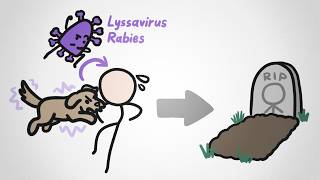
Rabies is one of the deadliest diseases, but its primary goal is not to kill—it's to control the host's behavior to facilitate transmission. Unlike most pathogens that cause physical changes, rabies travels through nerves to the brain, altering behavior to increase the likelihood of biting and spreading the virus.
Rabies is almost always fatal without treatment, but its intent is to control the host, not just kill.
Most pathogens cause physical changes (e.g., diarrhea, coughing) to spread, but rabies uses behavioral changes.
Rabies is transmitted through saliva; virus-laden saliva must enter another creature's body.
Rabies viruses travel through nerves, not bloodstream, moving a few inches per day, hiding from the immune system.
Viruses bind to brain cell receptors, seizing control, making hosts less fearful and more aggressive to bite others.
Infected humans may become agitated but rarely bite, making them dead-end hosts for rabies.
Rabies disrupts brain function, leading to failure of vital systems (breathing, blood pumping) and death.
Rabies moves slowly; vaccination post-exposure can train the body to fight the virus before it reaches the brain.
Rabies' unique strategy of behavioral control makes it deadly, but its slow progression allows for post-exposure vaccination to save lives if administered in time.
What is the primary goal of pathogens?
To replicate and spread to new hosts.
00:12
How does rabies differ from most pathogens in its transmission strategy?
It causes behavioral changes in the host rather than physical changes.
00:39
Through which system does the rabies virus travel in the host?
Through the nerves.
00:51
How fast does the rabies virus travel?
A few inches per day.
01:04
What behavioral changes does rabies cause in animals like dogs and bats?
They become less fearful and more aggressive, increasing the likelihood of biting.
01:18
Why are humans considered dead-end hosts for rabies?
Because infected humans rarely bite others, so the virus cannot spread further.
01:45
What is the only way to survive rabies?
To get vaccinated after exposure before the virus reaches the brain.
02:37
Rabies' Deadly Intent
Highlights the paradox that rabies' goal is control, not just killing.
Behavioral vs. Physical Change
Distinguishes rabies' unique strategy from most pathogens.
00:39Brain Seizure Mechanism
Explains how rabies manipulates brain receptors to alter behavior.
01:18Post-Exposure Vaccination
Emphasizes the critical window for treatment due to slow viral travel.
02:37[00:00] Rabies is one of the deadliest diseases we know of. If you don't get treatment soon after getting exposed, you are almost certain to die. But rabies' intent isn't actually to kill.
[00:12] It's to control. Hi, I'm Kate, and this is MinuteEarth. Pathogens have one goal, to replicate and spread to new hosts, and they use all kinds of creative strategies to accomplish that goal, like inducing a poop-tacular amount of diarrhea, or making
[00:27] their hosts' sneeze or cough all over the place, or causing oozing germ-filled sores. We made a video all about this. But most of these strategies share the same general approach.
[00:39] Cause physical changes in the host that make transmission more likely. Rabies takes a different approach. It causes behavioral changes in the host to make transmission more likely. Rabies is transmitted through saliva.
[00:51] In order to infect a new host, that virus-laden saliva needs to make its way into a different critter's body. Once it's in there, unlike most pathogens, which move through the bloodstream, rabies' viruses travel through their hosts' nerves.
[01:04] It's not a fast way to travel. The virus is only advanced a few inches a day, but it helps hide them from the host's immune system. And it's a direct route to rabies' desired destination, the brain. There, the viruses start to build up.
[01:18] Scientists don't totally understand the details, but the viruses seem to bind to receptors that allow brain cells to communicate with each other, basically seizing control of the brain. The host becomes less fearful and more aggressive, which means it's more likely to come into
[01:32] contact with and bite another potential host, passing along the virus. Well, at least that's the case in animals like dogs and bats. Humans infected with rabies sometimes do act differently.
[01:45] They may get agitated and anxious, but they don't go around biting people. Probably because, unlike rabies' normal hosts, humans' instincts to bite aren't that strong in the first place. As a result, humans are almost always a dead-end host for rabies.
[02:01] And speaking of dead, the clever way that rabies tries to ensure its transmission, by interrupting the brain's normal operation, causes serious collateral damage for its hosts, no matter what
[02:13] species they are. Because the brain is the control center not just for a critter's behavior, but also for its entire body. If brain cells can't communicate with each other properly, they can't coordinate the signals
[02:25] needed to keep the host breathing, its blood pumping, its muscles moving. These systems spiral into more and more disorder. Eventually, they fail completely, and the host dies.
[02:37] That is, unless you interrupt rabies' long-strange trip, before it's able to make much headway toward the brain. The disease moves so slowly that you can get vaccinated even after you get infected, because
[02:49] there's still enough time to train your body to recognize and fight off the disease. The only way to survive rabies is to control it before it controls you.


⚡ Saved you 0h 03m reading this? Transcribe any YouTube video for free — no signup needed.