
Poppy Seeds Look Like Alien Artifacts!
50sThe surprising honeycomb-like structure of poppy seeds revealed by a unique microscope is visually stunning and scientifically fascinating.
▶ Play Clip
[00:00] Have you brushed your teeth?
[00:01] >> Yes.
[00:02] >> H Let me see. I made a video about Gel
[00:06] Site about 2 years ago, and they just
[00:07] released this new one that goes even
[00:09] smaller. Its purpose is to take precise
[00:12] 3D measurements of very small things.
[00:15] But here's what I've been using it for.
[00:16] I've been comparing fake things to real
[00:18] things, old things to new things, and
[00:21] natural structures to synthetic
[00:23] structures. We discovered loads of
[00:24] amazing things, and I'm just going to
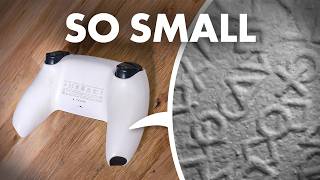
[00:26] show you all of them. Like this, for
[00:28] example, is the grippy surface on a
[00:30] PlayStation 5 controller. How cool is
[00:32] that? There's a link to the original
[00:34] video in the description, but here's a
[00:35] quick recap of how the thing works. So,
[00:38] what shape do you think a poppy seed is?
[00:41] Under a normal microscope, it's hard to
[00:42] tell because the surface of a poppy seed
[00:44] is black, but you'd probably assume it
[00:46] was roughly spherical. But if you could
[00:48] spray paint it like 50% matte gray, it
[00:52] would be a lot easier to figure out the
[00:54] shape of the thing. And that's the idea
[00:56] behind this weird microscope. It's as if
[00:58] it gives your subject a temporary coat
[01:01] of extremely neutral paint. And look,
[01:04] when an object is the same color all
[01:05] over and you shine a light on it from
[01:07] one direction, your brain can easily
[01:09] figure out the shape based on which bits
[01:12] are dark and which bits are light. This
[01:14] object is the same shape, but it's much
[01:16] harder to get a sense of its dimensions.
[01:18] But how does the Gelite microscope
[01:20] achieve this temporary coat of paint?
[01:22] Well, the camera is behind a gel pad,
[01:25] which confusingly is red, but the camera
[01:27] is black and white, so it comes out
[01:29] looking gray. Here's a large model of
[01:31] it, so I can show you what I mean. If I
[01:33] press my finger in on this side, you can
[01:36] see a gray version of my finger on this
[01:39] side, and that's what the camera sees.
[01:41] And there's lights on the inside, so it
[01:44] can be lit from different angles. And
[01:46] so, you can really get the sense of the
[01:48] structure of a poppy seed, for example.
[01:50] And isn't that amazing? I had no idea
[01:52] poppy seeds were shaped like that. It's
[01:54] kind of alien looking. So this way your
[01:56] eyes can more easily discern the
[01:58] structure of things. But interestingly,
[02:00] the software can actually map out in
[02:02] precise detail the 3D structure of
[02:05] whatever you press into the gel. More on
[02:07] that later. Gel site aren't paying me or
[02:09] anything, by the way. I just wanted to
[02:11] make a video about it and they said I
[02:13] could borrow one for a couple of months.
[02:15] Right, let's have a look at some stuff.
[02:16] This was the real versus fake example I
[02:19] showed you earlier. I don't know if you
[02:20] had any guesses, but this is real frost.
[02:23] And this is frost from a spray can.
[02:26] Frost is amazing. Actually, you can see
[02:28] the six-fold symmetry that arises from
[02:30] the underlying crystal arrangement of
[02:33] the water molecules. It's the same
[02:35] reason snowflakes have six-fold
[02:37] symmetry, but it's surprising to see
[02:39] those little turret looking things here
[02:41] and there. My car gets this spidery
[02:43] looking frost sometimes. That's pretty
[02:45] cool. And this is how the frost on
[02:48] blades of grass look. Actually, crystals
[02:51] in general are really fun. This is salt
[02:53] flakes. The symmetry is different
[02:55] because the underlying crystal structure
[02:57] is different. So, you end up with right
[02:59] angles and squares and cubes instead of
[03:01] hexagons. For comparison, here's fine
[03:04] pouring salt. You can still see lots of
[03:06] right angles. I guess they're all little
[03:08] cubes. I was a bit worried about pushing
[03:10] something so pointy into the gel, but
[03:12] actually it seems to fite well. This is
[03:14] the needle from a record player, for
[03:16] example. And this is what happens when
[03:18] we smeared tuna paste on it. If you're
[03:21] like me and you try to avoid thinking
[03:23] about the fact that cat tongues are
[03:25] spiky, well, I I'm sorry I reminded you,
[03:28] but anyway, this is another spike that I
[03:30] always wanted to take a proper look at.
[03:31] You find these on the back of a leaf.
[03:34] You can hardly see it with the naked
[03:35] eye, but it has the effect of only being
[03:38] able to stroke the leaf in one
[03:40] direction. If you've ever experienced a
[03:42] one-way leaf, this is why it's like
[03:45] that. This is what it looks like to
[03:47] write on gel site with a ballpoint pen.
[03:49] You can see the ball rolling around. I
[03:52] guess this is what it feels like to be
[03:53] paper. And for comparison, here's a
[03:55] pencil tip. You can see where the
[03:57] sharpener stopped sharpening. Coral is
[04:00] surprisingly sharp. Like from a
[04:02] distance, it looks like a smooth surface
[04:04] with little holes in it, but it feels
[04:06] really rough. And you can see why under
[04:08] a microscope. It's basically a load of
[04:10] tightly packed spikes. This is another
[04:12] type of coral and you can see all the
[04:14] tiny tubes. How cool is that? I like
[04:17] this one so much I printed it out. But
[04:19] how was the software able to extract 3D
[04:21] information from this image? Well,
[04:23] because that gray color is so even,
[04:27] there's a direct correlation between the
[04:29] brightness of a pixel and the steepness
[04:32] of the slope in that location. But
[04:34] because the direction of the slope also
[04:36] affects brightness, the software needs
[04:38] to take multiple pictures that are lit
[04:40] from different angles. The 3D
[04:42] information can then be exported in a 3D
[04:44] format, which means you can zoom in even
[04:47] more.
[04:49] Wait,
[04:51] wait.
[04:53] Nature has layer lines. You might have
[04:55] spotted some interesting structures in
[04:57] the background of the spiky leaf. And
[04:59] actually, leaves are really interesting.
[05:02] You can see this sort of branching even
[05:03] at a really small scale. They kind of
[05:05] look like veins. Some leaves don't have
[05:08] a fractal structure because they're
[05:09] actually feathers. Fake feathers look
[05:12] nothing like real feathers, by the way.
[05:13] Not that you need a microscope to
[05:14] discern that. But on the subject of fake
[05:16] and real things, which one of these do
[05:18] you think is real leather, and which is
[05:21] pleather? Well, this is the real
[05:22] leather. You can see those little pits,
[05:25] which I believe is where the fur was
[05:27] plucked from the hide. I've not found
[05:29] any fake leather that tries to replicate
[05:31] that detail, but it's not always that
[05:33] easy to tell the difference between
[05:35] natural and synthetic fibers. Can you
[05:37] tell, for example, which is real hair
[05:39] and which is plastic hair from a wig?
[05:43] This is some wooden furniture and this
[05:46] is fake wood veneer. The difference is
[05:48] quite clear. The veneer is perfectly
[05:50] flat except for the grooves, whereas the
[05:53] real wood has a general roughness to it
[05:56] as well. This is a nylon rope and a
[05:59] cotton rope. The nylon's much smoother.
[06:02] This is horsehair, which is to say it's
[06:04] a cello bow. The gel pads don't like
[06:07] being scraped, but I wanted to see what
[06:09] it would look like to drag the cello bow
[06:11] across it. So, I added a bit of
[06:13] lubricant. That's cool, isn't it? While
[06:16] we've got lube on the thing, here's
[06:17] Lycra or spandex being stretched.
[06:21] And here's Velcro. You can see the hook
[06:23] and loop in action there. And you can
[06:26] see where the hook eventually gives way.
[06:28] Let's have a look at some more synthetic
[06:30] objects. This is a printed circuit
[06:32] board.
[06:34] This is a light bulb filament. You can
[06:36] see that the coiled up wire is itself
[06:39] made of a coiled up wire. This is a
[06:41] pill. This one helps me make videos.
[06:43] Actually, it's got a clever design that
[06:45] lets you split the pill in half and then
[06:47] in half again.
[06:49] Woven fabrics look really cool,
[06:51] especially netting type fabrics like
[06:53] this laundry bag. You can see how all
[06:55] the different strands are all kind of
[06:57] hooked together. Here's some woven
[07:00] metal. And here's a tea strainer.
[07:03] This is sound waves carved into a disc.
[07:06] Not sure what that's about. I'm a big
[07:07] fan of nurling actually. And it looks
[07:10] really nice up close. These are some of
[07:12] my favorite knurled objects. Look at
[07:14] this though. It's like nature's nurling.
[07:17] Looks very different up close though.
[07:19] Let's have a look at some more natural
[07:20] structures. Actually, this is fish
[07:22] scales. I didn't take this one. Mrs.
[07:24] Jessica Arbor specifically, it's an
[07:26] orange throat dart. And the spikes on
[07:29] the edges of the scales actually helps
[07:31] to reduce drag. This is a pepperc corn.
[07:35] And this is some fungus. These are some
[07:38] more interesting seed varieties, though
[07:42] poppy seeds are the best in my opinion.
[07:44] I just want to go on a poppy seed
[07:45] tangent for a second because they're so
[07:47] cool. There's very often two different
[07:48] ways to explain why something is the way
[07:51] it is in biology. There's the mechanical
[07:54] reason and the evolutionary reason. The
[07:57] mechanical reason is that as the seed
[07:59] forms, the outer layer of cells fit
[08:02] together like hexagons and pentagons.
[08:04] The joining walls of the cells are
[08:06] thick, but the top walls are quite thin.
[08:08] So, when the poppy seed dries out, those
[08:11] top walls collapse, and you're just left
[08:13] with those joining walls. But what
[08:16] evolutionary pressures push the poppy
[08:18] seed towards that shape? Well, it's
[08:20] probably a few things. Seeds need
[08:23] protection, but in the case of poppy
[08:25] seeds that are dispersed by the wind,
[08:27] they also need to be really light. So
[08:29] instead of a full heavy outer shell,
[08:32] it's protected by lightweight ridges
[08:34] instead. And a bit like the dimples on a
[08:36] golf ball, the rough surface might help
[08:38] the seeds to be carried further by the
[08:40] wind. And finally, when the seed does
[08:43] land, that pitted surface helps to
[08:46] retain moisture. This is owl poop. Check
[08:49] out what's inside, though. Well, lots of
[08:51] fur for a start, but this is probably a
[08:54] mouse jaw. And there's a bit of spine
[08:56] there and some tail.
[08:59] I bought some dead bees on eBay because
[09:01] I wanted to see the compound eye. That
[09:03] doesn't really show up, unfortunately.
[09:05] But it's interesting to see a gray bee
[09:08] slowly being crushed. And here's a dead
[09:10] spider.
[09:12] These shots kind of remind me of horror
[09:15] movie posters, you know what I mean?
[09:16] It's often like something being pressed
[09:18] into fabric. I don't know why, but
[09:20] anyway, here's a tiny skull that I
[09:22] found.
[09:25] I suppose I should try and use this
[09:26] thing for what it was designed to do.
[09:28] And actually, in my video about bone
[09:30] drills, I cut a groove in the nail of my
[09:33] thumb. There's a nice feature where you
[09:35] can remove the first order slope, so you
[09:37] don't have to worry about getting the
[09:38] angle right when you press it into the
[09:40] gel. And so now, look, when I analyze
[09:42] the depth of the groove, I can see that
[09:44] it's about 300 microns or about.3 mm.
[09:48] The nail itself is only about.5 mm
[09:51] thick. So, a couple more takes and I'd
[09:53] have started to be in trouble. I made a
[09:55] video about atomic trampolines a while
[09:57] back. The reason the amorphous metal is
[09:59] so bouncy is because it doesn't
[10:01] plastically deform on impact. Compare
[10:04] that to steel where impacts create these
[10:07] little divots. You can exaggerate
[10:09] defects in the software to make them
[10:11] easier to see. And look, measuring it,
[10:13] it's only 16 microns deep. And actually,
[10:16] it's interesting in general to look at
[10:19] old things versus new things under the
[10:21] gel site. Here's a fresh razor blade
[10:24] versus a used one, for example. And
[10:27] here's an old key versus a new key. You
[10:30] know, if you bend a wire back and forth,
[10:32] it eventually snaps. That's metal
[10:34] fatigue. And look under the gel site,
[10:36] you can see all these fishes near the
[10:39] brake point. This is a brand new foot
[10:41] scraper. And this is after it's been
[10:43] used.
[10:45] I'm sorry you had to see that. This is a
[10:47] scab and this is a scar. See how the
[10:51] scar tissue is smoother than the skin
[10:53] around it? Actually, cuticles look
[10:55] pretty gross, too.
[10:58] Look at the difference between young
[11:00] teeth and old teeth. And this is brushed
[11:03] teeth versus unbrushed. Actually, on the
[11:06] subject of toothbrushing, this is
[11:08] toothpaste. See how it's full of little
[11:10] hard bits that araid your teeth? And
[11:13] finally, we come full circle. This is an
[11:16] inter dental brush. And I guess this is
[11:18] your gums point of view. Kids, I think
[11:21] you need a new toothbrush. I don't know
[11:23] what it is about this microscope, but I
[11:25] just love seeing all the tiny structures
[11:27] of things with all the glare and
[11:30] transparency and color information
[11:32] stripped away. Maybe it's about
[11:34] understanding the world at a deeper
[11:35] level. Or maybe it's just how my brain
[11:37] works. And actually, if you've watched
[11:39] the video this far, maybe your brain
[11:41] works in a similar way. in which case
[11:43] the sponsor of this video is really
[11:45] interested to hear from you. I'm talking
[11:47] about internships at Jane Street. Jane
[11:50] Street is a quantitative trading firm
[11:51] with offices in some of the most
[11:53] exciting cities in the world. And right
[11:55] now they're looking for the next wave of
[11:57] curious and passionate people to join
[11:59] their internship program in Hong Kong.
[12:01] Don't worry, you don't have to live in
[12:02] Hong Kong or be from Hong Kong to apply.
[12:04] And in fact, all travel and
[12:06] accommodation is paid for and you get a
[12:08] salary on top. J Street uses all sorts
[12:10] of interesting techniques to trade on
[12:12] markets around the world like machine
[12:14] learning, programmable hardware,
[12:16] statistics. So if you're a student and
[12:19] if you're interested in exploring a
[12:20] career in Hong Kong, internship
[12:22] applications are open now for
[12:24] quantitative trading, software
[12:25] engineering, research, and more. The
[12:28] program runs from May to August next
[12:30] year. And really, it's a one-of-a-kind
[12:32] experience. Basically, you get to dive
[12:34] into all the interesting stuff they do
[12:36] around the firm, and you'll be
[12:37] surrounded by brilliant people from
[12:39] diverse backgrounds and cultures that
[12:41] are passionate about what they do and
[12:43] who love sharing their knowledge. And
[12:45] when you're not working, you can explore
[12:46] the beautiful city of Hong Kong with a
[12:48] community of like-minded people. You
[12:51] need to be fluent in English and
[12:52] graduating in 2027 or later, but you
[12:56] don't need to have a background in
[12:57] finance to apply. In fact, many current
[13:00] people at Jane Street were in exactly
[13:02] that position when they first applied.
[13:04] If you have a curious mind and a
[13:05] collaborative spirit, you'll fit right
[13:07] in. So, click the link in the
[13:08] description to find out more and apply
[13:11] to the Jane Street Hong Kong internship
[13:13] program today. I hope you enjoyed this
[13:14] video. If you did, don't forget to hit
[13:16] subscribe and the algorithm thinks
[13:18] you'll enjoy this video next.


⚡ Saved you 0h 13m reading this? Transcribe any YouTube video for free — no signup needed.