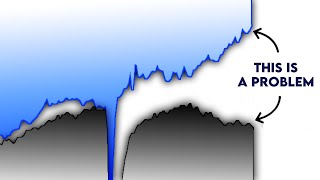

Job Openings vs Stock Market: Broken Correlation
53sThe surprising breakdown of a historical correlation between job openings and the stock market, tied to ChatGPT's release, sparks curiosity about AI's impact.
▶ Play Clip"The title promises a market-breaking gap and delivers a compelling analysis, but the speculative nature and lack of concrete predictions keep it from being exceptional."
The video analyzes the unprecedented divergence between rising unemployment and a surging stock market, linking it to the release of ChatGPT and the AI-driven job market transformation. It explores whether this signals a historic bull market or the peak of an AI bubble, considering factors like interest rate cuts and company earnings.
Historically, job openings and stock market performance were inversely correlated, but this relationship broke after November 30, 2022, when ChatGPT was released.
The job market lost 1.2 million jobs in 2025 alone, the most since the pandemic, and this number is rapidly increasing.
Historical data from 1965 shows that every time unemployment rises, a major market crash follows (e.g., Corona crash, housing crisis, dot-com crash).
The Federal Reserve, led by Jerome Powell, cut interest rates to help the economy, which incentivizes big money to move into the stock market.
Before every market crash, company earnings declined. Currently, despite high unemployment, companies are making more money than ever, driven by efficiency gains from AI.
Companies like Amazon (30,000 layoffs), Meta (10,000), and BuzzFeed are cutting jobs for AI efficiency, leading to record profits.
The market rewards companies that fire people because it improves margins and earnings, but this is unsustainable if consumers lose purchasing power.
The market may rise short-term if earnings grow and rates fall, but a major problem looms: if people can't spend, the market could crash aggressively.
The video concludes that while the market may have short-term upside, the AI-driven job displacement and reliance on interest rate cuts create a fragile bubble that could burst aggressively if consumer spending collapses.
What event marked the start of the break in the correlation between job openings and the stock market?
The release of ChatGPT on November 30, 2022.
00:44
How many jobs were lost in 2025 alone, according to the video?
1.2 million jobs.
01:51
What historical pattern does the video claim about unemployment and market crashes?
Every time unemployment rises, a major market crash follows.
02:32
Why does the Federal Reserve cut interest rates, and what effect does it have on the stock market?
To help the economy; it incentivizes big money to move into the stock market.
03:14
What is the key indicator before every market crash, according to the video?
Company earnings start going down.
04:34
Why are companies firing people if they are making more money?
For better efficiency, often replacing jobs with AI.
05:18
What are the four simple rules for the market to do well?
People earn money, people spend money, companies earn revenue, the stock goes up.
06:56
ChatGPT Release as a Market Inflection Point
Identifies a specific date where a technological event disrupted a long-standing market correlation.
00:44Unemployment as a Crash Predictor
Provides a historical pattern that is crucial for understanding current market risks.
02:32AI-Driven Efficiency vs. Consumer Spending
Highlights the paradox of record profits amid job losses, a key tension in the AI economy.
05:18The Four Rules of Market Health
Simplifies the fundamental economic cycle, making it easy to understand why job cuts threaten market sustainability.
06:56[00:03] line is job openings. If you look closely, they both seem to be very correlated, very correlated. When the blue line goes up, the black line goes black line goes down. So, in theory, you could predict what the stock market was
[00:16] about to do by solely just looking at what job openings are currently doing. But then the unthinkable happened. All of a sudden, it broke. So, now something very odd is happening. something that we've never seen before. Job openings
[00:31] are going down, but yet the stock market is going up. Hm. Interesting, right? But you know what's even more interesting? We can mark the start of this break represented by this black dotted line. If we put a date on this black dotted
[00:44] line, this all started on November 30th, 2022. But what happened on November 30th, 2022? Oh my. Chat GPT was released. Which
[00:56] brings us to the scary question. As AI takes more and more jobs, which it inevitably will, what happens to the stock market? This isn't just strange. This is an anomaly the market has never seen before. And that's why there's so
[01:10] much uncertainty right now because nobody knows what's going on and more importantly, what's going to happen next. Now, the moment I saw this graph, I shared it to the 40,000 people in my newsletter. This newsletter is basically
[01:22] a place where I share all my insights on the market and the plays I'm currently watching. I shared this Nvidia trade which is currently up 56%. I shared this AMD trade which is up 70% and I shared this trade QBTS that is currently up
[01:37] 400%. And unlike many other trading YouTubers where they charge 5 grand for a course for this information, I made this newsletter completely free. If you in the pinned comments. It's free real estate.
[01:51] >> But with a chart like this, we have to understand one key thing. You see, the job market has lost 1.2 million jobs in 2025 alone. 1.2 million. That's a lot of jobs. Actually, that is the most amount
[02:05] of jobs lost since the pandemic. And this number isn't slowing down. Oh, no. It's going up rapidly. Even as you're watching this video now, this number is getting bigger and bigger. But I want to show you something else. Look at this
[02:19] market I mean just look at it. I mean just get a look at that. >> This chart is an unemployment chart. Now to you this may seem like a normal everyday chart. Let me tell you it's not. If we look closely something very
[02:32] scary is starting to happen. You can see where we currently are. The chart is starting to rise. And this is something you need to take very seriously because let's grab an unemployment chart that goes all the way back to 1965. You can
[02:46] easily see that every time unemployment starts to rise, we had a major market crash after. Every time unemployment rises here, we have the Corona crash. housing crisis. Unemployment rises here, we have the dot crash. Every time
[03:01] unemployment rised, we later had a recession. So now we're at a very interesting point in time. More and more people are losing their jobs. Yet more the stock market. Now, this isn't all
[03:14] just because of AI or Chad GBT. Something else is happening in the occurring. Since unemployment is going up, the Federal Reserve, or in other words, this guy Jerome Powell, the head
[03:26] of the Federal Reserve, has decided the government needs to step in and help the economy by cutting interest rates, which is exactly what he did. And he also made this decision at this black dotted line. Now, cutting interest rates does one
[03:39] important thing. Big institutions and big money are now making less money on are going down. If interest rates are going down, they make less money. And incentivizes them to put their money elsewhere. And where are they likely to
[03:55] put their money? In the stock market. But what's weird is usually if they are cutting interest rates, it's because the economy is doing bad. And usually when the economy is bad, the market is going down with it. But that's not what's
[04:07] happening. The stock market is going up. So now we have to ask ourselves the important question. If you entered into the market right now, right at this very moment, are you entering in the midst of the best bull market of our lifetime? Or
[04:21] are you entering at the very top of a bubble so inflated it'll make the do crash look like a little wiener dog? To help answer this question, we need to figure out one key thing. Are companies actually making money even though they
[04:34] are hiring less people? You see, before every market crash in recent history, company earnings started going down. Or in other words, they started not living makes sense. Every time the market crashes, company's earnings would go
[04:48] down alongside with it. And that's a very good indicator of when the market going up, but companies aren't beating expectations, that is a very bad sign bubble. >> Who blew this bubble? which that fact
[05:05] proves itself time and time again. And you would think with unemployment at new record highs, company's earnings would start to go down alongside with it. But right now, that's not what's happening. Actually, it's quite the opposite.
[05:18] Companies aren't firing people because they're making less money, they're firing them for better efficiency. You see, even though unemployment is skyrocketing, for example, Amazon just laid off 30,000 employees, Meta just cut
[05:31] 10,000 jobs, and companies like BuzzFeed are firing their staff to use AI to write their articles. Even though all these companies are cutting jobs, companies are making more money than ever. Profits are up, like really up. In
[05:45] the past 3 years, earnings of companies in the S&P 500 have been going crazy. like Britney Spears when she was bald type crazy. We're not talking some gradual incline like previous years. This is sharp, fast upwards earnings
[06:00] movements. Companies are making more money than ever before and at a fast pace, meaning the stock charts are going up due to massive amounts of hype, but the companies are actually backing up this hype with their insane earnings.
[06:13] With that, that means companies are getting more and more expensive. So, of one of the best bull markets we've ever seen? Or is this the very top of the AI bubble? Right now, the market is actually rewarding companies that are
[06:28] firing people. You're fired. >> Why? Because markets are forwardlooking. When companies cut jobs for AI replacements, they don't have to pay as deal with labor strikes. They are making more profit and earnings are going up.
[06:42] But this style of thinking only works if margins of companies are improving. while this is happening, which currently they are. But how sustainable is that? And this is where things start to get tricky. If fewer people have jobs, who
[06:56] part the markets aren't really pricing in right now. In order for the market to do good, it needs to follow four simple rules. People earn money, people spend money, companies earn revenue, the stock goes up. But with job cuts rising, step
[07:11] one is getting removed completely. So, if people don't have money to spend because they don't have a job, who's going to buy the products? And the market really hasn't dealt with anything like this before. So, is the market
[07:23] simply rising just due to interest rates, or is this genuine growth? In my humble opinion, I think the market does have more room to go up as long as two things stay true. Company earnings are growing and interest rates are going
[07:36] down. I think we look good in the short term. But is this sustainable for the going to have to deal with a major problem. If people are getting fired and don't have money to buy stuff, this will affect the market sooner or later. And
[07:50] when that happens, we are going to be so inflated due to interest rate cuts and AI hype that if this comes crumbling down, it'll likely do it in a very aggressive manner. And what does the future look like? Can we continue using
[08:03] job openings as a metric to predict the markets? Or is this the old style thinking and the market is slowly evolving into something completely different right in front of our eyes? Or even scarier, is this just a signal that
[08:17] even scarier, is this just a signal that the bubble is about?
⚡ Saved you 0h 08m reading this? Transcribe any YouTube video for free — no signup needed.

![BEST MACD Trading Strategy [86% Win Rate]](https://img.youtube.com/vi/rf_EQvubKlk/mqdefault.jpg)